
 by
by Our Top Mattress Pick
Whatever sleep technology you use, it only works as well as the mattress underneath you. Saatva's handcrafted innerspring hybrid tops our testing for support, temperature regulation, and durability.
Why Bedroom Air Quality Affects Your Sleep
Most people investigating sleep quality focus on what they're doing wrong behaviorally — caffeine timing, screen exposure, stress — while overlooking the physical environment. A small bedroom with poor ventilation can accumulate CO2 levels that directly impair sleep quality, independently of any behavior. Humidity outside the 40–60% range stresses the respiratory system during sleep. Light at even 10 lux suppresses melatonin. These are measurable, correctable problems — but only if you're measuring them.
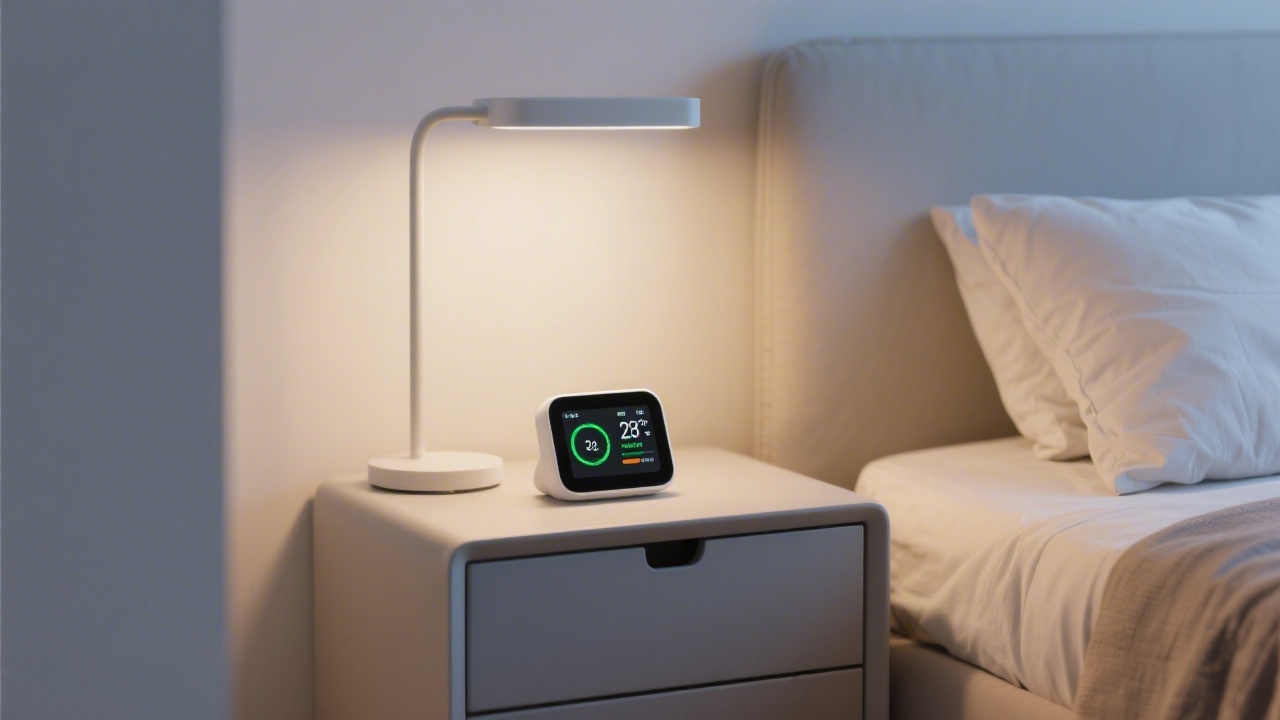
Environmental sensors pay for themselves in insight. One week of data from a comprehensive bedroom monitor typically reveals 2–3 specific, actionable issues that explain poor sleep data on your wearable.
CO2: The Most Overlooked Sleep Disruptor
CO2 is a byproduct of respiration. Two adults sleeping in a sealed room with no ventilation can raise bedroom CO2 from outdoor ambient levels (~420 ppm) to 2,000–3,000 ppm by morning. Research from Harvard's School of Public Health shows that CO2 above 1,000 ppm impairs cognitive function; levels above 2,000 ppm disturb sleep quality and are associated with increased nighttime awakenings.
Modern well-insulated homes, especially bedrooms with doors closed, frequently hit these levels. A cracked window or mechanical ventilation keeps levels below 1,000 ppm. You won't know your levels without measuring.
Best CO2 monitors for bedrooms: Aranet4 ($250) is the gold standard — accurate electrochemical sensor, long battery life, clear display. AirGradient Open Air ($80) is the best budget option with strong accuracy. Awair Element ($150) bundles CO2 with temperature, humidity, VOC, and PM2.5 in one device.
Temperature: The Most Impactful Variable
Bedroom temperature is the single environmental variable with the most scientific support for sleep improvement. As covered in our smart home guide, 65–68°F (18–20°C) supports the core body temperature drop required for deep sleep initiation. Temperatures above 72°F measurably reduce deep sleep percentage in controlled studies.
A simple digital thermometer ($15) tells you your ambient temperature, but doesn't account for radiant heat from the mattress itself. If your mattress retains heat (common in all-foam constructions), your actual sleep surface temperature can be 3–5°F warmer than the room — meaning a 68°F room with a foam mattress may effectively feel like 73°F at the sleep surface.
Best temperature sensors: SwitchBot Meter Pro ($20) is excellent for accuracy and smart home integration. Govee TH300 ($18) is the simplest option. For smart home integration with HomeKit, Ecowitt WH0291 is reliable.
Humidity: The Respiratory Comfort Factor
Bedroom humidity below 30% causes mucous membranes to dry out, increasing snoring frequency and throat irritation that causes micro-arousals. Humidity above 65% promotes dust mite proliferation (a common allergen trigger) and mold growth. The optimal range is 40–60%.
Humidity problems are seasonal in most climates — too dry in winter with forced-air heat, too humid in summer in humid climates. A smart humidifier with a built-in humidity sensor ($40–$100) automatically maintains the target range. Most combo temperature/humidity sensors will show if you have a persistent problem.
Light: Melatonin Protection at Night
Light exposure at even very low levels (10 lux — roughly a dim night light) suppresses melatonin secretion if it occurs during your biological night. Street light through thin curtains, LED standby lights from electronics, and charging indicators on devices all contribute to this. A lux meter on your phone (most phones have ambient light sensors accessible via apps) can quantify whether your "dark" bedroom is actually dark.
Blackout curtains (98%+ light blocking) are the single highest-ROI purchase for sleep environment improvement, costing $30–$80 for most windows. They also help with temperature by blocking solar gain in summer.
Best Multi-Parameter Bedroom Sensors
| Device | Price | CO2 | Temp/Humidity | VOC/PM2.5 | Smart Home |
|---|---|---|---|---|---|
| Awair Element | $149 | Yes | Yes | Yes | HomeKit, Alexa, Google |
| Aranet4 | $250 | Yes (NDIR) | Yes | No | Bluetooth only |
| Eve Room | $100 | Yes | Yes | VOC only | HomeKit native |
| AirGradient One | $89 | Yes | Yes | Yes | Open API |
| SwitchBot Meter Pro | $20 | No | Yes | No | HomeKit, Alexa, Google |
Correlating Sensor Data with Wearable Sleep Data
The most useful analytical step is overlaying your environmental sensor data with your wearable sleep data. If nights with CO2 above 1,500 ppm correlate with lower sleep efficiency or HRV, you've found your primary intervention. This cross-referencing typically takes 2–4 weeks of parallel data collection.
Most people find one dominant environmental factor — a bedroom that runs too warm, chronic high CO2 from closed doors, or low humidity in winter. Fixing one variable often produces noticeable improvements in the first week. See our cooling mattress guide if heat is a factor, and our complete sleep setup guide for integrating these findings. If you are dealing with insomnia patterns, also read about mattresses for insomniacs.
Our Top Mattress Pick
Whatever sleep technology you use, it only works as well as the mattress underneath you. Saatva's handcrafted innerspring hybrid tops our testing for support, temperature regulation, and durability.
Frequently Asked Questions
What CO2 level in a bedroom is too high for sleep?
CO2 levels above 1,000 ppm begin to impair cognitive function, and levels above 1,500–2,000 ppm are associated with disrupted sleep and increased nighttime awakenings. Two adults in a sealed bedroom can reach 2,000+ ppm by morning. A cracked window or brief ventilation before bed typically keeps levels below 1,000 ppm.
What is the ideal bedroom temperature and humidity for sleep?
The optimal bedroom temperature for sleep is 65–68°F (18–20°C), which supports the core body temperature drop required to initiate and maintain deep sleep. Humidity should be 40–60% to prevent both the dryness that causes snoring (below 30%) and the dust mite conditions created by high humidity (above 65%).
What is the best bedroom air quality monitor?
The Awair Element ($149) is the best all-in-one option, measuring CO2, temperature, humidity, VOC, and PM2.5 with smart home integration. The Aranet4 ($250) has the most accurate CO2 sensor (NDIR technology) but no air quality features. For budget monitoring, the SwitchBot Meter Pro ($20) covers temperature and humidity only.
Does room temperature affect sleep quality?
Yes, significantly. Research shows that sleeping in a room warmer than 72°F measurably reduces deep sleep percentage and increases nighttime awakenings. The mechanism is direct: your body needs to drop its core temperature by approximately 1–2°F to initiate deep sleep, and a warm room physically impairs this process.
Do blackout curtains actually improve sleep?
Yes. Light at even low levels (10 lux) suppresses melatonin secretion during your biological night. Street lights, device standby lights, and early morning light all contribute. Blackout curtains (98%+ light blocking) eliminate these sources at a cost of $30–$80, making them one of the highest-ROI sleep environment investments available.