
 by
by The mattress that supports your creative recovery
The Saatva Classic combines innerspring support with Euro pillow top comfort — built for people who take their rest seriously.
The Visual Imagination and Sleep: An Overview
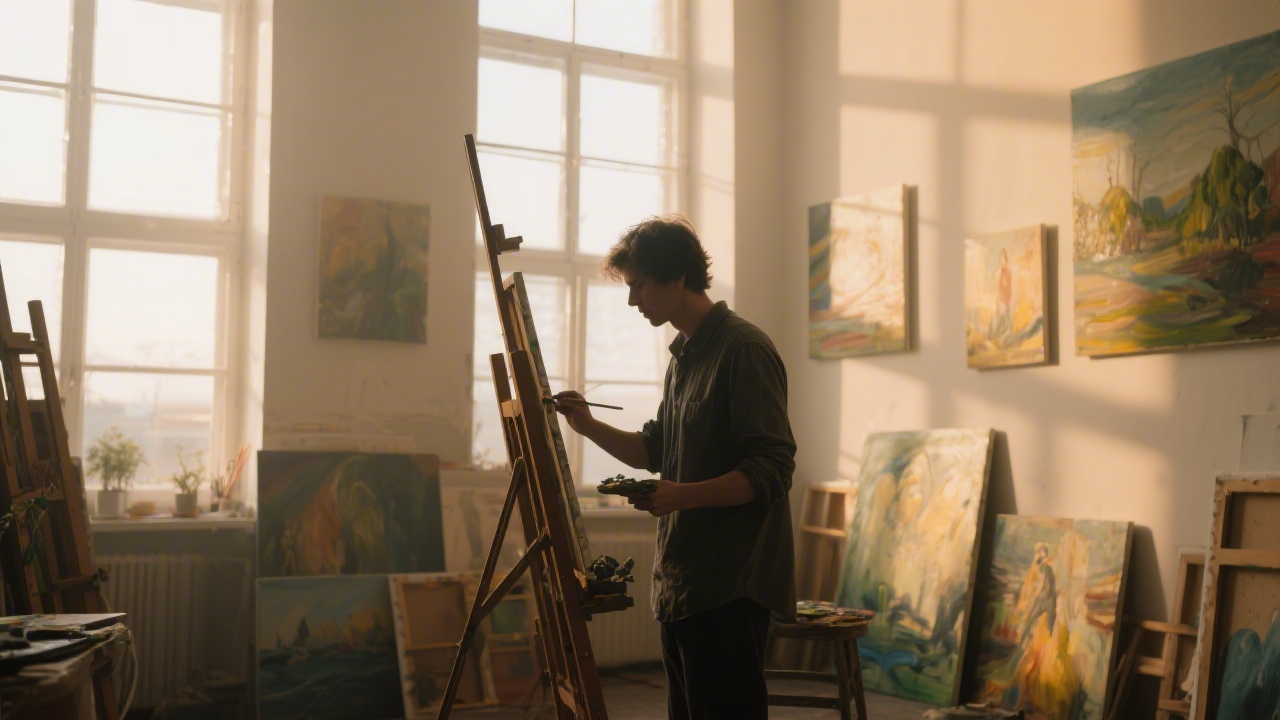
Visual art begins in the imagination — in the capacity to generate, hold, and transform mental images before they reach the canvas, screen, or stone. This visual imagination capacity is not a fixed trait. It fluctuates with sleep quality in ways that directly affect an artist's generative capacity, the originality of their imagery, and the precision of their physical execution.
The relationship between sleep and visual creativity is arguably better documented than any other creative domain, in part because the visual cortex is so active during sleep — particularly during REM, when the brain generates complex, original visual content entirely without external input.
REM Sleep as a Visual Generation Engine
During REM sleep, the primary and secondary visual cortices are highly active — at times approaching the activity levels seen during waking visual processing. The difference is that this visual activity is internally generated, drawing on stored visual memories and recombining them in novel configurations that the waking executive brain would normally inhibit.
Researchers at UC Berkeley have demonstrated that REM sleep enhances the ability to form remote associations — connections between conceptually distant elements. For visual artists, this is the neural mechanism underlying unexpected imagery: the sculpture that combines architectural forms with organic textures, the painting that borrows compositional logic from music, the illustration that fuses historical iconography with contemporary context. These are not accidental associations. They are products of the memory integration process that occurs specifically during REM.
Hypnagogia: The Artist's Edge State
Hypnagogia — the transitional state at sleep onset — produces some of the most distinctive and original visual imagery available to artists. Unlike dream imagery, hypnagogic imagery is experienced with a degree of conscious awareness, making it accessible for artistic capture. It is characterized by:
- Geometric patterns and phosphene-like forms
- Faces, figures, and scenes that appear with unexpected clarity
- Color combinations that differ from waking color perception
- Narrative sequences that follow non-linear, associative logic
Salvador Dali's technique of holding a key while napping in a chair — allowing the hypnic jerk at sleep onset to wake him with the imagery intact — is perhaps the most famous deliberate exploitation of this state. Thomas Edison reportedly used a similar technique. The practice is documented across artistic traditions and is now supported by neuroscientific research on the generative properties of hypnagogic consciousness.
Artists who wish to access this state intentionally can: set an alarm for 15-20 minutes into a nap, sleep in an upright position to reduce depth, or practice maintaining awareness during the sleep-onset transition while lying still in darkness.
Sleep Deprivation and Artistic Vision
The cost of sleep deprivation for visual artists falls in two distinct areas. The first is generative: sleep-deprived visual imaginations produce less novel imagery, defaulting to more familiar, conventional combinations. The second is evaluative: the critical judgment required to assess which visual ideas are worth pursuing, which compositions work, and which color relationships create the intended effect, also degrades under sleep restriction.
Studies on aesthetic judgment show that sleep-deprived subjects rate novel, unconventional stimuli as less appealing, preferring familiar, safe options. For artists, this translates to a bias toward conventional choices in sleep-deprived states — the opposite of what artistic development requires.
Fine Motor Control and Physical Art Practice
Painting, drawing, printmaking, and sculpture all require fine motor control that degrades with sleep deprivation. The cerebellum, which coordinates precise movement, and the motor cortex, which executes it, are both sensitive to sleep quality. Research on surgeons — whose fine motor requirements are comparable to those of detailed visual artists — shows measurable degradation in precision after insufficient sleep.
Artists who notice their brushwork feeling uncertain, their line quality declining, or their grip tension increasing may be experiencing motor degradation from inadequate sleep rather than a skill plateau.
Color Perception and the Rested Eye
Color perception is mediated by the cone cells in the retina and processed through opponent color channels in the visual cortex. Both peripheral processing and central color interpretation are affected by fatigue and sleep quality. Artists working with subtle color relationships — the kind that define serious painting, photography, and design — need rested visual systems to make accurate and intentional color decisions.
The practical implication: high-stakes color work (final adjustments to a painting, critical color grading decisions, selecting final print proofs) is best done in the morning after a full sleep cycle rather than late in the day or evening when visual fatigue compounds sleep deprivation effects.
Internal links: sleep and creativity, meditation before sleep, optimal sleep protocol, best mattress 2026.
Frequently Asked Questions
What is hypnagogia and can artists use it intentionally?
Hypnagogia is the transitional state between wakefulness and sleep characterized by vivid, involuntary visual imagery, auditory hallucinations, and loosened associative thinking. Artists including Salvador Dali, Thomas Edison, and Edgar Allan Poe deliberately induced this state by napping while holding an object — waking at the hypnic jerk as the object dropped — to capture imagery from the hypnagogic state.
Does REM sleep generate original visual ideas?
REM sleep generates novel combinations of existing visual memories through a process researchers call 'memory integration.' The sleeping brain recombines visual elements across unrelated memories in ways the waking brain's executive functions would filter out. Artists who keep a bedside sketchbook to capture post-sleep imagery are accessing this generative process deliberately.
Which artistic movements drew explicitly from dream imagery?
Surrealism is the most documented, with Andre Breton's Surrealist Manifesto explicitly citing dream imagery as a primary source. The Symbolist movement of the late 19th century also drew heavily from hypnagogic and dream states. Contemporary artists like Yayoi Kusama have described dream imagery as a significant generative source in their visual practice.
How does sleep deprivation affect fine motor skills for visual art?
Fine motor control — required for precise brushwork, detailed drawing, printmaking, and sculpture — degrades measurably with sleep deprivation. The cerebellum and motor cortex both require sleep for optimal function. Sleep-deprived artists show increased tremor, reduced grip precision, and slower fine motor response times in studies measuring manual dexterity.
What sleep setup is best for artists with studio-hours flexibility?
Artists with flexible schedules should anchor to a consistent sleep window rather than varying it with studio hours. The key metrics are sleep consistency (same window daily), darkness (blackout curtains for those who work late and sleep late), and a mattress that minimizes positional discomfort during sleep — critical for artists who stand or maintain demanding positions during work hours.
The mattress that supports your creative recovery
The Saatva Classic combines innerspring support with Euro pillow top comfort — built for people who take their rest seriously.
Our Top Mattress Pick
The Saatva Classic consistently ranks #1 for comfort, support, and long-term durability.
Key Takeaways
Sleep for Artists is a topic that depends heavily on individual needs and preferences. The most important thing is to consider your specific situation — your body type, sleep position, and personal comfort preferences — before making any decisions. When in doubt, take advantage of trial periods to test before committing.