
 by
by Voted best luxury innerspring mattress with exceptional lumbar support and white-glove delivery.
Check Price & Availability FAQPage", "mainEntity": [ { "@type": "Question", "name": "How much sleep do cyclists need during training?", "acceptedAnswer": { "@type": "Answer", "text": "Recreational cyclists need 7-9 hours. Those training above 10-12 hours per week should target 9+ hours and consider planned naps on recovery days. Sleep extension protocols have shown measurable performance benefits in endurance athletes." } }, { "@type": "Question", "name": "What is the best sleep position for cyclists?", "acceptedAnswer": { "@type": "Answer", "text": "Side sleeping is generally optimal \u2014 it reduces neck/shoulder tension and allows hip musculature to decompress. Back sleeping works well with a pillow under the knees to reduce lumbar curvature. Stomach sleeping is problematic for cyclists \u2014 it compresses the lumbar curve and strains the already-taxed neck." } }, { "@type": "Question", "name": "How does HRV relate to cycling recovery?", "acceptedAnswer": { "@type": "Answer", "text": "Heart rate variability (HRV) measured during sleep is the most sensitive early-warning indicator of incomplete recovery in cyclists. A sustained HRV drop of 10-15% below your baseline suggests systemic fatigue \u2014 often before perceived fatigue arrives." } }, { "@type": "Question", "name": "Why do cyclists have trouble sleeping after long rides?", "acceptedAnswer": { "@type": "Answer", "text": "Extended aerobic exercise elevates cortisol, core body temperature, and sympathetic nervous system activity for 2-4 hours post-ride. This delays sleep onset and can reduce deep sleep proportion on hard training days. Cooling strategies and structured wind-down routines mitigate this." } }, { "@type": "Question", "name": "Does mattress firmness matter for quad recovery?", "acceptedAnswer": { "@type": "Answer", "text": "Yes. Cyclists with developed quadriceps and hamstrings experience significant muscle density differences from typical sleepers. The interaction between body weight, muscle distribution, and mattress firmness determines whether hip and knee pressure is adequately managed through the night." } } ] }Cycling is exceptional among endurance sports for the specificity of its recovery demands. Unlike running — which creates symmetrical lower-body fatigue — cycling loads the quads, glutes, and hip flexors asymmetrically while holding the upper body in a sustained aerodynamic position for hours at a time. Neck and shoulder tension accumulate distinctly. Cardiovascular load from long efforts affects systemic recovery in ways that are not visible in muscle soreness alone.
The result: cyclists need sleep that addresses specific biomechanical recovery needs, not just generic endurance athlete recommendations.
The Cycling-Specific Recovery Problem
A four-hour road ride creates a recovery challenge across three systems simultaneously:
Muscular: Quadriceps are the primary driver in road cycling — they accumulate significant glycogen debt and micro-tear damage that requires 24-48 hours of adequate recovery to restore. Glutes and hip flexors tighten in the bike position and need decompression during sleep.
Cardiovascular: Sustained aerobic effort elevates plasma volume and creates cardiac adaptations that require recovery time. Heart rate variability (HRV) is the most sensitive systemic recovery marker — and it is primarily measured during sleep.
Postural: Extended time in the aero or road position compresses the cervical spine and creates sustained isometric load in the neck and shoulder stabilizers. These muscles need to recover during sleep — which means sleep position matters more for cyclists than for most athletes.
Sleep Position for Cyclists
The road bike position creates forward head posture and neck flexion patterns that persist as tension long after you have dismounted. Your sleep position either aggravates or counteracts this.
Side sleeping: Generally optimal. Use a pillow that keeps your cervical spine neutral — not elevated or dropped. A medium-density pillow matched to shoulder width is critical. Hip and knee alignment matters: a pillow between the knees reduces the internal rotation stress that tight hip flexors create.
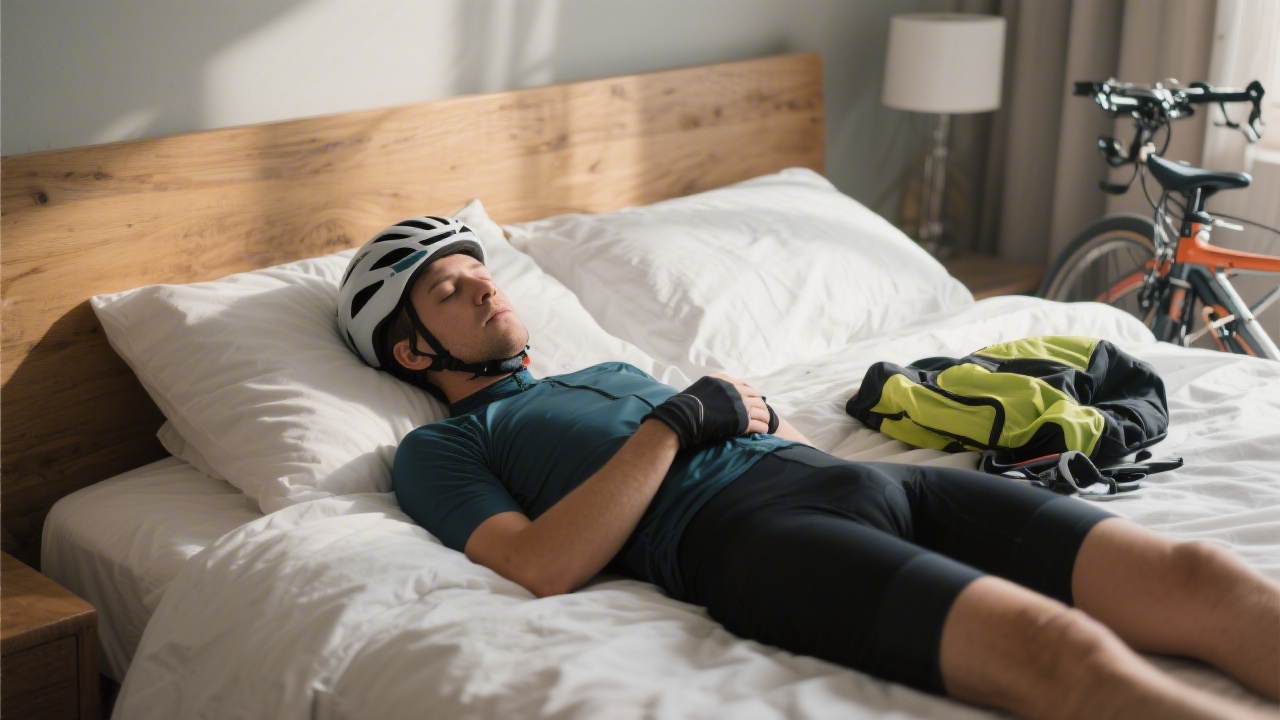
Back sleeping: Works well with a pillow under the knees. This flattens the exaggerated lumbar curve that cycling position creates and decompresses the disc spaces. Avoid a thick head pillow — it perpetuates the forward head posture from cycling.
Stomach sleeping: Problematic for cyclists specifically. It compresses the lumbar spine curve and forces cervical rotation — adding to existing neck tension rather than releasing it.
Mattress Firmness and Quad Recovery
Cyclists with well-developed quadriceps present a unique challenge for mattress specification. The muscle density of trained legs changes the pressure distribution across a mattress surface compared to an untrained sleeper of the same weight.
A mattress that is too firm creates pressure concentration at the hip and knee — reducing sleep continuity through micro-arousals. A mattress that is too soft fails to support the lumbar spine through the night, leading to morning back stiffness that compounds the cycling-position compression.
The target: a mattress with enough comfort layer depth to absorb hip and shoulder pressure, plus a supportive core that prevents excessive sinkage in the lumbar region. Our Saatva firmness comparison covers how to match firmness to body type and sleeping position.
HRV-Based Sleep Monitoring for Cyclists
Heart rate variability during sleep is the most sensitive recovery metric available to cyclists outside a sports science lab. HRV measures the variation in time intervals between heartbeats — higher variability indicates parasympathetic dominance (rest/recovery mode). A sustained HRV drop of 10-15% below your baseline indicates systemic fatigue — often appearing 24-48 hours before you consciously feel overtrained.
Practical application: if your HRV drops after three consecutive hard days, add a recovery ride and extend sleep by 60-90 minutes before resuming intensity. Most modern cycling computers (Garmin, Wahoo) and wearables (WHOOP, Oura) can track nocturnal HRV automatically.
Temperature and Post-Ride Sleep
Long rides — particularly in warm conditions — maintain elevated core temperature for 2-4 hours after completion. This delays the body temperature drop required to initiate deep sleep. For cyclists who complete long rides in the afternoon or evening, this is a significant issue.
Mitigation strategies: cold or lukewarm shower post-ride, a cool bedroom (65-68 degrees F), and a mattress with temperature-neutral properties. Our guide on optimal sleep temperature covers the research on bedroom temperature and sleep quality.
FAQs
How much sleep do cyclists need during training?
Recreational cyclists need 7-9 hours. Those training above 10-12 hours per week should target 9+ hours and consider planned naps on recovery days.
What is the best sleep position for cyclists?
Side sleeping is generally optimal — it reduces neck/shoulder tension and allows hip musculature to decompress. Back sleeping works well with a pillow under the knees. Stomach sleeping is problematic for cyclists.
How does HRV relate to cycling recovery?
HRV measured during sleep is the most sensitive early-warning indicator of incomplete recovery. A sustained drop of 10-15% below your baseline suggests systemic fatigue — often before perceived fatigue arrives.
Why do cyclists have trouble sleeping after long rides?
Extended aerobic exercise elevates cortisol, core body temperature, and sympathetic nervous system activity for 2-4 hours post-ride. This delays sleep onset and can reduce deep sleep proportion on hard training days.
Does mattress firmness matter for quad recovery?
Yes. Cyclists with developed quadriceps experience significant muscle density differences from typical sleepers. The interaction between body weight, muscle distribution, and mattress firmness determines whether hip and knee pressure is adequately managed through the night.