
 by
by Voted best luxury innerspring mattress with exceptional lumbar support and white-glove delivery.
Check Price & Availability FAQPage", "mainEntity": [ { "@type": "Question", "name": "How much sleep do I need for muscle growth?", "acceptedAnswer": { "@type": "Answer", "text": "Most research points to 7-9 hours for recreational athletes, and 9+ hours for those training at high volumes. More important than raw duration is sleep quality \u2014 specifically the proportion of deep sleep, during which 70% of daily growth hormone is secreted." } }, { "@type": "Question", "name": "Is it better to work out in the morning or evening for sleep quality?", "acceptedAnswer": { "@type": "Answer", "text": "Evening training within 1-2 hours of bed raises core body temperature and cortisol, which can delay sleep onset. Morning training has no negative effect on sleep. If you must train in the evening, allow at least 90 minutes between your last set and bedtime." } }, { "@type": "Question", "name": "What happens to muscles during sleep?", "acceptedAnswer": { "@type": "Answer", "text": "Satellite cells (muscle stem cells) are most active during sleep, repairing micro-tears from training. Growth hormone surges during the first deep sleep cycle, driving protein synthesis. Glycogen (stored muscle fuel) is replenished while the body is in a low-demand state." } }, { "@type": "Question", "name": "Does sleeping on the wrong mattress reduce muscle recovery?", "acceptedAnswer": { "@type": "Answer", "text": "Yes, indirectly. A mattress that creates pressure points or heat retention disrupts sleep continuity \u2014 fragmenting deep sleep cycles and reducing total growth hormone secretion. The cumulative effect over a training block is meaningful." } }, { "@type": "Question", "name": "Should I eat protein before bed for muscle growth?", "acceptedAnswer": { "@type": "Answer", "text": "Research supports consuming 30-40g of casein protein before sleep to sustain muscle protein synthesis through the night. This is particularly effective combined with proper sleep duration and quality." } } ] }The supplement industry has conditioned gym-goers to obsess over protein timing, creatine loading, and pre-workout stacks. But the single most anabolic intervention available to any strength athlete costs nothing, requires no prescription, and most people systematically undervalue it: sleep.
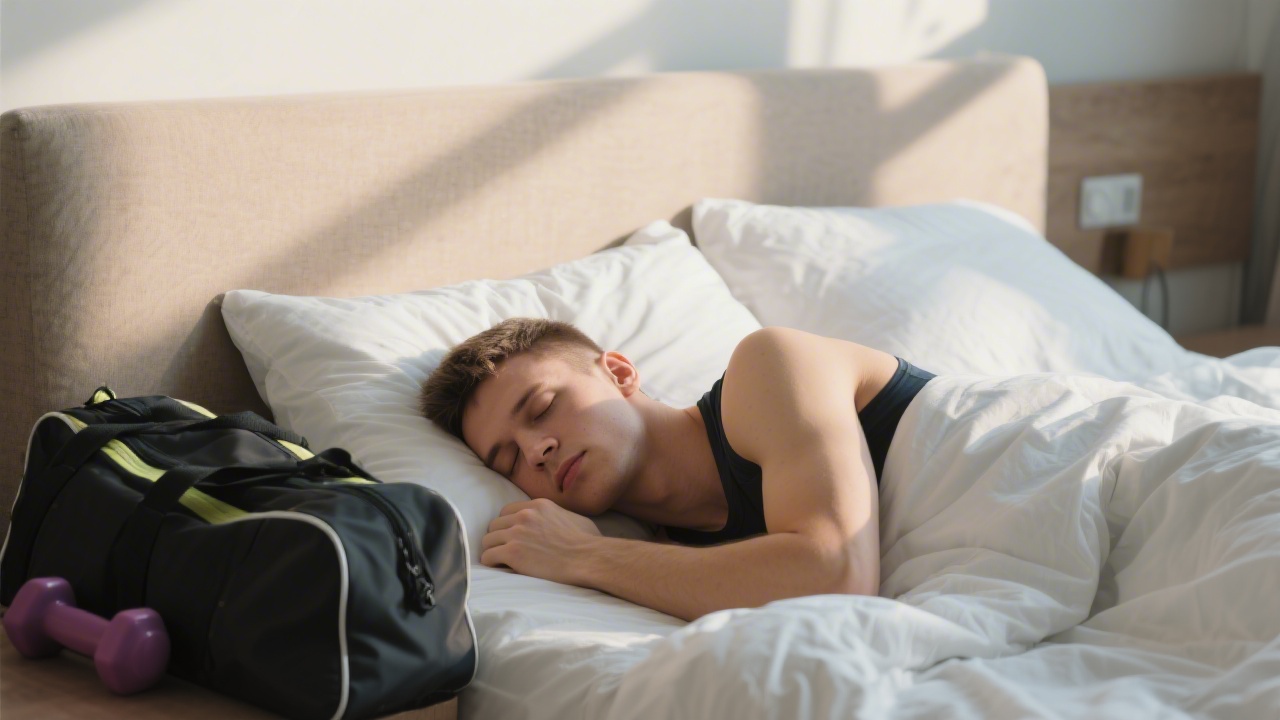
Specifically: deep sleep is when muscle growth actually happens. Approximately 70% of the body's daily growth hormone output is secreted during slow-wave (deep) sleep — the phase of sleep most vulnerable to disruption, most affected by mattress quality, and most shortened by lifestyle decisions like late screens, alcohol, and inconsistent sleep timing.
The Real Anabolic Window
Gym culture has built an entire mythology around the post-workout anabolic window — the 30-60 minutes post-training where protein consumption is supposedly critical. The science on that window is actually mixed. The science on what happens during sleep is not.
During the first 90-minute deep sleep cycle of the night:
- Growth hormone (GH) surges to its highest daily levels
- Satellite cells (muscle stem cells) activate to repair micro-tears from training
- Cortisol — the primary catabolic hormone — drops to its lowest daily level
- Testosterone secretion ramps up, peaking in early morning REM cycles
Interrupt that first deep sleep cycle — through alcohol, heat, noise, or a mattress that creates pressure-point arousals — and you have blunted your primary anabolic stimulus for the day.
Sleep Quality vs. Sleep Quantity for Muscle Growth
The gym recovery literature makes a useful distinction: quality of sleep matters more than total hours for muscle synthesis, up to a point.
Eight hours of fragmented sleep — with multiple micro-arousals from temperature discomfort, pain, or partner disturbance — produces less growth hormone than six hours of uninterrupted deep sleep. This does not mean six hours is enough (it is not), but it illustrates why simply being in bed for 8 hours does not guarantee recovery.
The practical implication: optimize your sleep environment before you try to extend duration. A cooler room (65-68 degrees F), a mattress that does not create hip or shoulder pressure points, and a consistent sleep schedule will produce better recovery outcomes than sleeping an extra hour on a poor mattress in a warm room.
Training Timing and Sleep Architecture
When you train matters for sleep quality — something many lifters ignore when planning their schedule.
Morning training (5-10 AM): Ideal for sleep. Cortisol is naturally elevated in the morning, making it a good physiological match for training intensity. No interference with nighttime sleep architecture.
Afternoon training (2-5 PM): Generally fine. Core body temperature peaks in the afternoon, which coincides with peak strength output for many athletes.
Evening training (6-9 PM): Requires management. Elevates core temperature and cortisol at a time when both need to be falling for sleep onset. Allow at least 90 minutes between training completion and bed. A cool shower post-workout accelerates the thermal drop required for sleep initiation.
Our guide on Saatva for hot sleepers covers how mattress materials affect thermal regulation — relevant for evening trainers whose core temperature stays elevated longer.
The Mattress-Recovery Connection
Lifters often experience post-training soreness in predictable areas: lower back, glutes, shoulders, and chest depending on training focus. These are also the primary pressure points that a poorly specified mattress fails to adequately support.
Two specific failure modes:
Insufficient pressure relief: A mattress that is too firm for your body composition creates compression at bony prominences — hips, shoulders — that generates micro-arousals. You wake up tired despite 8 hours because you were not getting quality deep sleep. Our Saatva firmness comparison covers how firmness interacts with body type.
Inadequate lumbar support: Lifters with developed posterior chains and tight hip flexors often default to anterior pelvic tilt during sleep. A mattress without zoned lumbar support amplifies this, leading to morning lower back stiffness. See our guide on Saatva for back pain.
Nutrition Timing for Overnight Recovery
- Casein protein (30-40g) before sleep — slow-digesting, sustains muscle protein synthesis through the overnight fast. Research by Maarten Res et al. (2012) showed 22% higher overnight muscle protein synthesis rates.
- Tart cherry juice — contains melatonin and anthocyanins that reduce exercise-induced inflammation and improve sleep quality. 480mL taken 1-2 hours before bed.
- Avoid alcohol entirely on high-volume training days — even 1-2 drinks suppress growth hormone release by up to 70% and fragment REM sleep.
FAQs
How much sleep do I need for muscle growth?
Most research points to 7-9 hours for recreational athletes, and 9+ hours for those training at high volumes. More important than raw duration is sleep quality — specifically the proportion of deep sleep, when 70% of daily growth hormone is secreted.
Is it better to work out in the morning or evening for sleep quality?
Evening training within 1-2 hours of bed raises core temperature and cortisol, which can delay sleep onset. Morning training has no negative effect on sleep. Allow at least 90 minutes between your last set and bedtime if training evenings.
What happens to muscles during sleep?
Satellite cells activate to repair micro-tears from training. Growth hormone surges during the first deep sleep cycle, driving protein synthesis. Glycogen is replenished while the body is in a low-demand state.
Does sleeping on the wrong mattress reduce muscle recovery?
Yes, indirectly. A mattress that creates pressure points or heat retention disrupts sleep continuity — fragmenting deep sleep cycles and reducing total growth hormone secretion. The cumulative effect over a training block is meaningful.
Should I eat protein before bed for muscle growth?
Research supports consuming 30-40g of casein protein before sleep to sustain muscle protein synthesis through the night. This is particularly effective combined with proper sleep duration and quality.