
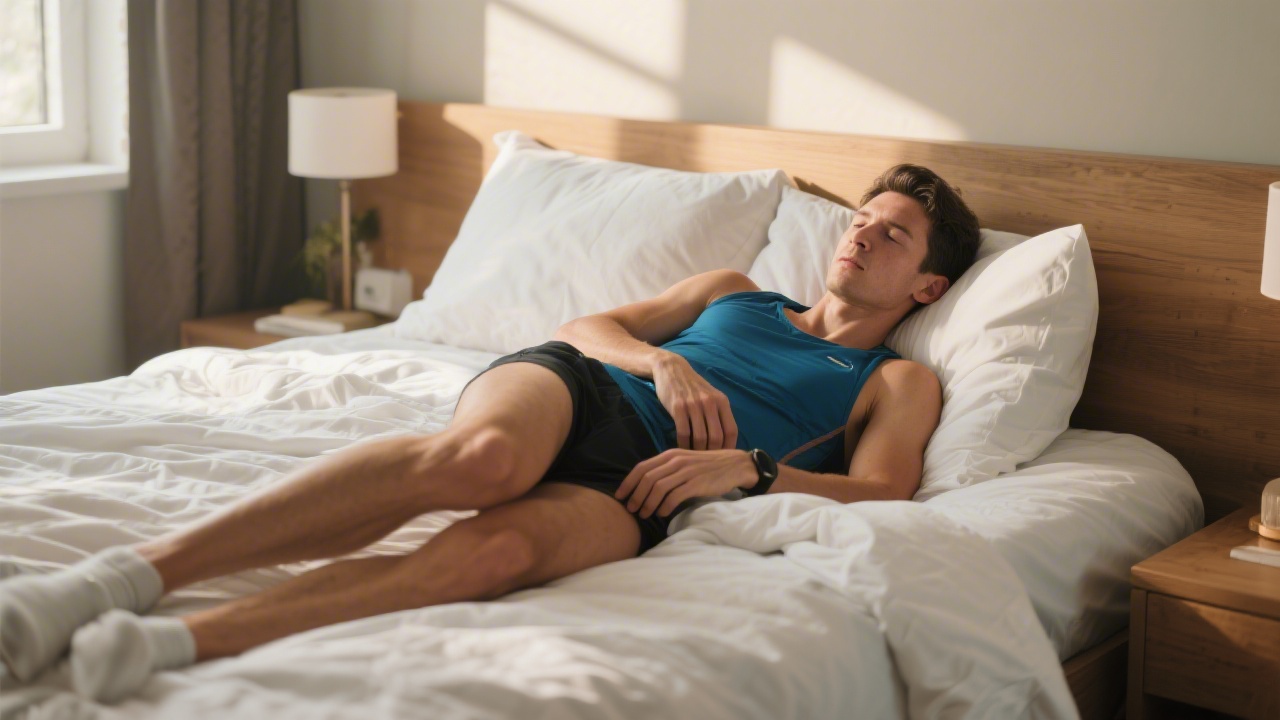
 by
by Voted best luxury innerspring mattress with exceptional lumbar support and white-glove delivery.
Check Price & Availability FAQPage", "mainEntity": [ { "@type": "Question", "name": "How many hours should runners sleep?", "acceptedAnswer": { "@type": "Answer", "text": "Elite runners typically sleep 9-10 hours during peak training blocks. Recreational runners benefit from a minimum of 8 hours, with nap supplements of 20-30 minutes on high-mileage days." } }, { "@type": "Question", "name": "Does sleep deprivation affect running performance?", "acceptedAnswer": { "@type": "Answer", "text": "Yes \u2014 significantly. Research shows one night of poor sleep reduces time to exhaustion by up to 30% and impairs lactate threshold. Over a training block, chronic sleep restriction leads to elevated injury risk and hormonal imbalance." } }, { "@type": "Question", "name": "What is the best sleep position for runners?", "acceptedAnswer": { "@type": "Answer", "text": "Side sleeping with a supportive pillow between the knees reduces hip rotation stress. Back sleeping with slight knee elevation is effective for IT band recovery. Stomach sleeping is generally discouraged \u2014 it increases lumbar lordosis and neck rotation stress." } }, { "@type": "Question", "name": "Should runners nap?", "acceptedAnswer": { "@type": "Answer", "text": "Yes. A 20-25 minute nap taken 6-8 hours before a race or hard training session improves alertness without causing sleep inertia. Avoid naps longer than 30 minutes unless in a formal sleep extension protocol." } }, { "@type": "Question", "name": "How does a mattress affect running recovery?", "acceptedAnswer": { "@type": "Answer", "text": "A mattress that does not adequately relieve pressure in the hips and shoulders keeps your muscles in a low-level tension state throughout the night, reducing the quality of deep sleep and slowing glycogen restoration. Zoned support mattresses help maintain spinal alignment during side sleeping." } } ] }When Eliud Kipchoge was preparing to break the two-hour marathon barrier, his coaching team did not just optimize his training load or nutrition protocol. Sleep became a structured performance variable — tracked, protected, and extended during the most demanding training blocks.
This is not a coincidence. The science of sleep and running performance has become one of the most robust areas in sports physiology, and the conclusions are clear: elite endurance athletes sleep more than average adults, and they do it deliberately.
Why Sleep Is a Non-Negotiable Training Variable for Runners
Running economy — the oxygen cost of maintaining a given pace — degrades measurably with sleep deprivation. A Stanford study on swimmers who extended sleep to 10 hours per night showed 0.51-second improvements in 15m sprint times after five weeks. Similar protocols in distance runners show reduced perceived effort at submaximal paces.
The mechanism matters: during slow-wave (deep) sleep, the body releases the majority of its daily growth hormone — the primary driver of muscle repair, glycogen restoration, and connective tissue recovery. Interrupt deep sleep, and you interrupt the repair cycle your legs depend on between training sessions.
For runners specifically, three recovery processes are sleep-dependent:
- Glycogen resynthesis — depleted muscle glycogen restores at its highest rate during the first 4 hours of sleep
- Micro-tear repair — satellite cell activity peaks during deep sleep phases
- Neuromuscular coordination — motor pattern consolidation (stride efficiency) requires REM sleep
Sleep Requirements by Training Phase
Not all training weeks are equal — and your sleep targets should not be either.
Base training (low intensity, high volume): 8-9 hours minimum. Your aerobic system is building capillary density and mitochondrial efficiency. Recovery is foundational here.
Threshold and tempo weeks: 9 hours. Lactate-intensive work creates significant muscular inflammation. Sleep is the primary anti-inflammatory recovery tool you have.
Race-specific and peak weeks: 9-10 hours. This is where cortisol is highest and injury risk peaks. Sleep extension studies show measurable performance benefits from adding even 30-45 minutes to regular sleep duration during these weeks.
Taper week: Aim for 8-9 hours but do not panic about race-week sleep anxiety — the night before your race barely matters.
The Race-Night Sleep Myth
Here is the most important thing most runners do not know: the night before your race barely matters.
Research consistently shows that performance on day N+1 is primarily determined by sleep quality over the preceding 5-7 days, not the night immediately before. Most runners sleep poorly the night before a race — elevated cortisol, adrenaline, and the logistical stress of race morning make deep sleep difficult. This is normal, expected, and almost inconsequential if the preceding week was well-slept.
What matters: protect your sleep in the 5-7 days before a target race. This is your actual sleep loading window.
Mattress Considerations for Runners
Your mattress affects running recovery in three concrete ways:
Pressure relief at hips and shoulders: Side-sleeping runners accumulate significant hip and shoulder pressure across 8+ hours. A mattress that does not adequately relieve this pressure keeps surrounding muscles in a low-grade tension state — reducing the depth of sleep and the quality of recovery. See our Saatva firmness comparison for how different firmness levels handle pressure.
Temperature regulation: Running elevates core body temperature for hours post-run. A mattress that traps heat prolongs the time before your body reaches the 1-2 degree drop required to initiate deep sleep. Our guide on Saatva for hot sleepers covers this in detail.
Lumbar support: Runners with weak hip flexors often develop anterior pelvic tilt during sleep — particularly problematic in back sleeping. Zoned lumbar support counteracts this. We cover Saatva for back pain in a dedicated guide.
Practical Protocol: Optimizing Sleep During a Training Block
- Set a consistent wake time — not a bedtime. Your anchor is the alarm, not the pillow. This stabilizes your circadian rhythm even during irregular training schedules.
- Post-run cool-down routine — spend 10 minutes cooling before bed. Light stretching, cool shower, no screens. This accelerates the thermal drop required for deep sleep onset.
- Track HRV, not just hours — heart rate variability during sleep is a more sensitive marker of recovery quality than sleep duration.
- Strategic napping — on double-day training or after a long run, a 20-minute nap taken 6-8 hours after waking accelerates glycogen restoration without disrupting nighttime sleep architecture.
- Alcohol elimination during peak weeks — even one drink fragments sleep architecture and suppresses deep sleep by up to 39%. During taper and peak training, this is non-negotiable for serious athletes.
FAQs
How many hours should runners sleep?
Elite runners typically sleep 9-10 hours during peak training blocks. Recreational runners benefit from a minimum of 8 hours, with nap supplements on high-mileage days.
Does sleep deprivation affect running performance?
Yes. Research shows one night of poor sleep reduces time to exhaustion by up to 30% and impairs lactate threshold. Chronic sleep restriction leads to elevated injury risk and hormonal imbalance over a training block.
What is the best sleep position for runners?
Side sleeping with a supportive pillow between the knees reduces hip rotation stress. Back sleeping with slight knee elevation works well for IT band recovery. Stomach sleeping is generally discouraged.
Should runners nap?
Yes. A 20-25 minute nap taken 6-8 hours after waking improves alertness without causing sleep inertia. Avoid naps longer than 30 minutes unless in a formal sleep extension protocol.
How does a mattress affect running recovery?
A mattress that fails to relieve pressure at hips and shoulders keeps muscles in low-level tension overnight, reducing deep sleep quality and slowing glycogen restoration. Zoned support mattresses help maintain spinal alignment during side sleeping.