
 by
by The mattress that supports your creative recovery
The Saatva Classic combines innerspring support with Euro pillow top comfort — built for people who take their rest seriously.
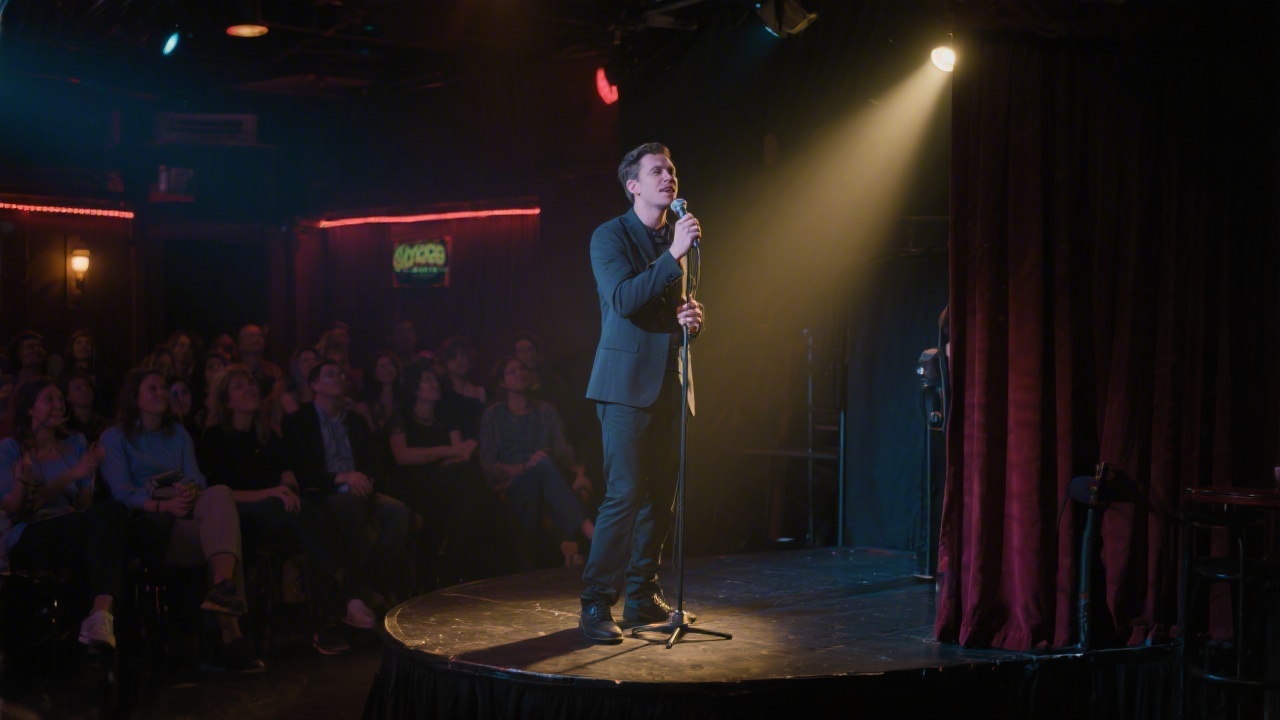
The Cognitive Architecture of Stand-Up Comedy
Stand-up comedy is one of the most cognitively demanding performance forms: it requires precise timing, real-time social cognition, rapid recall under pressure, emotional control, and the split-second executive judgment that decides whether to push forward with a bit, abandon it, or riff spontaneously. This cognitive load is managed by neural systems that are directly degraded by sleep deprivation — making sleep one of the most overlooked performance variables in comedy.
The conventional wisdom in comedy circles treats late nights, bar culture, and irregular sleep as occupational hazards — or even as part of the creative lifestyle. The neuroscience suggests a different interpretation: irregular sleep is a performance liability that compounds over time, degrading the specific cognitive capacities that comedy depends on.
Comedy Timing: A Prefrontal Function
The difference between a punchline that lands and one that doesn't often comes down to milliseconds — the pause length before delivery, the speed of the tag, the beat held after the laugh before the next setup. This timing precision is not intuitive or instinctive in the way it might appear from the outside. It is an active executive function: the comedian reads audience state, modulates delivery speed, and calibrates pause length in real time using the prefrontal cortex and anterior cingulate cortex.
Both of these regions show measurable impairment after sleep deprivation. Processing speed slows, reaction time increases, and the fluid real-time adjustment that experienced comedians describe as "reading the room" becomes sluggish and delayed. The subjective experience — timing feeling off, not quite catching the wave of a laugh, or rushing through a setup — corresponds precisely to the objective slowing of prefrontal processing under sleep restriction.
Joke Recall and Working Memory Under Pressure
Performing a set requires simultaneously holding the structure of the remaining material in working memory while managing current delivery, crowd response, and potential adjustments. This parallel working memory load is cognitively expensive in the best conditions. Under sleep deprivation, working memory capacity shrinks and retrieval speed slows — increasing the probability of the dreaded blank.
Stage blank — the experience of briefly losing access to material under performance conditions — is one of the most destabilizing things that can happen to a comedian early in a set. It triggers anxiety that degrades the relaxed confidence subsequent material depends on. Sleep deprivation does not guarantee stage blank, but it significantly raises its probability by reducing the buffer in working memory that smooth recall depends on.
Crowd Reading and Social Cognition
Experienced comedians describe crowd reading as their most valuable skill: the ability to sense whether the room is with them, which direction to take a bit, when to cut and move on. This is real-time social cognition — the rapid processing of facial expressions, body language, laughter quality, silence texture, and energy dynamics that the brain performs continuously during performance.
Research on social cognition and sleep deprivation consistently shows that subtle social signals — the exact category most relevant to crowd reading — are most impaired under sleep restriction. Subjects show reduced accuracy in reading facial expressions, particularly for subtle or ambiguous emotional signals. The loud laugh is easy to detect rested or not. The polite laugh that signals a bit isn't working as expected, the moment the room starts to lean away, the shift in energy that precedes a hostile silence — these are the signals that degrade under sleep deprivation.
Circadian Challenges of the Late-Night Comedy Circuit
Club comedy often means sets at 9pm, 11pm, or midnight, followed by post-show social time that further delays sleep. This schedule consistently conflicts with conventional sleep timing in a way that creates two options: accept shorter sleep by rising at a conventional morning time, or shift the entire sleep window later to maintain sleep duration. The second option is physiologically superior — but requires social and scheduling flexibility that many comedians lack.
The worst pattern is inconsistency: late nights during performance weeks followed by attempts to return to conventional timing on days off. This creates a weekly social jet lag cycle that degrades sleep quality regardless of total hours. Comedians who maintain consistent late-window sleep timing — sleeping from 2am to 9am consistently rather than varying between midnight and noon — show better subjective performance quality and fewer off-nights attributable to cognitive fatigue.
Emotional Regulation and Performance Confidence
The confidence that stand-up requires — the willingness to hold silence, stay with a bit through initial resistance, take risks on new material — is not simply a personality trait. It is a regulated emotional state that depends on prefrontal modulation of the amygdala's fear response. Sleep deprivation amplifies amygdala reactivity and reduces prefrontal regulation, producing the characteristic combination of increased anxiety and reduced risk tolerance that comedians sometimes describe as "tight" or "defensive" performing.
Internal links: sleep and resilience, sleep and entrepreneurship, optimal sleep protocol, flexible work schedule and sleep.
Frequently Asked Questions
Why is comedy timing so sensitive to sleep deprivation?
Comedy timing is an executive function that requires precise calibration of pause length, delivery speed, and audience reading — all in real time. This calibration is managed by the prefrontal cortex and anterior cingulate cortex, both highly sensitive to sleep deprivation. Sleep-deprived comedians consistently report their timing feeling 'off' — a subjective experience that corresponds to measurable slowing of processing speed and degraded real-time social perception.
How does sleep affect joke recall on stage?
Joke recall under performance conditions requires working memory — holding the set structure while managing crowd response and making real-time adjustments. Working memory is one of the most sleep-sensitive cognitive functions. Sleep-deprived performers show slower retrieval and more frequent tip-of-tongue failures. For comedians, a blank moment on stage can undermine the confidence that subsequent material depends on.
What's the best way to sleep with late-night show schedules?
The key is consistency, not conventionality. A comedian who consistently sleeps from 2am to 10am has a functional circadian rhythm. The problem is inconsistency — varying sleep timing by more than 90 minutes day-to-day disrupts the circadian clock regardless of total hours. Identify the sleep window that accommodates late-night shows and anchor to it consistently, including on off days.
Does sleep affect the ability to read a crowd?
Significantly. Crowd reading is real-time social cognition — detecting which jokes are landing, when energy is shifting, what emotional state the audience is in. This requires rapid processing of facial expressions, body language, laughter timing, and silence quality. Sleep deprivation specifically impairs the perception of subtle social signals, which are precisely the signals that separate experienced crowd readers from rigid performers.
Can poor sleep lead to bombing on stage?
Poor sleep alone doesn't cause bombing, but it creates conditions that make bombing more likely. Reduced timing precision, slower crowd reading, degraded emotional regulation (panic response to early silence), and impaired working memory during set delivery all compound under sleep deprivation. The confidence that underlies effective delivery is also affected — sleep-deprived performers show more performance anxiety and negative self-talk.
The mattress that supports your creative recovery
The Saatva Classic combines innerspring support with Euro pillow top comfort — built for people who take their rest seriously.
Our Top Mattress Pick
The Saatva Classic consistently ranks #1 for comfort, support, and long-term durability.
Key Takeaways
Sleep for Stand-Up Comedians is a topic that depends heavily on individual needs and preferences. The most important thing is to consider your specific situation — your body type, sleep position, and personal comfort preferences — before making any decisions. When in doubt, take advantage of trial periods to test before committing.