
 by
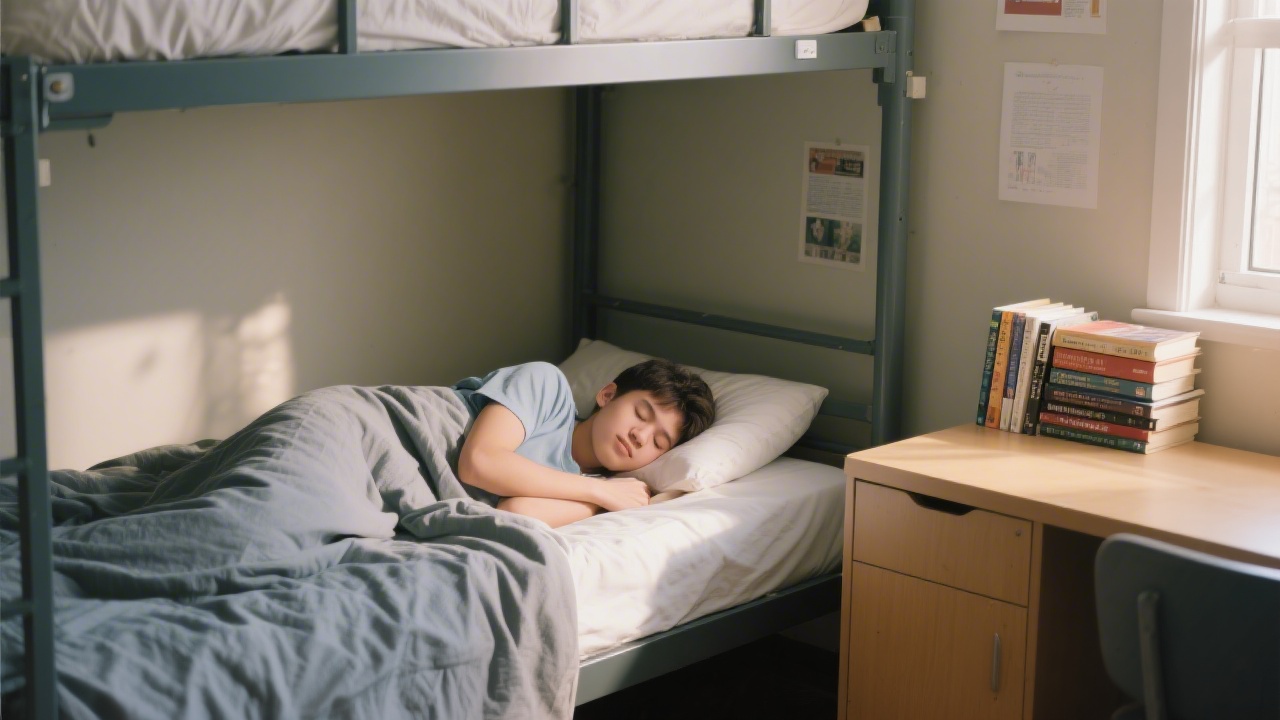
by Chronic sleep restriction is the single most prevalent academic performance issue that rarely appears on any intervention list. The data on how much sleep deprivation costs students academically is unambiguous.
Recommended Mattress
Saatva Youth Mattress
Award-winning innerspring for dorm rooms and student budgets. Free white-glove delivery.
The Academic Cost of Insufficient Sleep
A large-scale study published in Sleep found that students sleeping fewer than eight hours per night scored the equivalent of two IQ points lower on standardized assessments. This effect compounds: students who averaged six hours per night for two weeks showed cognitive deficits equivalent to two full nights of total sleep deprivation — while rating themselves as only slightly tired.
A Harvard study tracking 1,655 college students found that each hour reduction in average sleep was associated with a 0.07 drop in GPA. Students in the top academic quintile averaged 25 minutes more sleep per night than those in the bottom quintile.
Sleep and Memory Consolidation
Memory consolidation — the process by which information moves from short-term hippocampal storage to long-term cortical storage — occurs primarily during sleep. This process is not passive. During slow-wave sleep, the hippocampus replays and strengthens neural pathways associated with recently learned information. During REM sleep, the brain integrates new information with existing knowledge structures, which is why REM sleep improves problem-solving and creative connections.
Studying before sleep exploits this window. Research from the University of Luebeck found that students who slept after studying a logic problem were three times more likely to discover the hidden solution rule than students who stayed awake, regardless of whether the awake group studied longer.
Why All-Nighters Backfire
The intuitive case for all-nighters — more awake hours equals more study time — fails on both sides of the equation. Learning efficiency while awake degrades sharply after 17 to 19 hours. Attention becomes fragmented. Working memory capacity drops. Error rates increase. Students often spend the last hours of an all-nighter re-reading material they cannot retain.
The morning of an exam, an all-nighter student is cognitively comparable to someone who is legally impaired. Speed of processing, working memory, and anxiety regulation are all compromised during the exam itself.
More significantly, the memory consolidation that study depends on does not occur during wakefulness. An all-nighter followed by an exam forfeits the consolidation window entirely, meaning the additional study hours produce less durable learning than a shorter study session followed by adequate sleep.
Exam Timing and Chronotype
Chronotype — the individual preference for morning or evening activity — has a measurable effect on exam performance. A study of 400,000 students at the University of Munich found that evening chronotypes who were required to sit exams in the morning performed as if they were studying one to two academic years behind their morning chronotype peers, even when controlling for study hours.
College students are disproportionately evening chronotypes due to both biological factors (delayed circadian phase is a natural feature of adolescent and young adult biology) and social factors (late evening schedules). When exams are scheduled in the morning, evening-chronotype students compete at a circadian disadvantage.
Dorm Sleep: The Environment Problem
Dormitory environments create specific sleep challenges. Noise is the primary disruptor: research from Harvard Medical School found that even low-level noise that does not fully wake a sleeper fragments sleep architecture, reducing slow-wave sleep and REM time. Shared rooms create light pollution issues. Variable roommate schedules mean that one person's 2 a.m. return can fragment a light sleeper's night.
Mattress quality in dormitory settings is often poor. Thin, unsupportive mattresses increase body movement during sleep as the body attempts to relieve pressure, which reduces sleep depth and efficiency.
Recommended Mattress
Saatva Youth Mattress
Award-winning innerspring for dorm rooms and student budgets. Free white-glove delivery.
Evidence-Based Strategies
Schedule sleep as a fixed block: Treat sleep as a non-negotiable academic requirement, not an optional activity that expands when convenient. Research suggests that irregular sleep schedules produce GPA declines independent of average sleep duration.
Study timing: Study the most difficult or newly learned material in the two hours before sleep. The consolidation benefit is dose-responsive to recency.
Napping protocol: A 20-minute nap between classes improves afternoon alertness without disrupting nighttime sleep. Avoid napping after 4 p.m.
Light discipline: Use blue-light blocking settings on laptops and phones after 9 p.m. Evening light exposure delays melatonin onset by one to two hours.
Frequently Asked Questions
Disclosure: This article contains affiliate links. If you purchase through our links, we may earn a commission at no additional cost to you.