
 by
by Most people who struggle with sleep hygiene are not failing from lack of effort — they are making specific, identifiable mistakes that systematically counteract the sleep systems they are trying to support. These eight mistakes account for the majority of sleep hygiene failures seen in clinical practice and in the self-reported data from sleep tracker users. Identifying which ones apply to you is the first step toward an effective fix.
Mistake 1: Lights Too Bright Too Late
This is the most common and most impactful mistake. Overhead LED lighting at full brightness (typically 300–500 lux) in the 2 hours before bed significantly suppresses melatonin production. Even switching to a 60W-equivalent warm bulb at 50% brightness reduces the suppression substantially. The specific error most people make is not the phone screen (which everyone knows about) but the overhead kitchen and living room lights they are cooking, cleaning, and socializing under until the moment they decide to sleep.
The fix: Begin light dimming 2–3 hours before your target bedtime. See our complete light dimming schedule for the exact timeline and color temperature recommendations.
Mistake 2: Eating at the Wrong Time
A large meal within 3 hours of bedtime forces your digestive system into active mode — a state physiologically incompatible with deep sleep. The specific problem is not just fullness but the metabolic heat generated by digestion, which raises core body temperature at exactly the time it should be dropping. High-glycemic foods are particularly problematic because blood sugar spikes followed by drops can trigger stress hormone release at 2–3 AM.
The fix: Finish dinner at least 3 hours before bed. If you need a late snack, keep it small (under 200 calories) and lean toward complex carbs (oatmeal, banana) rather than protein or fat, which require more metabolic processing.
Mistake 3: Wrong Room Temperature
A room above 70°F (21°C) actively impairs deep sleep. Many people who report being "good sleepers" in cooler months and "bad sleepers" in summer are experiencing this effect without realizing the cause. The optimal range is 65–68°F (18–20°C) for most adults. If you share a bed with someone with a different thermal preference, separate blankets rather than compromising on room temperature — the room temperature affects both of you regardless of blanket thickness.
The fix: Set the thermostat before the wind-down begins, not at bedtime. The room needs 30–45 minutes to reach target temperature.
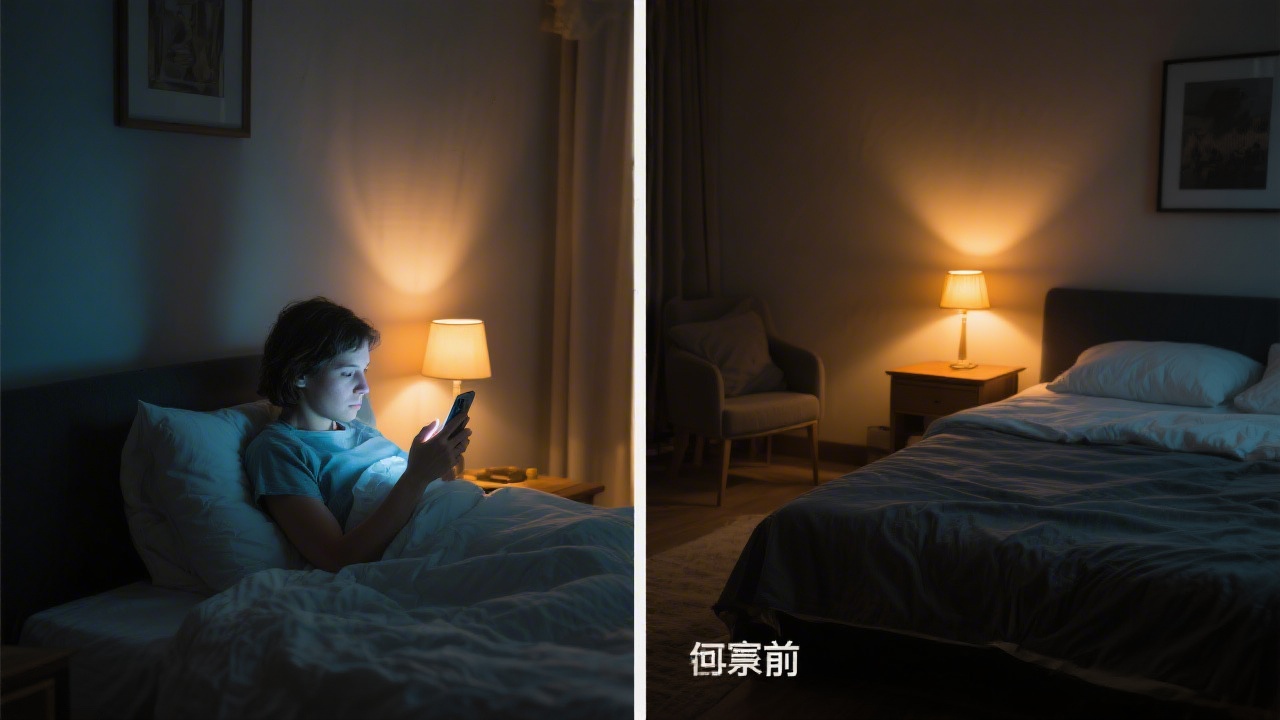
Mistake 4: Phone Use Within 30 Minutes of Bed
This mistake has two components that are often conflated. The first is blue-spectrum light from the screen, which suppresses melatonin. This is real but relatively modest in impact. The second and more significant component is cognitive arousal from content: email, social media, news, messages, and notifications all trigger mild stress responses that elevate cortisol and maintain the alert-vigilant state. Even pleasant social media use activates reward circuits that compete with sleep onset. See our guide on the phone-free hour before bed for the implementation approach.
The fix: Physical separation from the phone at T-30. This is not about willpower — it is about removing the option by placing the phone in another room.
Mistake 5: Inconsistent Sleep and Wake Times
Your circadian clock is a biological system that requires consistent entrainment. Sleeping at 11 PM on weekdays and 1 AM on weekends creates what researchers call "social jetlag" — a chronic misalignment between your biological clock and your social schedule. The Monday morning sluggishness most office workers experience is not about insufficient sleep duration; it is about circadian disruption from the weekend schedule shift. Studies show social jetlag of more than one hour is associated with increased rates of metabolic syndrome, depression, and cardiovascular risk.
The fix: Lock your wake time first. A consistent wake time is more important than a consistent sleep time — it regulates the entire 24-hour cycle. Allow sleep time to vary by 30 minutes at most.
Mistake 6: Sleeping In on Weekends
This is a specific consequence of Mistake 5 but worth separating because it feels counterintuitive. Sleeping in on weekends feels like recovery, but for every hour you delay your wake time past your weekday wake time, you push your circadian clock forward — making Monday morning feel like the first day after a transatlantic flight. Additionally, sleeping in reduces adenosine pressure going into Sunday night, making it harder to fall asleep, which creates the classic Sunday insomnia / Monday exhaustion cycle.
The fix: Cap weekend lie-ins at 30 minutes past your weekday wake time. If you are genuinely sleep-deprived, a short nap (20 minutes) on Saturday afternoon is more chronobiologically benign than sleeping until noon.
Mistake 7: Caffeine After 2 PM
Caffeine's half-life in the body is 5–7 hours for most adults, meaning a 3 PM coffee still has 50% of its stimulant effect at 8–10 PM. For slow metabolizers (genetic variation in the CYP1A2 enzyme — roughly 50% of the population), the half-life extends to 9–10 hours, meaning that 3 PM coffee still has 25% of its stimulant effect at midnight. Caffeine works by blocking adenosine receptors — it does not eliminate adenosine, it just prevents you from feeling its full effect. When caffeine clears, all the accumulated adenosine hits at once, which can cause a rebound crash but does not necessarily translate into better sleep architecture.
The fix: Cut off caffeine by 1–2 PM. If you are a slow metabolizer or sensitive to caffeine, noon may be more appropriate. Track your sleep quality after a 2-week caffeine cutoff experiment before dismissing the variable.
Mistake 8: Naps Too Long or Too Late
A nap under 20 minutes (a "power nap") stays within the lighter NREM stages and leaves you feeling refreshed without sleep inertia. A nap of 30–90 minutes risks entering slow-wave (deep) sleep and waking mid-cycle, producing significant grogginess. Any nap after 3 PM reduces adenosine pressure enough to push back sleep onset at night by 30–60 minutes. The combination of a late, long nap is one of the most reliable ways to produce Sunday-night-style insomnia on any day of the week.
The fix: If you nap, keep it to 20 minutes before 3 PM. Set an alarm — do not rely on your body to wake you.
The Compound Effect
The reason these mistakes are particularly damaging is not their individual impact but their compound effect. Bright lights at 9 PM plus a late dinner plus a 3 PM coffee plus a 45-minute 4 PM nap is a combination that would reliably impair sleep quality in a professional athlete on an optimized protocol — let alone in someone dealing with work stress and inconsistent schedules. Fixing even three of these eight mistakes produces measurable improvement in most people. The sleep hygiene checklist provides the positive-frame counterpart to this list.
Frequently Asked Questions
Which of these mistakes has the highest impact?
Inconsistent sleep/wake timing (Mistake 5) has the highest systemic impact because it disrupts the entire circadian architecture, affecting every other sleep parameter. Bright lights too late (Mistake 1) has the most immediate acute impact on any given night. If you can only fix one thing, fix your wake time first.
I've been making these mistakes for years. How long to see improvement?
Environmental changes (temperature, light dimming) show immediate impact within 1–3 nights. Circadian re-entrainment from fixing sleep timing takes 1–2 weeks of consistent behavior. Caffeine sensitivity normalization can take 2–4 weeks of elimination before your baseline sleep architecture improves.
Is a glass of wine before bed really a problem?
Yes, for sleep quality specifically. Alcohol is sedating but it fragments sleep architecture, suppressing REM in the first half of the night and causing arousal rebound in the second half. Even one drink within 3 hours of sleep reduces sleep quality scores in wearable tracker data. Two or more drinks reliably produces measurable REM suppression.
Are blue light glasses an effective fix for Mistake 4?
Partially. Blue light glasses reduce the photonic melatonin suppression component but do not address the cognitive arousal from content. Studies show modest improvement in sleep onset time with blue light glasses compared to full phone use, but far smaller improvements than simply not using the phone.
My mattress is old. Could that be causing sleep hygiene to fail?
Yes. A mattress that creates pressure points or fails to maintain spinal alignment produces micro-awakenings that show up as reduced deep sleep percentages in sleep tracker data, even if you don't consciously remember waking. If you've corrected behavioral sleep hygiene and still see fragmented sleep, the sleep surface is the next variable to investigate.
Complete Your Sleep Setup
The right mattress turns a good routine into exceptional sleep. The Saatva Classic is our top pick for pressure relief and lasting support.
Key Takeaways
Sleep Hygiene Mistakes is a topic that depends heavily on individual needs and preferences. The most important thing is to consider your specific situation — your body type, sleep position, and personal comfort preferences — before making any decisions. When in doubt, take advantage of trial periods to test before committing.