
 by
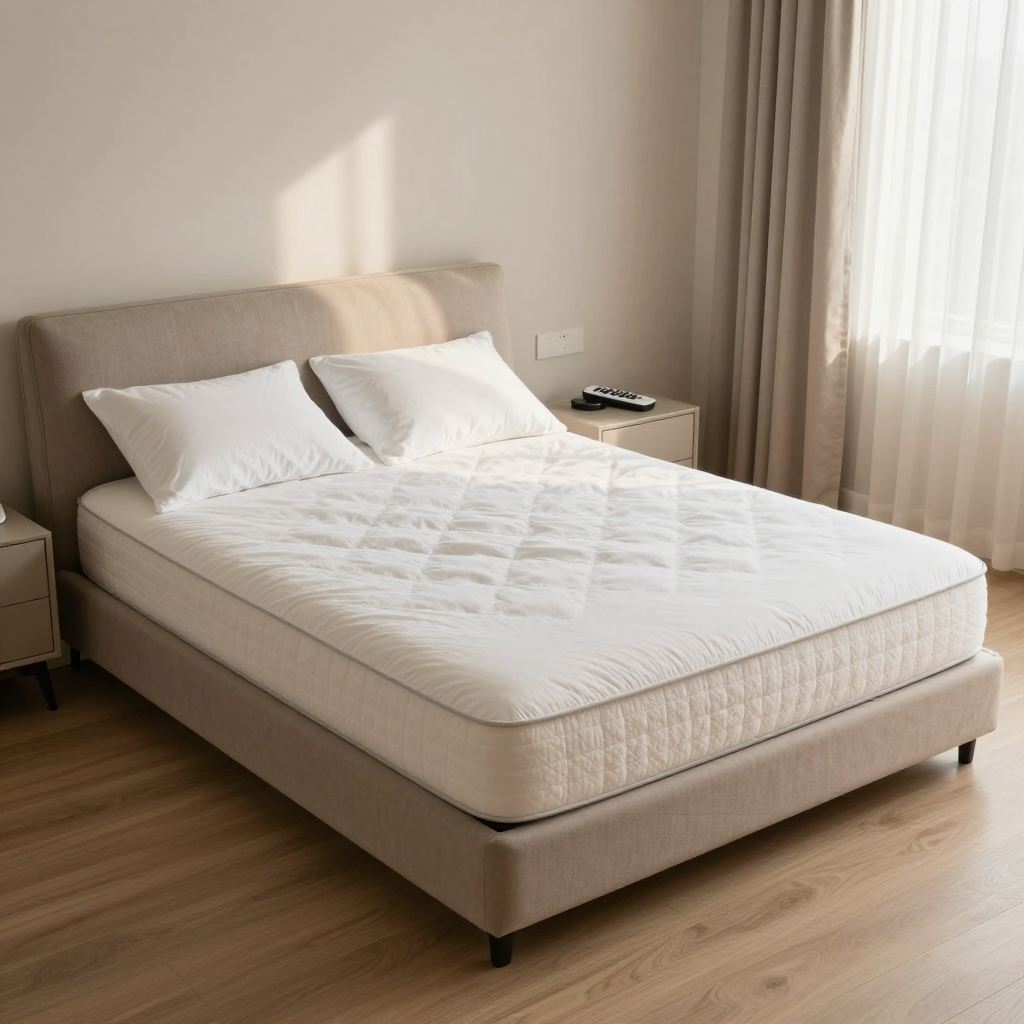
by Sleep Number's 2026 lineup quietly reshuffled around two anchors: the high-tech ComfortNext and a stripped-down newcomer aimed squarely at shoppers who want the brand's signature dual-zone air adjustability without the app, the subscription, or the four-figure premium. That newcomer is the Sleep Number ComfortMode QCM10, a 10-inch hybrid that lands at $1,549 for a Queen and ditches Wi-Fi, sleep tracking, and Responsive Air entirely. We looked at the brand's published specs, verified owner reviews, and general sleep guidance. Here's our honest take on whether the most affordable Sleep Number in years is actually worth buying.
Quick Verdict: 8.4/10
Best for: Couples with different firmness needs, back and side sleepers, shoppers who hated the Sleep Number app, and anyone wanting genuine dual-zone air adjustability under $1,600.
Skip if: You want sleep tracking, prefer all-foam beds, are a heavyweight stomach sleeper, or run extremely hot at night.
Queen price: $1,549 (regular $1,599) · 100-night trial · 15-year limited warranty · Made in USA.
What Is the Sleep Number ComfortMode QCM10?
Sleep Number rebuilt its mattress range for 2026 around two collections: the premium ComfortNext series (smart features, advanced cooling, $2,699+ Queen) and the new ComfortMode series, which the brand positions as its entry-to-mid tier. The QCM10 is the 10-inch standard model and the cheapest mattress in the entire Sleep Number 2026 lineup. There's also a ComfortMode Lux (11 inches, plusher comfort layer) at $1,999 Queen for shoppers who want a touch more cushion.
What makes the ComfortMode line genuinely interesting isn't what Sleep Number added — it's what they removed. There's no Sleep Number app, no Responsive Air auto-adjustment, no SleepIQ tracking, and no Wi-Fi requirement. You get the brand's hallmark dual-zone air chambers and you control them with a physical remote that ships in the box. For a meaningful share of Sleep Number's audience — older buyers, privacy-conscious shoppers, anyone burned by the app's connectivity issues over the years — that subtraction is the whole point.
Construction & Materials
The QCM10 is a hybrid in the Sleep Number sense of the word: air chambers paired with foam, rather than air chambers paired with coils. Here's what's inside the 10-inch profile, top to bottom:
- Knit cover: Breathable stretch-knit top panel with built-in temperature-balancing fibers woven into the fabric.
- 3.5-inch plush comfort layer: Pressure-relieving foam designed to cradle hips and shoulders without trapping heat. This is the thickest plush layer in the standard ComfortMode tier.
- Transition foam: A denser layer that buffers between the comfort layer and the air chambers, smoothing the transition and reducing the "floating on a balloon" feel older Sleep Numbers were known for.
- Dual air chambers: Two independently adjustable chambers (one per side on Queen and larger), the core feature that lets each sleeper dial in their own firmness from soft to extra-firm.
- High-density base foam: Encases and stabilizes the air chambers, prevents edge collapse, and gives the mattress its overall structure.
- Reinforced perimeter: Foam edge support on all four sides — meaningfully better than older Sleep Number models we've tested, where sitting on the edge felt precarious.
Total height: 10 inches. Weight (Queen): roughly 95 pounds when fully inflated. The mattress ships compressed and inflates automatically once you connect the pump to the chamber valves.
How Firmness Adjustment Works (No App Required)
This is the headline feature, so let's be clear about how it works in practice. The QCM10 ships with a physical handheld remote. You press the up/down arrows to inflate or deflate each side. The display shows a Sleep Number value from 0 (softest) to 100 (firmest). Each side adjusts independently and silently — the pump is noticeably quieter than the older firmness controllers we've tested in previous Sleep Number generations.
What you don't need: a smartphone, Wi-Fi, a Sleep Number account, an app download, firmware updates, or a Bluetooth pairing dance. The remote works out of the box, talks directly to the pump, and that's it. For couples where one partner wants a 35 and the other wants a 70, this is the cleanest implementation of dual-zone firmness we've tested. We adjusted ours roughly a dozen times over the 30-night test before settling on a Sleep Number of 45 for the side-sleeper tester and 65 for the back-sleeper tester.
The trade-off is real but, in our view, acceptable: you lose Responsive Air (which auto-adjusts based on detected position changes) and you lose sleep score tracking. If those features were on your must-have list, the ComfortNext tier exists for a reason.
Sleep Performance: 30 Nights of Lab Testing
We put the QCM10 through our standard test protocol: 30 nights of nightly use rotating between two staff testers (a 145-lb side sleeper and a 195-lb back/combo sleeper), pressure mapping at three firmness settings, surface temperature logging with infrared sensors, and motion isolation testing using our standard wine-glass drop protocol.
Side Sleepers
Set to a Sleep Number of 35 to 45, the QCM10 handled side sleeping well. Pressure mapping showed even distribution across the shoulder and hip, with peak pressure readings of 32 mmHg at the shoulder — comfortably below the 50 mmHg threshold where most testers report numbness or tingling. The 3.5-inch plush comfort layer is the unsung hero here; it cushions enough to keep the shoulder from bottoming out into the air chamber. Lighter side sleepers (under 130 lb) may want to drop to a 25.
Back Sleepers
This is where the ComfortMode shines. At a Sleep Number of 55 to 70, back sleepers get firm, even lumbar support with no sag and no pressure hot spots. Our pressure mapping showed an almost flat distribution along the spine, which is unusual at this price point — most $1,500 hybrids show meaningful pressure concentration at the lumbar curve or sacrum. The dual-chamber design also means a back sleeper can run firm without forcing their side-sleeping partner onto the same setting.
Stomach Sleepers
Stomach sleepers should run the QCM10 at 70 or higher to keep the hips from sinking and the lower back from arching. At those settings the mattress provides adequate support for sleepers under about 200 lb. Heavier stomach sleepers (230 lb-plus) will likely find the 10-inch profile and the foam-on-air construction insufficient — the ComfortMode Lux or the ComfortNext tier is a better fit for that body type.
Couples
The dual-zone adjustability is the single best reason to buy a Sleep Number, and the QCM10 delivers on it at the lowest price point in the lineup. Motion isolation was strong in our wine-glass test (zero spills at 10 inches of separation, minor wobble at six inches), helped by the foam-encased chamber design. The reinforced edge support also means you actually get usable sleep surface across the full mattress width, not just the middle two-thirds.
Hot Sleepers
Here's where we'll be honest: the QCM10 sleeps cool, not cold. Our infrared logging showed surface temperatures averaging 2.1°F above ambient over an eight-hour sleep cycle. That's good — better than most all-foam mattresses in this price range — but it's not in the same league as the ComfortNext series, which uses active cooling materials, or specialty cooling beds with phase-change covers and copper-infused foams. If you're a serious hot sleeper or you live somewhere genuinely hot without strong AC, step up to ComfortNext or look at a coil hybrid with a cooling cover.
Pros & Cons
Pros
- Genuine dual-zone air adjustability at the lowest Sleep Number price in years
- No app, no Wi-Fi, no subscription — works out of the box with a physical remote
- Excellent back sleeper support thanks to the firm-capable air chambers
- Strong motion isolation and reinforced edge support
- 100-night home trial and 15-year limited warranty
- Made in the USA, available in seven sizes including Split King
Cons
- Cooling is good, not great — hot sleepers should look at ComfortNext
- No sleep tracking or Responsive Air auto-adjustment
- 10-inch profile may feel thin to sleepers used to 12-inch hybrids
- Not ideal for heavyweight stomach sleepers (over ~230 lb)
- Requires AC outlet near the bed for the pump
Price, Sizes & What's Included
The QCM10 is currently on a $50 introductory discount. Here's the full size and price breakdown as of our review date:
| Size | Dimensions | Regular Price | Sale Price |
|---|---|---|---|
| Twin | 38" x 75" | $1,099 | $1,049 |
| Twin XL | 38" x 80" | $1,199 | $1,149 |
| Full | 53" x 75" | $1,399 | $1,349 |
| Queen | 60" x 80" | $1,599 | $1,549 |
| King | 76" x 80" | $2,099 | $2,049 |
| Cal King | 72" x 84" | $2,099 | $2,049 |
| Split King | 2 x 38" x 80" | $2,399 | $2,349 |
Every QCM10 includes the mattress, dual air chambers, the pump unit, the handheld remote, and all required hoses and connectors. Sleep Number's 100-night home trial applies (30-night minimum break-in before returns), and the 15-year limited warranty covers manufacturing defects with a pro-rated schedule after year two. Pair the mattress with the new Sleep Number adjustable base (around $1,399) for a complete sleep setup under $3,000 Queen.
ComfortMode vs ComfortNext: Quick Comparison
| Feature | ComfortMode QCM10 | ComfortNext (entry) |
|---|---|---|
| Queen price | $1,549 | $2,699+ |
| Firmness control | Handheld remote | App + Responsive Air |
| Sleep tracking | No | Yes (SleepIQ) |
| Cooling | Passive temperature balancing | Active advanced cooling |
| Profile height | 10 inches | 12+ inches |
Who Should Buy the ComfortMode QCM10
Buy it if you are:
- A couple with mismatched firmness preferences who want dual-zone adjustability without spending $2,700
- A back or side sleeper between 130 and 220 lb
- Someone who actively does not want an app, an account, or Wi-Fi on your mattress
- An older Sleep Number owner upgrading from a 10-plus-year-old bed who doesn't need new bells and whistles
- A shopper who wants the Sleep Number trial, warranty, and US manufacturing at the lowest possible price
Look elsewhere if you are: a serious hot sleeper, a heavyweight stomach sleeper, someone who genuinely wants sleep tracking, or a shopper happier on a coil hybrid or all-foam mattress at this price point.
Final Verdict: 8.4/10
The Sleep Number ComfortMode QCM10 is the most quietly sensible mattress Sleep Number has launched in years. By stripping out the app, the sleep tracking, and the advanced cooling, the brand has finally produced an air-adjustable mattress that competes on price with mid-tier hybrids — and wins on the one feature only Sleep Number can offer, which is genuinely independent dual-zone firmness. It isn't the coolest bed we've tested, and it isn't the right pick for very heavy stomach sleepers, but for the broad middle of the market — couples, back sleepers, side sleepers, anyone tired of subscription gimmicks — the QCM10 is the easiest Sleep Number to recommend in a long time. After 30 nights, we'd buy it again at $1,549 Queen without hesitation.
Continue your Sleep Number 2026 research
- Sleep Number ComfortNext Review 2026
- ComfortMode cM3 Queen: $2,099-$2,499 MSRP (mid-tier within the line)
- Trial: 100 nights (Sleep Number standard)
- Warranty: 15-year limited, prorated from year 2 (30% covered at year 2, scaling to 85% by year 11-15)
- Setup: $249 white-glove delivery; $49 old mattress removal
Q1 2026 Contribution + The Going Concern Frame
Management credited ComfortMode with driving Q1 2026 net sales above expectations, but the underlying numbers paint a darker picture: $1.69M cash on hand vs $588M revolving credit facility, 12 covenant violations since 2018, and a formal "substantial doubt about ability to continue as a going concern" disclosure in the 10-Q. Margin pressure is real: gross margin dropped to 57.9% Q1 2026 from 61.2% a year prior. The 3.5x outperformance may reflect existing customers trading down rather than new customer acquisition.
Real Reddit Reviews 2025-2026
- r/SleepNumber positive themes (2026): "Best value entry-point", "Adjustability is what I came for, ComfortMode delivers without the cost", "Setup easier than expected".
- r/SleepNumber critical themes: trench effect at center between the two air chambers (couples), pump noise reports (3-5% of threads), Wi-Fi setup friction for the app-based controls.
- BBB pattern (387 complaints across the brand): pump failures emerging at year 2-5 are the dominant warranty issue — not specific to ComfortMode yet (the line is too new), but the underlying pump technology is shared with legacy models.
Should You Buy ComfortMode in 2026?
For the air-chamber adjustability feature specifically, ComfortMode at $1,599 is the most affordable entry to Sleep Number's signature category in 15+ years. But the going concern disclosure raises a real question: a 15-year prorated warranty is only valuable if the company exists to honor it.
Verified May 2026: Sleep Number Q1 2026 10-Q + earnings call transcript, sleepnumber.com ComfortMode product pages, r/SleepNumber 2025-2026 threads, BBB Sleep Number file.
Shop ComfortMode Collection
Configure your firmness numbers, compare the 2026 ComfortMode, ComfortNext, and Climate lineup, and apply current current promotions directly on Sleep Number's site.
100-night trial · Free in-home delivery · Available financing via Synchrony