
 by
by Our Top Pick
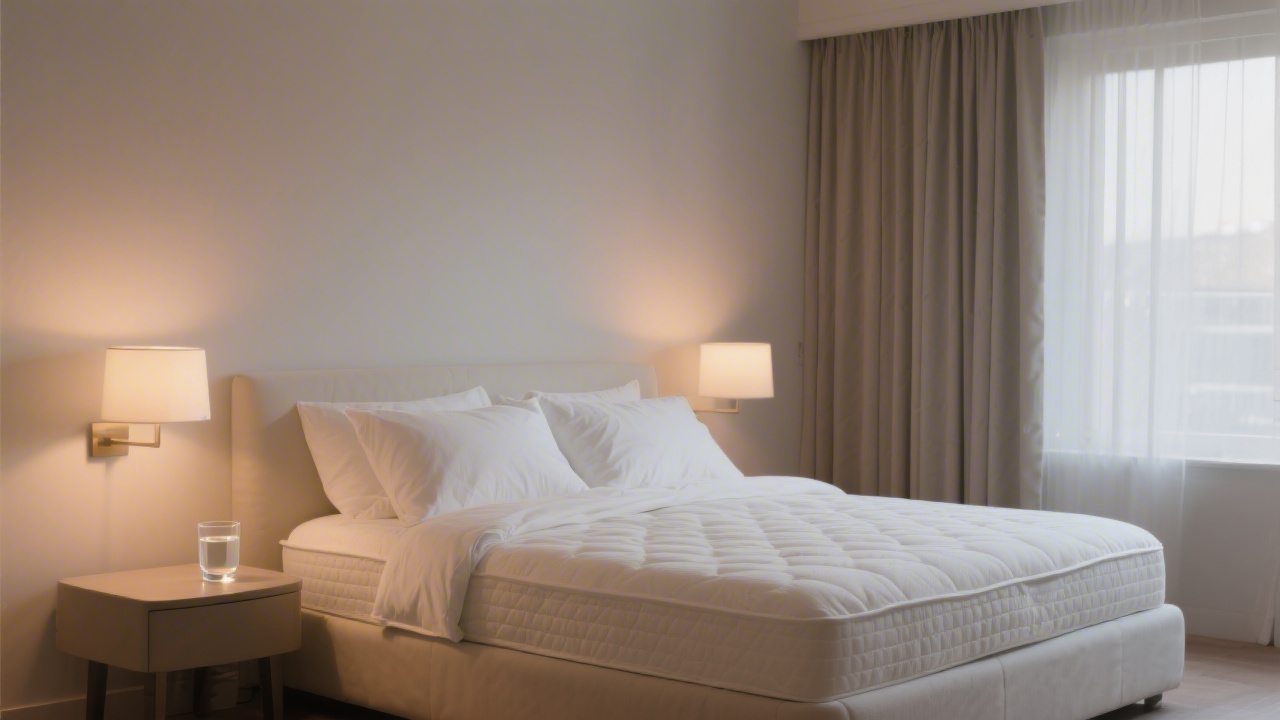
Saatva Classic — Our #1 Recommended Mattress
Expert-crafted innerspring luxury. 365-night trial, lifetime warranty, free white-glove delivery.
Affiliate disclosure: We may earn a commission if you purchase through our links, at no extra cost to you.
Why Most Sleep Advice Fails
Most sleep advice treats symptoms rather than causes. "Try melatonin." "Put your phone down." "Get blackout curtains." These are not wrong, but they are components of a larger system that only works when addressed in the right order.
This framework identifies the 5 core variables that determine sleep quality and sequences them by leverage: the variables with the highest impact for the lowest effort come first. Addressing them out of order wastes time and often produces frustration when high-effort interventions fail to compensate for foundational issues.
The 5-Variable Sleep Framework
Variable 1: Environment (Highest leverage)
Your sleep environment sets the floor for what is achievable. Three dimensions matter most:
- Temperature: 65-68 degrees F (18-20 degrees C) is optimal for most people. Above 75 degrees F measurably reduces slow-wave sleep.
- Light: Complete darkness during sleep. Even small light intrusions disrupt melatonin production. Blackout curtains or a quality sleep mask are high-ROI investments.
- Sound: Consistent ambient sound (white or pink noise) outperforms silence for most people in urban environments. The brain habituates to consistent sounds but is disrupted by sudden ones.
Your mattress is also environment. Pressure points that cause microarousals, inadequate support that strains the spine, or heat retention that prevents temperature regulation all degrade sleep architecture without you necessarily waking fully. This is why sleep quality often improves dramatically on a quality mattress even when nothing else changes.
Variable 2: Schedule (High leverage)
A fixed wake time is the single most evidence-supported behavioral sleep intervention. Your circadian clock governs sleep pressure and hormone timing. Varying your wake time creates desynchrony between your internal clock and your schedule.
Implementation sequence:
- Set a fixed wake time and commit to it for 4 weeks, including weekends.
- Add morning light exposure (10-30 minutes outdoors within 60 minutes of waking).
- Identify your natural sleep window based on when you become sleepy vs. your fixed wake time.
- Set a consistent bedtime around this window.
Variable 3: Pre-sleep Habits (Moderate leverage)
Pre-sleep habits reduce physiological arousal and signal the brain that sleep is approaching. The most evidence-backed:
- Progressive dimming: Reducing light intensity over the 2 hours before bed allows natural melatonin rise. Total dimming matters more than blue-light filtering specifically.
- Temperature descent: A warm bath or shower 1-2 hours before bed paradoxically helps you fall asleep by triggering peripheral vasodilation that accelerates core cooling.
- Cognitive offloading: Writing tomorrow's task list before bed reduces sleep onset latency. A 2018 Baylor University study found this reduces rumination more effectively than a general journaling approach.
- Caffeine cutoff: Caffeine's half-life is 5-7 hours. A 3pm cutoff means half the caffeine from a coffee is still active at 8-10pm, elevating arousal and suppressing adenosine-driven sleep pressure.
Variable 4: Mindset and Arousal Management (Context-dependent)
Performance anxiety around sleep, such as monitoring the clock, calculating remaining sleep time, or catastrophizing about tomorrow's function, is a primary driver of chronic insomnia. Cognitive Behavioral Therapy for Insomnia (CBT-I) is the gold-standard treatment for this and is more effective than medication at 12-month follow-up.
Key CBT-I principles applicable without a therapist:
- Sleep restriction: Temporarily limiting time in bed to match actual sleep time, then gradually extending. Counter-intuitive but highly effective.
- Stimulus control: Use the bed only for sleep and sex. If not asleep within 20 minutes, leave bed until sleepy.
- Cognitive restructuring: Identifying and challenging unhelpful thoughts about sleep consequences.
Variable 5: Equipment Optimization (Foundation)
Equipment comes last in the framework not because it is unimportant, but because the gains from optimizing equipment on top of a solid foundation are substantial, whereas upgrading equipment without fixing schedule and habits provides marginal benefit.
Priority equipment: mattress first (spinal support, temperature regulation, motion isolation), then pillow (cervical alignment), then bedding (breathability). Smart gadgets, such as sleep trackers and temperature-control systems, come after the fundamentals.
Implementation Roadmap by Week
Weeks 1-2: Fix wake time and morning light. These changes alone produce measurable improvement in most people within 10 days.
Weeks 3-4: Audit your environment. Temperature, light, sound. Invest in blackout curtains if needed.
Weeks 5-6: Pre-sleep protocol. Caffeine cutoff, evening dimming, wind-down routine.
Weeks 7-8: Evaluate mattress and pillow quality. If you wake with stiffness or heat, these are diagnostic.
Month 3+: Advanced interventions (temperature regulation tools, supplements, tracker-guided optimization) as needed.
Our Top Pick
Saatva Classic — Our #1 Recommended Mattress
Expert-crafted innerspring luxury. 365-night trial, lifetime warranty, free white-glove delivery.
Affiliate disclosure: We may earn a commission if you purchase through our links, at no extra cost to you.
Related guides: evidence-based sleep biohacking techniques, sleep supplements ranked by evidence, and how sleep duration affects longevity.
Frequently Asked Questions
What is the most important factor for better sleep?
Sleep schedule consistency, specifically a fixed wake time, has the strongest evidence base. Consistent wake time stabilizes your circadian rhythm more effectively than any supplement or gadget. Other factors build on this foundation.
How long does it take to see sleep improvements?
Most behavioral interventions show measurable results within 2-4 weeks of consistent application. Circadian rhythm adjustments typically take 2-3 weeks to stabilize. Equipment changes (mattress, pillow) often show results within the first week as the body adapts to improved support.
Should I track my sleep?
Sleep tracking is useful for identifying patterns and measuring intervention effects, but use it as a tool, not a scorecard. Consumer trackers are reasonably accurate for sleep duration and overall trends but less accurate for specific sleep stages. Track for defined periods rather than indefinitely.
What should I do if I wake up in the middle of the night?
If you cannot return to sleep within 20 minutes, leave bed and do something calm in dim light. This preserves the association between bed and sleep. Lying awake in bed strengthens the association between bed and wakefulness, which perpetuates insomnia. This is a core CBT-I principle with strong evidence.
Is 6 hours of sleep enough?
For most adults, no. The evidence for chronic sleep restriction below 7 hours is substantial: impaired cognitive function, increased inflammatory markers, elevated cortisol, and higher mortality risk. A small percentage of people carry a genetic variant (ADRB1) that allows functioning on 6 hours, but this represents roughly 1-3% of the population.