
 by
by Reading before bed is one of the oldest and most widely recommended pre-sleep activities — and one of the least precisely practiced. The 68% stress reduction finding from a 2009 University of Sussex study is frequently cited, but what is less often discussed is that the format, duration, and content of pre-sleep reading can either accelerate or undermine sleep onset. A thriller novel on a bright e-reader is categorically different from a physical novel read under a dim lamp. This guide covers the specific variables that determine whether your pre-sleep reading supports or fights your sleep.
Format: Physical Books vs. E-Readers vs. Tablets
Physical Books: Best for Sleep
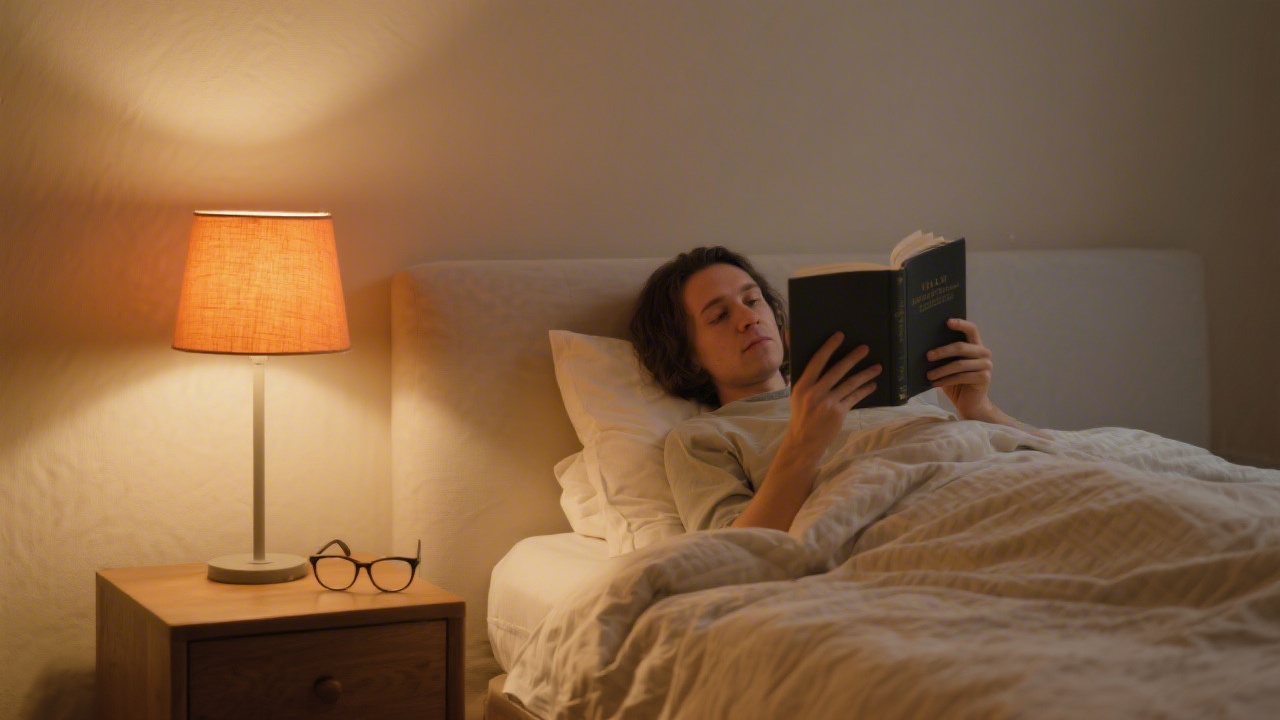
A physical book under a warm-toned, dim lamp is the optimal reading format for pre-sleep. No screen, no blue light emission, no notification interruptions, no social media one swipe away. The visual experience is also categorically different — the eyes rest on a matte, non-backlit surface that does not generate autonomic arousal. The cognitive engagement with a physical book is passive in the right way: it captures attention without demanding reactive behavior (no clicking, no scrolling, no responding).
E-Ink Readers (Kindle Paperwhite, Kobo): Acceptable with Adjustments
E-ink displays are significantly better than LCD/OLED for pre-sleep reading because they are front-lit rather than backlit, substantially reducing the blue-spectrum emission. Adjustments to make them sleep-compatible: reduce brightness to minimum, enable the warm light setting (orange filter), turn off Wi-Fi to eliminate notification access, and use them with the Do Not Disturb setting. This is an adequate but not ideal substitute for physical books.
Tablets and Phones: Avoid for Pre-Sleep Reading
The Kindle app on an iPad or iPhone combines backlit OLED screen with the structural temptation to switch apps. Even with Night Shift enabled and blue light reduced, the social media apps, email, and news are one tap away. The cognitive state required to resist those taps is incompatible with the passive, low-arousal state you are trying to maintain. If you must read on a device, a dedicated e-ink reader with Wi-Fi disabled is acceptable; a multifunctional tablet or phone is not.
Content: Fiction vs. Non-Fiction
Fiction: Significantly Better for Sleep
Fiction works because it engages the narrative-tracking system (theory of mind, character modeling, plot anticipation) in a way that is immersive but not analytically demanding. You are "in" the story rather than evaluating it. This is the cognitive equivalent of the default mode network running — which is associated with reduced prefrontal activation and a state compatible with sleep.
Genre considerations: literary fiction and character-driven narratives are more consistently sleep-compatible than plot-driven thrillers or horror. A Cormac McCarthy novel is different from a Lee Child thriller at the neurological level — the former asks you to inhabit a world, the latter asks you to solve a puzzle and predict a resolution. The puzzle-solving mode is incompatible with sleep onset.
Non-Fiction: Use with Care
Non-fiction varies enormously by subtype. Narrative non-fiction (travel writing, memoir, nature writing) is nearly as sleep-compatible as fiction — it engages the same narrative tracking systems. Analytical non-fiction (business books, science, economics, history) is problematic because it activates the evaluative, critical-thinking mode that maintains prefrontal arousal. If you find yourself arguing with the author, making notes, or thinking about how ideas apply to your life, you are too cognitively engaged for pre-sleep reading.
Duration: The Optimal Reading Window
The optimal pre-sleep reading duration is 20–30 minutes. Under 10 minutes does not provide sufficient cognitive capture to genuinely displace intrusive thoughts. Over 45 minutes risks reading through the initial drowsiness wave — a phenomenon where you pass through the first peak of sleepiness while engaged in reading and then find yourself more alert on the other side. Most people have experienced this: "I was falling asleep 30 minutes ago and now I'm wide awake."
The practical protocol: begin reading when you first notice drowsiness or at your scheduled start time (whichever comes first), and stop at 30 minutes or at the first sign of genuine eye-heaviness — whichever comes first. Close the book. Lights out.
The Reading Environment
Lighting
A single warm-toned lamp (2700K or lower, 10–20% brightness) positioned to illuminate the page without spilling onto the rest of the room. This maintains the dim-light environment required for melatonin production while providing sufficient light for comfortable reading. For specifics on the full lighting sequence, see our light dimming schedule.
Position
In bed, supported upright rather than fully reclined. Fully horizontal reading before sleep onset is associated with faster unintentional sleep onset (positive) but also with neck and shoulder strain if you are propped against pillows in an unsupported way. A proper bed rest pillow or wedge pillow allows comfortable supported reading without the progressive slouching that produces morning neck pain.
Temperature
The room should already be at 65–68°F from your earlier environmental setup. One light blanket over the legs is appropriate — warmth at the extremities while the room stays cool accelerates the core temperature drop required for deep sleep.
Comparing Reading to Other Pre-Sleep Activities
The University of Sussex study that found 68% stress reduction from reading compared reading to other de-stress techniques over 6 minutes: listening to music reduced stress by 61%; having a cup of tea or coffee by 54%; taking a walk by 42%; playing video games by 21%. The superiority of reading was attributed to its ability to engage cognitive attention sufficiently to displace anxious thoughts while not activating the arousal response. For the full pre-sleep activity context, see the pre-sleep checklist and the complete wind-down routine.
Frequently Asked Questions
Does rereading the same book make pre-sleep reading more effective?
Potentially yes. Rereading eliminates plot-anticipation tension (one of the subtle arousal sources in first-read thrillers or mysteries) and reduces the "I need to find out what happens" drive that encourages you to read past drowsiness. Many people keep a dedicated re-read pile of comfortable, familiar novels specifically for pre-sleep reading. The familiarity feels like slipping into a known, safe world rather than exploring an unknown one.
Is listening to audiobooks the same as reading for sleep?
Similar but not identical. Audiobooks have the advantage of not requiring light, allowing you to close your eyes and remain in a lying position. The disadvantage is that following a spoken narrative requires more sustained attention than reading — it is easier to lose the thread and feel frustrated. A set sleep timer is essential so the audio stops automatically rather than running through the night.
What about reading news or magazines before bed?
News is one of the worst pre-sleep reading choices. It is specifically designed to be emotionally engaging (fear, outrage, and uncertainty are the primary engagement mechanisms of news media), it presents unresolved situations that trigger open-loop monitoring, and it activates political and social threat responses that elevate cortisol. Magazines vary by genre — a cooking magazine is sleep-compatible; a business or political magazine is not.
What if reading makes me more awake rather than sleepy?
This usually indicates one of three problems: the content is too stimulating (switch to gentler fiction), the lighting is too bright (reduce further), or you are reading during a circadian alerting window (approximately 7–9 PM for most people) when the body actively resists sleep signals. Try reading only after the alerting window has passed — most people find that reading after 9:30 PM is more naturally sleep-inducing than reading at 8 PM.
How does mattress comfort affect the reading experience?
A mattress with adequate support allows you to sit semi-upright in bed without lower back discomfort — which makes the reading position sustainable for 20–30 minutes. A sagging mattress or a mattress that is too soft forces you into a rounded lower back posture that creates discomfort within 10–15 minutes, interrupting the reading session and introducing the physical arousal of repositioning. It is a small but real factor in reading session quality.
Complete Your Sleep Setup
The right mattress turns a good routine into exceptional sleep. The Saatva Classic is our top pick for pressure relief and lasting support.
Key Takeaways
Optimal Reading Before Bed is a topic that depends heavily on individual needs and preferences. The most important thing is to consider your specific situation — your body type, sleep position, and personal comfort preferences — before making any decisions. When in doubt, take advantage of trial periods to test before committing.