
 by
by For couples optimizing shared sleep:
The Saatva Solaire adjustable mattress — individually adjustable firmness on each side, so both partners can optimize their sleep environment without the compromises that disrupt synchrony.
What Is Sleep Synchrony?
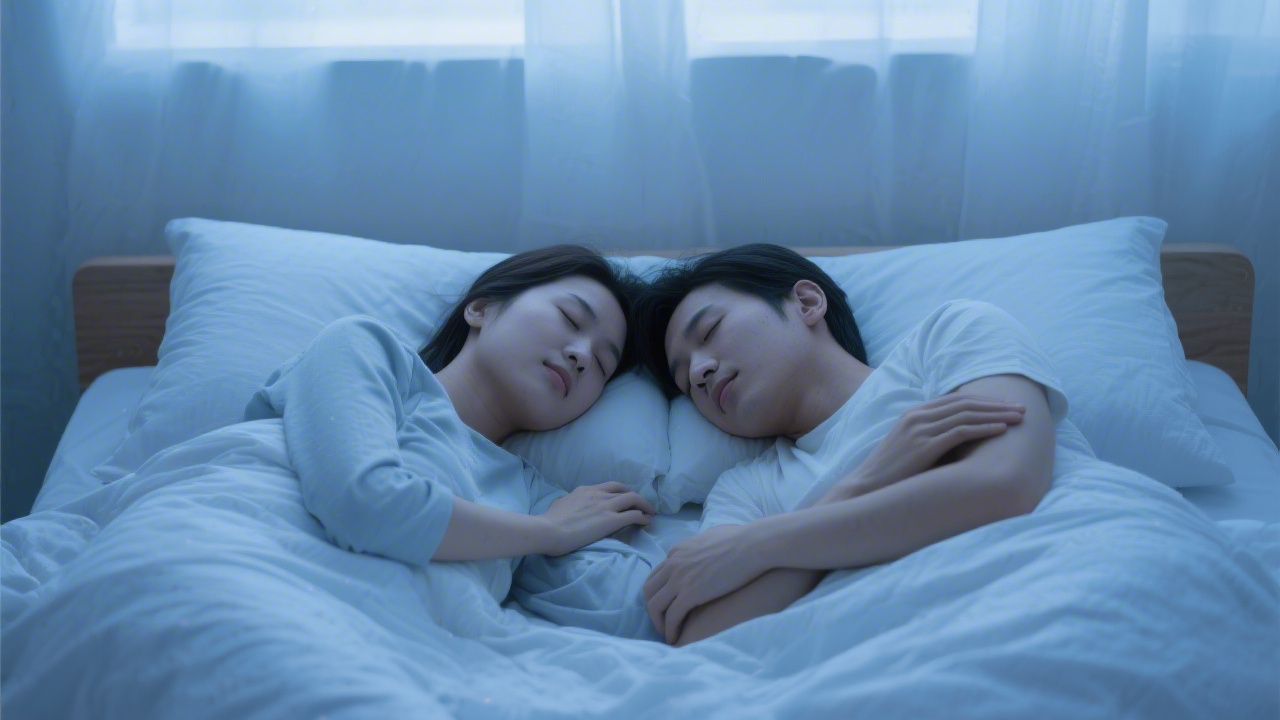
Sleep synchrony refers to the phenomenon where two people sleeping together begin to align their sleep architecture over time — entering and exiting the same sleep stages, particularly REM sleep, at similar times. It's one of the more counterintuitive findings in couples sleep research: not only do partners share a bed, they begin to share the structure of their sleep itself.
The term comes from research using simultaneous polysomnography on co-sleeping couples — recording both partners' brain activity at once. The data consistently shows above-chance alignment in sleep stage transitions, with the effect strongest during REM sleep.
The Research: What Synchrony Studies Actually Show
The most cited study on couple sleep synchrony comes from the University of Michigan (Henning and colleagues, 2020), which simultaneously measured sleep architecture in couples over multiple nights. Key findings:
- Couples showed significantly more REM sleep synchrony than would be expected by chance
- REM synchrony was positively correlated with relationship quality — couples who reported better relationships showed more synchronized REM
- The degree of synchrony remained even after controlling for individual sleep schedule differences
- Co-sleeping increased REM duration for both partners compared to nights sleeping alone
A follow-up analysis found that the synchrony effect was bidirectional: each partner's sleep stage transitions influenced the other's, rather than one partner consistently "leading" and the other following.
Why Does Sleep Synchrony Happen?
The mechanisms aren't fully established, but several are well-supported:
Shared light environment. Both partners experience the same light-dark cycle, which is the primary zeitgeber (time-setter) for the circadian rhythm. Shared bedroom conditions — blackout curtains or no curtains, ambient light from streetlights or phones — produce matching circadian signals in both partners.
Shared temperature regulation. The sleep architecture is highly sensitive to body temperature changes. Sharing a bed means both partners are influenced by the same ambient temperature curve, producing parallel shifts in sleep stage transitions.
Subtle sensory coupling. Small movements, sounds, and tactile cues from a sleeping partner provide continuous low-level sensory input that influences the other partner's sleep stage. This may sound disruptive, but at the right intensity it appears to anchor rather than fragment sleep.
Chronotype adjustment over time. Long-term couples show partial convergence of chronotype — night owls shift slightly earlier, morning people slightly later. This chronotype averaging reduces the baseline mismatch that would otherwise prevent synchrony. The morning person / night owl couple research suggests this adjustment happens over years, not weeks.
Why Sleep Synchrony Matters for Relationship Quality
REM sleep is the stage most associated with emotional processing, social cognition, and what some researchers call "overnight therapy" — the emotional re-processing of experiences from the previous day in a neurochemical context that reduces their affective charge. Waking from REM sleep feeling "settled" about something difficult is a real phenomenon with a neurological basis.
When couples enter REM simultaneously, they're both undergoing this emotional processing at the same time, in proximity to each other. The hypothesis — supported by the correlation data — is that synchronized emotional processing creates a subtle alignment in emotional state the following morning, which manifests as higher relationship satisfaction scores.
The relationship between synchrony and quality runs in both directions: sleep-deprived couples show lower relationship quality, which may then reduce synchrony, which then further disrupts sleep quality. The upward spiral of good sleep synchrony and good relationship quality is matched by a downward spiral in the opposite direction.
Can You Improve Sleep Synchrony?
The research doesn't yet support specific interventions to increase synchrony directly. But the conditions that enable it are modifiable:
- Consistent shared bedtime: Even partial schedule alignment significantly increases synchrony opportunities
- Shared light environment optimization: Blackout curtains and consistent morning light exposure align both partners' circadian timing
- Minimizing movement disruption: A mattress with strong motion isolation preserves the sleep architecture of both partners through the other's movements
- Temperature management: Both partners' thermal comfort affects sleep architecture — individual temperature control on each side of the bed removes a major desynchronizing variable
The Saatva Solaire adjustable mattress addresses the last two directly — with per-side firmness control and strong motion isolation that lets each partner's sleep architecture progress undisturbed while remaining in physical proximity.
What is sleep synchrony in couples?
Sleep synchrony is the alignment of sleep stage architecture between co-sleeping partners — entering and exiting the same stages, especially REM, at similar times. It occurs at above-chance rates in romantic couples and correlates with relationship quality.
Do couples really synchronize their sleep?
Yes. Simultaneous polysomnography studies show significant REM synchrony in co-sleeping couples, stronger in partners with higher relationship satisfaction and increasing over time in long-term partnerships.
Why do couples start waking up at the same time?
Shared light exposure, temperature environment, and subtle sensory proximity align circadian rhythms over time. Chronotype convergence — night owls shifting earlier, morning types shifting later — also contributes to similar wake times in long-term couples.
Does relationship quality affect sleep quality?
Yes, bidirectionally. Higher relationship quality correlates with greater sleep synchrony and more REM sleep. Sleep deprivation reduces relationship quality through lower empathy and higher conflict. It's a positive feedback loop in both directions.
Can couples with different sleep schedules still synchronize?
Partially. Long-term couples show gradual chronotype convergence over years. Partial schedule overlap during shared sleep still produces some REM synchrony — particularly during REM-rich late sleep in the final hours before waking.
Optimize the conditions for sleep synchrony:
The Saatva Solaire adjustable mattress — individually adjustable comfort per side, strong motion isolation, and the support structure that lets both partners sleep deeply in proximity.