
 by
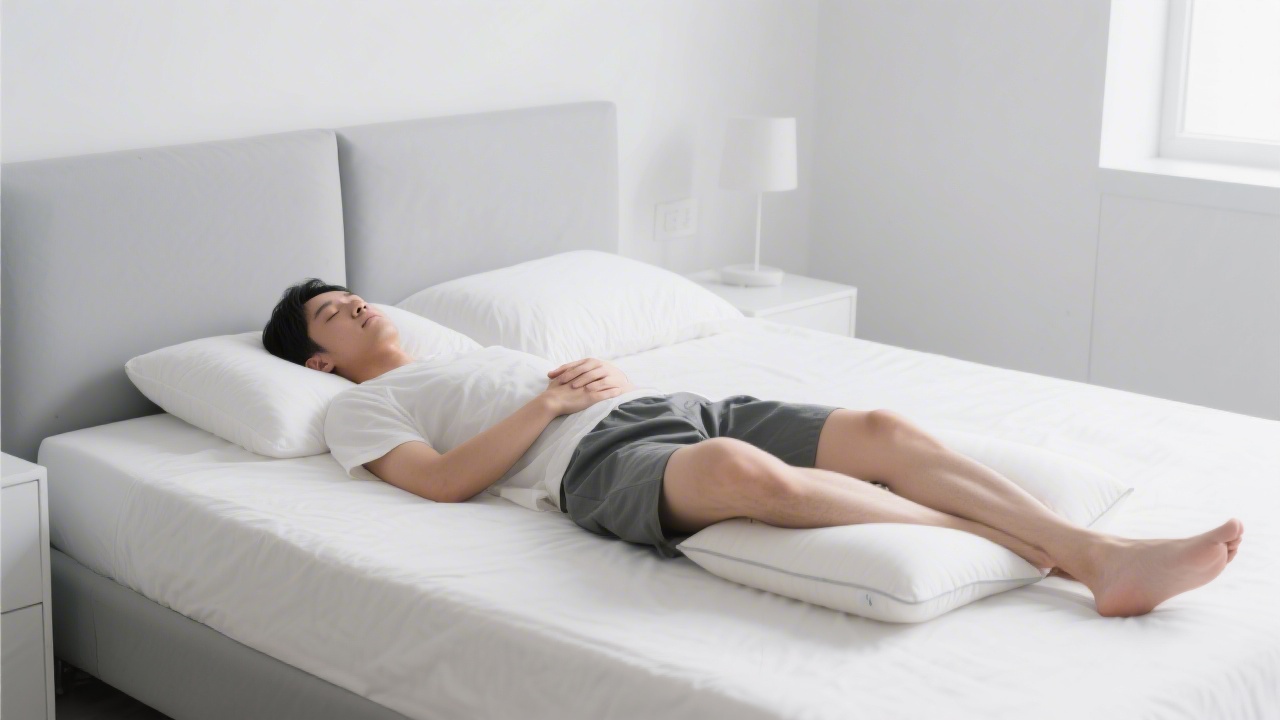
by Sleeping with knees bent — either with a pillow under them for back sleepers or a pillow between them for side sleepers — is one of the most consistently recommended sleep position modifications for lower back, hip, and lumbar pain. But the same elevation that relieves lumbar pressure can create hip flexor tightness over time if the position is extreme. Getting the knee angle right is the key variable.
Our Top Mattress Pick for Sleep Position Support
The Saatva Classic is available in three firmness levels (Plush Soft, Luxury Firm, Firm) and features a dual coil-on-coil construction that adapts to your sleep position while maintaining proper spinal alignment.
Back Sleepers: Why Elevating the Knees Works
When you lie flat on your back with legs fully extended, the lumbar spine assumes a pronounced lordotic curve (inward arch). This curve compresses the posterior facet joints and puts mechanical stress on the posterior disc. People with lumbar disc herniation, facet arthritis, or spinal stenosis often find this position uncomfortable despite it being the "correct" sleep position recommendation.
Placing a pillow under the knees changes the picture significantly. Elevating the knees by 8 to 12 inches creates approximately 20 to 30 degrees of hip flexion and knee flexion. This flattens the lumbar curve (reduces lordosis) and decompresses the posterior facet joints. The lumbar muscles relax, and intervertebral disc pressure decreases. Clinical studies on lying postures consistently show lower lumbar electromyographic activity in the knees-flexed supine position versus the fully extended supine position.
For people managing best mattress for back pain, the knee pillow modification is often the first recommendation before mattress changes are considered — and it costs nothing but a spare pillow.
Side Sleepers: Between the Knees, Not Under Them
Side sleepers face a different problem. In lateral lying, both hips are roughly equal in height if the top leg is stacked directly over the bottom leg. But without support, the top leg drops forward under gravity, rotating the top hip downward relative to the bottom hip. This creates lateral pelvic tilt — the pelvis tilts toward the mattress — and transmits a lateral flexion stress up through the lumbar spine.
A pillow between the knees prevents this drop. It keeps the top knee elevated at the same height as the hip, neutralizing the pelvic tilt and maintaining a straight lateral spinal line. This is the between-knee pillow version of the back sleeper's under-knee pillow: same principle (preventing abnormal pelvic mechanics), different implementation.
For full best mattress for side sleepers pillow setup guidance, see our dedicated guide.
Hip Flexor Shortening: The Long-Term Concern
The hip flexor muscles — primarily the psoas major, iliacus, and rectus femoris — cross the hip joint and shorten when the hip is in flexion. When you sleep with knees significantly elevated, these muscles are in a shortened position for 6 to 9 hours. Over time, the muscle fibers and their fascial sheaths adapt to this shortened resting length.
Clinically, this presents as morning hip flexor tightness, reduced hip extension range of motion, and in some cases, anterior pelvic tilt during standing. The phenomenon is well-documented in people who also spend many hours seated (also a hip-flexed position), compounding the nocturnal effect.
Mitigation strategies:
- Keep knee elevation moderate (8 to 12 inches, 20 to 30 degrees) rather than extreme.
- Perform morning hip flexor stretches — low lunge stretch, supine hip extension over the edge of the bed — before getting up.
- Alternate between under-knee support and fully extended leg position periodically during the night if possible.
Sciatica and Knee-Flexed Positions
The sciatic nerve exits the lumbar spine and passes through or near the piriformis muscle in the gluteal region. Hip and knee flexion in the supine position reduces tension on the sciatic nerve by slackening the piriformis and decreasing lumbar nerve root stretch. Many patients with sciatica find that the knees-up back-sleeping position is the only comfortable supine position during acute sciatica episodes.
Important nuance: sciatica caused by significant disc herniation may be aggravated by some postures that flex the lumbar spine excessively. If neutral knee elevation does not provide relief, consult a physical therapist who can assess your specific nerve tension patterns.
Optimal Knee Elevation for Different Body Types
Pillow height recommendations are body-proportion dependent:
- Average adult (5'5" to 5'11"): 8 to 12 inch elevation at the center of the knee creates the target 20 to 30 degrees of hip and knee flexion.
- Taller adults (6'+ with longer femurs): May need 12 to 16 inches to achieve the same joint angle, since the lever arm is longer.
- Shorter adults: 6 to 8 inches may be sufficient to produce the decompressive effect without excessive hip flexion.
A firm cylindrical bolster pillow is more appropriate than a standard bed pillow for this application. Standard pillows compress flat under knee weight within an hour, negating the positional benefit. Consider a dedicated knee pillow product or a dense foam cylindrical bolster.
Mattress Selection for Knee-Position Sleepers
The knee-under-pillow setup is most effective on a medium-firm mattress that doesn't let the sacrum and hips sink excessively. If the hips sink deeply into a soft mattress, the lumbar decompression benefit of the knee elevation is partially negated because the pelvis is tilting posteriorly. The Saatva Classic review in Luxury Firm configuration provides the right balance — enough pushback at the pelvis and sacrum to keep the spine level, with sufficient Euro pillow-top contouring for shoulder and thoracic comfort.
Also review our best mattress for back sleepers guide for mattress options specifically evaluated in the supine position.
Our Top Mattress Pick for Sleep Position Support
The Saatva Classic is available in three firmness levels (Plush Soft, Luxury Firm, Firm) and features a dual coil-on-coil construction that adapts to your sleep position while maintaining proper spinal alignment.
Frequently Asked Questions
Does sleeping with a pillow under your knees actually help back pain?
Yes, for back sleepers. Elevating the knees by 8 to 12 inches reduces lumbar lordosis, which decompresses the posterior facet joints and reduces posterior disc stress. Studies on supine lying position confirm lower lumbar muscle activation when the hips and knees are flexed versus fully extended. Physical therapists routinely recommend this for patients with lumbar disc disease or facet arthritis.
Can sleeping with bent knees shorten my hip flexors?
Over time, yes. If you consistently sleep with knees significantly elevated, the hip flexors (psoas, iliacus) adapt to the shortened position and can become chronically tight. This is more of a concern with very high knee elevation or with fetal-style positions than with the moderate 8 to 12 inch knee-under-pillow elevation used for back sleeping. Morning hip flexor stretching helps counteract this.
What is the best pillow height for under-knee support?
For back sleepers, an 8 to 12 inch elevation at the knee (measured from the mattress surface to the top of the support) is the target range. This creates roughly 20 to 30 degrees of knee flexion. A firm cylindrical bolster pillow is more durable than a standard bed pillow, which compresses flat over the night. For taller people with longer femurs, slightly higher elevation is appropriate.
Should side sleepers also elevate their knees?
Side sleepers benefit from a pillow between their knees rather than under them. This keeps the hips stacked (neither elevated nor depressed), preventing lateral pelvic tilt and the resulting spinal lateral flexion. The goal for side sleepers is hip-level alignment, not elevation.
Can sleeping with knees up help with sciatica?
Flexing the hips and knees while lying supine reduces tension on the sciatic nerve by slackening the piriformis and gluteal muscles. Many sciatica patients find the knee-elevated back-sleeping position provides immediate relief. However, if sciatica is caused by disc herniation, neutral positions that avoid both excessive flexion and extension may be safer — consult a physical therapist for your specific presentation.
This article is for informational purposes only and does not constitute medical advice. Consult a healthcare provider for sleep-related medical conditions.