
 by
by Struggling with sleep? Your mattress matters too.
A supportive, pressure-relieving mattress reduces the time it takes to fall — and stay — asleep. The Saatva Classic is our top-rated pick for deep, restorative sleep.
Three Mechanisms — Each One Enough to Wreck Your Sleep
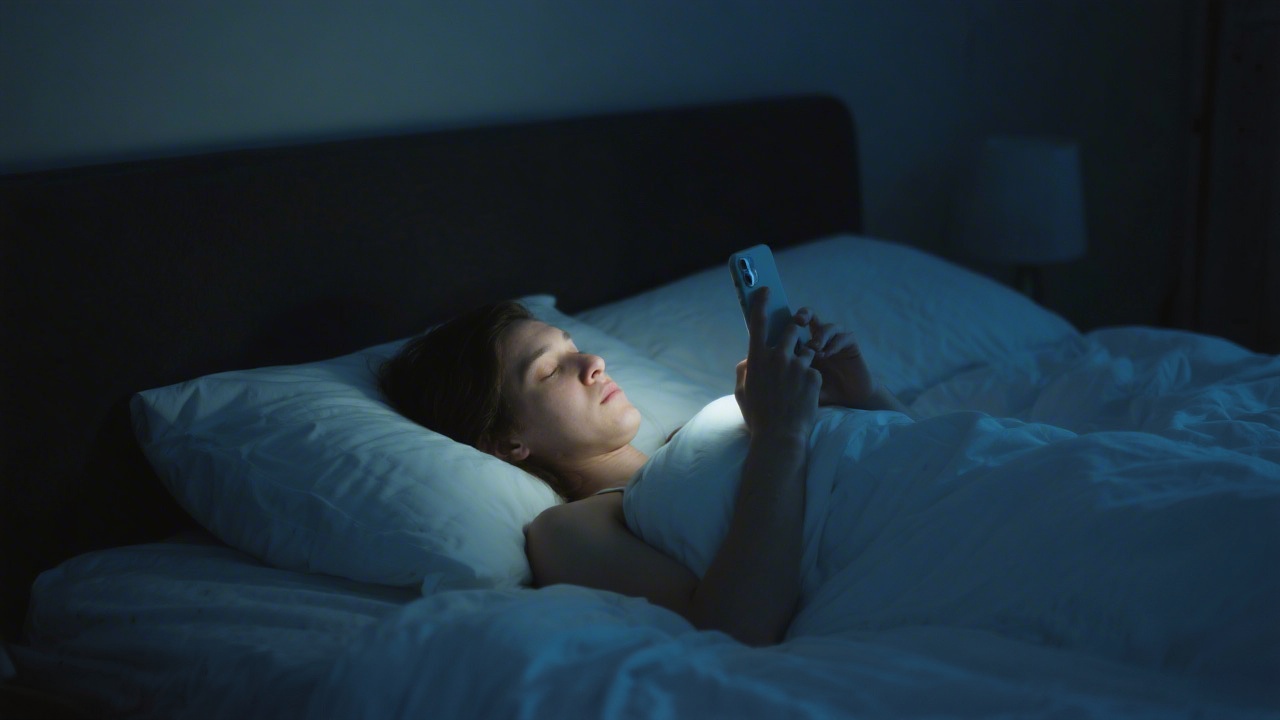
Most sleep advice lumps social media into the generic bucket of "screens before bed." That framing misses why social media is uniquely damaging. Unlike watching a neutral documentary, social media delivers three independent sleep disruptors simultaneously: blue light, emotional arousal, and social comparison. Even without the blue light, the other two would be enough.
Mechanism 1: Blue Light and Melatonin Suppression
Blue-wavelength light (peak ~480 nm) suppresses melatonin production by signaling the suprachiasmatic nucleus that it's still daytime. A 2015 study in PNAS found that evening blue light use shifted melatonin onset by 1.5 hours and reduced REM sleep the following night. Smartphones emit substantial 400–490 nm light, particularly with brightness above 50%.
What makes social media worse than a static screen: the variable, attention-pulling content keeps brightness elevated as you lean in to read. You're not passively watching — you're actively engaging, which keeps the screen at maximum brightness and face-distance. See our full guide on blue light and sleep for the complete suppression curve data.
Mechanism 2: Emotional Arousal
Sleep onset requires cortical deactivation — a literal cooling of neural activity in the prefrontal cortex, amygdala, and anterior cingulate cortex. Social media content is specifically engineered to prevent this. Platforms optimize for engagement, which correlates with emotional activation: outrage, envy, amusement, anxiety.
A 2019 study in Sleep Medicine found that social media use within 30 minutes of bed increased sleep onset latency by an average of 23 minutes compared to reading print material. The effect was driven primarily by emotional arousal, not blue light (they controlled for screen exposure with neutral digital content). how to fall asleep faster covers the broader physiology of cortical deactivation and how to accelerate it.
Mechanism 3: Social Comparison and Rumination
Social comparison — evaluating your life against curated presentations of others — activates the default mode network (DMN), the brain network responsible for self-referential thinking and rumination. DMN activation is incompatible with sleep; it's the same network that produces the racing thoughts that keep anxious sleepers awake.
Research from the University of Pittsburgh (2017) found a dose-response relationship: each additional hour of social media use per day corresponded to increased odds of sleep disturbance (OR 1.95). The mechanism wasn't screen time generally — participants who spent equivalent time on non-social media had no equivalent association.
The Research on Timing
A systematic review in Sleep Medicine Reviews (2020) analyzed 41 studies and found consistent evidence that social media use within 1 hour of bed was associated with poor sleep quality, later sleep onset, and shorter sleep duration. The association was stronger for use within 30 minutes.
Important nuance: the studies used self-reported sleep quality, not polysomnography. But subjective sleep quality is itself a meaningful health outcome — it predicts daytime functioning, mood, and long-term health independently of objective sleep metrics.
Strategies That Work (Beyond "Just Put Your Phone Down")
The "just don't use your phone" advice fails because it treats social media use as a rational choice problem. It's not — it's a habit loop with neurological reinforcement. More effective approaches:
- Friction-based interruption: Log out of every social media app. The re-login friction breaks the automatic tap-open-scroll loop. Studies on friction interventions show 20–40% reduction in evening phone use without requiring willpower.
- Replacement, not suppression: Replace the habit with a lower-arousal activity that fills the same "wind-down" psychological niche. Physical books, podcasts (non-news), or light stretching work because they address the underlying need (transition signal) without the arousal cost.
- Context engineering: Charge your phone outside the bedroom. This single structural change has the largest effect size in intervention research — larger than app limits, grayscale mode, or most other approaches.
- Hard cutoff at 60 minutes: If you use social media in the evening, stop at least 60 minutes before your target sleep time. This window allows partial cortisol normalization and residual melatonin buildup before lights-out.
For the complete sleep onset optimization framework, see our guide on screen time before bed and sleep.
What About Night Mode and Blue Light Glasses?
Night mode (warm color shift) addresses mechanism 1 partially — it reduces peak blue light emission but doesn't eliminate it, and it does nothing for mechanisms 2 and 3. A 2021 RCT in Sleep found no significant difference in sleep outcomes between night mode users and controls. Blue light glasses show similarly weak effects when emotional arousal isn't controlled for.
These tools aren't useless, but they're not substitutes for stopping social media use before bed. They're mitigation for people who will scroll regardless. For information on sleep hygiene tips, which improves sleep quality regardless of screen use, investing in proper sleep infrastructure has a larger effect than any phone setting.
Frequently Asked Questions
How long before bed should you stop using social media?
Research supports a minimum 60-minute cutoff, with 90 minutes showing additional benefit for sleep onset latency. The critical factor is allowing emotional arousal to subside, which takes longer than blue light clearance.
Does social media affect sleep more than TV?
Yes, for most people. TV is typically passive consumption; social media involves active engagement, social comparison, and variable reward schedules. The intermittent reinforcement mechanism in social media is specifically designed to maintain engagement, making disengagement harder.
Can you use social media in the morning instead?
Morning social media use has no direct sleep impact (though it may affect mood and cortisol rhythms differently). Shifting to morning use is a practical middle ground for people who can't eliminate social media entirely.
Does deleting social media apps improve sleep?
Studies show significant sleep improvements after social media reduction or elimination. A 2018 study at the University of Pennsylvania found that limiting social media to 30 minutes/day reduced sleep disturbance significantly over 3 weeks compared to a control group.
What about social media for relaxation?
Self-report often describes social media as 'relaxing,' but physiological measures (heart rate variability, cortisol) don't support this. The relaxation is likely habit completion (the reward of checking), not genuine arousal reduction. Actual relaxation requires cortical deactivation, which social media prevents.
Struggling with sleep? Your mattress matters too.
A supportive, pressure-relieving mattress reduces the time it takes to fall — and stay — asleep. The Saatva Classic is our top-rated pick for deep, restorative sleep.
Our Top Mattress Pick
The Saatva Classic consistently ranks #1 for comfort, support, and long-term durability.
Key Takeaways
Social Media and Sleep is a topic that depends heavily on individual needs and preferences. The most important thing is to consider your specific situation — your body type, sleep position, and personal comfort preferences — before making any decisions. When in doubt, take advantage of trial periods to test before committing.