
 by
by Every morning, millions of people wake up with a stiff lower back, aching neck, or dull mid-spine pain. The cause is frequently the same: their spine spent six to eight hours in a position that flattened, exaggerated, or laterally twisted its natural curves. Spinal alignment during sleep is not a marketing concept — it is a biomechanical requirement, and the mattress you sleep on is the primary variable you can actually control.
What Spinal Alignment Actually Means
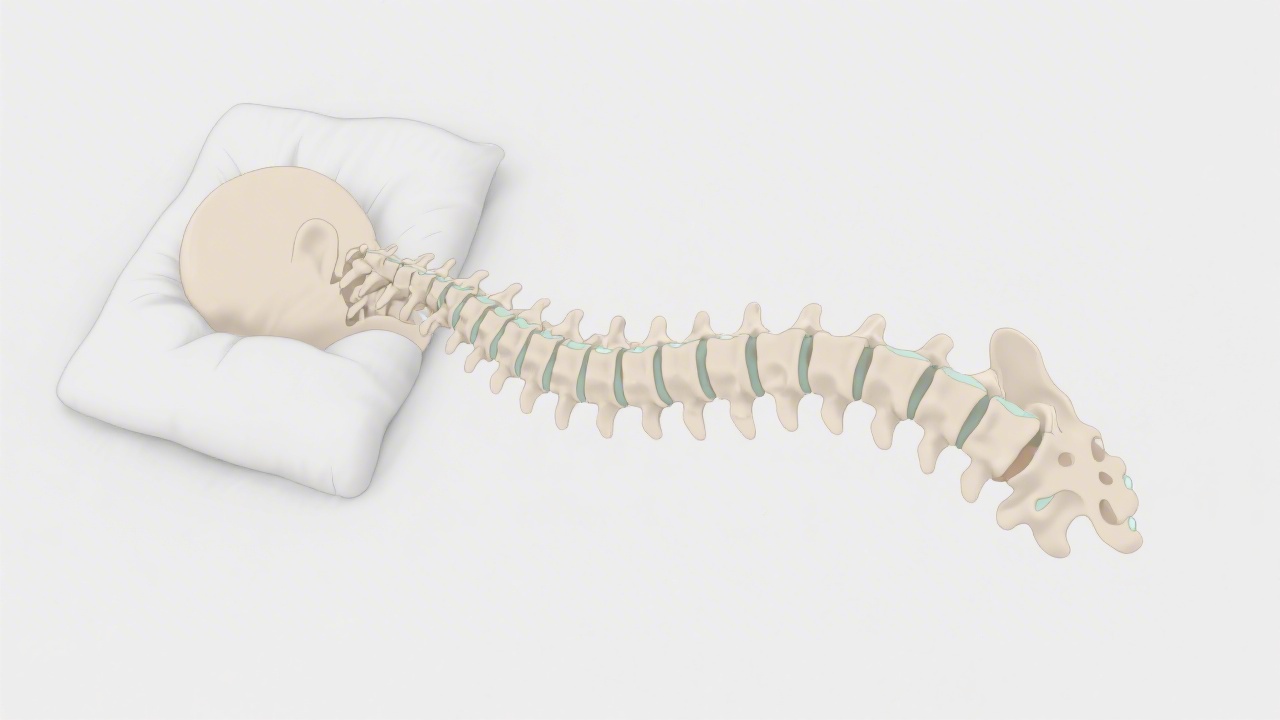
The spine has three natural curves: the cervical lordosis (neck, convex forward), the thoracic kyphosis (mid-back, convex backward), and the lumbar lordosis (lower back, convex forward). Together they form the S-curve that absorbs compressive load and allows movement.
Spinal alignment during sleep means preserving those curves in their neutral, unloaded state throughout the night. A mattress achieves this by supporting heavier regions (hips, shoulders) without letting them sink too deep, while filling the space under lighter regions (waist, neck) so they are not suspended in the air.
What Misalignment Causes
When the lumbar curve flattens — the most common misalignment — the posterior spinal ligaments are placed under sustained tension. By morning, that tension registers as stiffness and pain. When the lumbar curve is exaggerated (hyperlordosis, often caused by stomach sleeping), the facet joints are compressed. When the spine is laterally rotated — typical of side sleepers on a mattress that is either too soft or too firm — one side of the intervertebral discs is compressed while the other is distracted.
Chronic misalignment during sleep has been linked to persistent low back pain, cervicogenic headaches, and accelerated disc degeneration in the lumbar and cervical segments.
Mattress Firmness and Spinal Alignment by Position
Back Sleepers
Back sleeping is the most forgiving position for spinal alignment, but only on a mattress with the right firmness. A mattress that is too soft lets the hips sink past the shoulders, posteriorly tilting the pelvis and flattening lumbar lordosis. A mattress that is too firm creates a gap between the lumbar region and the sleep surface, leaving the lumbar curve unsupported.
For most back sleepers weighing 150–250 lbs, a medium to medium-firm mattress (5–6.5 on a 10-point scale) is optimal. Heavier sleepers need more firmness to prevent hip sinkage; lighter sleepers can tolerate slightly softer surfaces without losing support.
Side Sleepers
Side sleeping requires the mattress to accept the shoulder and hip — the widest points — while keeping the spine in a straight lateral line. A firm mattress pushes back against the shoulder and hip, bowing the spine into a lateral arc. A mattress that is too soft lets the shoulder and hip sink until the ribcage contacts the surface, creating a different arc in the opposite direction.
Medium-soft to medium (4–5.5) tends to work for side sleepers under 200 lbs. Heavier side sleepers generally need medium to medium-firm to prevent excessive sinkage at the hip.
Stomach Sleepers
Stomach sleeping places the lumbar spine in hyperextension and rotates the cervical spine to one side. No mattress can fully correct this — position change is the real solution. However, a firmer mattress reduces the degree of hyperextension by limiting hip sinkage. A pillow placed under the abdomen further reduces lumbar extension.
Pillow Height and Spinal Alignment
The cervical spine is the most frequently neglected segment. For back sleepers, a low-to-medium loft pillow maintains the cervical lordosis without pushing the head into flexion. For side sleepers, pillow loft must equal the distance between the ear and the mattress surface — which is the shoulder width. For stomach sleepers, no pillow or a very flat pillow is least harmful.
Critically, mattress firmness affects pillow requirements. On a softer mattress, the shoulder sinks deeper, reducing the effective distance to fill with the pillow. A side sleeper who switches from a firm to a medium mattress often needs to reduce their pillow loft accordingly.
How to Test Your Current Setup
Have a partner photograph you from behind while you lie in your usual sleep position. Draw a line along your visible spine. On a well-aligned setup, that line is straight for side sleepers and shows a mild lumbar curve for back sleepers. Any visible arc or rotation indicates misalignment. A second test: if you wake stiff in the lumbar region and the stiffness resolves within 20–30 minutes, the mattress is the likely cause — disc material rehydrates during the day and the symptom pattern is diagnostic.
Mattress Construction and Alignment
Zoned support systems — which use firmer coils or foam under the hips and softer layers under the shoulders — are the most effective construction for maintaining spinal alignment across positions. The Saatva Classic uses a dual-coil system with a firmer lumbar zone, which actively supports the lower back rather than simply yielding to body weight. This architecture is relevant for both back and side sleepers who need differentiated support across body zones.
Internal Resources
- How to Sleep With a Neutral Spine
- Best Sleeping Position for Your Spine — Biomechanics Guide
- Neck Alignment During Sleep: Pillow Height and Mattress Interaction
Frequently Asked Questions
Key Takeaways
- What Spinal Alignment Actually Means: a key factor in making the right sleeping decision.
- What Misalignment Causes: a key factor in making the right sleeping decision.
- Every morning, millions of people wake up with a stiff lower back, aching neck, or dull mid-spine pain.
- Together they form the S-curve that absorbs compressive load and allows movement.
- Spinal alignment during sleep means preserving those curves in their neutral, unloaded state throughout the night.
Our Top Pick: Saatva Classic
Voted best luxury innerspring mattress with exceptional lumbar support and white-glove delivery.
Check Price & AvailabilityHow do I know if my mattress is causing spinal misalignment?
The clearest sign is morning stiffness or pain that improves within 30 minutes of getting up. Pain that is present throughout the day or worsens with movement suggests a structural or disc issue rather than a sleep surface problem. If stiffness correlates with nights on your home mattress versus hotel beds (firmer or softer), the mattress is the likely variable.
Does a firmer mattress always mean better spinal support?
No. Firmness and support are different properties. A very firm mattress can refuse to accommodate the shoulder and hip, forcing the spine into a lateral arc. The best support comes from zoned firmness — softer where the body is widest (shoulders), firmer where it needs lift (lumbar). Flat firmness, whether soft or firm, is less effective than zoned construction for spinal alignment.
Can I improve spinal alignment without buying a new mattress?
Yes, partially. A mattress topper (2–3 inches of medium-density memory foam or latex) can soften an overly firm mattress. A pillow under the knees improves lumbar alignment for back sleepers on soft mattresses. A pillow between the knees maintains hip and lumbar alignment for side sleepers. These are corrections, not solutions — they do not address the underlying support architecture.
Is back sleeping or side sleeping better for spinal alignment?
Back sleeping is biomechanically easier for the mattress to support because the body weight is distributed over a wider surface and the spine's natural curves only need to be maintained in one plane. Side sleeping is manageable with the right mattress firmness and pillow height, but leaves less margin for error. Stomach sleeping is the most challenging and generally discouraged for spinal health.
How does mattress age affect spinal alignment?
Most innerspring and hybrid mattresses lose meaningful support within 7–10 years as coil tension degrades and comfort layers compress permanently. Foam-only mattresses typically show body impressions within 5–7 years in the zones of highest pressure. Once a mattress has developed visible body impressions deeper than 1 inch (or 0.75 inches for heavier sleepers), it is unlikely to provide adequate spinal support regardless of original firmness.