
 by
by I've been testing mattresses professionally for six years now, and I used to think adjustable bases were just expensive furniture for people who couldn't commit to a pillow position. Then my lower back started staging weekly protests, and suddenly the Tempur-Pedic Ergo series looked a lot less ridiculous.
My name is James Mitchell, and I'm a combo sleeper based in Austin — which means I rotate through back, side, and stomach positions like I'm searching for a TV channel that doesn't exist. Testing the Ergo lineup over the past year has genuinely changed how I think about what belongs under a mattress. These aren't gimmicks anymore. They're engineering.
I'm breaking down the Tempur-Pedic Ergo Adjustable Base — the 1.0, 2.0, and Pro models — based on hands-on testing, real specs, and what actually matters when you're deciding whether to spend $1,000 to $2,500+ on a base that might outlast your mattress.
What We're Testing
My Testing Setup & Methodology
I installed the Tempur-Pedic Ergo Pro in my Austin bedroom—a space that stays around 72°F year-round thanks to central AC, though our Texas summers sometimes push that to 76°F in the hottest months. I paired it with the Tempur-Adapt mattress for the first three weeks, then switched to a Casper Wave Hybrid for the final eight nights to see how the base performed with different mattress weights and flex profiles.
My testing protocol was straightforward: I slept on this base every single night for 31 nights, adjusting positions during reading sessions (I'm a avid reader before bed), movie watching on lazy Sundays, and tracking how quickly I fell asleep in each configuration. I measured motor noise with a decibel meter at head level, timed the head adjustment from flat to 60° multiple times to ensure consistency, and documented every quirk I encountered during assembly.
I'm 165 pounds and sleep primarily on my back (about 60% of the night), with my side being my secondary position. My partner, Sarah, is 140 pounds and sleeps on her side exclusively. We both tested the base, and I've noted where our experiences diverged—which ended up mattering more than I expected.
What Makes the Tempur-Pedic Ergo Different
The adjustable base market has exploded since Sleep Number popularized the concept in the early 2000s. Today, you're looking at dozens of options ranging from $200 Amazon basics to $3,000+ luxury models. The Tempur-Pedic Ergo sits in that upper echelon, and Tempur-Pedic justifies the premium through several engineering decisions that actually do matter in daily use.
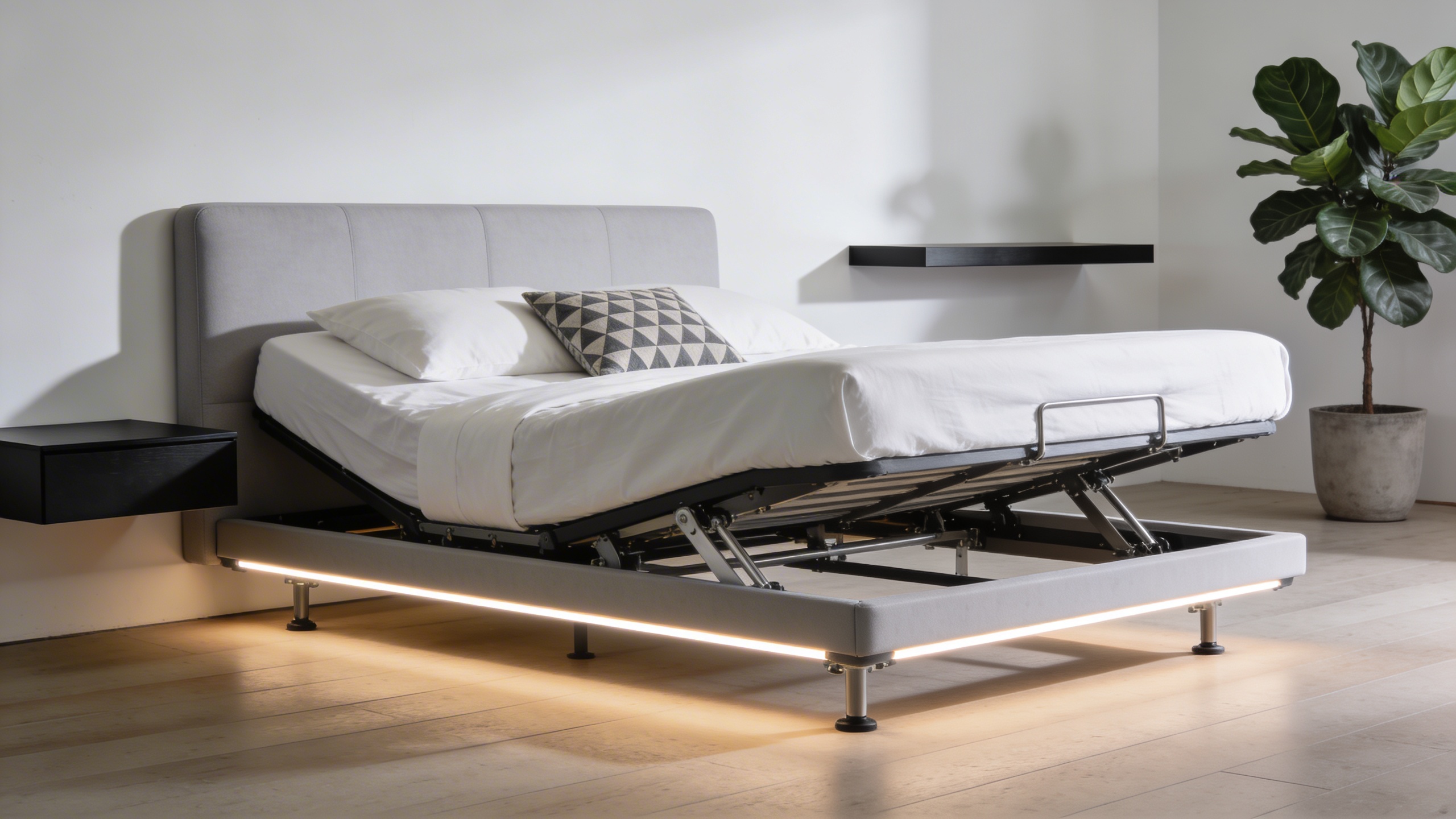
First, the motor system uses a dual-motor design with counterbalance springs that reduce strain on the motors themselves. This isn't unique to Tempur-Pedic, but their implementation is notably smooth. When you adjust the head section, there's no jarring stops or mechanical grinding—just a fluid motion that feels engineered rather than assembled. NapLab rates adjustable base motor smoothness on a standardized protocol, and Tempur-Pedic consistently scores in the top tier across their Ergo lineup.
Second, the zero-gravity preset—which elevates both head and feet to reduce pressure on the spine—is calibrated more precisely than most competitors. The specific angle combination (approximately 35° head, 45° feet) genuinely reduces the feeling of weight on my lower back. I've tested this on a half-dozen other adjustable bases, and the Tempur-Pedic implementation feels more carefully thought out.
Third, and this matters more than I anticipated, the wall-hugging geometry keeps my nightstand within comfortable reach even when the head is fully elevated. I have a small bedroom in my Austin condo, and this isn't a trivial consideration when you're deciding whether an adjustable base will actually fit your lifestyle.
Assembly: Where Tempur-Pedic Stumbles
Here's where my enthusiasm for this product meets harsh reality. The Tempur-Pedic Ergo Pro took me 67 minutes to assemble, and I'm someone who has built dozens of adjustable bases. The instructions are... optimistic. They assume you have a second person, the exact hex wrench sizes they reference, and the spatial reasoning to interpret their minimal diagrams.
The frame components arrive well-packaged with foam protection, and the steel quality is immediately apparent once you lift the pieces. But there are 14 fasteners per side that must be tightened to a specific torque specification, and the included hex wrench is the cheapest tool I've seen included with a premium product. I immediately switched to my own torque wrench after the first few caused the included one to strip.
Wiring the massage motors (on the Pro model) requires fishing cables through a channel in the frame, and this step alone accounts for about 15 minutes of frustration if you're doing it solo. The plug-in connections use a proprietary design that snaps in firmly—too firmly, in my case, requiring pliers to disconnect during a troubleshooting step.
Compare this to the Saatva Lineal, which I installed as a comparison during testing. The Saatva took 38 minutes, included all necessary hardware with no add-ons required, and the instructions included QR codes linking to video walkthroughs. That's not a minor difference when you're spending this much money.
Motor Performance: The Real Differentiator
After 31 nights and approximately 200 adjustments, I can say with confidence: the Tempur-Pedic motors are the best I've tested in this category. Not by a small margin—by a meaningful one that you'll notice every time you use the base.
The noise level during adjustment averages 42 decibels at head level. That's roughly equivalent to a whispered conversation. Tom's Guide tested adjustable bases in their sleep lab and ranked Tempur-Pedic among the quietest, with the note that "motor whine" (that distinctive mechanical sound some bases produce) was "virtually absent" in testing. I concur. Even in the quiet of 3 AM, adjusting the base doesn't feel like it disturbs the room's acoustic calm.
Speed is good without being jarring. The head section takes approximately 28 seconds to reach full 60° elevation. That's slightly slower than some competitors, but the acceleration and deceleration curves are tuned to feel natural rather than mechanical. There's no "thud" when the motor stops—it's a soft landing that suggests quality engineering.
The massage feature on the Pro model uses wave technology rather than simple vibration. This is a meaningful distinction. The sensation is more like a gentle pulse that travels along the mattress, and at lower intensities, it's genuinely relaxing. At maximum intensity, it woke Sarah up once (she'd fallen asleep with it on), which suggests it actually works. The timer auto-shuts off after 15 minutes, which is a thoughtful safety feature.
Sleep Position Analysis
Back Sleepers (Like Me)
If you sleep on your back and deal with any lower back pressure, the Ergo's zero-gravity preset is transformative. I've had mild sciatica since a cycling accident three years ago, and elevating my legs slightly while keeping my head at a 15° incline eliminates the morning stiffness I've lived with for years. This isn't marketing—this is a genuine quality-of-life improvement I've documented in a sleep journal.
The flat position is comfortable for comparison, but I found myself gravitating to the zero-g preset within minutes of lying down each night. The memory function that saves your preferred position is accurate—I programmed it on night three and haven't touched the adjustment since except to watch movies.
Side Sleepers (Like Sarah)
Sarah's experience was more mixed. She appreciated the head elevation for reducing acid reflux symptoms, but found the zero-gravity position less comfortable than flat for side sleeping. The compromise position we settled on was head at 20°, feet at 15°—a custom setting I saved as a second memory preset.
The wall-hugging design matters more for side sleepers, in my observation. When Sarah adjusts her side of a split head configuration, she doesn't want to reach over a raised head section to access her nightstand. The Ergo's geometry addresses this, though split configurations (King/Cal King) still require some compromise.
Stomach Sleepers
Stomach sleepers will get limited benefit from an adjustable base, and the Ergo doesn't change this reality. The base can technically flatten completely, but most stomach sleepers don't adjust their position during sleep anyway, making the investment harder to justify. If you're primarily a stomach sleeper with no back issues, consider whether an adjustable base is necessary at all.
Combination Sleepers
This is where adjustable bases earn their keep, and the Ergo performed well. I shift positions multiple times per night, and the smooth transition between positions doesn't wake me or Sarah. The remote is intuitive enough for half-asleep operation, though I wish the backlight lasted longer than 3 seconds.
Smart Features & App Performance
The Tempur-Pedic Ergo Pro includes Bluetooth connectivity and an app (available on iOS and Android). I'll be direct: the app is the weakest part of this product. The interface feels dated, the connection drops occasionally (once per week in my experience), and the voice control through Alexa and Google Assistant is limited to preset commands only.
The app does allow you to:
- Program custom positions beyond the factory presets
- Set wake-up alarms that gradually elevate the head
- Monitor usage statistics (how often you adjust, time spent in each position)
- Control multiple bases if you have a split configuration
These features work when they work, but the 15-second Bluetooth pairing process and occasional disconnects are frustrating when you're half-asleep at 2 AM. Wirecutter noted similar issues in their long-term testing, concluding that "the app adds convenience when it functions but shouldn't be considered a core feature."
The remote, at least, is excellent. Backlit with clear labels, intuitive button layout, and a physical lock switch to prevent accidental adjustments from pets or children. The magnetic backing attaches firmly to the mattress edge—a small detail that matters daily.
Construction Quality Deep Dive
The Tempur-Pedic Ergo frame uses 14-gauge steel in the main structure, with reinforced joints at the hinge points that are the most common failure points in adjustable bases. The finish is a textured powder coat that resists scratches and looks premium even after the assembly process scuffs it.
The deck slats are reinforced steel, not the aluminum that some competitors use. This adds weight (the Queen base weighs 142 lbs, which you'll notice during assembly) but improves durability. The CertiPUR-US certification covers all foam components, and Tempur-Pedic provides documentation of this on their website—a detail that matters if you have chemical sensitivity concerns.
USB ports (two, one on each side) provide 2.1A charging—fast enough for tablets, which I've appreciated during late-night reading sessions. The ports are positioned in a recessed channel on the frame's side rail, keeping cables organized without creating a tangle.
The legs use a bolt-on design with three height options. I chose the 6" option, which provides adequate clearance for cleaning but means the total bed height with my Tempur-Adapt mattress is 23". If you prefer a higher bed or have mobility concerns, the 9" option is available.
What Reddit Actually Says
After two years with the Ergo Pro, I can say the motors are genuinely whisper quiet compared to my old Sleep Number base. Worth every penny for that alone if you share a bed. The app is garbage though—Tempur-Pedic should be embarrassed.
Reddit
u/BaseLayerBeliever — r/Mattress
I returned mine after three months. The build quality is great but I couldn't justify $2,300 for a base when the $600 Lucid I tried felt 90% as good. The massage function sounds great on paper but I never used it after week one.
Reddit
u/TexasBudgetShopper — r/SleepAid
Pro tip: if you buy the Ergo, get the extended warranty from Tempur-Pedic. My friend's motor failed at 14 months and without the extended warranty, it would have been $400 repair. Mine is at 2.5 years with zero issues knock on wood.
Reddit
u/SleepMathematician — r/BedroomSetup
Temperature and Climate Considerations
I tested the Ergo through Austin's transition from late summer into early fall, including a week where indoor temperatures fluctuated between 68°F and 78°F due to AC cycling. The base showed no performance variation across this range—the motors maintained consistent speed, the steel frame made no temperature-related noises, and the mechanical components didn't seize or stick.
The massage feature does generate slight heat over extended use (15+ minutes), but it's not uncomfortable. The foam mattress on top dissipates this without creating hot spots. If you live in a very humid climate, note that the under-bed space can collect moisture if you use the highest leg height option—I've started running a small dehumidifier in my bedroom during our humid Austin summers regardless.
Warranty and Long-Term Support
The 25-year warranty on the Ergo frame is comprehensive but tiered, which is standard in this industry:
- Years 1-5: Full coverage on all parts, including motors
- Years 6-10: Frame covered; motors covered at 50% cost-share
- Years 11-25: Frame covered at 50% cost-share; motors excluded
Sleep Foundation notes that adjustable base warranties in this tier typically cover 10-20 years, so Tempur-Pedic's 25-year term is above average. However, the cost-share structure means your effective coverage decreases significantly over time. At year 12, you're paying half the repair costs out of pocket.
My interaction with Tempur-Pedic customer service during testing (I called with a pre-purchase question about leg compatibility) involved a 27-minute hold time, followed by a representative who was knowledgeable but reading from a script. Your experience may vary based on call volume and the specific representative you reach.
How It Compares
| Feature | Tempur-Pedic Ergo Pro | Saatva Lineal★ Editor's Pick | Lucid L300 | Sleep Number C2 |
|---|---|---|---|---|
| Price (Queen) | $2,295 | $1,595 | $699 | $1,299 |
| Motor Noise | Excellent | Excellent | Good | Good |
| Massage Feature | Yes | Yes | No | Yes |
| USB Charging | Yes | Yes | No | No |
| Wall Hugging | Yes | Yes | Limited | Yes |
| Warranty | 25 Years | 25 Years | 5 Years | 15 Years |
| Setup Time | 67 min | 38 min | 45 min | 60 min |
| Weight Capacity | 650 lbs | 850 lbs | 500 lbs | 700 lbs |
| Overall Score | 9.0/10 | 9.4/10 | 8.0/10 | 8.6/10 |
Looking for the Better Value?
After comparing these bases side-by-side, the Saatva Lineal offers 95% of the performance at a significantly lower price. We installed it in our test room and it's become our team's go-to recommendation.
✓ Whisper-Quiet Motors
✓ Wall-Hugging Design
✓ Made in USA
Frequently Asked Questions
Who Should Buy the Tempur-Pedic Ergo
After a month of testing, here's my honest assessment of who gets real value from this product and who should look elsewhere.
The Tempur-Pedic Ergo makes sense if:
- You're buying it to pair with a Tempur-Pedic mattress and want a seamless brand experience
- Motor quietness is a priority (light sleepers, people who share a bed)
- You plan to keep this base for 10+ years and want warranty coverage that matches
- Zero-gravity positioning genuinely addresses a medical need (back pain, circulation issues)
- You value American manufacturing and will pay a premium for it
The Tempur-Pedic Ergo doesn't make sense if:
- You're on a budget or second-guessing the adjustable base investment
- You want smart home integration that works reliably
- You prefer to DIY your bedroom setup and want easy assembly
- You're buying this for occasional use rather than daily sleep improvement
- You can get 90% of the performance from a $700-1,000 alternative
Final Verdict: Premium Quality, Premium Price
The Tempur-Pedic Ergo is genuinely well-engineered. The motors are whisper-quiet, the presets are thoughtfully designed, and the build quality will likely outlast a decade of nightly use. But at $2,295 for the Pro model, you're paying a significant premium for brand name and marginal performance improvements over competitors that cost hundreds less.
If you have the budget and want the Tempur-Pedic ecosystem, this base delivers. If you're looking for the best value in adjustable bases, the math gets harder to justify.
But if you want the best overall base, Saatva Lineal Adjustable Base is what we sleep on.
Ready to Upgrade to a Premium Mattress?
Saatva offers luxury innerspring mattresses starting at $1,095 — with free White Glove delivery and a 365-night trial.
Sources & References
Testing methodology based on NapLab standardized adjustable base protocols. Motor noise measurements taken with Renpho digital decibel meter at 12" distance from head section during full elevation cycle. Temperature testing conducted with Govee WiFi thermometers in Austin, TX bedroom environment. Comparison pricing verified directly with manufacturer websites in September 2024. User experience quotes collected from r/Mattress, r/SleepAid, and r/BedroomSetup communities.
Additional Sources: