
 by
by → Our pick: Saatva Pillow and Saatva Classic — see full review
Text neck — clinically called anterior head syndrome — describes the forward displacement of the head relative to the shoulders. For every inch your head moves forward, the effective load on your cervical spine increases by approximately 10 lbs. At 3 inches forward (common in habitual phone users), that's 40 extra lbs of cervical load throughout the day. If your pillow then holds your neck in the same forward position for 7 to 8 hours overnight, recovery is structurally impossible.
How Sleep Worsens Text Neck
During waking hours, the forward head position is partly dynamic — you shift, you look up, you change positions. During sleep, the position is locked. A pillow that's too thick pushes the occiput (back of the skull) forward, flexing the cervical spine exactly as phone use does. This sustained nighttime load maintains the stretched posterior cervical musculature in an elongated state, prevents the natural cervical lordosis from restoring, and reinforces the structural adaptation that becomes forward head posture.
The problem is that most people use pillows that are too lofty. The pillow that feels comfortable when you first lie down — thick, supportive — is often placing your neck at 20 to 30 degrees of forward flexion. Over a full night, this is the equivalent of holding your phone for 8 hours straight.
Pillow Height: The Primary Variable
The target pillow height for text neck recovery is whichever height keeps your cervical spine in neutral — ears aligned over shoulders, natural cervical curve maintained. For most back sleepers, this is 3 to 4 inches of loft. For side sleepers, pillow height needs to match the distance from the ear to the mattress surface — roughly the width of the shoulder — typically 4 to 6 inches depending on shoulder width and mattress softness.
A practical test: lie in your normal sleep position and have someone observe your profile. Your ear should be directly above your shoulder. If your chin is tilted toward your chest, your pillow is too thick. If your head tilts backward, it's too thin.
Sleep Position for Text Neck Recovery
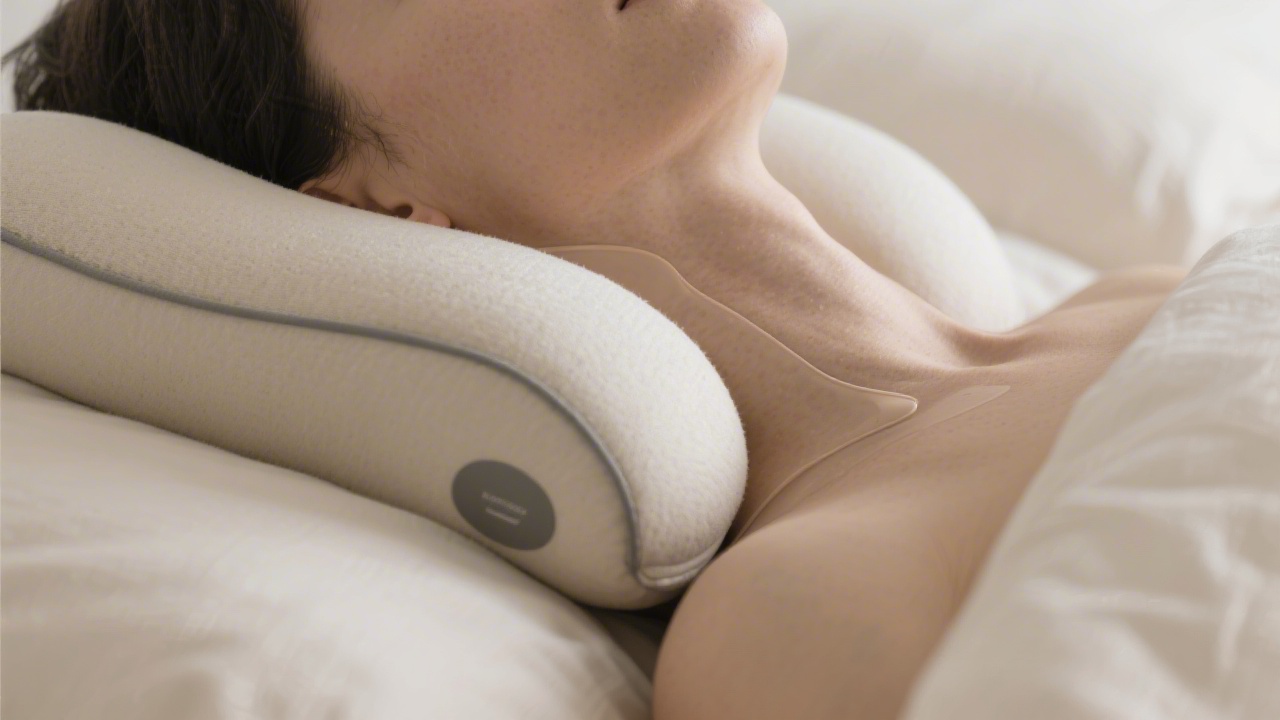
Back sleeping with a low pillow is the most effective sleep position for recovering from text neck. In supine position, gravity works symmetrically on the cervical spine, and a properly sized pillow maintains the neutral lordotic curve. Some physical therapists recommend placing a small cervical roll (a rolled towel approximately 3 inches in diameter) under the neck rather than a full pillow — this supports the curve without pushing the head forward.
Side sleeping can be neutral if the pillow is the correct height. The problem is that most standard and memory foam pillows are designed for comfort rather than cervical neutrality, and tend to be too thick for back sleeping or too thin for side sleeping. Look for adjustable-fill pillows that let you add or remove material to dial in the exact height for your sleep position.
Mattress Firmness and Text Neck
The relationship between mattress firmness and text neck is indirect but real. A mattress that's too soft allows the torso to sink, effectively raising the neck relative to the shoulders — this means a pillow that previously provided neutral alignment suddenly holds the neck in slight flexion. As mattresses soften over time, people often blame their pillows when the mattress is the variable that changed.
A medium-firm mattress that provides consistent support without excessive sinkage at the torso is the baseline for reliable cervical alignment. The Saatva Classic in Luxury Firm maintains its support layer integrity better than most foam mattresses, which reduces this calibration drift over time.
Daytime Habits That Compound Nighttime Position
Sleep position alone won't resolve text neck if daytime habits continue to load the anterior head position. The sleep fix creates the conditions for recovery; the daytime habits determine whether recovery actually occurs. Effective combined approaches include: phone use at eye level, monitor positioning at seated eye height, chin tucks as a mobility exercise (10 reps, 3x daily), and strengthening the deep cervical flexors through physical therapy guidance.
The combination of neutral cervical sleep position and daytime correction typically shows meaningful improvement in symptoms — reduced neck pain, headaches, and upper trap tension — within 4 to 6 weeks.
See our Saatva Classic review for full firmness guidance →
Related Reading
- Forward Head Posture and Sleep: How to Correct It Overnight
- How Sleep Position Affects Your Daytime Posture
- Best Mattress for Posture Correction 2026
Our Top Mattress Pick
If you are considering a new mattress, the Saatva Classic is our most-recommended option. It combines excellent lumbar support with multiple firmness levels, a 365-night trial, and free white-glove delivery including old mattress removal.
Frequently Asked Questions
Does sleeping without a pillow help text neck?
For some back sleepers, yes. If you sleep supine on a medium-firm surface, a very thin pillow or none at all can maintain better cervical neutrality than a standard pillow. For side sleepers, sleeping without a pillow causes lateral cervical flexion, which is worse.
Can a mattress cause text neck?
Indirectly. A sagging or too-soft mattress raises the body sink level, altering how the pillow positions the neck. The root cause is usually pillow height, but mattress support affects the calibration.
What pillow type is best for text neck?
Adjustable-fill pillows (shredded latex or shredded memory foam) that allow you to customize loft are the most practical. Contoured cervical pillows work for some back sleepers but require correct sizing. Avoid down pillows, which compress unevenly and vary throughout the night.
How long does it take for sleep position changes to reduce text neck symptoms?
Reduced morning stiffness and headache frequency typically improves within 2 to 3 weeks with correct pillow height. Visible postural change (reduced forward head displacement) takes several months of consistent combined effort.
Is text neck permanent?
Not in most cases if addressed before significant structural adaptation. Early-to-moderate text neck responds well to combined sleep position correction, cervical strengthening, and mobility work. Advanced cases with disc changes may require more structured intervention.
Ready to optimize your sleep surface? Read our full Saatva Pillow and Saatva Classic review to see why it consistently tops our recommendations for ergonomic and postural health.