
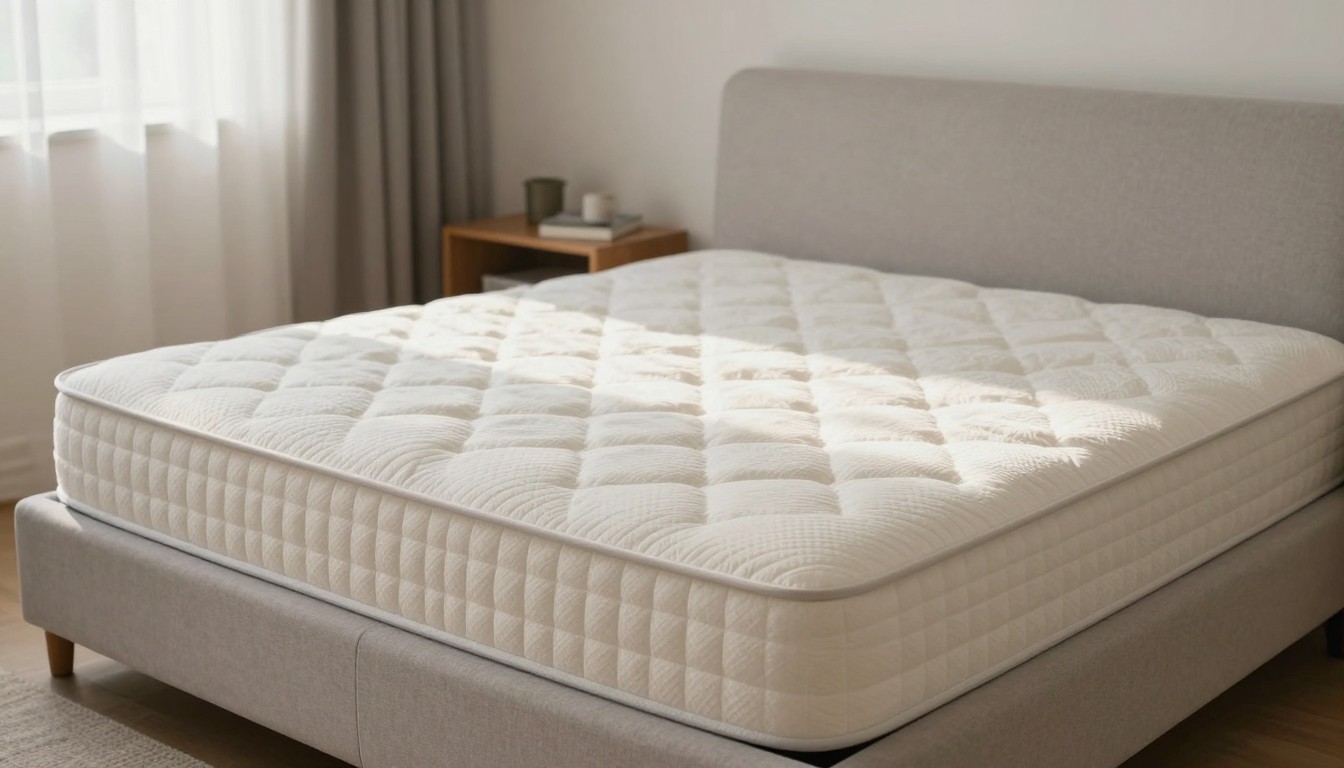
 by
by Quick answer: Put a rigid bunkie board on top of the wide slats. It spans the gaps, spreads your weight evenly, and keeps the mattress from bulging down between rails. A plywood or hardboard panel is the budget version.
- Wide gaps make a futon mattress sag in stripes, and that pattern of crushed batting doesn't recover.
- Rigid and thin beats thick and soft: you want a load-spreading surface, not another layer of cushion.
- Whatever you lay down, leave the mattress able to breathe, since a sealed panel traps body moisture underneath.
Updated July 2026 · Reviewed for accuracy
Wide gaps are a support problem, not a comfort problem, so the fix has to be stiff. A bunkie board is the cleanest answer, and a single sheet of plywood or hardboard cut to the frame does the same job for less money. What you should not do is pile on another soft layer and hope it bridges the space, because foam and batting follow gravity straight down into the void.
I spend most of my time looking at how mattresses are built and how they fail, and slat gaps are one of the most avoidable failure causes I see on futons. The mattress usually gets blamed. The frame is the culprit.
Start With the Gap, Not the Topper
Before you buy anything, kneel next to the frame and press your palm flat into the space between two slats. If your hand sinks in past the surface of the rails without resistance, the mattress has nothing to sit on there. Now lie on the bed and reach under with your other hand. If you can feel the underside of the mattress pushing down into the gaps while you're on it, that's the exact spot where the fill is being crushed every night.
Do the same check along the edges. Futon frames often space slats generously in the middle and leave a wider run at the head and foot, which is why so many futons develop a soft band right where your shoulders and hips land.
The other thing to note is slat behavior. Lay a hand on the center of one slat and lean on it. If it flexes and creaks, the slats themselves are undersized, and adding a board on top will help but won't cure it. In that case you're reinforcing the frame, not just covering gaps.
The Nut's rule: if a fix compresses when you push on it, it isn't support. Support is the thing that refuses to move. Everything soft belongs above the support layer, never in place of it.
What to Put on a Futon Base With Wide Gaps
Here are the options that actually change how the mattress is loaded, and what each one costs you in return. Prices vary by size and material, so check current pricing wherever you shop.
| Option | How it fixes wide gaps | Best for | Trade-off |
|---|---|---|---|
| Bunkie board | Rigid panel, usually a wood grid wrapped in fabric, that spans every gap at once | Anyone who wants a finished look and no sawdust | Adds a little height, and cheap ones can be flimsy in the middle |
| Plywood sheet | One continuous stiff surface, the most load-spreading per dollar | Very wide gaps, or slats that already flex | Blocks airflow unless you drill it, and edges need sanding |
| Hardboard or underlayment panel | Thin, dense, smooth, good at hiding slat ridges | Moderate gaps where you don't want extra height | Too thin on its own to bridge big spans, better over decent slats |
| Extra slats | Cuts each gap down by filling the spaces between existing rails | Fold-out frames where added thickness would fight the hinge | Fiddly to size and secure, and loose slats shift |
| Roll-up slat mat | Wood strips joined by webbing, laid crosswise over the old slats | Renters and anyone who needs the bed to fold or store flat | Only as rigid as its strips, and it can creep out of position |
| Firm foam support pad | Softens the ridge feel over slats, does not truly bridge a wide gap | A finishing layer on top of a board | Used alone it sinks into the gaps with the mattress |
If you want one recommendation and no debate, buy the bunkie board. It's purpose-built for exactly this, it needs no tools, and it lifts the mattress off the slat ridges without turning your futon into a tall bed.
If you already own a saw or you're covering unusually wide spans, plywood wins on pure stiffness. Cut it a touch smaller than the inside of the frame so it drops in without binding, then round the corners so it can't chew the mattress cover.
Why Wide Gaps Wreck a Futon Mattress
Futon mattresses are mostly compressed fill. Cotton batting, wool, foam cores, sometimes a coil unit, all held under tension by tufting. That construction is designed to be supported continuously, the way a futon sits on a tatami floor. It is not designed to span open air.
Put that build on wide slats and every gap becomes a hinge. The fill above the void gets folded and crushed on each cycle of you getting in and out. Cotton batting is the most vulnerable, because once the fibers pack down they stay packed, which is why a gap-damaged futon shows hard ridges where the slats were and dead soft valleys where they weren't.
Foam behaves differently but fails just as visibly. Unsupported foam flexes in tension across the gap, and repeated flexing in one narrow line is how you get a permanent body impression far sooner than the material would otherwise deserve. Innerspring futons complain in a third way, with coils near a gap taking a side load they were never wound to handle, which is where the squeaks come from.
Signs your gaps have already done damage:
- Ridges you can feel through the mattress that line up with the slats.
- Soft bands between those ridges that don't plump back up when you flip the mattress.
- New creaking that appears only when weight shifts, not when it lands.
- A cover that looks stretched or scuffed in parallel lines on the underside.
Worth being honest here: a board fixes the frame, it does not un-crush fill. If the ridges are already set, the support panel stops the damage from spreading and evens out the feel, but a mattress with dead valleys is a mattress on borrowed time. If you're at that point, the fix and a replacement are two separate decisions, and my general guidance on picking a replacement lives in what makes the best mattress.
The Fixes I'd Skip
Cardboard is the one I see most, and it's the worst. It's stiff for a week, then humidity and load turn it into a soft, sagging sheet that also traps moisture against the mattress. Same story for foam board insulation, which crushes into permanent dents under a hip.
A folded rug or blanket over the slats feels like progress because the ridges disappear. It doesn't span anything. All you've done is add compressible material that follows the mattress into the gap, and you've added a moisture-holding layer while you're at it.
Egg-crate or convoluted foam has the same flaw with less bulk. Cutting down a box spring is another one to avoid, since a box spring is engineered to flex, and flex is the opposite of what a gappy frame needs. And skip stacking two thin panels loosely on top of each other, because they slide against each other and shear instead of acting as one stiff sheet.
Laying the Board Down Without Trapping Moisture
Sleepers put out water vapor all night, and it moves downward through the mattress. Open slats let it go. A solid panel gives it nowhere to leave, and the underside of the mattress is where you'll find the consequences: a musty smell first, then discoloration.
So the install matters as much as the material. Drill a scatter of ventilation holes across a plywood panel, spread out rather than clustered in the middle where the load is highest. Choose a fabric-wrapped bunkie board over a plastic-wrapped one if you have the option, since fabric breathes and plastic sweats. If your futon lives in a humid room, stand the mattress up against a wall every few weeks and let both faces air out.
Two more small things that save headaches. Secure the panel so it can't creep, with a couple of blocks screwed to the frame rails or a non-slip pad underneath, because a shifting board scuffs the mattress cover and can bind the frame. And check clearance before you commit, since anything you add raises the sleeping surface and can put a low platform or a captain's-bed drawer out of reach.
Matching the Fix to Your Mattress Type
All-cotton futons are the least forgiving. They have no elastic layer to distribute load, so they need the stiffest surface you can give them, and a full panel rather than added slats is the safer call.
Cotton and foam blends tolerate slats better, because the foam layer does a little bridging on its own. A bunkie board or a hardboard panel is usually plenty. Wool and latex builds are heavier, and weight is exactly what a wide gap punishes, so those deserve a continuous rigid surface too. Innerspring futons want a flat, level plane above all, since an uneven base loads individual coils unevenly and that's how you get sag on one side.
If you're shopping for a replacement futon mattress, it's worth checking what base the maker specifies, because retailers like The Futon Shop publish support guidance alongside their best-selling futon mattresses, and matching the mattress to the frame beats fighting the mismatch later.
Fold-Out Frames Behave Differently Than Platforms
On a bifold sofa-style futon frame, the seat and back decks fold against each other, and every bit of thickness you add gets doubled at the hinge. Adding slats or using a thin roll-up mat is often the smarter move there, and if you do use panels, use one per deck rather than trying to span the hinge.
Flat platform futon frames are simpler. Nothing folds, so a single full-size panel is the obvious choice and the only real constraints are height and airflow. Metal frames deserve one extra look: if the rails are thin tubing set far apart, the rails themselves may flex under a rigid panel, and then you're supporting the support.
Size confusion causes its own gap problems, since a mattress that's narrower than the frame leaves an unsupported strip along one side. I've covered the dimension question separately in whether a twin bed fits on a futon frame. And if you're weighing a rebuild against a different sleep setup, note that adjustable bases solve support in a completely different way. My primer on what an adjustable base is covers where that makes sense, though a futon mattress is generally the wrong mattress for one.
What I'd Do This Weekend
Measure the widest gap, then buy a bunkie board sized to your frame and drop it in. It takes minutes, needs no tools, and it removes the single biggest cause of premature futon sag. If the gaps are unusually wide or the slats already flex under a hand, cut plywood instead, drill it for airflow, and block it so it can't slide.
Then leave the soft stuff for the top. A support panel underneath and a comfort layer above is the right order, and doing it in that order is what keeps the mattress you already own from turning into a washboard.
ONE OPTION WORTH COMPARING
Shopping as well as reading? Here is one current option worth comparing: the Futon Best Selling. Check today’s price, sizing and return terms on the official product page before you order.
Futon Best Selling
- Wide gaps make a futon mattress sag in stripes, and that pattern of crushed batting doesn't recover
- What to Put on a Futon Base With Wide Gaps Here are the options that actually change how the mattress is loaded, and what each one costs you in return

FAQ
Can I just add a mattress topper instead of a board?
No, and this is the most common mistake with gappy futon frames. A topper compresses, so it sinks into the gaps along with the mattress instead of spanning them. Use a topper for comfort after you've added a rigid layer underneath.
Is a bunkie board or plywood better for wide slat gaps?
Plywood is stiffer per dollar and better for the widest gaps or flexing slats. A bunkie board is finished, needs no cutting, and breathes better when it's fabric-wrapped. For most futon frames the bunkie board is the easier call, and the difference in support is small once the gaps are covered.
Will a solid panel cause mold under my futon mattress?
It can if you seal the base completely and never air the mattress out, because body moisture has to escape somewhere. Drill ventilation holes in plywood, avoid plastic-wrapped panels, and stand the mattress up to air periodically, especially in humid rooms.
Should I add more slats instead of a panel?
Adding slats is the right choice on fold-out frames where extra thickness would fight the hinge, or when you want to keep the bed low. It takes more work to size and secure them, and it won't help if the existing slats are already flexing under load.
Can a support board fix a futon that already sags?
It stops the sagging from getting worse and evens out how the mattress is loaded, but crushed cotton batting and set foam impressions don't recover. If you can feel hard ridges and dead valleys that persist after flipping, treat the board as damage control and start planning a replacement.