
 by
by Wolf Mattress has made beds in the US since 1873. Their current hybrid lineup (Envoy Pillow Top, Lynx, Atria, Leo) offers good value for side and back sleepers who want a plush, foam-forward feel at a mid-range price. The flagship 14-inch Plush Pillow Top earns high marks for pressure relief and motion isolation but has average edge support and is not ideal for sleepers over 230 lb or strict stomach sleepers. If you want comparable innerspring comfort with a longer trial and stronger warranty, the Saatva Classic is our recommended upgrade.
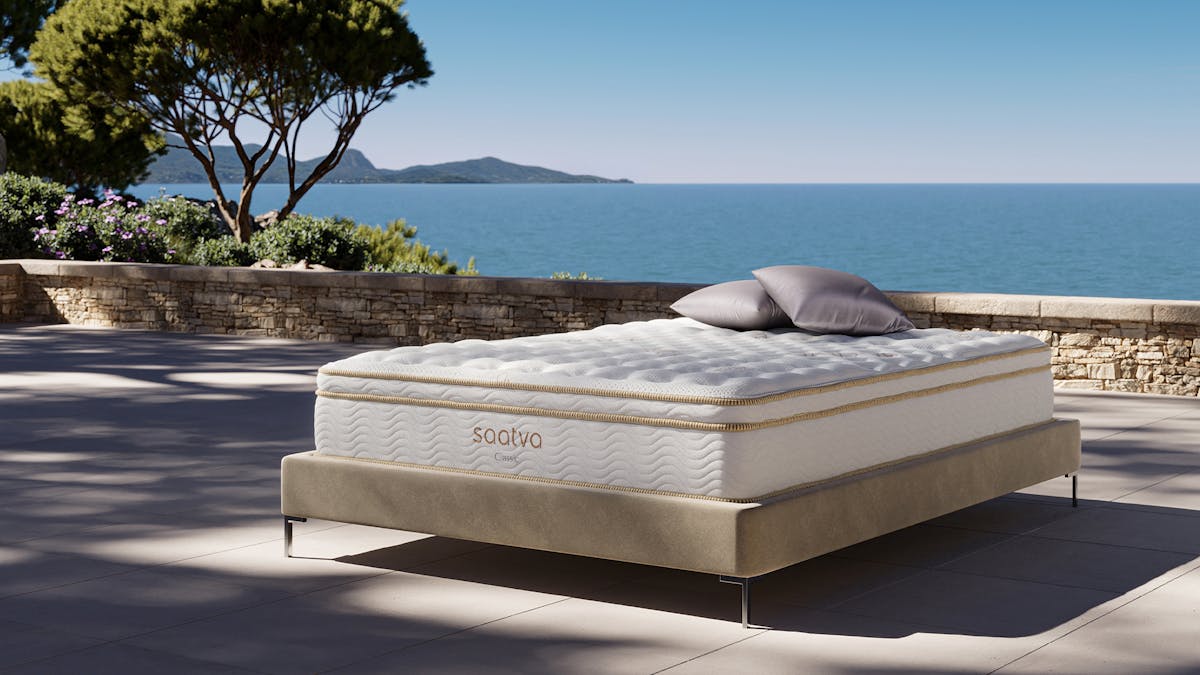
Saatva Classic
9.4/10
- Dual-coil construction with a reinforced lumbar zone pad and zoned support
- Three firmness options (Plush Soft, Luxury Firm, Firm) to suit different sleepers
- Free white-glove delivery, in-room setup, and old-mattress removal
- 365-night home trial and a lifetime warranty with no prorating
- GREENGUARD Gold certified, CertiPUR-US foam, fiberglass-free construction
- Ships uncompressed (not bed-in-a-box), requires doorway clearance
- $99 return fee applies during the trial period
- Higher price than Wolf's entry-level models
For anyone shopping Wolf Mattress and wanting a longer trial, stronger warranty, and a more refined innerspring feel, the Saatva Classic is the natural step up. It matches Wolf's coil-hybrid approach but adds a zoned lumbar system, 365-night trial, and lifetime coverage that Wolf's 10-year warranty does not match.
Wolf Mattress: 150 years of American manufacturing
Wolf Mattress is one of the oldest mattress manufacturers still operating in the United States, having started production in 1873. Unlike most modern direct-to-consumer brands, Wolf builds its mattresses domestically and sells primarily through its own website and select retailers. Their current lineup leans heavily on hybrid construction: pocketed coils paired with gel-infused memory foam, marketed across four style collections (Envoy Pillow Top, Lynx, Atria, and Leo).
The positioning is straightforward: value-forward, American-made hybrids for sleepers who want a plush, pressure-relieving feel without paying luxury pricing. The collections differ mainly in profile height, firmness, and comfort-layer configuration rather than fundamentally different materials or construction approaches.
The four Wolf collections explained
Wolf organizes its lineup by feel and profile. Here is what each collection targets:
- Envoy Pillow Top: The softest option, available in twin through king. Gel memory foam quilted pillow top, individually wrapped coils, and a plush feel suited to side and combination sleepers. Soft firmness, roughly 5/10. Sizes run twin to king, priced from $699 to $1,199.
- Lynx: A euro-top hybrid with plush and medium-firm firmness options. Better for sleepers who want some bounce and responsiveness. The medium-firm variant (roughly 6.5/10) suits average-weight back sleepers and lighter combination sleepers. Priced from $649 to $999.
- Atria: A medium-firm hybrid (around 6.5/10) with 580 individually wrapped coils in the queen. Good motion isolation for a coil bed, with gel foam regulation for hot sleepers. Priced from $449 to $799.
- Leo: The firmest collection (around 8/10), with firm foam over an innerspring core. Primarily targets stomach and back sleepers. The firmest option in the Wolf lineup. Priced from $349 to $499.
Construction and materials
Wolf's flagship 14-inch Plush Pillow Top (sold across the Envoy line) is representative of their current build quality. The construction from top to bottom:
- Cover: Stretch-knit fabric with a cool-to-the-touch surface. Quilted gel memory foam in the top panel for initial plushness.
- Comfort layers: Two 1-inch blue memory foam layers with slow response, focused on pressure relief at the shoulders and hips.
- Transition layers: Two polyfoam layers with faster recovery to prevent bottoming out onto the coil core.
- Support core: 8-inch individually wrapped pocketed coils, with perimeter reinforcement. CertiPUR-US certified foams throughout, no fiberglass.
The 13-inch (Lynx/Atria) and 12-inch (Leo) variants trim the comfort and transition layers to achieve firmer feels. The core coil structure remains consistent across the lineup.
Feel and performance: what the testing shows
Pressure relief and side sleeping
Wolf's softer hybrids (Envoy Pillow Top, softer Lynx) earn their strongest scores for side sleepers of light to average weight. The slow-response memory foam relieves pressure at the shoulder and hip with a deep, enveloping feel. Third-party pressure mapping tests show low-pressure readings across both contact zones for average-weight side sleepers. Heavier side sleepers (over 230 lb) may experience insufficient support in the transition zone and some feeling of bottoming out toward the coils.
Back sleeping
Medium-weight back sleepers do well on the Lynx or Atria medium-firm variants. The plush comfort layers fill the lumbar curve adequately for most people without chronic back issues. For back sleepers with lower back pain, however, targeted lumbar zoning (available on mattresses like the Saatva Classic) provides a more reliable mechanical solution than Wolf's uniform comfort layer approach.
Stomach sleeping
Only the Leo firm collection is suitable for stomach sleepers, and then only for average-weight sleepers. The Envoy and Lynx soft variants allow the hips to sink too far for proper spinal alignment in this position. Strict stomach sleepers would be better served by a purpose-built firm mattress.
Cooling
Despite the foam-forward construction, Wolf's gel-infused cover performs better than most soft hybrids in thermal testing. Independent reviews record a surface temperature increase of roughly 6 degrees Fahrenheit after five minutes (good for a foam-heavy bed). The pocketed coil core allows some airflow that all-foam mattresses cannot match.
Motion isolation
This is a genuine strength. The memory foam layers absorb partner movement effectively, and the individually wrapped coils prevent vibration transmission across the bed surface. Motion isolation in testing rates 5 out of 5 across multiple third-party evaluations, with the water-glass test showing minimal disturbance. Wolf hybrids are a solid choice for couples where one partner is a light sleeper.
Edge support
This is the weakest area. Perimeter coil reinforcement provides some edge structure, but testing shows 4.5 to 5.5 inches of sinkage under weighted sitting simulation, which is more than expected for a hybrid. Sitting on the edge feels unstable, particularly given the 14-inch height and significant foam compression. Sleeping close to the edge is manageable for back sleeping but weaker for side sleeping.
Pricing and value
| Collection | Sizes | Price range | Firmness |
|---|---|---|---|
| Envoy Pillow Top | Twin to King | $699 to $1,199 | Soft (5/10) |
| Lynx | Twin to King | $649 to $999 | Plush / Medium Firm |
| Atria | Twin to King | $449 to $799 | Medium Firm (6.5/10) |
| Leo | Twin to King | $349 to $499 | Firm (8/10) |
Wolf's pricing is competitive for US-made hybrid construction. Most comparable DTC luxury hybrids from other brands price a queen 50 to 100 percent higher. The value case is strongest for the Envoy and Lynx collections, where the build quality justifies the price. The Leo represents the most budget-accessible entry point, though the construction is simpler.
Trial, shipping, and warranty
Trial: 101-night sleep trial. This is a reasonable window and above the 100-night standard used by many DTC brands.
Warranty: 10-year full, non-prorated manufacturer's warranty. This covers manufacturing defects and body impressions over a defined threshold. It does not carry lifetime coverage.
Shipping: Free shipping within the contiguous US. Bed-in-a-box delivery, which means the mattress ships compressed and rolled. Allow 24 to 48 hours for full expansion after unboxing, with normal off-gassing that dissipates over a few days.
Pros and cons
- Excellent pressure relief for side and average-weight back sleepers, particularly on the Envoy line
- Outstanding motion isolation, making it a strong choice for couples with a light-sleeping partner
- Above-average cooling for a foam-heavy hybrid, with a genuinely cool-to-the-touch cover
- US-made construction with CertiPUR-US certified foams and no fiberglass in the lineup
- 101-night trial is competitive for the price category
- Not well-suited for sleepers over 230 lb in any position due to insufficient support depth
- Edge support is average at best; sitting on the perimeter or sleeping close to the edge feels unstable
- Slow-response foam can make position changes and nighttime mobility more effortful
- 10-year warranty is shorter than many competing brands that offer lifetime coverage
- Adjustable base compatibility is limited; the thick pillow top does not flex cleanly at sharper angles
Who should buy Wolf and who should look elsewhere
Wolf is a good fit if: You weigh under 230 lb and primarily sleep on your side or back. You want the deep, enveloping pressure relief of a foam-forward hybrid without paying luxury prices. Motion isolation is important to you, and you or your partner are a light sleeper. You prefer American-made mattresses and want a brand with a long track record.
Consider an alternative if: You weigh over 230 lb, since Wolf's foam layers do not provide enough support depth for heavier sleepers in any position. You are a strict stomach sleeper, where most of the Wolf lineup underperforms on spinal alignment. You sit on the edge of the bed frequently, as Wolf's edge support is the weakest part of the design. You want a longer warranty, a larger trial window, or white-glove delivery included.
Wolf Mattress delivers on its core promise: a plush, well-built American hybrid at a fair price. The motion isolation and pressure relief are genuine strengths. The edge support and weight capacity are real limitations. If Wolf's design matches your profile, it is a solid buy. If it does not, see our Saatva Classic pick above.
Frequently asked questions
Is Wolf Mattress good for back pain?
For non-specific lower back discomfort in average-weight back sleepers, the Lynx or Atria medium-firm collections provide adequate lumbar support. For chronic back pain or heavier body weights, a mattress with dedicated lumbar zoning, such as the Saatva Classic, is a more reliable choice. Wolf's uniform comfort layer does not replicate the mechanical lumbar reinforcement of a zoned coil system.
How long do Wolf mattresses last?
Expect 7 to 10 years of normal performance for the firmer collections (Lynx Luxury Firm, Atria, Leo) and 5 to 7 years for the softest configurations (Envoy Pillow Top). The thick soft foam layers in the plush models are more susceptible to body impressions over time, particularly for heavier sleepers or those who sit on the edge frequently. The 10-year warranty covers manufacturing defects but does not equal 10 years of like-new performance.
Is Wolf Mattress made in the USA?
Yes. Wolf has manufactured mattresses in the United States since 1873. Their US-made construction is a genuine differentiator in a market where most bed-in-a-box brands outsource manufacturing. CertiPUR-US certification on their foams confirms no harmful chemicals, heavy metals, or ozone-depleting substances.
How does Wolf Mattress compare to Saatva Classic?
Both use innerspring hybrid construction with foam comfort layers, but the comparison favors Saatva on several key dimensions. Saatva's dual-coil system includes a dedicated lumbar zone reinforcement that Wolf's single-coil design lacks. Saatva's 365-night trial is more than three times Wolf's 101-night window, the lifetime warranty significantly outlasts Wolf's 10-year coverage, and Saatva includes free white-glove delivery with in-room setup and old-mattress removal. Wolf's advantage is price: entry-level Wolf collections cost less than half the Saatva Classic's starting price. For budget-conscious buyers who match Wolf's ideal sleeper profile, that gap matters. For those who want long-term value and a risk-free purchase experience, Saatva is the stronger investment.
Does Wolf Mattress work on an adjustable base?
Wolf officially supports flat foundations, platform beds, slatted bases, and adjustable bases. In practice, the thick pillow top in the Envoy collection does not flex cleanly at sharper adjustable-base angles, with some bunching in the quilted top at TV or reading positions. The Lynx and Atria collections, with thinner and firmer comfort layers, perform better on adjustable bases than the Envoy Pillow Top.