
 by
by I've built a lot of outdoor spaces, and the ones dogs actually use don't start with a fence. They start with the ground under their paws. The first backyard I "dog-proofed" was a disaster of good intentions: pea gravel everywhere, one of those plastic splash pools, and a row of store-bought herbs in pots. My dog ignored all of it. He wanted the shady patch by the oak, the cool stone after noon, and the hose when he was hot. The lesson cost me a weekend and about eighty bucks in unused gear. This article is the shortcut I wish I'd had. Twelve ideas that make your backyard work for both of you, with materials that hold up and details that don't look like a pet-store aisle.
- Anchor the space with a terracotta stone patio and real outdoor furniture
- Define a shallow gravel run along the fence line
- Build a low stone wall that doubles as extra seating
- Plant a dense hedge border for natural privacy
- Install a pergola with draped outdoor fabric overhead
- Lay a large-format porcelain tile patio for easy hosing
- Set up a galvanized stock tank as a splash pool
- String cafe lights in a zigzag above the lawn
- Add a weatherproof outdoor daybed under a tree
- Create a raised planter bed with dog-safe herbs
- Run a wide stepping-stone path through the grass
- Hang a wall-mounted hose reel by the back door
1Anchor the space with a terracotta stone patio and real outdoor furniture
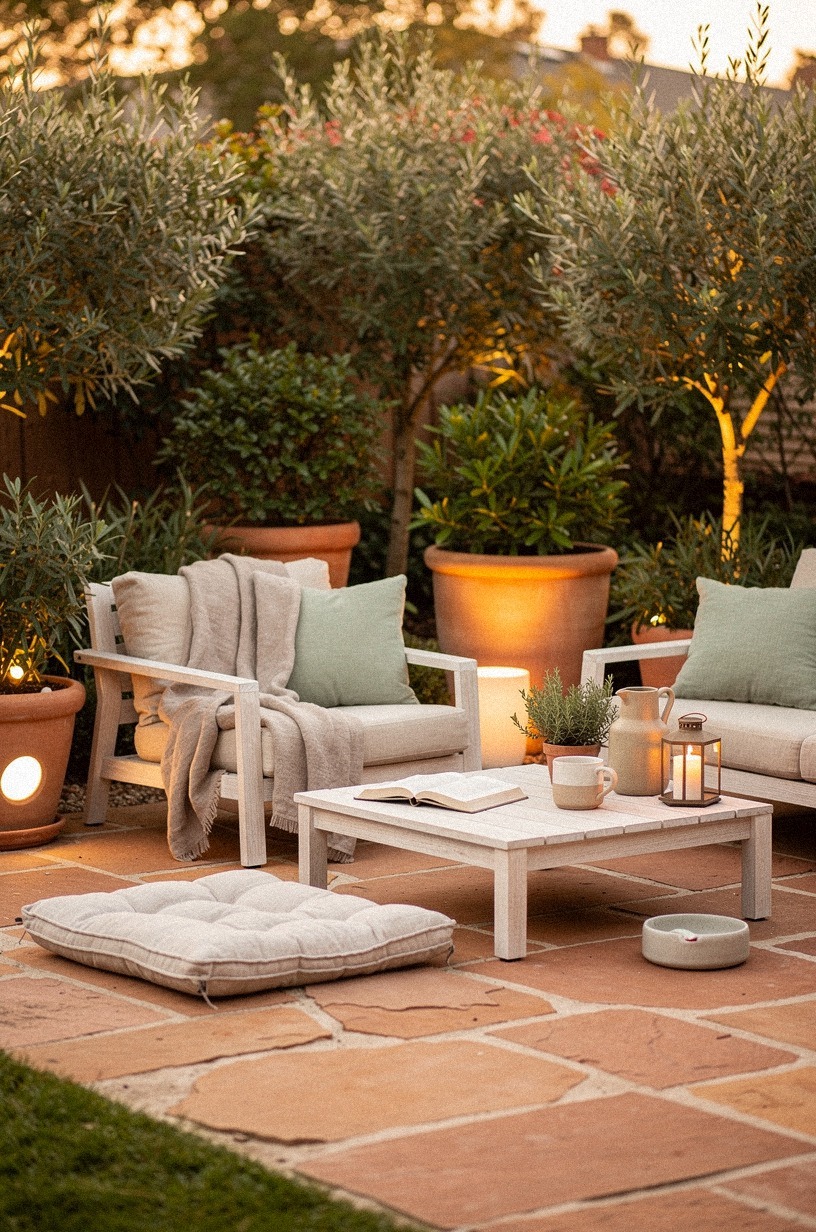
A dog-friendly backyard doesn't mean sacrificing the patio. The move is choosing materials that handle claws and water without turning into a maintenance job.
Terracotta stone laid in a warm, irregular pattern gives you a surface that stays cool underfoot and forgives a muddy paw print. Pair it with cerused white oak furniture, the kind with a lived-in finish that looks better after a season outside.
The grain opens up and silvers slightly, which hides the wear that would scream on a painted set.
I've found that dogs gravitate toward seating areas because that's where you are. If your outdoor sofa is tucked against the house with no sightline to the lawn, your dog will camp on the step instead.
Pull the seating out a little. Add olive-green potted plants in simple terracotta, nothing fussy.
The green reads as shade even in full sun, and the pots are heavy enough that a leaning dog won't topple them. If you're working with a smaller footprint, our 23 cozy small backyard ideas that feel bigger than they are has layouts that keep the dog in view without crowding the furniture.
The real win here is the combination of warm stone and pale wood. It photographs well, it ages honestly, and it doesn't look like you bought a "set" in April and regretted it by July. That's the part nobody tells you.
The patio isn't the background. It's the room.
2Define a shallow gravel run along the fence line
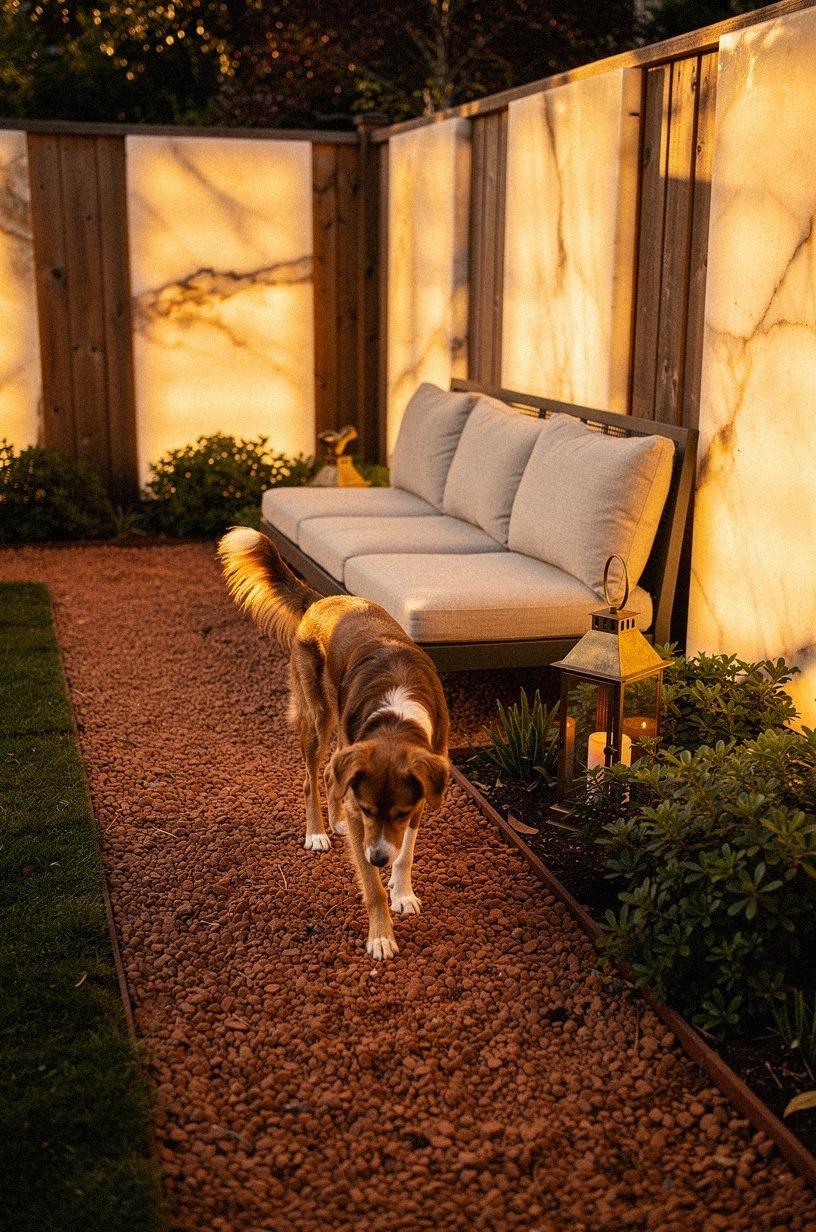
Dogs need a track. They patrol the perimeter by instinct, and if your grass is there, it's dead by August.
A shallow gravel run, maybe eighteen inches wide, gives them a path that drains fast and doesn't hold smell. Clay-colored gravel is the move here.
It's warm, it blends with most hardscaping, and it doesn't glare like white limestone.
I learned the hard way that depth matters. Two inches is plenty. Four inches and your dog starts kicking it everywhere, and you'll find pebbles in the house for weeks.
Line the edge with something low, a steel strip or a row of pavers, so the gravel stays put. The linen-textured outdoor cushions on your nearby seating will pick up the same warm tone, and the whole zone starts to feel intentional rather than resigned.
The aged brass accents are a small detail that pays off. A hose bib, a gate latch, a simple wall sconce. They go from shiny to soft in about six weeks, and that patina is the difference between "installed" and "settled." If your dog is a digger, skip the loose mulch near this run.
Gravel only. Mulch is a toy.
3Build a low stone wall that doubles as extra seating
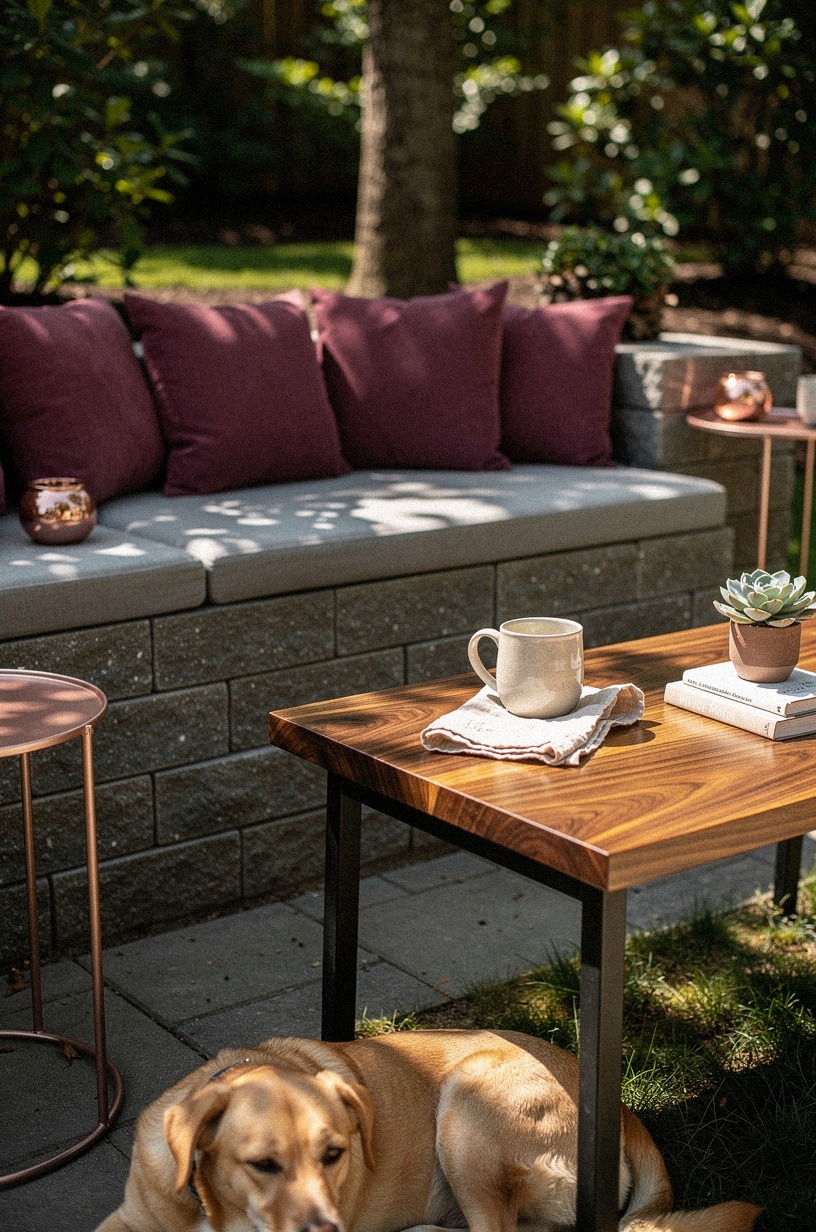
A wall you can sit on is one of the most useful things in a backyard. It defines space without blocking it, and dogs treat it like a bench they own. Grey stone, honed smooth enough for jeans but textured enough to grip, is the sweet spot.
I've used limestone and bluestone, and both work if the cap is flat and wide. Twelve inches is the minimum for a comfortable perch.
Fourteen is better.
The plum-colored throw pillows sound like a risk outside, but the move is the fabric. Solution-dyed acrylic or a good Sunbrella canvas means the color holds through rain and the occasional muddy paw.
The grey stone against that depth of color is what makes the space feel designed rather than assembled. And the rose gold accents, a small side table or a planter edge, warm up the coolness of the stone without fighting it.
Behind the wall, book-matched walnut wood on a storage bench or a built-in planter box ties the hardscape back to the house. It's a small move that makes the backyard feel like an extension of the interior rather than an afterthought.
Dogs love the wall because it's height. They can see the whole yard.
Honestly, I think that's half the appeal for them. The other half is that it's usually in the sun.
4Plant a dense hedge border for natural privacy
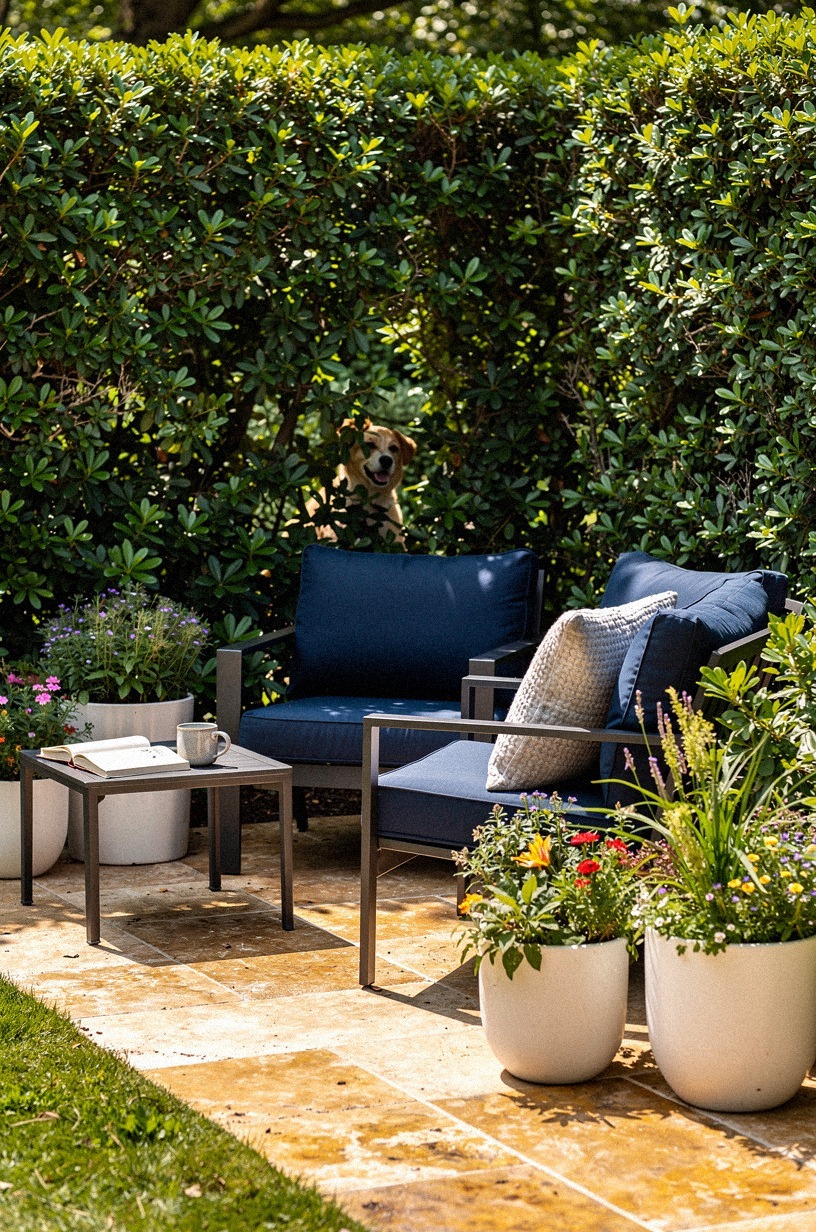
A fence is a statement. A hedge is a room.
If you've got the patience, a dense border of viburnum or arborvitae gives you privacy that softens over time and doesn't feel like you're hiding from the neighbors. The key is density at the base.
Dogs push through gaps. Plant tight, two feet on center, and accept that the first two years will look a little thin. By year three, it's a wall of green.
The navy-blue outdoor furniture against that green is a combination that works in every light. Morning, it's crisp.
Evening, it goes moody. The white ceramic planters in front of the hedge, simple cylinders with a single olive tree or boxwood ball, keep the ground plane clean.
Dogs won't bother them if they're heavy and slightly boring. The warm travertine stone pathways that run between the hedge and the seating area give you a dry route even after rain, and the natural pitting of the stone hides the dirt that dogs inevitably track.
I put this idea fourth because it's the one that takes longest to pay off. But it's also the one that makes the backyard feel finished. The hedge is the architecture.
Everything else is furniture. And the dog peeking through a gap in the foliage?
That's the photo you'll actually want to keep.
5Install a pergola with draped outdoor fabric overhead
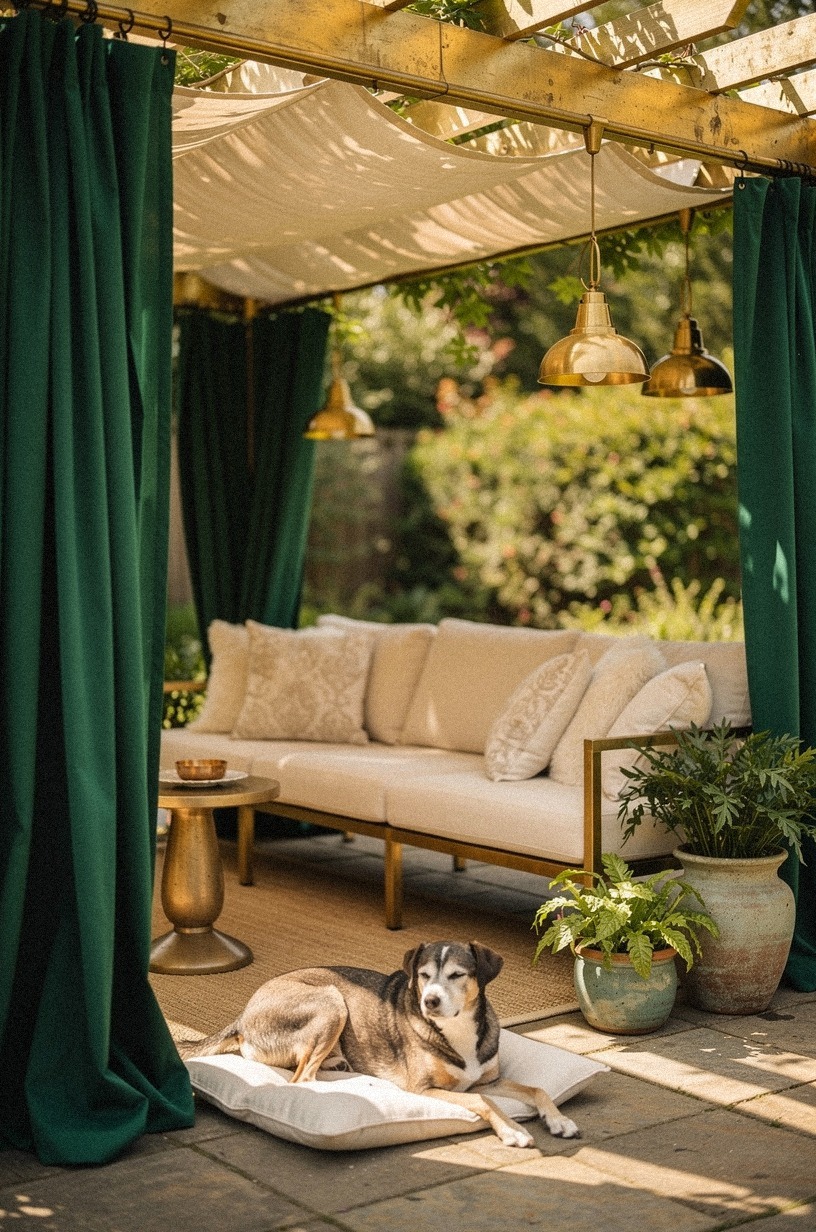
A pergola without fabric is a skeleton. Add emerald green curtains in a heavy outdoor linen, and you've got a room that happens to be outside.
The fabric filters light without killing it, and the movement in a breeze is what makes the space feel alive. Dogs notice this.
They'll nap in the shifting shade for hours.
The gold metal fixtures on the pergola frame need to be powder-coated, not painted. Paint flakes.
Powder coat wears. The cream-colored seating underneath should be deep enough that you can tuck your legs up, and the dog can stretch out beside you without crowding.
Unlacquered brass develops a soft patina that matches the green fabric surprisingly well. It's a detail that looks expensive because it is, but you don't need much of it.
A single light fixture, a pair of hooks for the curtains.
The draped fabric also helps with sound. It softens the hard surfaces that make a backyard feel like a parking lot.
Stone, concrete, glass. The fabric absorbs the bounce.
And honestly, the green is the right call here. It's the color of shade, of depth, of a place that feels cooler than the air around it.
If you're wondering how to make a larger space feel this intimate, our how to make a large backyard feel cozy not empty breaks down the same principles at scale.
6Lay a large-format porcelain tile patio for easy hosing
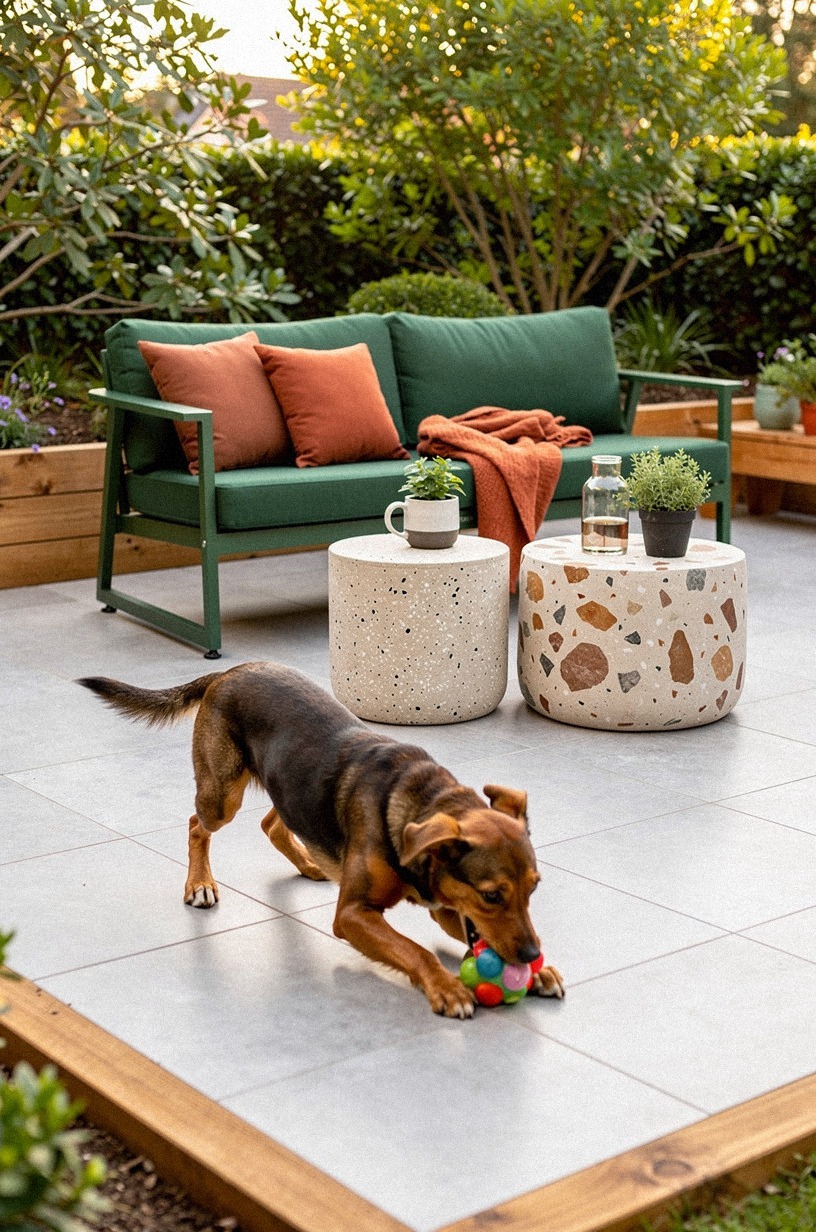
Porcelain tile outdoors used to feel wrong. Too slick, too cold, too much like a bathroom.
The new large-format stuff, 24-by-48-inch slabs in a warm grey or soft white, is different. It's matte, it's textured, and it hoses clean in about thirty seconds.
That's the feature you want if you've got a dog that swims, rolls, or just finds mud with supernatural accuracy.
The forest green outdoor furniture on this surface is a bold move that pays off. Green on grey is a combination that reads as grounded, not trendy.
The rust-colored accents, a single planter or a throw, warm up the coolness of the tile without fighting it. And the natural oak borders at the edge of the patio, a low bench or a planter box, keep the whole thing from feeling like a showroom floor.
I used porcelain on a project last year because the client had two Labs and a white sofa inside. The patio was the transition zone. Dogs came in wet, got hosed on the tile, dried on the oak bench, and only then hit the house.
The oversized-chip terrazzo detail in a few of the tiles, a subtle variation, gives the eye something to rest on without demanding attention. It's the kind of detail that makes a space feel designed by someone who understood the brief.
Which, in this case, was "dogs live here."
7Set up a galvanized stock tank as a splash pool
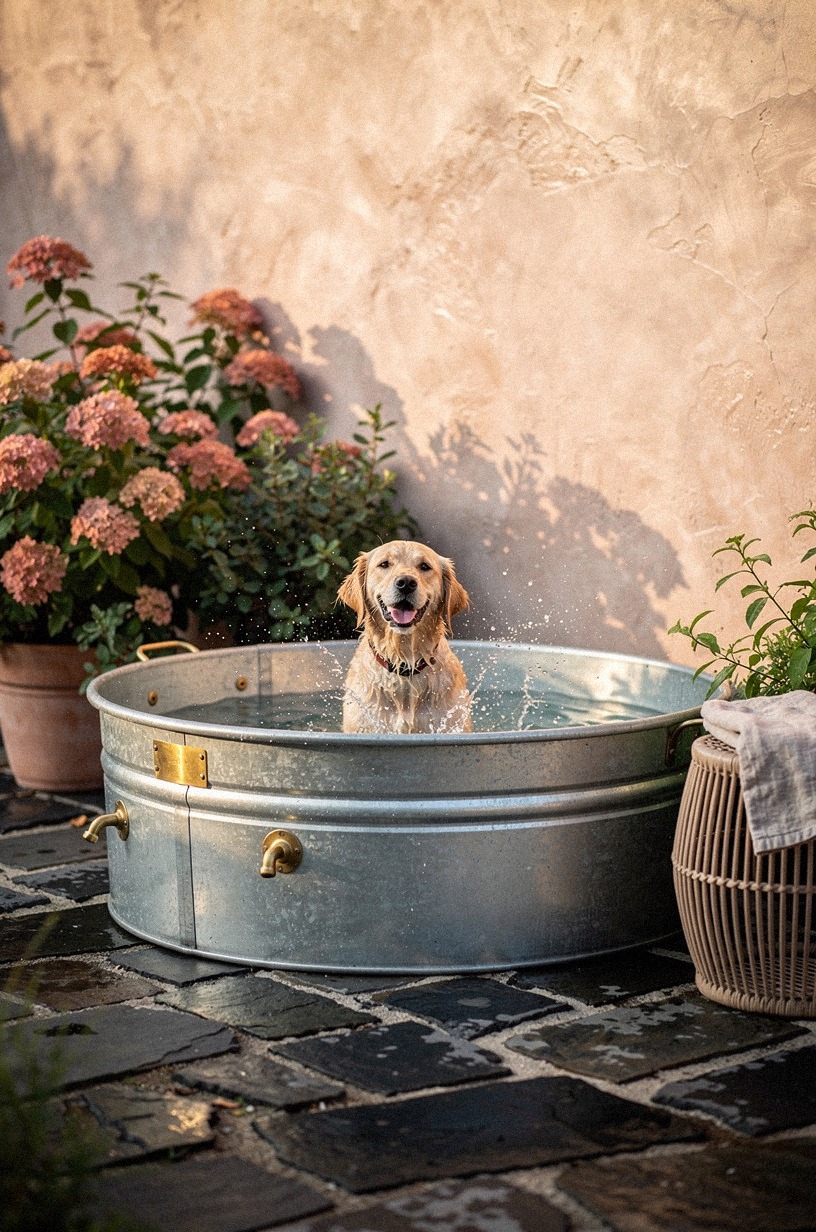
A stock tank pool is the best backyard tip for dogs, and I don't use the word tip.
8String cafe lights in a zigzag above the lawn
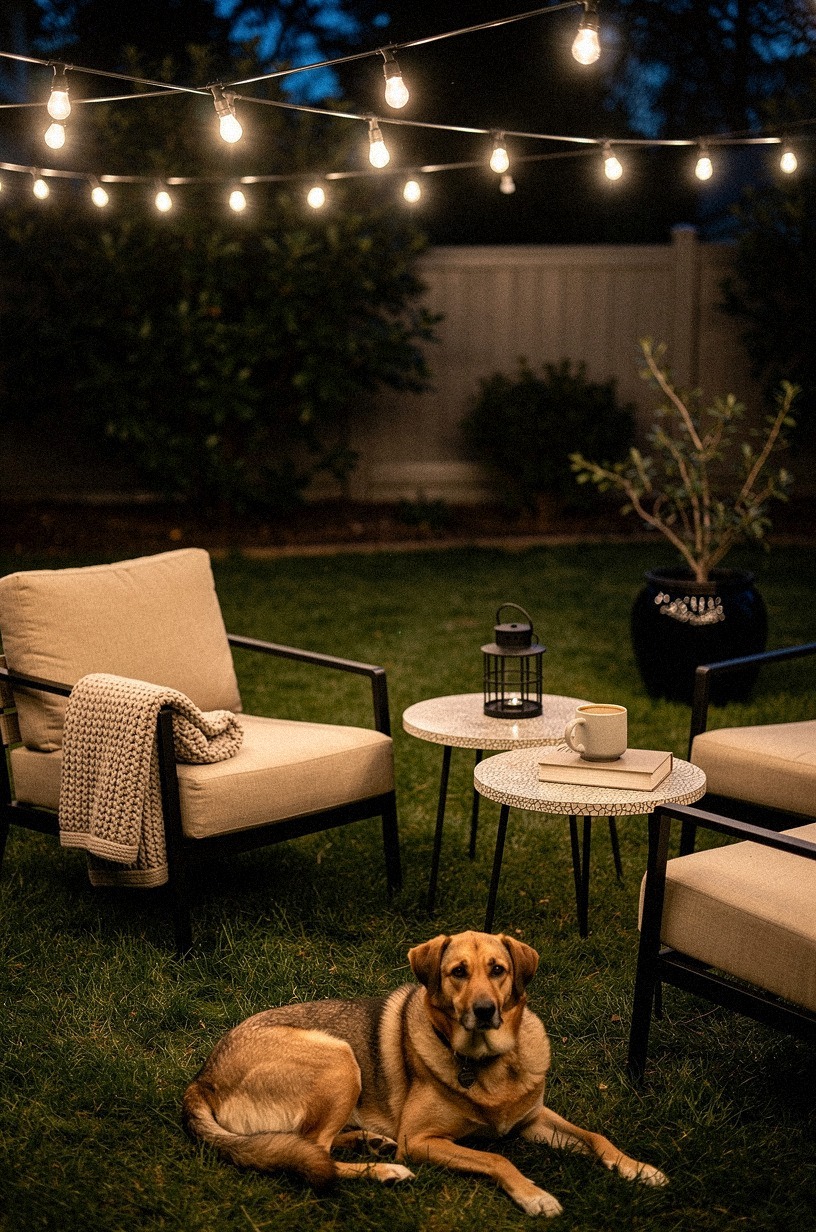
Cafe lights are the easiest way to make a backyard feel like a place after six p.m. The zigzag pattern, not a straight line, is what gives you coverage without looking like a parking lot.
Warm white bulbs, 2700K, nothing bluish. The blue light is for security cameras.
The warm light is for people and dogs who want to stay out past dinner.
The camel-colored outdoor furniture underneath should be low and deep. A few floor cushions, a low table, a place to sprawl.
The black accent details, the cord, the stakes, the simple clips that hold the wire, keep the installation from feeling decorative. It's functional.
It's honest. And the shagreen-textured side table is a small piece that adds texture without demanding attention.
I string lights on galvanized steel cable, not the cheap wire that sags after a season. The cable costs more upfront but holds tension for years.
The zigzag needs anchor points, usually the house wall and a fence post or a tree. If you're using a tree, pad the cable so it doesn't cut the bark as the tree grows. That's the kind of detail you learn after killing a branch.
The lights themselves are the cheapest part of this idea. The installation is what makes it last. And the dog doesn't care about the lights, but he'll sleep longer under them. Something about the warm glow slows everything down.
9Add a weatherproof outdoor daybed under a tree
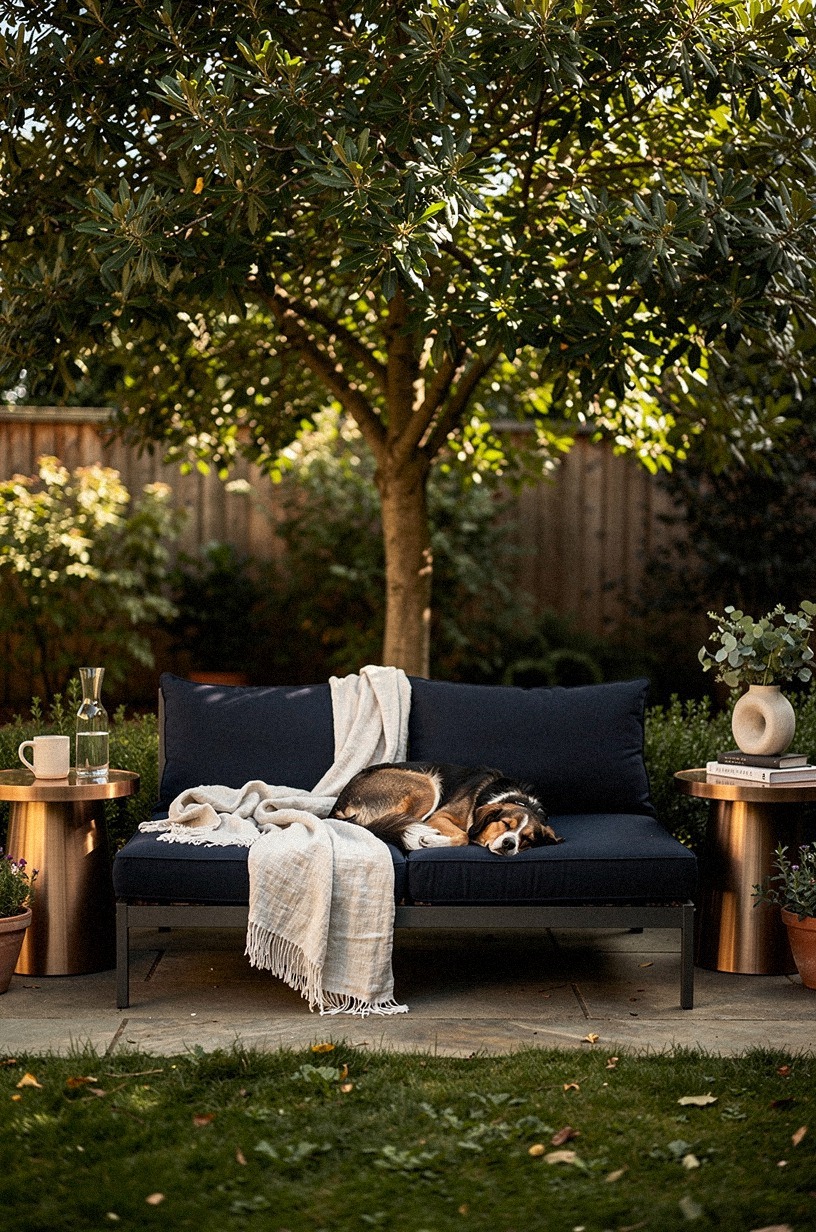
A daybed outdoors sounds like a luxury. It's actually one of the most used pieces if you've got a dog. They want to be where you are, and a daybed under a tree is the coolest spot in the yard by about two p.m.
The midnight blue cushions in a solution-dyed fabric hold their color through sun and rain, and the depth of the blue against green leaves is a combination that works in every season.
The copper side tables are the detail that makes this feel like a room. They weather to a soft bronze in about a month, and the patina is the difference between "placed" and "grown." The ivory throw blankets, washed Belgian linen with a lived-in texture, are for you, but the dog will claim them.
That's fine. Linen only gets better with abuse.
The tree is the architecture here. A mature oak or a good maple gives you the canopy, the dappled light, and the root structure that keeps the ground slightly raised and dry. Don't fight the roots.
Build the daybed platform around them, a few inches above grade, with gaps for air. The dog will sleep underneath it too, in the coolest pocket of shade.
If your dog is older or joint-sensitive, our how to set up a dog grounding mat has indoor setups that pair well with this outdoor rest zone.
10Create a raised planter bed with dog-safe herbs
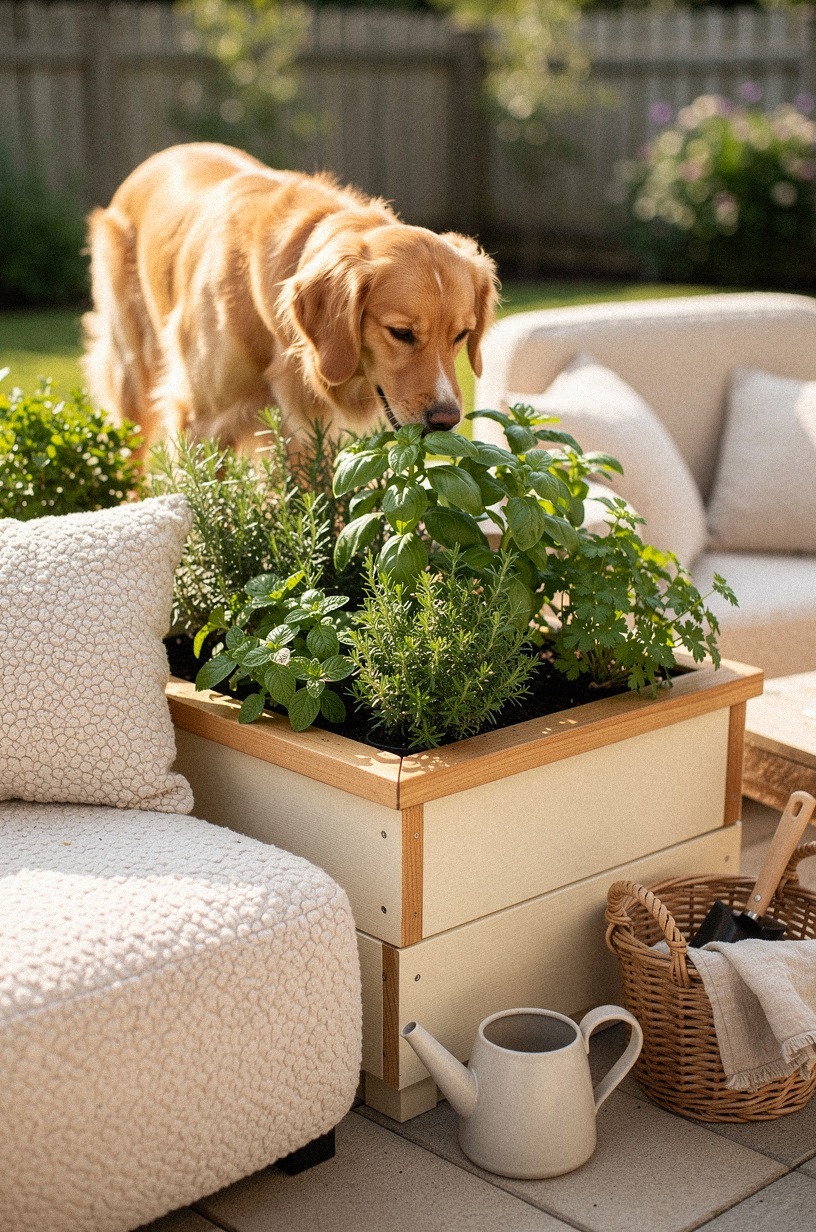
Dogs eat grass. They also eat herbs if the herbs are interesting enough.
A raised planter bed, eighteen inches high and lined with cedar, keeps the plants in reach of your kitchen and out of reach of a digging paw. The sage green plants themselves, rosemary, thyme, and basil, are safe for dogs and smell good enough that they'll sniff without destroying.
The warm cream wooden frames of the bed should be simple. A box, four legs, no ornament.
The natural wood accents, a few birch poles or a single oak slab as a shelf, keep the material palette honest. And the organic bouclé-textured outdoor cushions on a nearby bench give you a place to sit while the dog investigates the new smells.
The height is the key. Too low and it's a sandbox.
Too high and it's a table. Eighteen inches is the height of a chair seat, which means you can work the bed without bending, and the dog can sniff without climbing.
I line the bottom with hardware cloth to stop burrowing from below, and I fill with a mix of potting soil and compost. The herbs grow fast, the dog stays interested, and you get a kitchen ingredient that cost you nothing but the setup.
If you're introducing new sensory elements to your dog's space, our how to introduce your dog to a grounding mat has a method that applies to any new texture or scent.
11Run a wide stepping-stone path through the grass
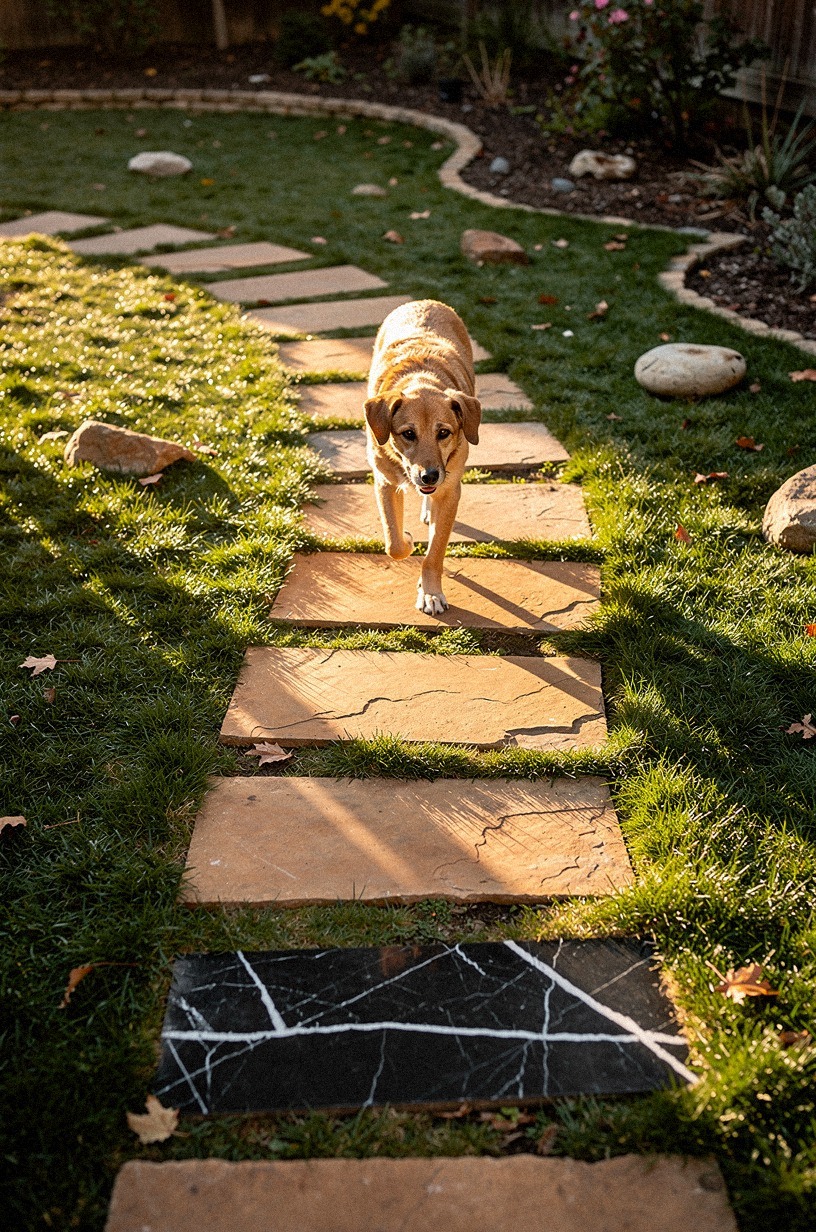
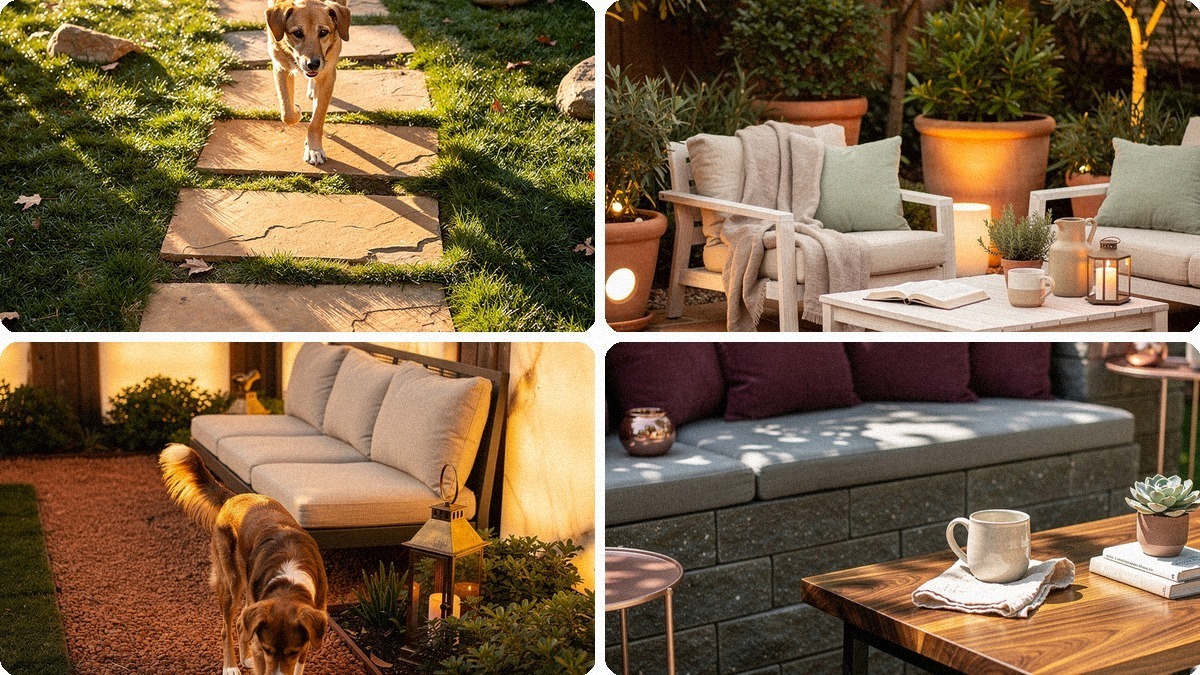
A path is a promise. It tells the dog where to go, and it tells you where to walk without crushing the lawn. Terracotta-colored stones, eighteen to twenty-four inches across, set into the grass with about two inches of space between them, give you a surface that drains and a route that reads as design.
The olive green grass between the stones is the real color here. It's not the bright green of fertilizer.
It's the deeper tone of grass that gets some shade and some stress, which is what most backyards actually have. The natural stone edges, left rough rather than cut straight, keep the path from feeling like a sidewalk. And the Nero Marquina black marble detail on a single stone, a small inlay or a contrasting cap, is the move that makes someone stop and look.
I set these stones on a bed of sand, not concrete. They shift slightly over time, which is fine. The path should feel like it belongs to the yard, not like it was imposed on it.
The dog will use it immediately. They prefer defined routes to open grass, especially when the grass is wet. And the spacing, two inches, is enough for grass to grow but not enough for a paw to slip through. That's the detail that took me two tries to get right.
The first path was too tight, and the grass died. The second was too loose, and the stones rocked.
Two inches is the balance.
12Hang a wall-mounted hose reel by the back door
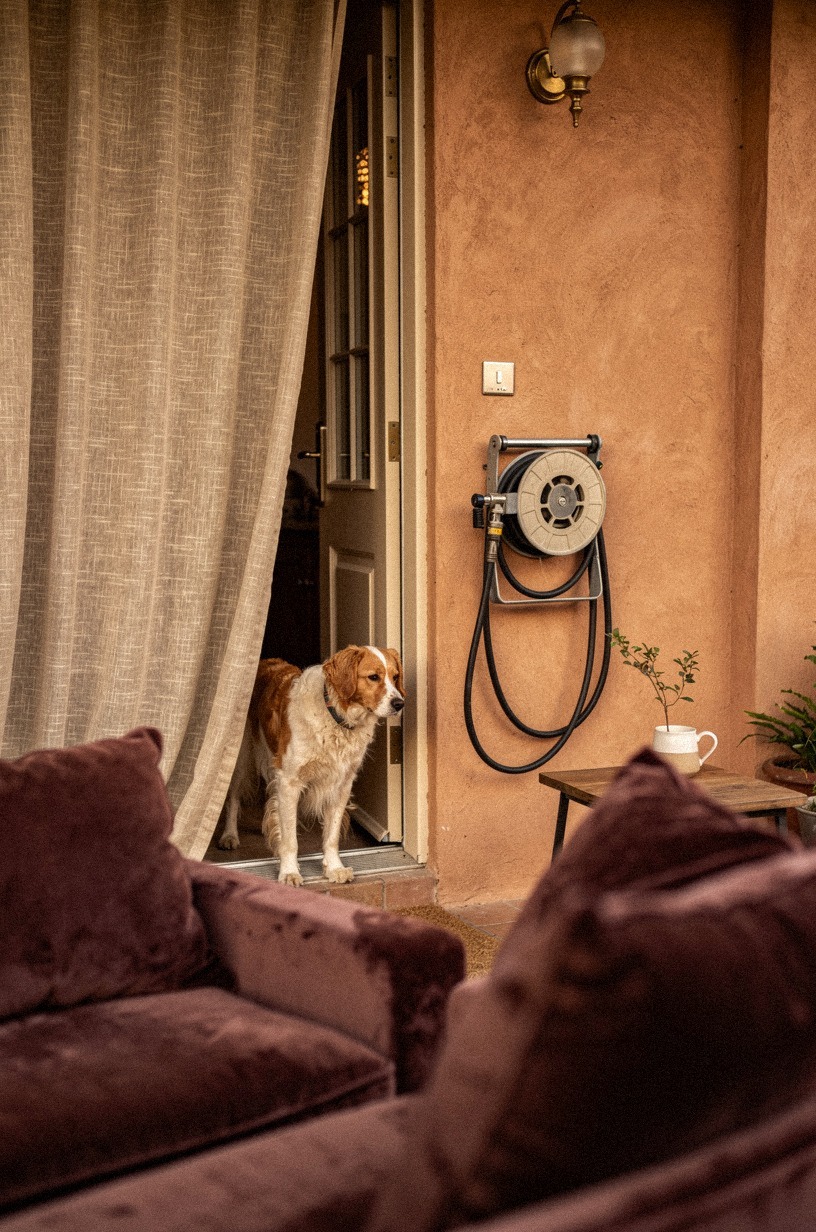
This is the least glamorous idea and the one you'll use most.
The Honest Cost of a Dog-Friendly Backyard Refresh
I've spent enough on outdoor projects to know that the budget is where good intentions go to die. The table below is based on what I've actually paid or quoted for similar work. These are US averages, not exact figures, and the range depends on whether you're doing the labor or hiring out.
The budget tier is where most of these ideas live. A stock tank, a hose reel, a string of lights, and a few good cushions.
The mid tier is where you add the stone patio, the pergola, or the real furniture. The high tier is a full rebuild, and honestly, most dogs don't care about the outdoor kitchen. They care about the shade, the water, and where you are.
The material table is more specific, and it's where I usually start when someone asks me what to buy first.
Teak is the investment that pays off. It silvers, it holds screws, and it doesn't splinter under claws. A polypropylene rug is the budget move that looks like a splurge. It hoses clean, it dries in an hour, and the patterns have gotten surprisingly good.
LED string lights are the cheapest mood upgrade you can make, and Sunbrella cushions are the difference between a seat you use and a seat you cover with a tarp. I've learned that the hard way twice.
The first set of cushions I bought were "outdoor" in name only. They mildewed in six weeks. Sunbrella is the standard for a reason.
Why the Best Dog Backyards Don't Look Like Dog Backyards
Here's the thing. The backyards that work for dogs aren't the ones with the most gear. They're the ones where the dog's needs and the human's taste happen to overlap.
Shade, water, a path, a place to watch the house. Those are dog instincts.
They're also design principles. The best spaces solve both without either side feeling like they compromised.
I've made the mistake of over-engineering. A dedicated dog zone, a special surface, a piece of furniture just for them.
It never works. The dog wants the sofa you're on, the patch of sun you're in, the door you're near. The solution is to make the whole yard comfortable enough that the dog's presence doesn't feel like a disruption.
That means materials that age well, surfaces that clean fast, and furniture that's deep enough for two species.
The other mistake is thinking that dog-friendly equals cheap. It doesn't.
A Calacatta Gold marble side table will survive a dog's tail better than a pressed-wood knockoff. Unlacquered brass handles the humidity and the occasional chew. Belgian flax linen gets better with the wear that would destroy a synthetic.
The investment is in quality that lasts, not in products labeled "pet-safe" that fall apart in a season.
The trend I'm seeing in 2026 is the disappearance of the line between indoor and outdoor material. People are using interior fabrics outside, interior furniture on covered patios, and interior color palettes in the garden.
The dog doesn't know the difference. But the human feels the coherence, and that's what makes the backyard a place you actually use.
Not a project you finished. A room you live in.
The Questions I Get Asked Most
What is the best backyard setup for a small yard with a dog?
A shallow gravel run along the fence and a raised planter with herbs. Both give the dog territory without eating the lawn. If space is tight, our 23 cozy small backyard ideas that feel bigger than they are has layouts that keep the dog in view without crowding the furniture.
Where can I buy outdoor pieces on a budget?
IKEA for the basics, Target Threshold for textiles, and Wayfair for the mid-range furniture. The real tip is Facebook Marketplace for teak and brass. People sell outdoor sets every September for a fraction of retail.
Sunbrella cushions are worth buying new, but the frames rarely are.
How much does a dog-friendly backyard refresh cost?
About $200 to $900 for a budget pass with textiles, lights, and plants. A mid-range patio and furniture run lands around $1,500 to $6,000.
The high end, with a pergola and paving, starts near $10,000. Most of the ideas in this article sit in the budget tier.
Can I create a dog-friendly backyard on a tight budget?
Yes, and the free moves are the most important. Move your seating to a shadier spot.
Define a gravel path with stone you already have. Hang a string of lights you own.
The only purchase I'd insist on is a galvanized stock tank for water. It's about $150 and lasts a decade.
Is a backyard upgrade worth it in a small space?
Absolutely. Small yards force you to be intentional, which is where good design lives.
A dog in a small backyard uses every corner. The right path, the right shade, and the right seating make the space feel larger because it functions better.
Worth it is the right word here.
Is a dog-friendly backyard a good idea for a rental?
Yes, if you stick to removable changes. A stock tank is portable.
String lights come down in ten minutes. Raised planters on legs leave no mark. Even a gravel run can be laid on landscape fabric and lifted whole.
The only thing I'd skip in a rental is the stone patio. That's a conversation with the landlord.
Where I'd Start First
If I had to pick one, I'd start with the gravel run along the fence. It costs almost nothing if you already have gravel, it saves your lawn, and it gives the dog a job.
Everything else builds on that. The patio, the seating, the lights.
They all look better when the grass isn't dead. Get the path right first.
The rest lands.