
 by
by I've installed a lot of privacy screens, and the ones that fail aren't the cheap ones. They're the ones where nobody thought about what happens at eye level. A six-foot fence looks solid on paper and it feels like a cage the first time you sit down with coffee. The best backyards don't block the neighbors. They redirect your attention somewhere better. Here's what actually works.
- Plant a pleached hornbeam hedge for living architecture
- String café lights overhead in a zigzag canopy
- Build a partial stone wall with a planted top
- Drape outdoor curtains on a simple galvanized rod
- Lay a cedar pergola with climbing jasmine
- Sink a sunken fire pit into a gravel circle
- Float a weathered teak daybed under a mature tree
- Run a narrow water rill along one boundary
- Stack terracotta pots in a staggered privacy screen
- Paint a garden shed interior in deep moss green
- Hang a vintage mirror on a weathered fence panel
- Scatter low zinc lanterns along a stepping-stone path
- Train espaliered fruit trees flat against a boundary wall
- Tuck a woven willow arch over a hidden bench
- Rig a retractable shade sail at a sharp angle
1Plant a pleached hornbeam hedge for living architecture
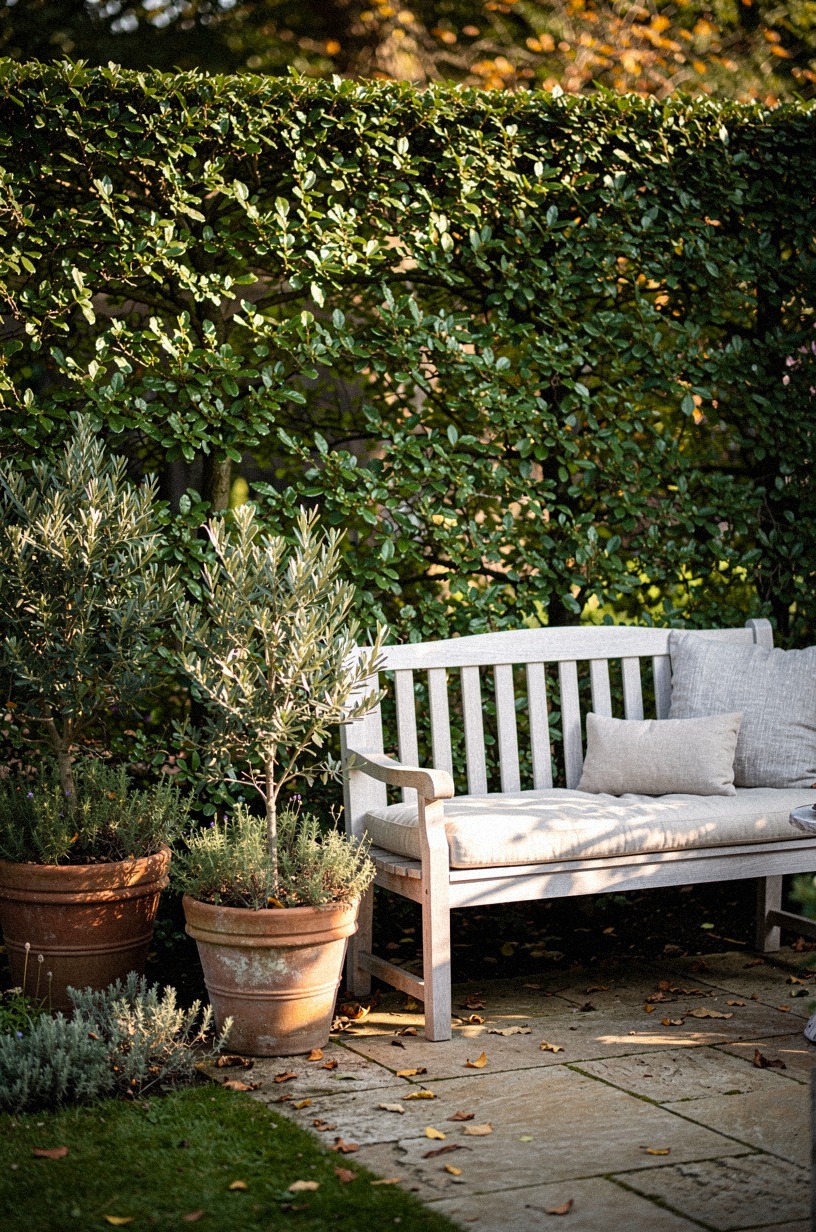
A pleached hornbeam hedge is the closest thing to a green wall that still breathes. The branches are trained horizontally along a frame until they knit together, which gives you privacy at exactly the height you need it without turning the yard into a box. It takes two to three growing seasons to fill in, so if you're impatient this isn't your move.
But once it closes, you've got something no fence can match: a screen that changes with the light and drops leaves in autumn like a curtain.
Start with Carpinus betulus 'Fastigiata' at eighteen-inch centers. The narrow upright habit trains faster than standard hornbeam.
You'll need a simple frame of galvanized wire strung between posts for the first three years. After that the wood hardens and holds the shape.
Water deeply the first season, then back off. Hornbeam that gets too much irrigation stays soft and doesn't lignify properly.
I've made that mistake. The hedge looked lush and it flopped in the first storm.
For underplanting, keep it low. Terracotta pots with olive trees or lavender at the base keep the ground plane open so the yard doesn't feel walled.
The visual weight sits at six to eight feet where you want it, not at your ankles. If you're planning the whole yard layout, our how to make a large backyard feel cozy not empty guide covers the spacing logic that makes a hedge feel intentional instead of defensive.
2String café lights overhead in a zigzag canopy
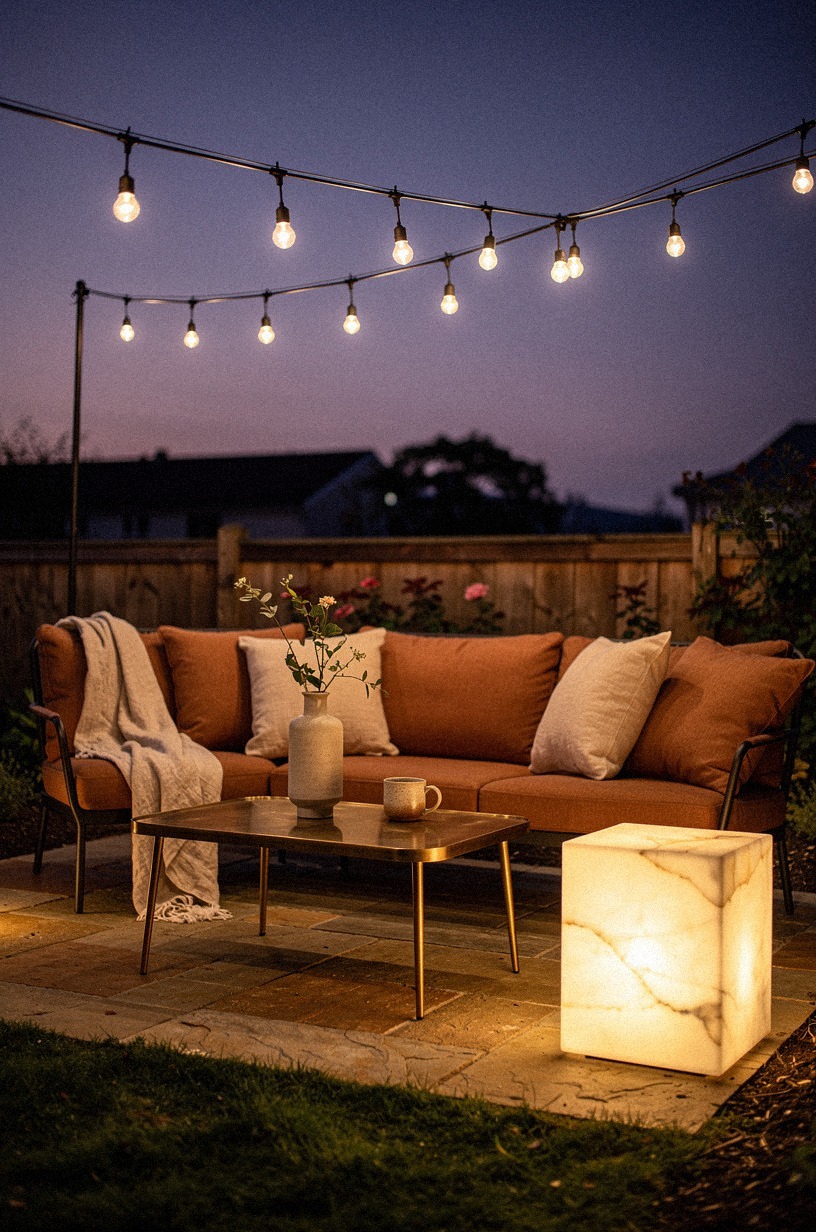
Café lights do two jobs at once. They give you a ceiling, which makes a backyard feel like a room, and they draw the eye upward so you're not looking at the neighbor's windows.
The zigzag pattern matters more than you'd think. A straight line reads as a wire.
A zigzag reads as a canopy.
Use commercial-grade LED stringers with warm 2700K bulbs. The cheap big-box versions flicker after one season and the sockets corrode. Spend the extra thirty dollars on vintage-style Edison LED strands with sealed gaskets.
String them from the house eave to a galvanized steel pole at the far end, then back again at a slightly different angle. Three runs minimum for a twelve-foot-wide space.
The overlap is what creates the density.
Keep the bulbs low enough to glow but high enough to walk under. Seven and a half feet is the sweet spot. Any lower and the wires feel like an obstacle. Any higher and you lose the intimacy.
If you're running power from the house, put the outlet on a switch inside. You'll use them more if you don't have to walk outside to plug them in.
And honestly? The warm glow against twilight is what makes you stay outside past dinner.
Everything else is just furniture.
3Build a partial stone wall with a planted top
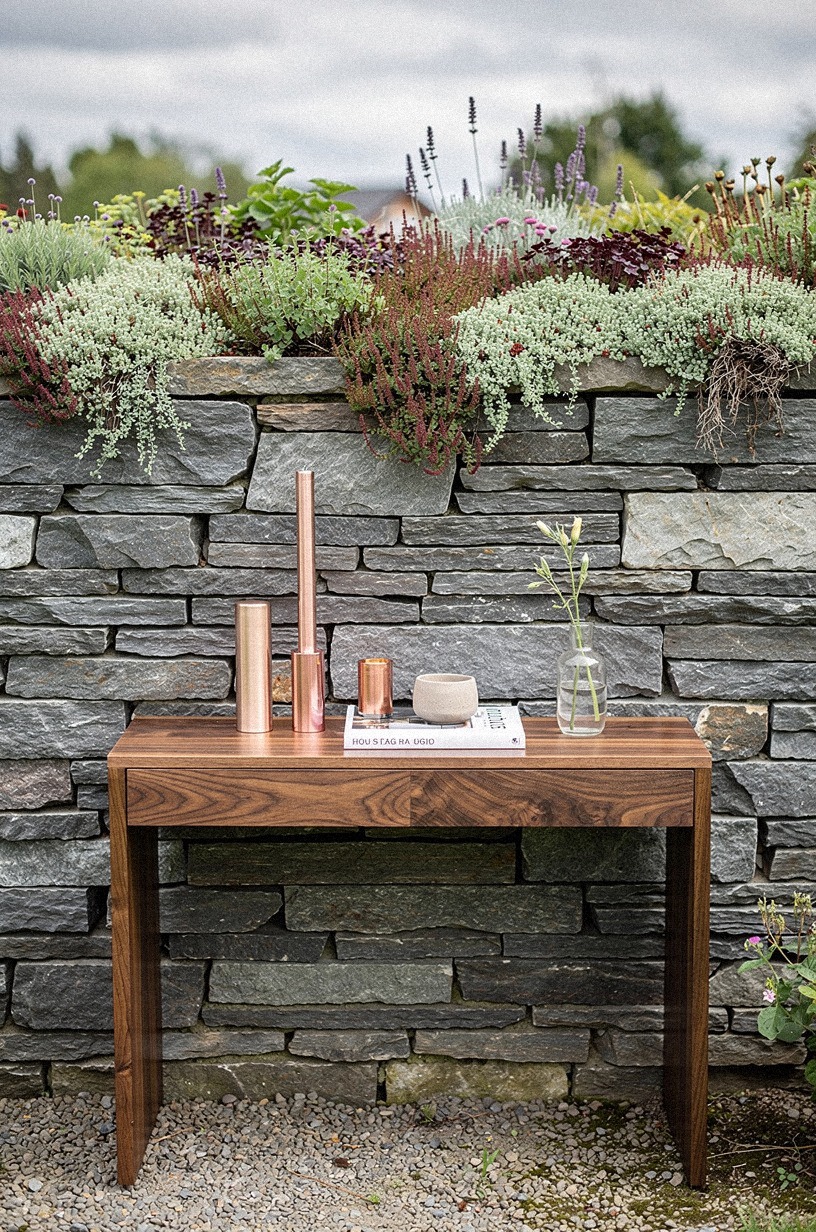
A full stone wall is expensive and it can feel like a fortress.
4Drape outdoor curtains on a simple galvanized rod
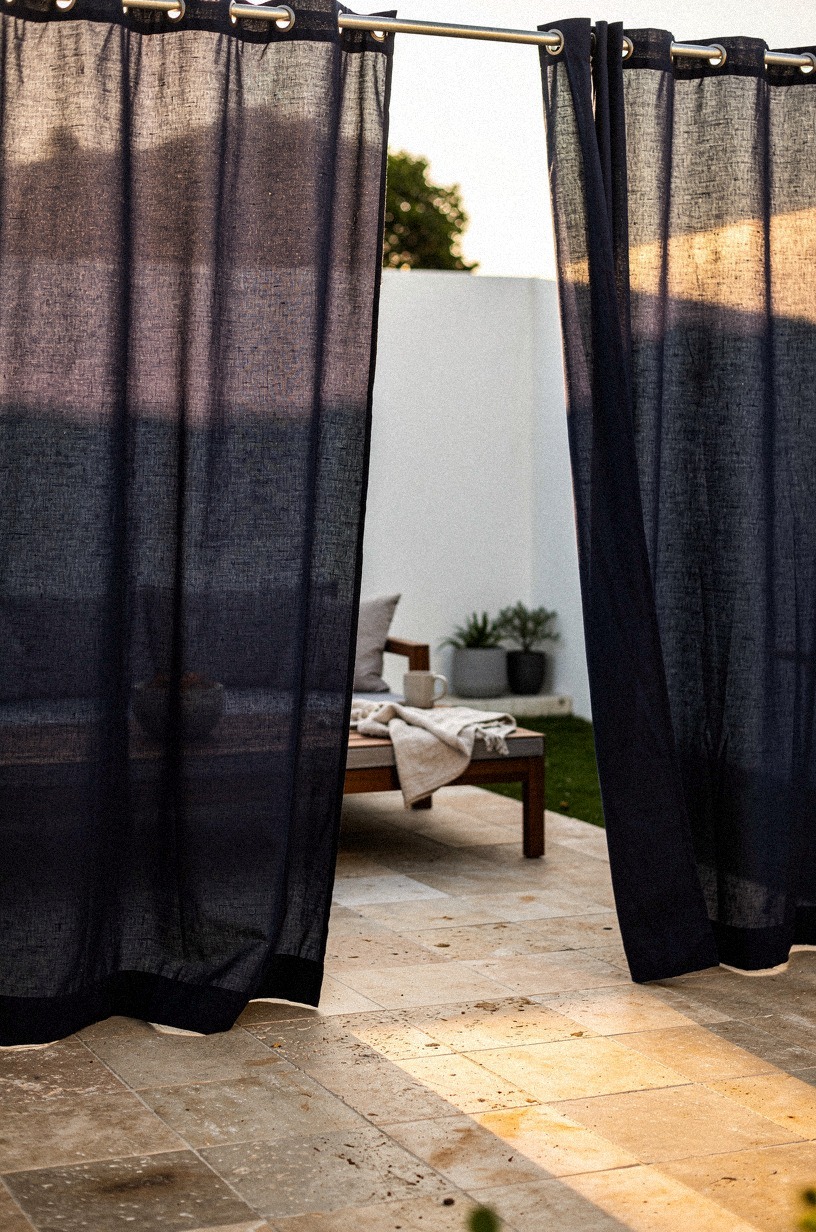
Outdoor curtains are the fastest privacy upgrade you can make. They move, which makes them feel less permanent than a wall, and they filter light instead of blocking it.
The result is soft, not defensive. A galvanized steel rod mounted on stainless steel cable between two posts gives you the structure without the visual weight of a pergola.
Choose deep navy linen or heavyweight Sunbrella canvas in charcoal or sage. The dark colors recede visually and they don't show pollen or dust the way lighter fabrics do. Panels should be double-width so they billow rather than hang flat.
Flat panels look like shower curtains. Billowing panels look like a beach club in Mykonos.
The rod needs to be one-inch diameter minimum. Anything thinner sags under the weight of wet fabric after rain. Mount it at seven feet if you want drama, six feet if you want enclosure.
Use ring clips with stainless steel hooks so you can pull the panels back in high wind. I've watched cheap grommets tear out in a thunderstorm. The curtain doesn't fail. The hole in the fabric does.
If you're on a tight budget, IKEA MAJGULL room-darkening panels in the darkest gray work surprisingly well outside for a season or two. They're polyester, not linen, but the weight is right and the price is hard to beat.
5Lay a cedar pergola with climbing jasmine
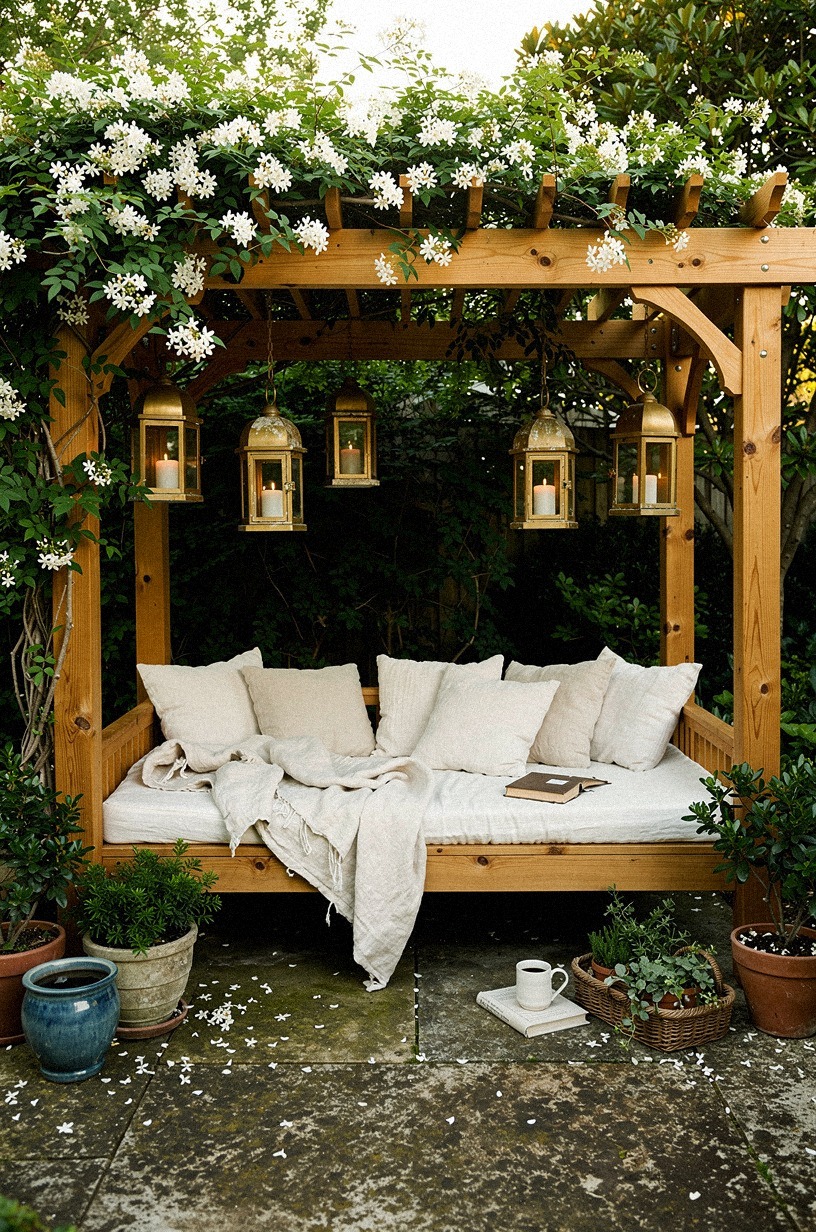
A pergola is the classic backyard ceiling, but most people build them too open. Four posts and a flat grid of beams gives you shade at noon and nothing else. A dense pergola with climbing jasmine or wisteria overhead gives you a green room that smells like summer.
The key is the slat spacing. Tight enough to support vines, open enough to let dappled light through.
Use western red cedar for the structure. It's resistant to rot without chemical treatment and it weathers to silver-grey in about two years if you don't stain it. The posts should be six-by-six, not four-by-four.
The visual scale is completely different. Four-by-four looks like a garden-center kit.
Six-by-six looks like architecture. Run the beams at twelve-inch centers and add stainless steel wire between them for the vines to grab.
Star jasmine is the beginner's choice. It's evergreen in zones eight to ten, fragrant from late spring through summer, and it fills in within two seasons. Carolina jessamine is the alternative if you want yellow trumpet flowers and faster coverage, though it's deciduous and gives you bare branches in winter.
Plant at the base of each post and train the leaders upward. Don't let them wander horizontally until they've reached the top. Horizontal growth weakens the vertical structure.
Once the canopy closes, you'll sit underneath and forget there are neighbors at all. The green filters everything.
6Sink a sunken fire pit into a gravel circle
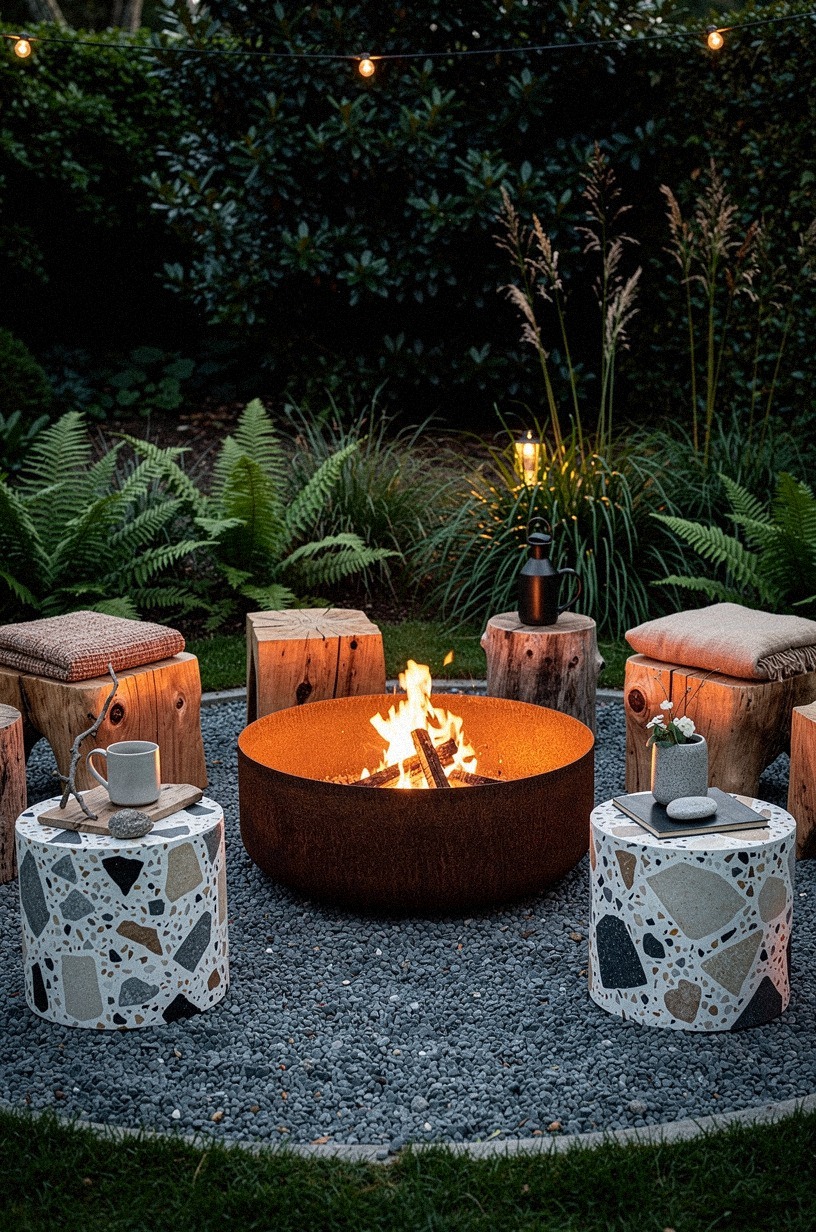
A sunken fire pit changes the geometry of a backyard. Instead of looking across flat ground toward the property line, you look down and inward toward the flame.
The conversation circle becomes the focus. The neighbors disappear from your peripheral vision without you having to build a single screen.
It's psychological privacy, which is the most effective kind.
Dig a circular depression four to six inches deep and eight to ten feet across. Line it with crushed limestone or pea gravel in warm grey.
The gravel should be three-quarter-inch for stability. Anything smaller migrates. Anything larger is uncomfortable underfoot.
Set a rusted steel bowl or cast-iron fire ring in the center. The rusted finish is called Corten steel and it stabilizes after the first season.
It won't run or stain your gravel.
For seating, oak stumps or reclaimed timber rounds at sixteen to eighteen inches high are the most comfortable height for a sunken conversation pit. Lower than that and you feel like you're sitting in a hole. Higher and you lose the intimacy. Arrange them in a circle, not a semicircle.
A semicircle reads as a stage. A circle reads as a gathering. The forest-green ferns and grasses planted at the rim soften the edge and hide the grade change from the lawn side. From the seating position, you're below grade and the planting is at eye level.
It's the simplest way to feel enclosed without building walls.
7Float a weathered teak daybed under a mature tree
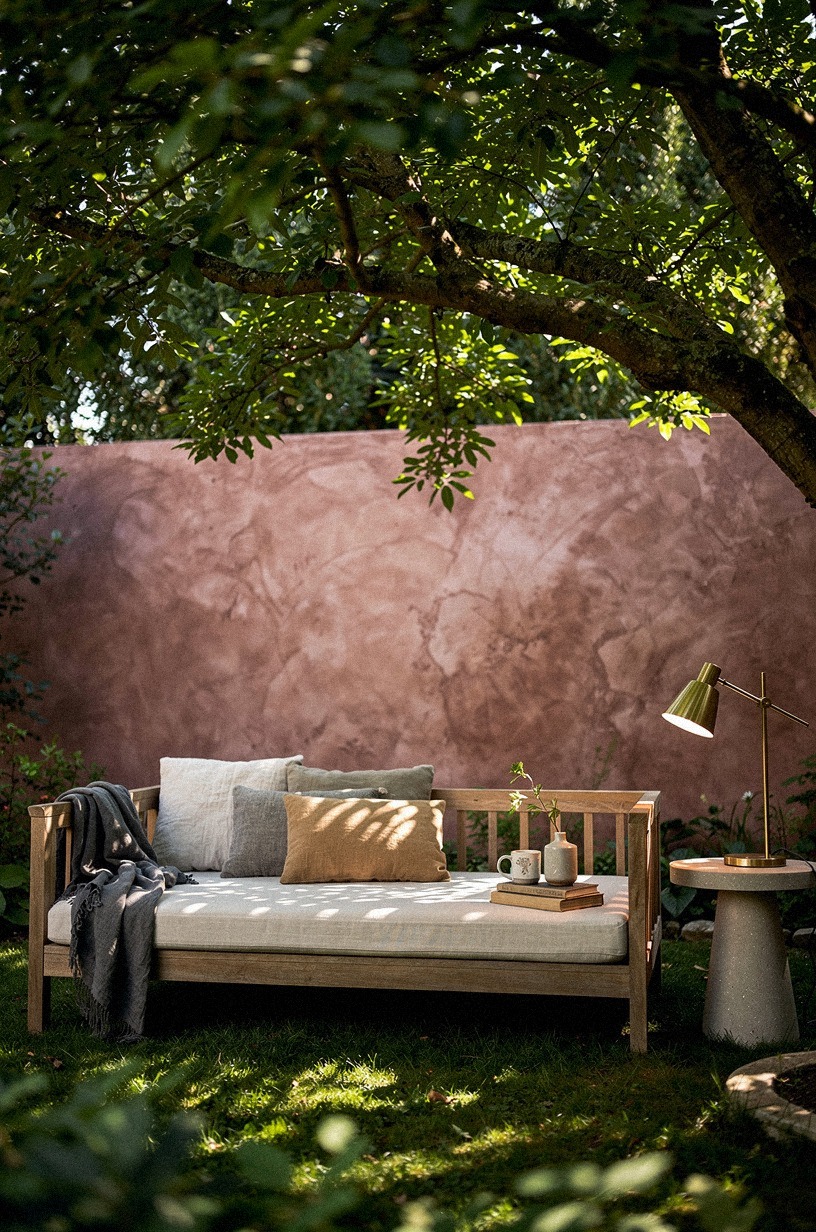
The best privacy isn't always a barrier. Sometimes it's a destination so compelling that you stop looking at what you're trying to hide.
A weathered teak daybed under a mature tree creates that destination. The canopy overhead becomes your ceiling. The trunk becomes your wall.
The daybed becomes the only thing you see.
Look for grade-A teak that's already silvered, not freshly oiled. The silver patina reads as intentional.
The honey-brown of new teak reads as temporary. The daybed should be deep: thirty-six inches from front to back minimum. Anything shallower is a bench, not a lounger.
Charcoal linen cushions with down-alternative inserts hold up better outside than foam, which molds. Add one chunky knit throw in undyed wool for the evenings.
Behind the daybed, a Venetian plaster wall in dusty rose or warm terracotta gives you a backdrop that photographs beautifully and reflects light back onto the seating. The plaster is lime-based, not acrylic, so it breathes and doesn't peel in humidity.
If you're building the wall, keep it under five feet so it doesn't compete with the tree. The tree is the architecture.
The wall is the stage. The daybed is where you end up reading until it's too dark to see the pages.
If your backyard is on the smaller side, our 23 cozy small backyard ideas that feel bigger than they are might give you the layout move you need before you place something this big.
8Run a narrow water rill along one boundary
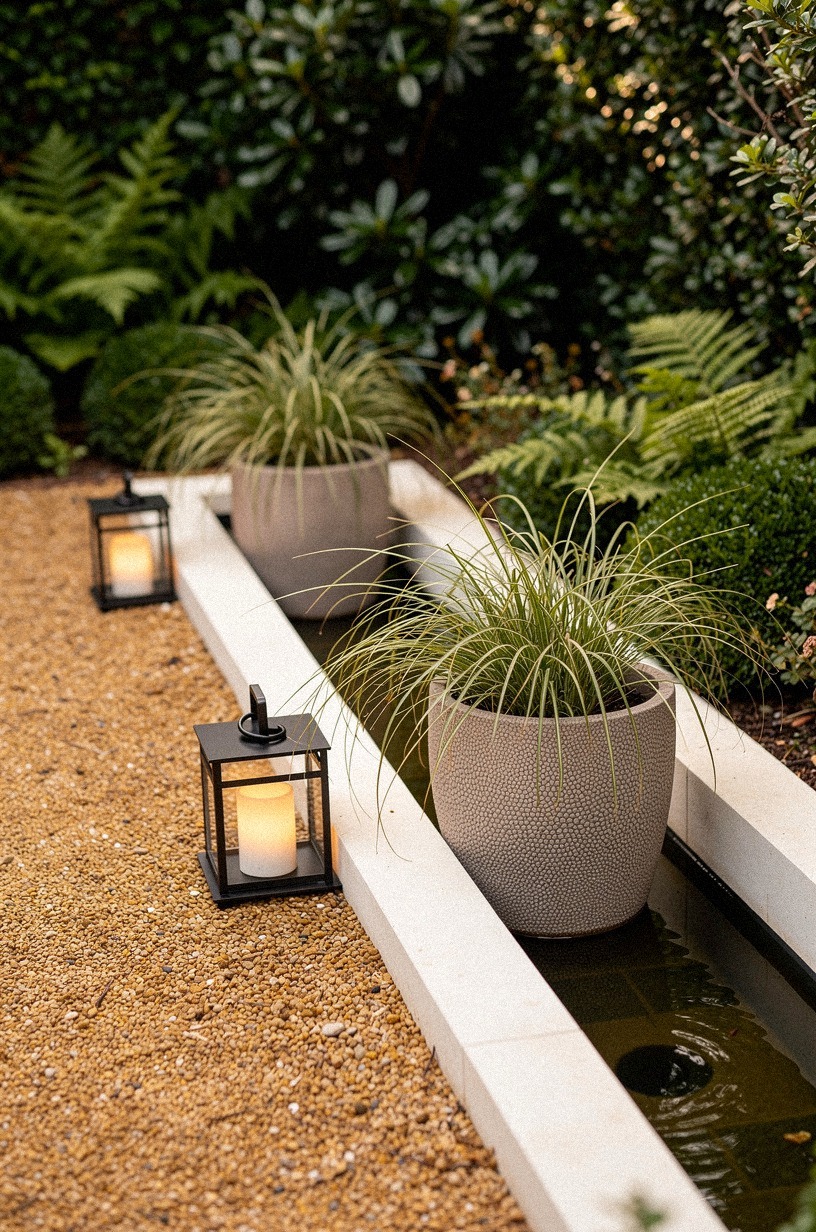
Water is the most effective privacy screen nobody talks about. The sound masks conversation.
The movement draws the eye. The reflective surface catches light and throws it back at angles that make the space feel larger and more complex.
A narrow water rill is the formal garden version of this move, and it works surprisingly well in a small backyard.
Build a channel six to eight inches wide and six inches deep into the ground along your least attractive boundary. Line it with white limestone or honed travertine so the water reads as a ribbon of light.
The stone should be sealed with a penetrating sealer meant for wet environments. Topical sealers peel when they're underwater half the time. Use a recirculating pump with a spillway at the high end and a catch basin at the low end.
The pump can be hidden in a weathered oak box that doubles as a bench.
The gravel bed alongside should be camel-colored pea stone in warm tones that pick up the limestone. The contrast between the cool water and the warm gravel is what makes the rill read as designed, not accidental.
Plant black mondo grass or dark-leafed ajuga at the edge for a sharp tonal contrast. The dark foliage makes the water brighter by comparison.
The whole installation runs about sixty to eighty dollars per linear foot if you do the digging yourself. More if you hire out.
But the sound alone is worth it! You'll sit next to it and realize you haven't heard the neighbor's dog in twenty minutes.
9Stack terracotta pots in a staggered privacy screen
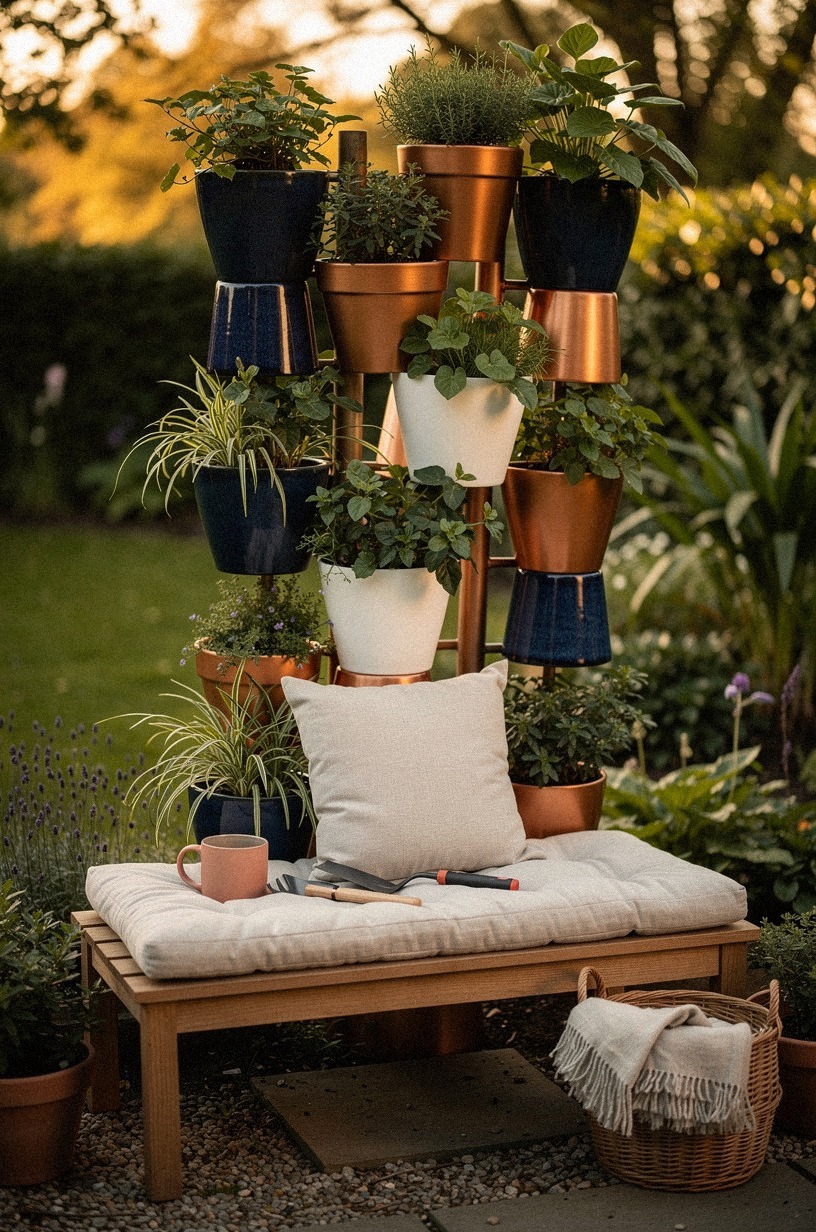
This is the budget move that outperforms most expensive installations.
10Paint a garden shed interior in deep moss green
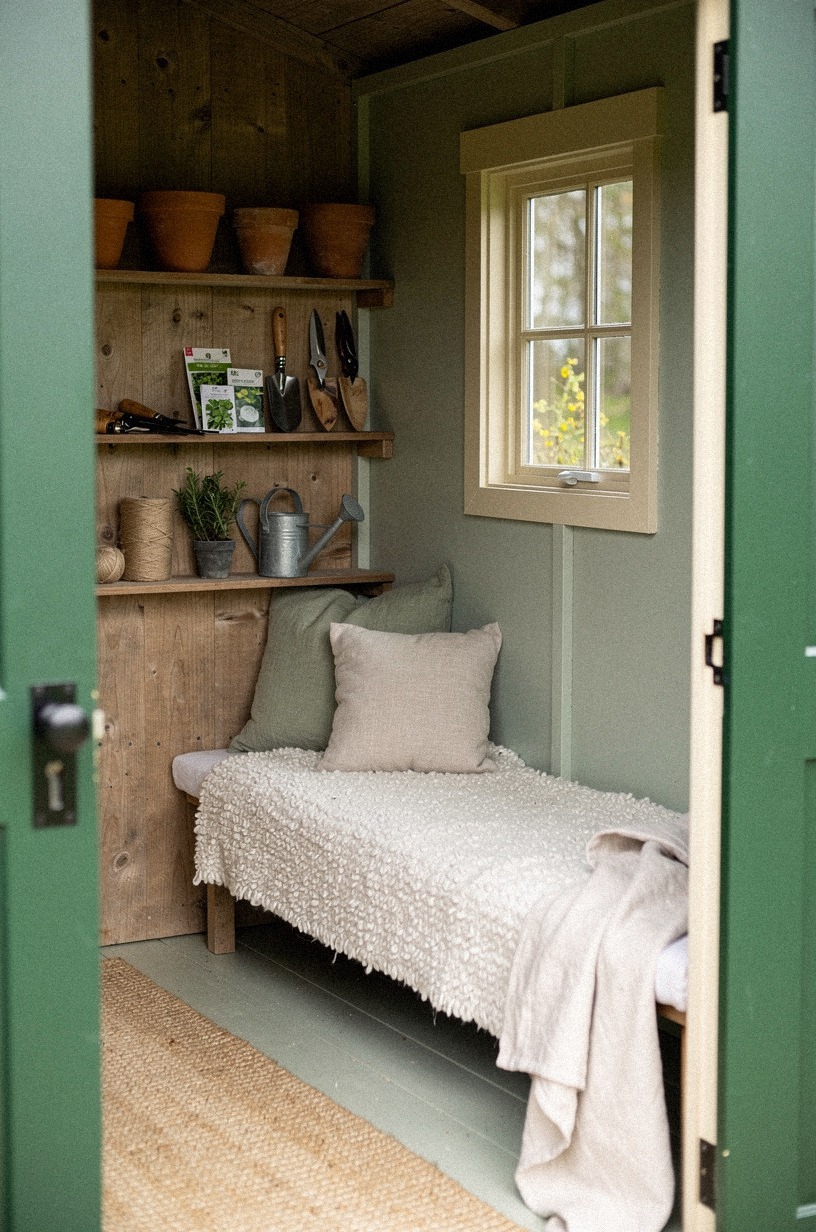
Sometimes the best privacy is a room you can retreat into. A garden shed converted to a reading nook or afternoon nap spot gives you an interior space that feels completely removed from the main house.
The move is the paint. The outside can match the fence or the house.
The inside should be deep moss green or sage with grey undertones so the space feels enclosed and calm.
Use Farrow & Ball Studio Green or Benjamin Moore Essex Green HC-188 on the walls. Both are dark enough to recede but green enough to feel alive.
The ceiling should be two shades lighter so you don't feel like you're in a cave. Add a simple daybed with a bouclé throw in cream or oatmeal for texture contrast.
The organic, nubby weave of bouclé against the smooth painted wall is what makes it feel designed rather than furnished.
A small wood stove or electric fireplace insert extends the season into October or November. The shed doesn't need to be large.
Six by eight feet is enough for a daybed, a small shelf, and a window that looks back at the garden, not the neighbor's yard. The view from inside is as important as the privacy from outside.
Frame the window so it captures a specific planting or a path curve, not the fence. The shed becomes a viewing device as much as a hiding place.
If you're thinking about how the whole yard flows together, our how to make a large backyard feel cozy not empty guide covers the layout logic that makes a shed feel like a destination instead of an afterthought.
11Hang a vintage mirror on a weathered fence panel
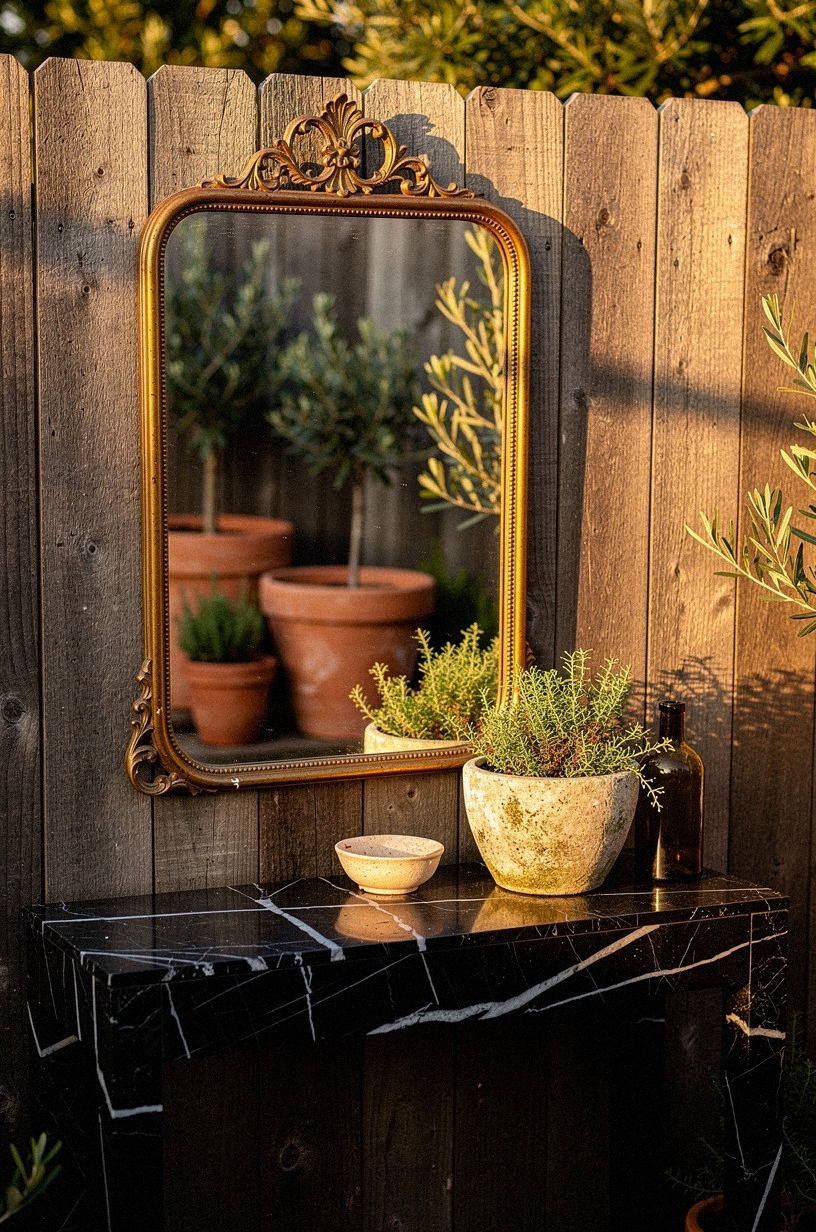
This sounds counterintuitive. A mirror reflects.
It doesn't block. But a vintage mirror hung on a weathered fence panel reflects the garden back at you, which doubles the visual depth and redirects your attention from the boundary to the planting.
It's the same move interior designers use in small rooms. It works even better outside.
Find a mirror with an ornate brass or iron frame at a flea market or estate sale. The frame should be weathered, not polished.
Polished brass looks like a bathroom fixture. Aged brass looks like a garden find.
Mount it on a fence panel that's been allowed to silver in the sun. The contrast between the reflective glass and the matte wood is what makes the composition work. The mirror should be large: thirty inches or more in one dimension.
Small mirrors look like decorations. Large mirrors look like architecture.
Behind the mirror, plant olive trees or tall grasses in terracotta pots so the reflection captures something worth seeing. A mirror that reflects a blank fence defeats the purpose.
The Nero Marquina marble or bluestone shelf below the mirror gives you a place for one candle or a small vase. Keep it minimal. The mirror is the statement.
Everything else is supporting cast. In afternoon light, the reflection throws pools of gold onto the ground that move as the sun shifts.
It's the most dynamic privacy screen you can install. And it costs less than a good outdoor rug.
12Scatter low zinc lanterns along a stepping-stone path
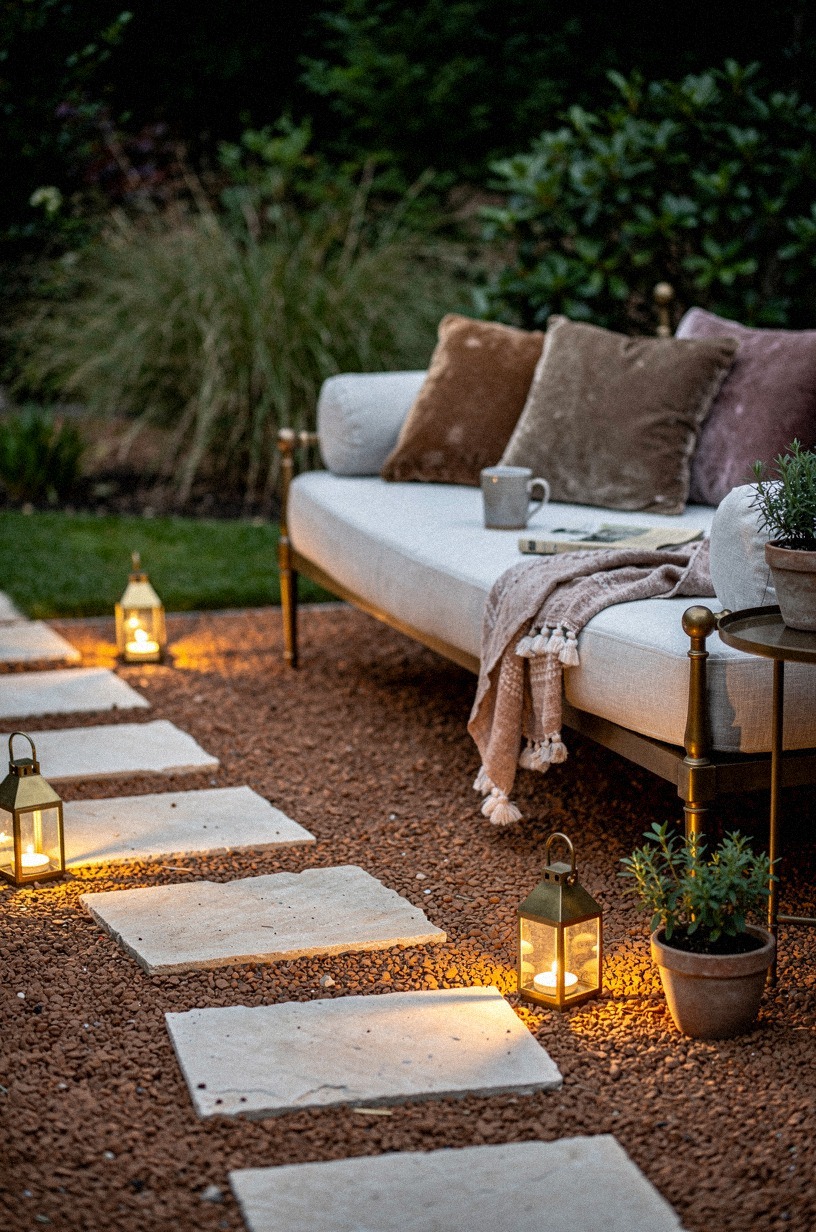
Path lighting is usually an afterthought. People install solar spikes along the edge and wonder why the yard still feels flat. Low zinc lanterns scattered along a stepping-stone path create a rhythm of light that guides you through the space and makes the journey feel longer than it is.
The light pools on the ground, not in the air, which keeps the sightlines low and the sense of enclosure high.
Use zinc or galvanized steel lanterns with frosted glass and LED pillar candles inside. Real candles are romantic and they're a maintenance job you don't want.
The frosted glass diffuses the light so you don't see the source. Clear glass reads as a bulb. Frosted glass reads as glow.
Space them at six-foot intervals along a limestone stepping-stone path with clay-colored gravel between the stones. The gravel should be three-eighths-inch for stability underfoot.
The path itself should curve, not run straight. A straight path is a corridor.
A curved path is a discovery. The lanterns should be eight to ten inches tall, low enough that you look down into the light, not up at it. The deep-pile mohair velvet or heavy linen cushions on a nearby bench give you a destination at the end of the path.
The whole composition is a sequence: stone, light, stone, light, then a seat. By the time you reach the bench, you've forgotten you're in a city lot.
The path has done the privacy work without a single wall.
13Train espaliered fruit trees flat against a boundary wall
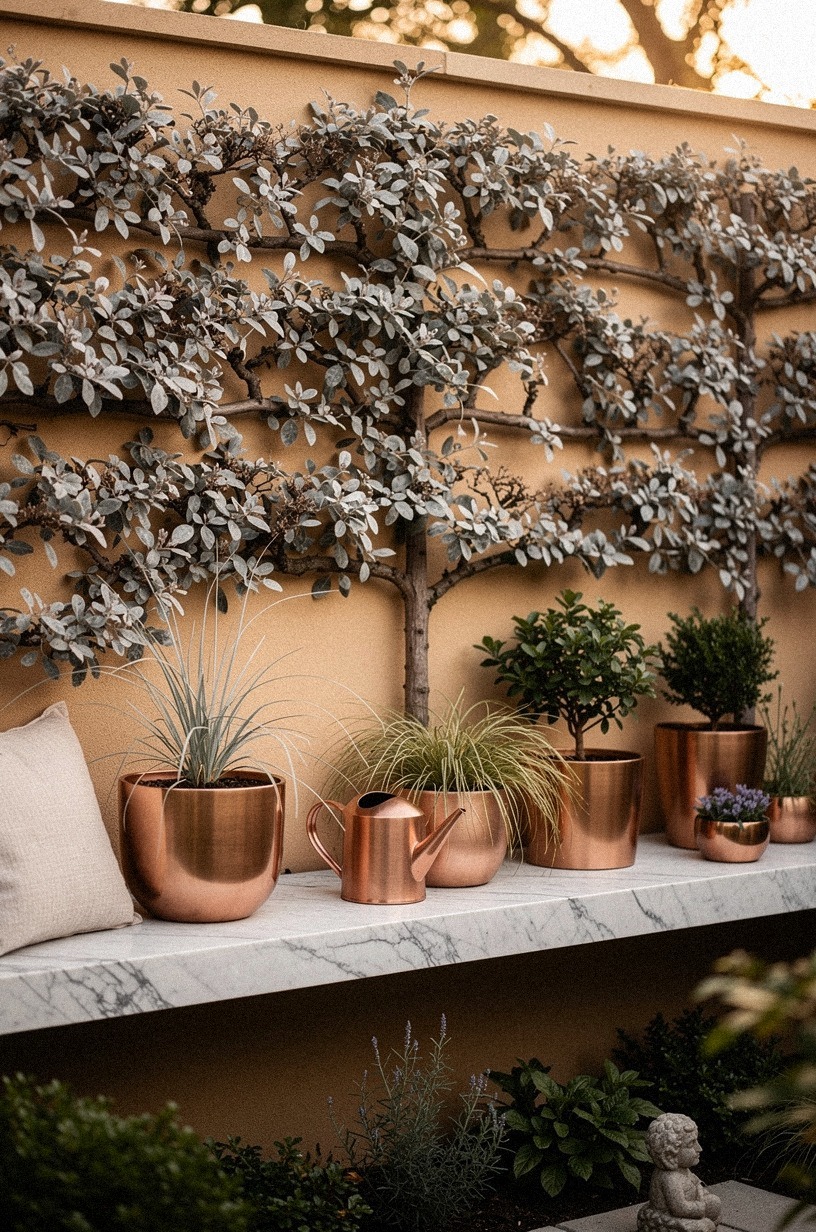
Espalier is the ancient technique of training trees flat against a wall in a formal pattern.
14Tuck a woven willow arch over a hidden bench
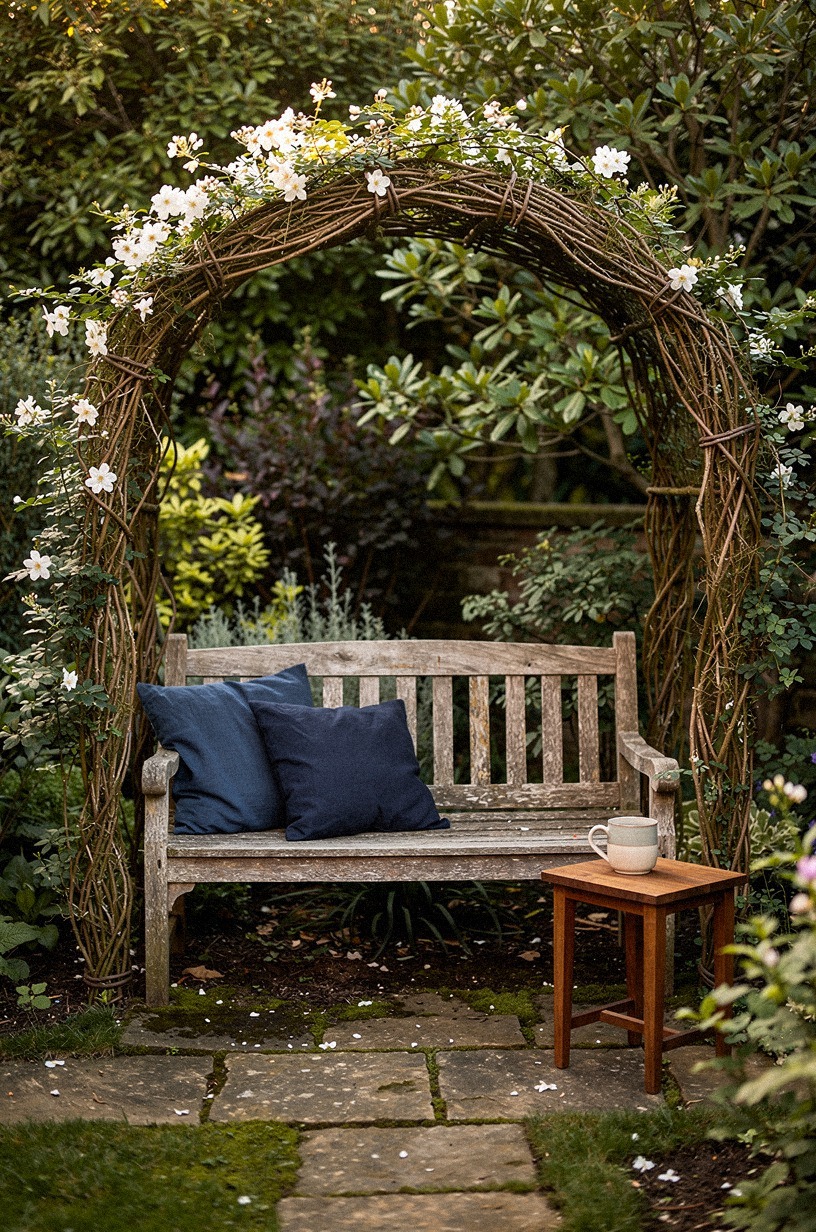
A willow arch is the softest architectural move in this list. It's not a wall.
It's not a screen. It's an invitation that happens to block the view beyond it.
The woven branches create a tunnel effect that frames whatever is inside and hides whatever is behind. A bench tucked into that tunnel becomes a detail.
The neighbor's house becomes invisible.
Build the arch from fresh willow whips in late winter when they're flexible. Weave them over a rebar frame hammered into the ground in an arch shape.
The rebar gives you the structure. The willow gives you the skin.
By summer, the willow leafs out and the tunnel is green. By autumn, it yellows.
By winter, you're back to the sculptural weave. The seasonality is the feature, not the bug.
The bench should be reclaimed teak or weathered cedar, simple and unadorned. Navy cushions in Sunbrella canvas hold the color and resist mildew.
The white flowering clematis or jasmine planted at the base climbs the willow and extends the bloom season. The whole structure is temporary in the sense that willow lasts five to seven years before it rots.
But it's permanent in the sense that you can reweave it in a weekend when the time comes. I've rebuilt two willow arches now. The second one took four hours. The first one took two days.
The learning curve is real but short.
15Rig a retractable shade sail at a sharp angle
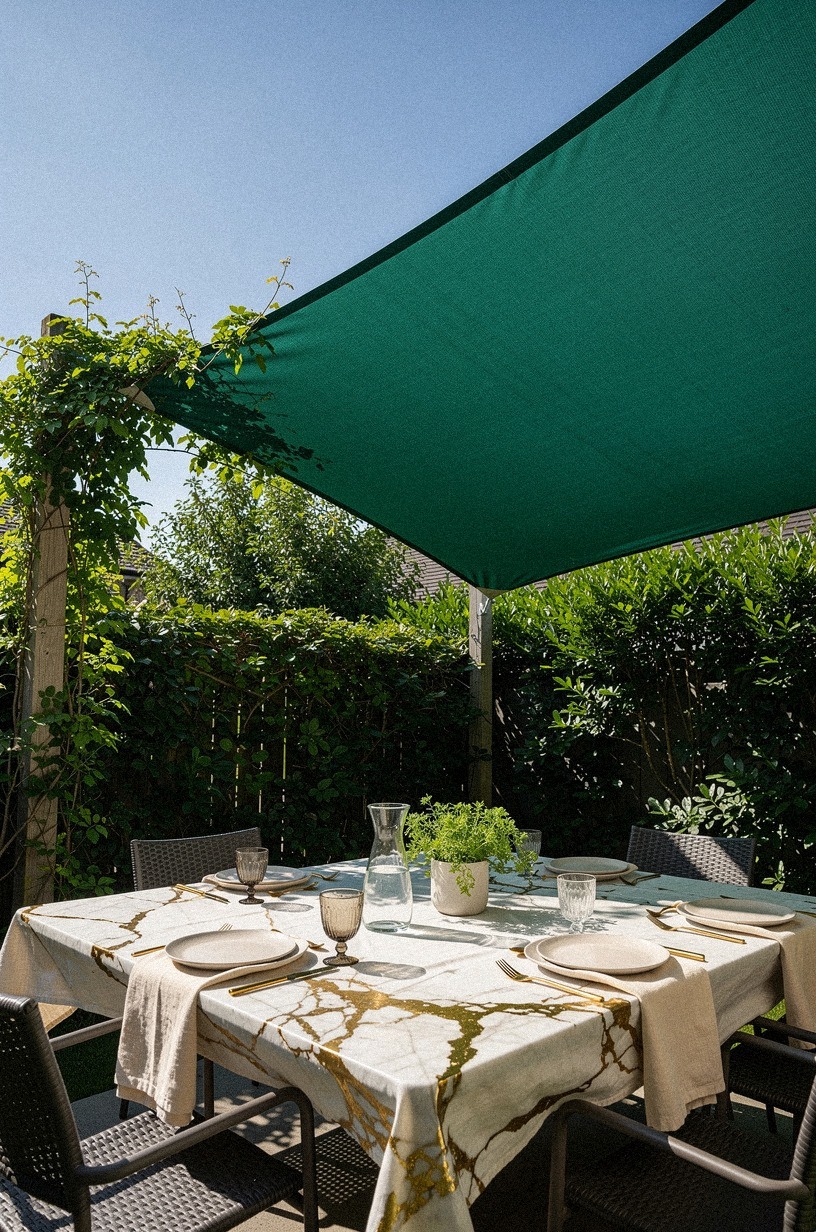
A shade sail is usually installed flat and high, which gives you shade but no privacy and no architecture.
The Honest Cost of a Private Backyard
Here's what I've seen people actually spend to get real privacy without building a fortress. The ranges are typical US costs for a standard suburban lot, not fantasy budgets or contractor markups.
And for the specific pieces that come up again and again:
The budget tier is where most people should start. A $200 run at a wholesale nursery for pots and plants, plus fifty dollars in string lights, plus a gallon of good exterior paint gives you three of the ideas on this list.
The mid tier is where you add furniture that lasts and lighting that doesn't corrode. The high tier is where you rebuild the hardscape.
Most backyards don't need it. They need direction, not demolition.
Why the Best Privacy Doesn't Feel Like Privacy at All
I've been in backyards that cost fifty thousand dollars and felt like prisons. I've been in backyards that cost five hundred and felt like sanctuaries.
The difference is never the budget. It's the intention.
The mistake I see most often is treating privacy as a defensive problem. You build a wall because you don't want to be seen.
You plant a hedge because you don't want to see. The result is enclosure without atmosphere.
A space that blocks the world but doesn't invite you in. The best backyards do the opposite.
They create something so compelling that the neighbor's house becomes irrelevant. A fire pit that pulls everyone inward.
A daybed under a tree that makes you forget to check your phone. A water rill that drowns out the conversation next door with sound you chose.
The designers I follow, the ones whose work actually gets pinned and saved and copied, think about privacy as a byproduct of delight. Not the other way around. Sally Markham, whose London courtyard went viral last year, told me her pleached hornbeam was originally structural. She needed to hide a parking area.
But she underplanted it with lavender and added a bench inside the green room it created. Now the privacy is incidental.
The destination is the point. That's the move. Build the destination.
Let the privacy follow.
The materials matter, but not the way people think. Expensive stone doesn't guarantee atmosphere. Cheap string lights don't guarantee cheapness.
What matters is coherence: the same warm palette running through hardscape, furniture, and planting. The same tonal range from terracotta to charcoal to sage. When everything speaks the same language, the eye relaxes.
When the eye relaxes, the mind stops scanning for threats. That's privacy. Not a wall.
A visual exhale.
I've learned this the hard way. My first backyard project was a six-foot cedar fence on three sides.
It blocked the neighbors and it blocked the light. The space felt smaller after the fence went up, not larger. I ended up removing one panel and replacing it with a pergola and jasmine.
The neighbor's window was visible again. And I didn't care.
The jasmine smelled better than the fence looked. The privacy I thought I needed was paranoia.
The privacy I actually needed was distraction. Something better to look at than a brick wall.
That's what this list is. Not fifteen ways to hide. Fifteen ways to build something worth seeing instead.
The Questions Worth Answering First
What is the best backyard privacy idea for a small space?
The stacked terracotta pot screen wins on footprint. It gives you five to six feet of blocking height in a run under two feet deep.
A pleached hornbeam needs eighteen inches of width minimum plus access for pruning. The pot wall needs zero maintenance beyond watering and you can rearrange it if your sightlines change.
For vertical space, a shade sail at an angle blocks upper windows without touching the ground. Both work in rentals if you don't alter the structure.
If you're working with a tiny yard, our 23 cozy small backyard ideas that feel bigger than they are has the layout logic that makes privacy features feel intentional instead of cramped.
Where can I buy backyard privacy pieces on a budget?
IKEA for outdoor textiles: the MAJGULL and GURLI lines are polyester but the weight and color are right for one to two seasons. Target Threshold and Studio McGee for planters and lanterns at mid-range prices that look premium. Wayfair for shade sails and pergola kits if you read the reviews and avoid the cheapest tier.
For terracotta pots, skip the garden center and find a local wholesale nursery or stone yard. They sell seconds at half price: glaze flaws that don't matter for a staggered screen. Facebook Marketplace and estate sales are the best sources for vintage mirrors and reclaimed timber. The mirror I used in section eleven cost twelve dollars at a church rummage sale.
The frame was tarnished brass. I didn't polish it.
How much does a backyard privacy makeover cost?
The short answer: about two hundred to six thousand dollars depending on what you count. A pure softscape approach (pots, plants, lights, curtains) stays under nine hundred.
A mixed approach with one hardscape element (pergola, partial wall, or fire pit) lands in the fifteen hundred to six thousand range. A full rebuild with paving, outdoor kitchen, and structure starts at ten thousand and climbs fast. The cheapest privacy is free: rearrange your existing furniture so your back faces the boundary and your view faces a planting or feature.
Psychological privacy costs nothing. Physical privacy costs what you're willing to spend.
Can I create backyard privacy on a budget?
Yes, and you should start with the free moves. Move your seating so you're not facing the neighbor's house. Prune your existing shrubs up from the bottom to create a visual block at eye level while keeping the canopy open. String lights in a zigzag cost under fifty dollars and change the ceiling plane.
Outdoor curtains on a galvanized rod cost under a hundred if you use IKEA panels. The terracotta pot screen is under two hundred for a six-foot run.
The willow arch is free if you have willow on your property or under fifty if you buy whips. Three of those together give you layered privacy for under four hundred dollars.
That's less than a good outdoor rug!
Is backyard privacy worth it in a small space?
Worth it, and sometimes more important than in a large one. A big yard has distance as privacy.
A small yard is close to the boundary by definition. The neighbor's window is twenty feet from your chair, not a hundred. The good news is that small spaces are cheaper to transform. A three-hundred-dollar shade sail and a hundred-dollar mirror change the feel of a twelve-by-sixteen-foot patio completely.
The bad news is that mistakes show faster. A six-foot fence in a small yard is oppressive. A partial wall or screen is essential. Get the scale right and the privacy follows.
Is a backyard privacy setup a good idea for a rental?
Yes, with the right swaps. Peel-and-stick outdoor wallpaper on a fence panel gives you pattern without permanence. Tension rods between fence posts or deck railings hold outdoor curtains without drilling. Freestanding screens in bamboo or willow move with you.
Potted plants in large containers create movable walls. The shade sail is the only item on this list that needs structural attachment. Skip it or use heavy-duty suction cups on smooth siding (risky in wind, but possible). Everything else is portable.
When you move, you take your privacy with you.
Where I'd Start First
If I had to pick one, I'd start with the zigzag café lights. They're the cheapest move that changes the most.
You get a ceiling, you get ambiance, and you get privacy from above in one hour with a ladder. Everything else builds on that foundation.
Get the light right first. The furniture, the plants, the walls all land better when the space already feels like a room.
And if you're looking for a mattress that makes getting out of bed easier after those late nights outside, our mattress for getting out of bed might be the next read.