
 by
by A platform bed wins on price, style, and compatibility with any mattress. An adjustable base wins for back pain, snoring, acid reflux, and active lifestyle use. The choice of base does not change which mattress you should buy -- both work best with a quality foam or hybrid. Our top mattress recommendation for either foundation: the Saatva Classic.
- Dual-coil construction with lumbar support pad, works on both platform beds and adjustable bases
- Free white-glove delivery, setup, and old-mattress removal
- 365-night home trial -- the longest in its class
- Three firmness options to match any sleep position
- Higher price point than budget-tier platform bed pairings
- Luxury Firm model works best; Plush Soft can feel too soft for back sleepers
Whether you settle on a sleek platform bed or invest in an adjustable base, the Saatva Classic handles both setups. Its lumbar zone pad and dual-coil design give you genuine spinal support, and the 365-night trial is long enough to confirm the pairing works for your body.
Platform bed vs adjustable base: the core difference
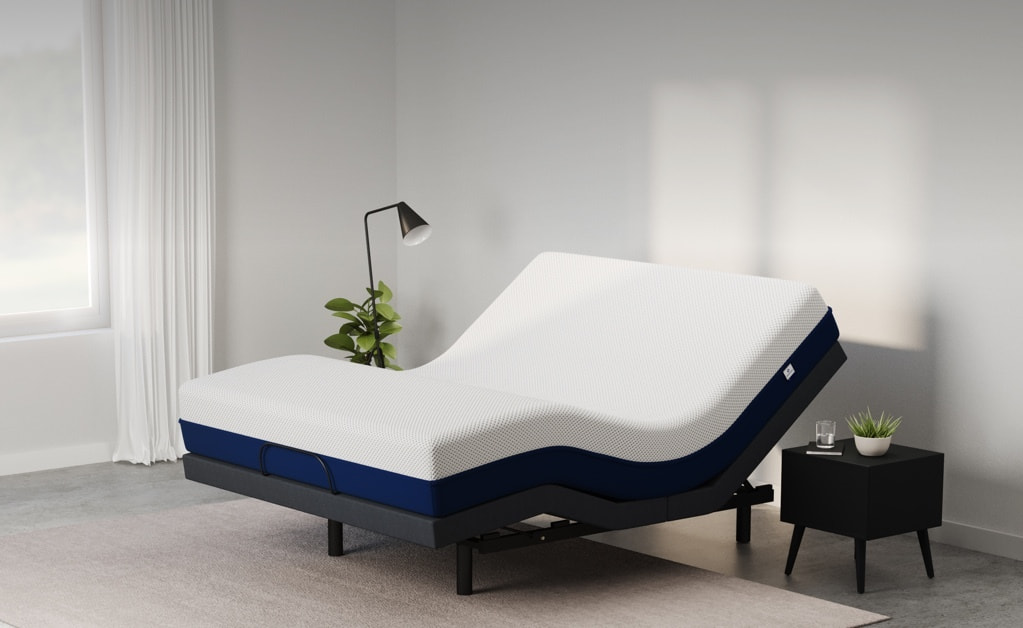
A platform bed is a fixed frame with a solid or slatted surface. The mattress sits on it flat, and it stays flat. A platform bed does not move. An adjustable base is a powered articulating frame that raises and lowers the head and foot sections independently. You can elevate your head to read, raise your legs to reduce swelling, or dial in zero-gravity positioning to reduce lumbar disc pressure. The base moves; the mattress flexes with it.
That distinction -- static vs articulating -- determines everything else: price, mattress compatibility, health benefits, and how the bed looks in the room.
Head-to-head comparison
| Feature | Platform Bed | Adjustable Base |
|---|---|---|
| Function | Static support surface | Articulating head and foot control |
| Mattress compatibility | Most mattresses (foam, hybrid, latex, innerspring) | Foam and hybrid only -- rigid innerspring coils cannot flex |
| Price range | $200 to $2,000 | $500 to $4,000+ |
| Aesthetics | Headboard and frame styles, integrates with room design | Utilitarian -- typically hidden inside a bed frame or skirt |
| Assembly | Moderate, 30-60 minutes typical | Complex motor and remote setup -- white-glove delivery recommended |
| Back pain benefit | None beyond a firm, flat surface | Significant -- zero-gravity position reduces disc pressure |
| Snoring or acid reflux benefit | None | Head elevation reduces both conditions materially |
| Split configuration available | No | Yes -- split king allows independent adjustment per side |
| Warranty typical | 1 to 20 years (varies widely by material) | 10 years on motor and frame |
When a platform bed is the right call
- You have an innerspring mattress you plan to keep -- adjustable bases require a flexible mattress, platform beds do not.
- Bedroom aesthetics matter -- platform beds come in wood, upholstered, and minimalist metal designs that integrate naturally with furniture.
- Budget is tight -- a solid platform bed from $300 to $600 is genuinely durable and does the job.
- No health conditions benefit from position adjustment.
- Guest rooms where simplicity and low-maintenance are more important than features.
A good platform bed is not a compromise. If you are not dealing with chronic back pain, snoring, or acid reflux, a well-built platform bed paired with the right mattress will give you every bit of restorative sleep an adjustable base provides, for a fraction of the cost.
When an adjustable base is worth the price
- Back pain, herniated disc, sciatica, or spinal stenosis -- zero-gravity positioning (roughly 30 degrees head elevation, 15 to 30 degrees leg elevation) reduces disc pressure measurably. Position change that a mattress alone cannot provide.
- Chronic snoring or mild sleep apnea -- head elevation keeps the airway more open. Not a substitute for a CPAP, but an evidence-supported complement.
- GERD or acid reflux -- elevating the head of the bed reduces nighttime acid exposure, a recommendation that appears in clinical guidelines for GERD management.
- Reading or watching TV in bed frequently -- head elevation is more comfortable and puts less strain on the neck than propped pillows.
- Couples with different needs -- a split king configuration gives each person independent control without disturbing the other.
- You are buying a foam or hybrid mattress anyway -- compatibility is automatic, so you are not adding any mattress-replacement cost.
The hybrid approach: adjustable base inside a bed frame
Most adjustable bases are designed to sit inside a standard bed frame. You remove the center support slat or cross-rail, set the adjustable base legs inside the frame, and place the mattress on the adjustable base. A bed skirt conceals the mechanical base entirely. The result is adjustable-base functionality with platform-bed aesthetics -- which is what most buyers who care about both end up doing.
Before buying, measure the interior clearance of the frame (width between the inner rails) and compare it to the adjustable base footprint. Most queen adjustable bases run about 59.5 to 60 inches wide; most queen bed frames have 60 to 61 inches of interior clearance. Measure both before assuming compatibility.
Mattress compatibility: the factor most people overlook
If you are keeping an existing innerspring mattress, a platform bed is your only option. Traditional interconnected coil systems cannot flex around a hinge point without losing structural integrity and voiding the warranty. The coils kink, the mattress body warps, and you end up replacing it within a year.
If you are buying a new mattress, the adjustable base decision opens up. Foam mattresses (memory foam, plant-based foam), latex mattresses, and hybrids (foam or latex over pocketed coils) all work on adjustable bases because their materials flex without permanent deformation. Pocketed coils are individually wrapped and move independently, so they handle the articulation without damage.
One rule: slat spacing for platform beds should be 3 inches or less. Foam and latex mattresses sag into wider gaps within months, creating an uneven surface and voiding most warranties. Two-inch slat spacing is safer.
Amerisleep AS3
8.9/10
- Plant-based Bio-Pur foam certified CertiPUR-US, runs cooler than standard memory foam
- HIVE 5-zone system firms under the lumbar and softens under shoulders
- Fully adjustable-base compatible -- the AS3 flexes cleanly at any angle
- Amerisleep also sells its own adjustable base, sold separately or as a bundle
- All-foam feel -- some sleepers prefer the responsiveness of a coil hybrid
- Edge support softer than innerspring designs
If you want a foam mattress that pairs natively with an adjustable base, the AS3 is the strongest all-foam pick at this price. The HIVE zoning is meaningful for back sleepers using zero-gravity, and Amerisleep's own adjustable bases bundle cleanly with it.
Price reality check
Platform beds start around $200 for a basic metal frame with center support and go up to $2,000 or more for solid hardwood with upholstered headboard and drawer storage. The sweet spot for a genuinely durable platform bed is $400 to $800. At that range you get solid wood or heavy-gauge steel slat construction, rated weight capacity of 500 lbs or more on a queen, and hardware that won't work loose within two years.
Adjustable bases start around $500 for a no-frills head-only model and run to $4,000 for a split king with massage, USB charging, under-bed lighting, and app control. A useful mid-range adjustable base -- head and foot articulation, wireless remote, zero-gravity preset, 10-year warranty -- sits around $1,000 to $1,500 for a queen. Budget more for split king configurations, which require two twin XL mattresses instead of one queen.
Frequently asked questions
Do I need a special mattress for an adjustable base?
Yes. You need a mattress that can flex repeatedly without damage: memory foam, plant-based foam, latex, or hybrid (foam or latex over pocketed coils). Traditional innerspring mattresses with interconnected coils cannot bend around a hinge point. Most modern direct-to-consumer mattress brands explicitly state adjustable-base compatibility on their product pages. Confirm before purchasing.
Can I use an adjustable base inside a platform bed frame?
Yes, and this is a common setup. Remove the center support rails from the bed frame, set the adjustable base inside the frame, and use a bed skirt to conceal the mechanical parts. You get adjustable functionality with platform bed aesthetics. Measure interior frame clearance against the adjustable base footprint before buying -- queen dimensions are typically close but not always identical across brands.
Is an adjustable base worth the price for back pain?
For moderate to severe chronic back pain (herniated disc, stenosis, sciatica), yes. Zero-gravity positioning reduces lumbar disc pressure in a way a mattress upgrade alone cannot replicate. For mild morning stiffness from a mattress firmness mismatch, a better mattress is usually the more cost-effective first step. An adjustable base makes most sense when position change is part of what a doctor or physical therapist has recommended.
What slat spacing works with foam and latex mattresses?
Slats should be no more than 3 inches apart. Two inches is safer and is the spacing most foam mattress brands require to keep the warranty valid. Gaps wider than 3 inches let the mattress sag into the spaces, which creates an uneven surface and compresses the foam unevenly over time.
Do adjustable bases require a box spring?
No. An adjustable base replaces the box spring. Foam and hybrid mattresses go directly on the adjustable base surface. Platform beds also eliminate the need for a box spring, since the slat or solid-deck surface provides the support a box spring would otherwise give.
Choose a platform bed if you want lower cost, better style integration, and no mattress restrictions. Choose an adjustable base if back pain, snoring, acid reflux, or active lifestyle positioning is a real priority. Either way, pair it with a mattress rated for both -- the Saatva Classic handles both setups and brings a 365-night trial so you can confirm the combination works.