
 by
by An adjustable base earns its cost if you deal with snoring, acid reflux, leg swelling, or morning back stiffness, or if you spend real time reading or watching TV in bed. A flat frame is the smarter buy if you sleep flat without issues, sleep on your stomach, or need that budget going toward a better mattress. Most back and side sleepers who spend any time upright in bed will find the adjustable worth it long-term.
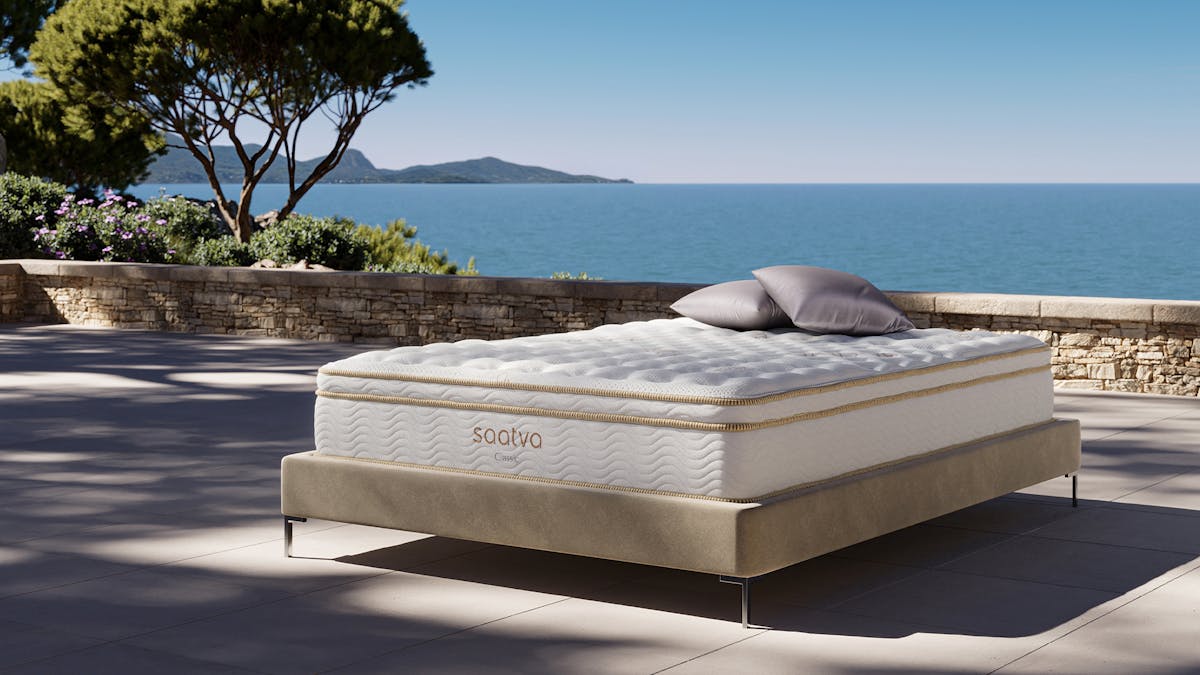
Saatva Solaire
9.2/10
- 50 adjustable firmness settings via remote, so each sleeper dials in their feel independently
- Hybrid construction flexes cleanly through the full adjustable base angle range
- Free white-glove delivery, setup and removal of old mattress
- 365-night trial, lifetime warranty
- Premium price point, not a budget option
- Firmness-control features require a compatible Saatva adjustable base
The Saatva Solaire is the natural answer when the question is adjustable bed versus flat bed and you want a long-term upgrade. The adjustable firmness solves the "we want different feels" couple problem, the hybrid construction flexes well through the full angle range, and the white-glove delivery matters given the weight involved.
What an adjustable base actually does
An adjustable base is a motorized foundation that lets you raise the head, the foot, or both independently. The mechanical range varies by model, but most quality bases go from 0 to about 60 to 65 degrees at the head and 30 to 45 degrees at the foot.
Beyond basic position changes, current mid-to-high-end models include:
- Zero-gravity preset: a specific angle, roughly 120 to 130 degrees at the hips, that distributes body weight more evenly and reduces pressure on the lower back. Originally a NASA-derived concept for low-gravity environments, adapted for sleep comfort.
- Anti-snore preset: raises the head 7 to 12 degrees to open the airway slightly. Not a medical treatment for sleep apnea, but practical for mild positional snoring.
- Massage and vibration: built-in vibration motors, usually in two zones. More useful for relaxation or restless legs than therapeutic massage.
- Under-bed lighting: useful for nighttime navigation without waking a partner.
- USB and wireless charging ports: standard on most premium models.
- App or remote control: wireless remotes or companion apps for position memory presets.
- Split options: king-size bases often come as two twin XL units, giving each partner independent control.
The real benefits, and how to think about them
Adjustable bases are sold with health language that ranges from accurate to vague. Here is a grounded breakdown of what they genuinely help with:
Reading, TV, and working from bed. This is the most universally appreciated benefit. Head elevation at 30 to 45 degrees puts you in a supported reclined position without needing to stack four pillows. Neck and shoulder strain from propping up drops noticeably.
Snoring and mild airway congestion. Raising the head 10 to 15 degrees encourages gravity to keep the tongue and soft palate forward, reducing the vibration that causes snoring. Partners report meaningful improvement in many cases. For diagnosed obstructive sleep apnea, a CPAP remains the standard. An adjustable base is a complement, not a replacement.
Acid reflux and heartburn. Head elevation above roughly 6 to 8 inches has been associated with reduced nighttime reflux episodes. Gravity helps keep stomach acid from traveling upward. An adjustable base achieves this more consistently than wedge pillows, which compress and shift during the night.
Leg elevation and circulation. Raising the foot section promotes venous return, so blood flows back toward the heart more easily. People who stand all day, experience mild lower-leg swelling, or have varicose veins often find this position relieves end-of-day discomfort overnight.
Easier sit-to-stand. For older adults or anyone recovering from surgery, raising the head to near-seated position before getting up reduces the effort required to stand. This is a genuinely practical function, not a marketing add-on.
Zero-gravity sleeping. The zero-gravity position offloads lumbar pressure by slightly flexing the knees and supporting the natural spinal curve. Sleepers with chronic lower back tightness often report less morning stiffness.
Adjustable bed vs flat bed: side-by-side comparison
| Category | Adjustable Base | Flat Bed Frame |
|---|---|---|
| Typical cost | $500 to $2,500+ (base only) | $100 to $600 for a quality frame |
| Sleep positions supported | Infinite incline combinations; head and foot independently adjustable | Flat only |
| Snoring and airway support | Yes, head elevation reduces positional snoring | No positional adjustment |
| Reflux and heartburn relief | Yes, consistent head elevation more effective than pillows | No; pillow wedges required |
| Leg elevation and circulation | Yes, foot section raises independently | No; pillow-under-legs only |
| Reading and screen use in bed | Excellent, head raised without neck strain | Pillow stacking required |
| Who it suits best | Side and back sleepers; couples with different preferences; anyone with snoring, reflux, or mobility concerns | Budget buyers; stomach sleepers; people who sleep flat without issues |
| Mattress compatibility | Requires flexible mattress (foam, latex, flexible hybrid) | Works with any mattress type including rigid innerspring |
| Noise | Motor noise during adjustment (varies by build quality) | Silent (unless frame creaks) |
| Weight and setup | Heavy, 80 to 150 lbs; professional delivery often needed | Lightweight; easy assembly |
| Longevity | Motors typically rated 10 to 15 years; mechanical components can fail | Simple frames last decades with no mechanical failure risk |
The downsides worth knowing before you buy
Price. A worthwhile adjustable base starts around $700 to $800 for a queen. Add in a compatible mattress and you are looking at $1,500 to $3,500+ total. Budget bases under $400 exist but typically have noisy motors, limited angle range, and short warranties.
Mattress compatibility. This is the most commonly overlooked issue. Traditional innerspring mattresses with rigid coil borders and tight-top constructions cannot flex without permanent damage to the comfort layers and coil structure. You need a foam mattress, a latex mattress, or a hybrid built specifically to flex, which means an adjustable base may also require a new mattress purchase.
Weight. Motorized bases are heavy. Moving one after setup is a two-person job at minimum. Apartment dwellers, anyone on upper floors without elevator access, or people who move frequently should factor this in.
Noise during adjustment. All motor-driven bases make some noise when moving. Premium models are quieter, but none are silent. Adjusting position at 3 a.m. will typically wake a light-sleeping partner, at least initially.
Complexity. Remotes, apps, preset programming: there is a learning curve. For older adults who just want to raise the head slightly, an overly app-dependent base can be frustrating. Prioritize models with straightforward physical remotes.
When a flat bed is the right answer
An adjustable base is not a universal upgrade. A flat setup is the better choice when:
- Budget is genuinely tight. Spending $600 on a quality flat frame and a great mattress will almost always produce better sleep than spending the same total on a cheap adjustable base with a thin mattress.
- You sleep on your stomach. Stomach sleeping requires a flat, firm surface. Head or foot elevation with stomach sleeping creates spinal misalignment. Stomach sleepers have no meaningful use for an adjustable base's core functions.
- You sleep flat without issues. If you fall asleep easily, stay asleep, have no snoring complaints, no reflux, and no leg discomfort, you probably do not need the complexity or the cost.
- You use a rigid innerspring mattress you love. Some people have a traditional coil mattress they are not ready to replace. Until that changes, an adjustable base is not compatible.
- You move frequently. The logistics of moving a 120-lb motorized base through doorways and up flights of stairs make adjustable bases impractical for renters or frequent movers.
Mattress compatibility: what actually flexes
The compatibility question comes up constantly and is worth addressing clearly. Mattresses that work with adjustable bases:
- All-foam mattresses: memory foam and polyfoam flex without any structural concern.
- Latex mattresses: both Dunlop and Talalay latex flex well, though very thick all-latex beds may feel stiff at extreme angles.
- Flexible hybrids: hybrids built with individually wrapped pocketed coils and without rigid perimeter borders flex well. Most quality hybrid mattresses sold today are explicitly marketed as adjustable-base compatible. Check for the designation before purchasing.
Mattresses that do not work:
- Traditional innerspring mattresses: rigid interconnected coils and foam-encased borders are not designed to flex. Forcing them on an adjustable base causes permanent deformation and voids most warranties.
- Very firm or extra-firm all-foam beds: technically compatible, but the bend radius at extreme angles can feel wrong. Test at lower inclines before committing.
Verdict by buyer type
Buy an adjustable base if: you snore or sleep with someone who does; you deal with acid reflux at night; you spend time reading or watching TV in bed; you experience morning lower back stiffness; you have lower-leg swelling or circulation concerns; you are a back or side sleeper willing to invest in long-term comfort.
Stick with a flat frame if: you sleep on your stomach; your sleep is already uninterrupted and comfortable; your budget is better allocated to the mattress itself; you move apartments regularly or have difficult stair access.
For most back and side sleepers who spend any time upright in bed, an adjustable base earns its cost over time. The Saatva Solaire is a strong pairing for anyone making the switch: 50 firmness settings, a hybrid that flexes cleanly through the full angle range, and free white-glove delivery that matters given the weight involved.
If you have specific reasons to elevate, an adjustable base pays off. If you sleep flat without problems, invest that money in a better mattress instead. The Saatva Solaire is our top pick for anyone making the switch: adjustable firmness, a flexible hybrid build, and white-glove setup included.
Frequently asked questions
Can you use any mattress with an adjustable base?
No. Rigid innerspring mattresses with bonded or encased perimeters cannot flex without structural damage. Foam, latex, and flexible hybrid mattresses work. Most modern hybrids with pocketed coils are adjustable-base compatible, but check the manufacturer's specification before purchasing.
Does sleeping with the head raised actually reduce snoring?
For positional or mild snoring, yes. Raising the head 10 to 15 degrees uses gravity to keep the airway more open. It is not a treatment for obstructive sleep apnea, which requires medical evaluation. For the common pattern of sleeping flat causing snoring, head elevation is a well-established practical fix.
Is zero-gravity the same as sleeping in a recliner?
Not exactly. A recliner seats you more upright with the legs fully extended or slightly raised. The zero-gravity position on an adjustable base is flatter, roughly 20 to 30 degrees at the head with a complementary knee flex, so body weight distributes more evenly and lower back pressure drops. It is a closer approximation to floating than to sitting.
How long do adjustable base motors last?
Most quality motors are rated for 10 to 15 years of normal use. Cheap bases under $400 may use lower-grade actuators that fail sooner. Brands like Saatva offer multi-year motor warranties. Keeping the base clear of pinch points and not exceeding weight limits extends lifespan.
Can two people share an adjustable base with different position preferences?
Yes, with a split configuration. A split king is two twin XL bases operating independently, letting each partner choose their own head and foot position. This is one of the most common reasons couples upgrade to an adjustable setup. Split queen options are available but less common.
Do adjustable bases work with platform bed frames or do you need a box spring?
Adjustable bases are self-supporting, so no box spring is needed or desired. A box spring would block the motor's range of motion. Many adjustable bases have legs that sit directly on the floor. Some are designed to slide into a compatible open platform frame for aesthetics. Traditional bed frames with rigid slat decks are not compatible.
Is the added cost worth it compared to a wedge pillow?
Wedge pillows are cheaper ($30 to $80) and solve the elevation problem adequately for some people. The practical difference is stability: wedge pillows compress, shift, and migrate during the night, and they only address head elevation. An adjustable base maintains precise angle settings all night, adds foot elevation, and includes features a wedge cannot replicate. If consistent head elevation is your only need and budget is tight, a quality wedge pillow is a reasonable starting point.