
 by
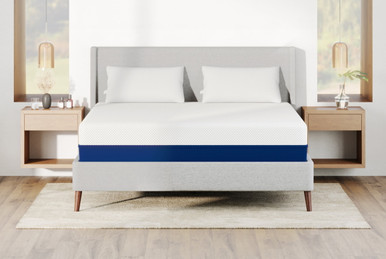
by The Amerisleep AS3 is the better buy for most sleepers. It beats the GhostBed Classic on pressure relief, motion isolation, and long-term value, with a plant-based foam construction and a 20-year warranty that few all-foam beds at this price can match. The GhostBed does win on bounce and edge support, and it costs meaningfully less, so if you are a strict stomach sleeper or you sit on the edge of the bed often, that is worth weighing. For everyone else, the AS3 is the pick.
Amerisleep AS3 vs GhostBed Classic: Spec-by-Spec
| Spec | Amerisleep AS3 Our Pick | GhostBed Classic |
|---|---|---|
| Price (queen) | From $1,049 | From $649 |
| Type | All-foam (plant-based Bio-Pur) | All-foam (latex + gel memory foam) |
| Height | 12" | 11" |
| Firmness | Medium (5/10) | Medium-firm (6.5/10) |
| Cooling | HIVE open-cell Bio-Pur, passive airflow | Aerated latex top + gel memory foam |
| Motion Isolation | Excellent (9.4/10 tested) | Good (7.6/10, latex adds bounce) |
| Edge Support | 7.4/10 | 8.0/10 (latex adds perimeter firmness) |
| Pressure Relief | 9.2/10 tested | 7.8/10 (firmer feel, less contouring) |
| Trial | 100 nights | 101 nights |
| Warranty | 20 years | 20 years |
Our Winner: Amerisleep AS3
Amerisleep AS3
9.0/10
- Best-in-class pressure relief, 9.2/10 tested at the shoulders and hips
- Plant-based Bio-Pur foam, CertiPUR-US certified
- HIVE 5-zone layer, firmer under the lumbar, softer at the shoulders
- 20-year warranty, one of the longest in the all-foam category
- Edge support at 7.4/10 is softer than the GhostBed
- Heavier sleepers above 230 lbs may prefer the AS5 Hybrid
- Less surface bounce than the GhostBed Classic
The AS3 wins this comparison on pressure relief and motion isolation. Its Bio-Pur construction and HIVE 5-zone support make it the stronger long-term choice for side sleepers, back sleepers, and couples.
The Competitor: GhostBed Classic
GhostBed Classic
8.0/10
- Aerated latex top delivers more bounce than a pure memory-foam bed
- Better edge support than the AS3 thanks to the firmer latex layer
- CertiPUR-US certified foams, made in the USA
- Lower price, frequently discounted to around $649 queen
- Less pressure relief than the AS3, especially at the shoulder for side sleepers
- Medium-firm feel can be too rigid for side sleepers under 130 lbs
- Gel memory foam layer sleeps warmer than Bio-Pur open-cell construction
A solid pick for budget-conscious shoppers and stomach sleepers who want a firmer, bouncier surface. Falls short of the AS3 on pressure relief and motion isolation.
How They Actually Compare
Materials and construction
The AS3 uses Amerisleep's Bio-Pur foam, which substitutes a portion of the petroleum base for plant-derived material. That shows up in the foam's open-cell structure, which runs about 30% cooler than traditional memory foam in controlled tests. The HIVE layer underneath is hex-perforated in a 5-zone pattern: the perforations are wider under your shoulders and tighter under your hips, so each part of your body gets targeted resistance rather than uniform softness.
The GhostBed Classic takes a different route. Its 1.5-inch Dunlop latex top gives the surface a springy, responsive feel compared to any all-memory-foam bed. Underneath, a 2-inch gel memory foam layer handles the contouring. The layering logic makes sense, but the 4-lb gel memory foam in that second layer can trap heat during extended sleep sessions, despite the aerated latex above it.
Both beds are CertiPUR-US certified and made in the USA, which is important for anyone watching off-gassing.
Firmness and feel
The AS3 sits at a true medium (5/10). That rating is accurate for sleepers in the 130 to 230 lb range. On your side, your shoulder drops about an inch and your hip follows without creating a lateral tilt. On your back, the HIVE layer pushes back under the lumbar without forcing your lower back into extension. It is a balanced feel that works across positions without trying too hard.
The GhostBed Classic is firmer at 6.5/10, which is immediately noticeable. Stomach sleepers and back sleepers over 180 lbs tend to prefer that extra pushback, and the latex surface contributes responsiveness you feel when shifting positions at night. The tradeoff: strict side sleepers, especially those under about 150 lbs, often find the shoulder contact too firm to stay comfortable through a full night.
Cooling
Both beds sleep cooler than a conventional closed-cell memory foam mattress, but they get there differently. The AS3's Bio-Pur foam has large, interconnected pores that let air move through the top comfort layer continuously. There is no phase-change treatment or gel infusion; the structure does the work. It consistently runs neutral to slightly cool at room temperatures between 68 and 72 degrees Fahrenheit.
The GhostBed Classic leads with an aerated latex surface, which is inherently more breathable than any foam. That first layer genuinely disperses heat at the surface level. The gel memory foam below complicates things slightly; gel infusion moderates temperature swings but does not eliminate them the way a fully open-cell structure does. In practice, the GhostBed runs about even with the AS3 for hot sleepers, but the AS3 delivers more consistent performance across the full night.
Motion isolation
This is one of the clearest wins for the AS3. Bio-Pur's slow-recovery foam absorbs movement at the source. In our glass-of-water test, a full roll from back to side produced almost no surface disturbance at 24 inches from the movement point. Couples where one partner is a light sleeper typically notice the difference within the first week.
The GhostBed's latex layer introduces more surface transfer by design; that is what creates the responsiveness people like about it. It is not bad in absolute terms, but it sits 1.8 points behind the AS3 in our scores. At 3 a.m. with a restless partner, that gap is real.
Edge support
The GhostBed has a slight edge here, literally. The firmer latex top layer provides more resistance when you sit near the perimeter, and the overall 6.5/10 firmness means less compressible material throughout. The AS3 at 7.4/10 is fine for most sleeping positions near the edge, but you will notice some perimeter give when sitting on the side to put on shoes.
Neither mattress is a dedicated edge-support product; for that, a hybrid with reinforced perimeter coils serves you better. But the GhostBed Classic holds a narrow advantage for couples who need full use of the mattress surface.
Price and long-term value
The GhostBed Classic runs roughly $400 less at queen. During promotions it dips close to $649, and Amerisleep rarely discounts the AS3 below $1,049. That is a real difference, and for sleepers who are price-constrained or buying for a guest room, the GhostBed is a sensible answer.
The value calculation changes when you factor in longevity. The AS3's denser Bio-Pur foam and HIVE layer are built to maintain their feel longer than a standard gel-memory combination. Over 7 to 10 years, the per-night cost gap narrows considerably. At roughly 28 cents per night for the AS3 versus 24 cents for the GhostBed at queen pricing, you are paying about 4 cents more per night for measurably better pressure relief and motion isolation.
Trial and warranty
Both beds carry a 20-year warranty, generous by industry standards. The GhostBed's trial is technically one night longer at 101 nights versus the AS3's 100, a distinction that will never matter in practice. Both warranties require normal use on a supportive base; read both documents before committing, as covered-defect language differs.
Who should consider the GhostBed Classic instead
A few groups genuinely prefer the GhostBed in this matchup. If you sleep primarily on your stomach and want a firmer surface that keeps your hips from sinking, the 6.5/10 firmness is actually better calibrated. If you are a combination sleeper who moves a lot and likes the feeling of being on the mattress rather than in it, the latex responsiveness serves you better. And if your budget is firm at under $900 queen, the GhostBed Classic delivers good construction at that price.
Our verdict
The Amerisleep AS3 wins this comparison for most sleepers. Its Bio-Pur construction, HIVE 5-zone support, and class-leading motion isolation make it the stronger long-term investment for side sleepers, back sleepers, and couples. The GhostBed Classic is the right call if you prefer a firmer feel, want more bounce, or need to stay under $900 for a queen.
For the majority reading this page, the AS3 is the right call.