
 by
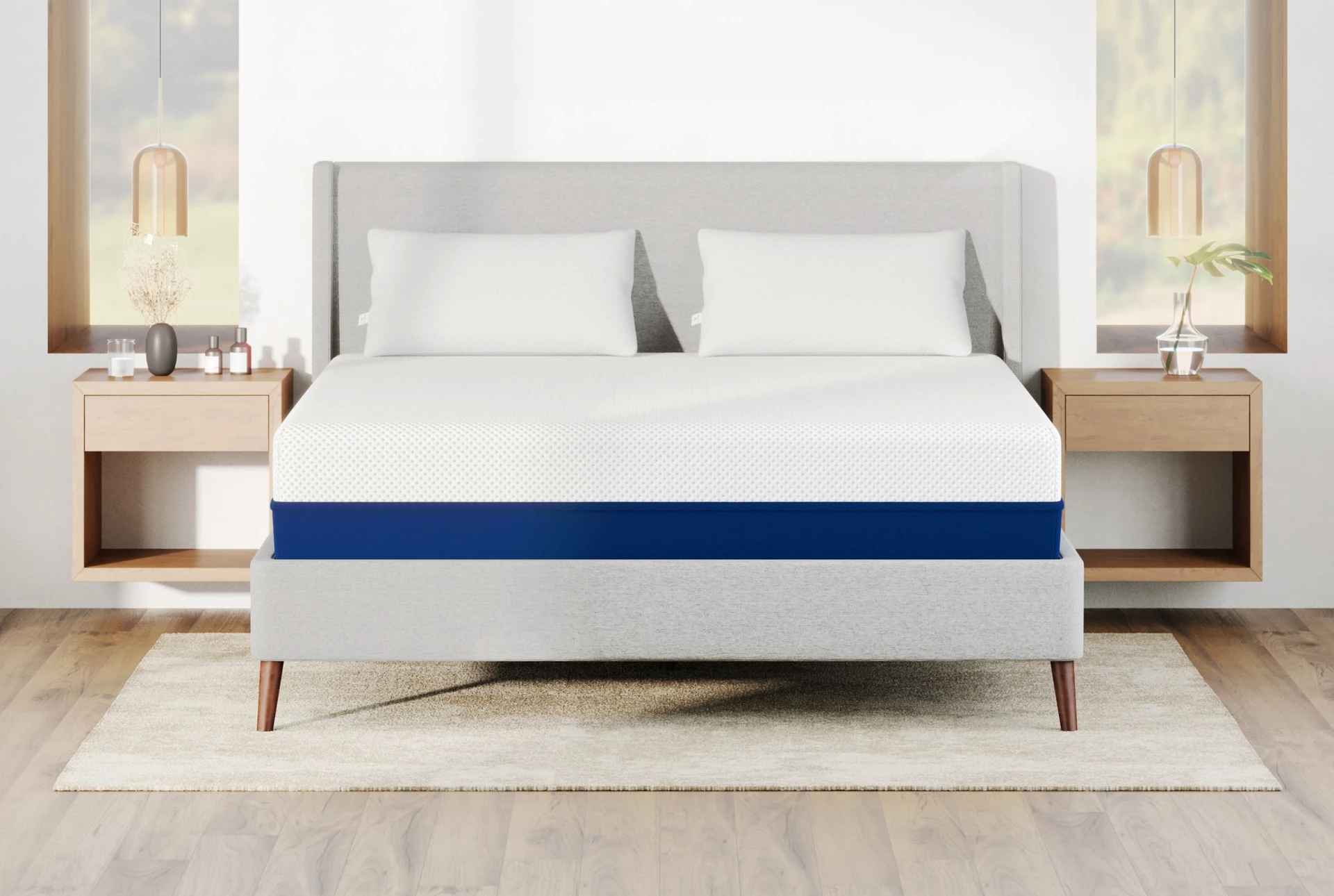
by Amerisleep HIVE is a 5-zone hex-cell layer that varies firmness by body region, firmest under the lumbar (zone 3), softest at the shoulders (zone 2). The Amerisleep AS3 carries it as standard and is our top pick for anyone who wants that zoned support in a medium-feel all-foam mattress.
Amerisleep AS3
9.1/10
- HIVE 5-zone layer firms at the lumbar and softens at shoulders, the most direct engineering solution to spinal alignment
- Plant-based Bio-Pur open-cell foam runs cooler than traditional memory foam
- CertiPUR-US certified, made in the USA, free shipping
- 20-year warranty covers sag over 1.5 inches
- Edge support softer than a coil-based hybrid
- Sleepers over 230 lb may want the AS5 Hybrid instead
The AS3 is the best way to experience HIVE at medium firmness. The zoned geometry actively reinforces the lumbar so the spine stays neutral whether you sleep on your back or side, and at from $1,049 queen with a 100-night trial, the risk is low.
What is Amerisleep HIVE technology?
HIVE stands for Harnessing Intelligent Ventilation and Energy. It is a proprietary transition layer that Amerisleep places between the Bio-Pur comfort foam and the Bio-Core support base. The innovation is structural rather than chemical: the layer is cut into a repeating hexagonal cell pattern, and the cell size and wall thickness vary by body zone. Wider cells with thinner walls compress more easily, they feel softer. Narrower cells with thicker walls resist compression, they feel firmer. Amerisleep divides the body map into five distinct zones, each with its own cell geometry.
What that means in practice is that a single continuous foam layer can deliver differentiated firmness without any seams, zippers, or separate foam inserts. The engineering challenge is getting the cell geometry right so each zone transitions smoothly rather than creating a hard line between soft and firm. Amerisleep's implementation uses a gradual density gradient at each zone boundary, which is why you feel the zoning as a general support shift rather than a sharp edge when you roll over.
The 5 zones: what each one does and why it matters
Firmness: Moderate. Your head, even on a pillow, presses lightly against the mattress during back sleep. Zone 1 is not the softest zone because that would create instability for the neck. It is firmer than the shoulder zone but still yielding enough to let the cervical curve settle naturally. This matters most for back sleepers who use a thin pillow and for people who shift from side to back during the night.
Firmness: Softest of the five. The shoulder is the widest, most pressure-concentrated point for side sleepers. A mattress that is too firm at the shoulder pushes back against the shoulder joint and rotates the whole upper arm inward, which eventually wakes you up with numbness or pain. HIVE's shoulder zone uses the widest hex cells with the thinnest walls, so it gives enough to let the shoulder pocket sink without bottoming out onto the firm base. For back sleepers the shoulder zone also prevents the arm from being pushed outward, which can cause rotator cuff discomfort over time.
Firmness: Firmest of the five. The lumbar spine has a natural lordotic curve, it bows slightly forward when you stand. When you lie down, gravity tries to flatten that curve. If the mattress is too soft under the lumbar, the spine sags into flexion, stretching the posterior ligaments and compressing the disc spaces at L4-L5 and L5-S1, which is where most chronic lower back pain originates. Zone 3 uses the narrowest hex cells, which means the HIVE layer pushes back with more force in exactly this region. It does not force the lumbar into hyperextension, it simply prevents the sag that softer foam would allow. This is why the AS3 consistently tests well for lumbar support despite being an all-foam mattress.
Firmness: Softer than lumbar, firmer than shoulder. The hip zone is a balance point. Side sleepers need the hip to sink slightly so the pelvis stays level and the lumbar spine does not develop lateral sway. But if the hip sinks too far, it pulls the spine out of alignment in the opposite direction. HIVE sets zone 4 to an intermediate firmness, enough give to accommodate the hip's prominence, not so much that the pelvis drops below the lumbar. For heavier side sleepers above 200 lb, this zone may still feel too firm; that is the group Amerisleep directs toward the AS3 Hybrid or the AS5 Hybrid.
Firmness: Medium, similar to Zone 1. The legs and feet are the lightest load zone. HIVE makes this zone moderately firm to support circulation and prevent the calves from sinking below the level of the hips, which can add to lower back strain in back sleepers. It is not as firm as zone 3 because over-supporting the legs tilts the pelvis forward, which paradoxically increases lumbar lordosis beyond the comfortable range.
The science behind hex-cell foam engineering
Hexagonal cell geometry is not unique to mattresses, it is used in aeronautical composites, bicycle helmets, and orthopedic padding for the same reason: a hex grid provides the highest compression-resistance per unit of material. Each wall shares load with six adjacent cells, so the structure fails gradually rather than suddenly. In practical sleep terms, this means HIVE compression is progressive rather than stepwise, the layer feels like it gets firmer the deeper you sink, rather than feeling uniformly soft until it suddenly bottoms out.
The ventilation half of the HIVE acronym refers to the gaps created by the hex cutouts. Those voids allow air to move vertically through the layer as you shift position. Conventional flat foam blocks this vertical airflow. In an all-foam mattress without the hex layer, heat and moisture build up between the comfort foam and the transition layer during the night. HIVE's open geometry reduces that accumulation, which is why the AS3 sleeps cooler than comparable all-foam mattresses without proprietary ventilation layers.
One more detail worth understanding: HIVE is not latex despite having a similar hex-cell appearance to some Talalay latex products. It is a polyurethane foam with a machined hex pattern. Latex would provide more natural bounce and higher durability, but it would also cost significantly more and add weight. Amerisleep chose foam for cost-efficiency and for its compatibility with the Bio-Pur chemistry in the layer above.
HIVE vs flat foam: what the difference feels like in practice
The most useful comparison is the AS3 against a flat-foam mattress at the same medium firmness, say, a standard all-foam bed at 5 out of 10. In back sleep, both feel similar for the first few minutes. The difference becomes apparent over the course of a full night. On flat foam, the lumbar zone gradually sinks to the same depth as the hips and legs, because the foam has no mechanism to resist the concentrated weight of the lower back differently than it resists the lighter weight of the calves. By morning, many sleepers find themselves in mild lumbar flexion without having consciously moved.
On the AS3 with HIVE, zone 3 pushes back with measurably more force than zones 4 and 5, keeping the lumbar slightly elevated relative to the hips and maintaining the lordotic curve throughout the night. The effect is subtle, you will not feel a hump under your lower back, but it is consistent, which is why reviewers who switch from flat-foam beds to the AS3 often report less morning stiffness within two to four weeks even without changing anything else about their sleep setup.
For side sleepers, the shoulder difference is more immediately noticeable. A flat-foam medium bed at 5 out of 10 applies the same upward force to your shoulder as it applies to your ribs. HIVE softens specifically at zone 2, so the shoulder sinks 20 to 30 percent deeper relative to the rib cage before resistance increases. That extra give moves contact pressure away from the shoulder joint and onto the broader chest wall, which tolerates pressure better.
Which Amerisleep models carry HIVE
| Mattress | Type | Firmness | Trial | Warranty | Queen price |
|---|---|---|---|---|---|
| Amerisleep AS3 | All-foam (Bio-Pur) | Medium 5/10 | 100 nights | 20 years | From $1,049 |
| Amerisleep AS3 Hybrid | Hybrid (foam + coils) | Medium 5/10 | 100 nights | 20 years | From $1,499 |
| Amerisleep AS5 Hybrid | Hybrid plush (foam + coils) | Soft 3/10 | 100 nights | 20 years | From $2,099 |
| Amerisleep AS5 Hybrid | Hybrid plush (reinforced coils) | Soft 3/10 | 100 nights | 20 years | From $2,299 |
The all-foam AS1, AS2, AS4, and AS5 do not use HIVE. Those models use standard SMT (Surface Modification Technology) zoning, which is a simpler version of the concept. HIVE is the premium implementation, reserved for the models where Amerisleep positions zoned support as the primary selling point.
HIVE vs competitor zoning systems
Most major mattress brands have some version of zoned support. The implementation varies more than the marketing implies.
Saatva Classic (Lumbar Zone pad): Saatva uses a physical foam pad sewn into the center third of the mattress, between the dual coil layers. It is a separate insert, not an integrated geometry change. The result is a firmer rectangular zone rather than a gradual transition. It works well for back sleepers but creates a slight perceptible edge at the zone boundary when you roll from hip to lumbar in side sleep.
Helix Midnight Luxe (zoned coils): Helix achieves zoning through differentiated coil gauges, stiffer gauge wire in the lumbar column, softer gauge at the shoulders and hips. This is effective and arguably more durable than foam-based zoning, but it comes at a higher price point and only applies to the Luxe tier, not the standard Midnight.
Standard pocketed coil beds (no active zoning): A bed with pocketed coils but no deliberate zone differentiation will provide some passive zoning because heavier body regions compress coils further, but the spring rate is uniform across the surface. It will never actively resist in the lumbar the way HIVE's narrower cells do.
HIVE's advantage is integration. It is built into a single continuous layer, so the zoning is present at every density of contact, whether you are lying still or shifting position. Inserted foam pads and zoned coils can feel inconsistent depending on where your body falls relative to the zone boundary. HIVE's gradual cell-geometry transitions reduce that inconsistency.
Who benefits most from HIVE and who should look elsewhere
HIVE-equipped models are best suited for back sleepers and side sleepers in the 130 to 230 lb range. The zoning geometry is calibrated for average adult body proportions, shoulder width, hip-to-waist ratio, and lumbar-to-hip height differential within that weight band. If you are significantly lighter than 130 lb, you may not compress the zones enough to feel the firmness variation. If you are over 230 lb, zone 3 may not provide sufficient resistance before you compress fully through the HIVE layer to the denser Bio-Core base, at which point the zoning effect is reduced.
Stomach sleepers receive less benefit from the shoulder and hip zoning because neither is a pressure point in stomach sleep, and the lumbar zoning actually risks working against them slightly, stomach sleepers generally need more uniform firmness under the hips to prevent lumbar hyperextension. Amerisleep directs stomach sleepers toward the firmer AS1 or AS2, neither of which carries HIVE.
The other group who should look elsewhere is anyone who needs maximum edge support. HIVE improves on-surface zoning but does nothing for perimeter compression. An all-foam AS3 still has softer edges than any coil hybrid, including the AS3 Hybrid. If you sit on the edge of the bed regularly or share the mattress with a partner who needs usable edge-to-edge space, the AS3 Hybrid's coil core provides meaningfully better perimeter stability.
Verdict: is HIVE technology worth it?
For the target user, a back or side sleeper in the 130 to 230 lb range who wants an all-foam bed, HIVE is a genuine differentiator. The hex-cell geometry is not marketing language. It produces measurably different compression characteristics by zone, which translates to better lumbar support maintenance and better shoulder pressure relief than a flat-foam bed at the same stated firmness. The ventilation benefit is secondary but real: HIVE-equipped all-foam mattresses sleep cooler than comparable foam-only alternatives.
The 100-night trial is long enough to feel the zoning effect in full. Most people notice the shoulder difference within the first week. The lumbar benefit takes two to four weeks because your body needs time to readjust to sleeping in better alignment, muscles that have been compensating for poor support need to relax before the benefit is felt as reduced soreness rather than new soreness. This is worth knowing before you return the mattress at day 20 because your back aches in a new way.
HIVE is Amerisleep's best structural innovation and the main reason the AS3 tests above average for lumbar support despite being an all-foam mattress. If zoned support matters to you, the AS3 is the most accessible entry point, medium firmness, 100-night trial, 20-year warranty, from $1,049 queen.
Frequently asked questions
What does HIVE stand for in Amerisleep mattresses?
HIVE stands for Harnessing Intelligent Ventilation and Energy. It refers to the hex-cell cutout layer that creates 5 body-mapped firmness zones and allows airflow through the mattress.
Which Amerisleep models have HIVE technology?
The AS3 (all-foam), AS3 Hybrid, AS5 Hybrid, and AS5 Hybrid all include HIVE. The AS1, AS2, AS4, and AS5 all-foam use a simpler SMT zoning system instead.
Is HIVE actually foam or is it latex?
It is polyurethane foam with a machined hexagonal cell pattern. It is not latex, though the visual appearance is similar to some open-cell Talalay latex products. Amerisleep chose foam to keep production costs down and maintain compatibility with Bio-Pur chemistry.
Does HIVE make the AS3 good for back pain?
For non-specific lower back pain in average-weight adults, yes. Zone 3 firms specifically under the lumbar spine, which prevents the sag that causes posterior ligament strain in back and side sleepers. For anyone over 230 lb, the AS3 may not provide enough zone 3 resistance and the AS3 Hybrid or AS5 Hybrid is a better fit.
How is HIVE different from other zoned mattresses?
Most competitor zoning uses a separate lumbar foam insert (Saatva) or differentiated coil gauges (Helix Luxe). HIVE achieves zoning through continuous geometric variation within a single layer, which creates a more gradual zone transition. Whether this is better or worse depends on the individual; some sleepers find insert-based zoning too pronounced, others prefer its more defined lumbar lift.
Does HIVE improve cooling?
Yes, modestly. The hex cutouts create vertical air channels through the layer. This reduces the heat and moisture accumulation that occurs between flat foam layers during the night. It does not make the AS3 a cooling mattress by any aggressive standard, but it measurably outperforms flat-foam all-foam beds at the same firmness.
Can I feel the zone boundaries when I move?
No, and that is intentional. Amerisleep uses a gradual cell-density gradient at each zone boundary rather than an abrupt cut. When you roll from your lumbar to your hip, the transition is felt as a general firmness shift, not a hard edge. Some sleepers can feel it with focused attention; it does not disturb sleep during normal position changes.
How long does HIVE technology last?
Amerisleep covers the AS3 with a 20-year warranty and specifically covers sagging over 1.5 inches. Years 1 through 10 include free repair or replacement; years 11 through 20 provide replacement at 50 percent off the purchase price. There is no specific degradation timeline for the HIVE geometry itself.
Is the AS3 Hybrid worth the extra cost over the all-foam AS3?
For sleepers over 200 lb or anyone who needs strong edge support, yes. The coil core in the AS3 Hybrid increases edge stability significantly and adds more resistance in zone 3 for heavier frames. The base HIVE layer is the same in both; the difference is what is underneath it.
Where can I try the AS3 in person?
Amerisleep has showrooms in Phoenix (Scottsdale), Denver, and Austin. Most buyers rely on the 100-night in-home trial, which includes free returns with assisted removal if the mattress does not work for you.
Amerisleep AS3
9.1/10
The best and most accessible way to experience HIVE's 5-zone support. Medium firmness, plant-based Bio-Pur foam, 100-night trial, 20-year warranty, from $1,049 queen. The shoulder and lumbar zoning is real engineering, not just marketing nomenclature.