
 by
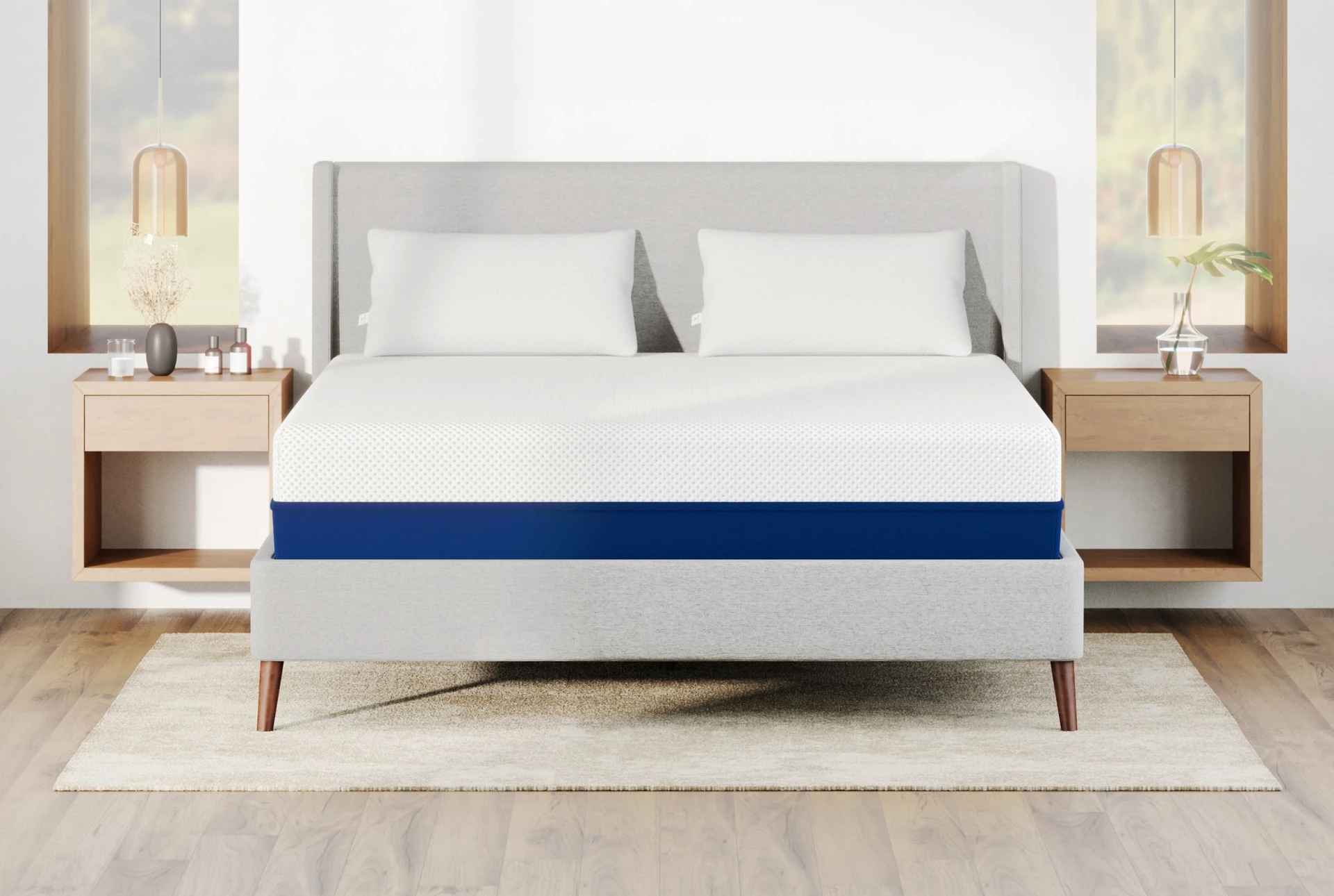
by The Amerisleep AS3 wins this comparison for most sleepers. Its HIVE 5-zone support layer firms precisely under the lumbar while staying soft at the shoulders, which is something GhostBed Classic's single-density foam construction cannot replicate. GhostBed Classic is a legitimate budget pick at $848 queen for stomach or back sleepers who want a firmer, bouncier surface and don't need deep pressure relief.
Amerisleep AS3
9.1/10
- HIVE 5-zone support: softer at shoulders and hips, firmer at lumbar
- Bio-Pur open-cell foam runs measurably cooler than standard memory foam
- CertiPUR-US certified, made in the USA
- 20-year warranty, twice the industry standard
- Softer edges than a coil hybrid
- Sleepers over 230 lb may prefer the AS5 Hybrid for added support
The AS3 is the better mattress for side sleepers and anyone with shoulder or hip pressure. Its HIVE zoned layer does real work. This is not marketing language but a measurable firmness difference across the five support zones.
Amerisleep AS3 vs GhostBed Classic: how they actually compare
These two mattresses sit at opposite ends of the all-foam spectrum. The AS3 is a true contouring memory-foam bed with slow response, deep hug, and excellent motion isolation. The GhostBed Classic uses a perforated latex top layer over gel-infused memory foam, which makes it firmer, more responsive, and bouncier than the AS3 at a lower price.
Neither is a bad mattress. But they serve different sleepers, and the wrong pick will feel noticeably off within the first two weeks.
Side-by-side specs
| Mattress | Type | Firmness | Trial | Warranty | Queen price |
|---|---|---|---|---|---|
| Amerisleep AS3 | All-foam (Bio-Pur) | Medium 5/10 | 100 nights | 20 years | $1,249 (queen) |
| GhostBed Classic | Combo foam (latex + gel) | Medium-Firm 6.5/10 | 365 nights | 20 years | ~$848 |
Construction breakdown
Amerisleep AS3 is 12 inches tall with three layers: a 3-inch Bio-Pur comfort layer on top, a 2-inch HIVE transition layer in the middle (the zoned support layer), and a 7-inch Bio-Core high-density base. The HIVE layer is the defining feature. Hexagonal foam cutouts create five distinct support zones across the body. Shoulders and hips get softer zones for pressure relief; the lumbar gets a firmer zone to prevent the reverse arch that causes lower-back pain.
GhostBed Classic is 11 inches tall with a perforated aerated latex top (1.5 inches), gel-infused memory foam middle (2 inches), and a high-density support foam base (7.5 inches). The perforated latex is what differentiates GhostBed: it's bouncier and more responsive than memory foam, runs slightly cooler due to the aerated structure, and gives the mattress a medium-firm rather than pure-medium feel. Total comfort layer is 3.5 inches, which is thinner than the AS3's 5-inch comfort stack.
Performance head-to-head
Pressure relief
The AS3 wins clearly here. Its slower-response Bio-Pur foam lets the shoulder and hip sink into the comfort layer while the HIVE support layer holds the lumbar. Side sleepers in particular will notice the difference. The GhostBed Classic's firmer latex surface does not give the same hip-relief on the side. NapLab's testing records the GhostBed Classic with a 10/10 motion isolation score (4.80 m/s² transfer), which confirms how dead the feel is, but pressure relief depends on the comfort layer depth, and at 3.5 inches the GhostBed is at a disadvantage for heavier side pressure.
Cooling
GhostBed has a structural edge here. Aerated latex moves air better than solid memory foam. NapLab records the GhostBed Classic at 92.7 degrees Fahrenheit max surface temperature, which is above average for foam mattresses. The AS3's Bio-Pur open-cell structure improves on standard memory foam (which typically hits 95 degrees or higher), landing in the 90-91 degree range. Both sleep reasonably cool for foam mattresses, but GhostBed's latex layer provides slightly better airflow. Neither is as cool as a hybrid with a coil core.
Motion isolation
GhostBed Classic measures 4.80 m/s² acceleration transfer, which is a perfect 10/10 per NapLab and best-in-class for a foam mattress with a latex top layer. The AS3 is also excellent at motion isolation (10/10 from multiple sources, 2.11 m/s²). Both beds work well for couples. Slight edge to Amerisleep in pure motion deadening due to the slower-response Bio-Pur foam.
Feel and responsiveness
This is the biggest practical difference. The AS3 has the slow-melt memory foam feel: you sink in, and the foam holds you there. Combination sleepers who switch positions frequently find the AS3 a little slow to respond. The GhostBed Classic is the opposite. Latex bounces back almost instantly, making position changes easy. If you share the bed and both of you move during the night, GhostBed's responsiveness is noticeably more comfortable. If you sleep on your side in one position all night, the AS3's pressure relief is more valuable.
Edge support
Both beds are all-foam, and all-foam beds have softer edges than coil hybrids. Neither wins this category. Both give noticeable compression when sitting on the perimeter. GhostBed's firmer overall feel makes it slightly more stable at the edge, but not enough to be a deciding factor.
Trial and warranty
GhostBed Classic wins on trial length at 365 nights, well above the AS3's 100 nights. Both carry 20-year warranties. Amerisleep's warranty is split: full replacement in years 1 through 10, and replacement at 50% cost in years 11 through 20. GhostBed's warranty covers sagging over 1 inch and manufacturing defects across the 20 years. For long-term protection the structure is similar; for trial confidence GhostBed gives you more runway.
Price
GhostBed Classic is meaningfully cheaper at approximately $848 queen versus the AS3 at approximately $1,249 queen. That $401 gap is real money. For side sleepers who need the HIVE zoning, the AS3 is worth the premium. For back or stomach sleepers who sleep cool and want a responsive, durable foam bed, GhostBed delivers solid value.
Who should choose which
Choose the Amerisleep AS3 if: you sleep primarily on your side, you have shoulder or hip pressure-point issues, you share the bed and need motion isolation, or you want the 20-year warranty with the best pressure-relief zoning in the foam category.
Choose GhostBed Classic if: you sleep on your back or stomach and prefer a firmer 6.5/10 surface, responsiveness matters more than deep contouring, you want a longer 365-night trial, or budget is the deciding factor at $848 queen.
For most sleepers, especially side sleepers and those with back pain, the Amerisleep AS3 is the better-engineered mattress. Its HIVE 5-zone support layer does something GhostBed's construction cannot. GhostBed Classic is a legitimate budget alternative for back and stomach sleepers who want bounce, firmness, and a long trial window.
GhostBed Classic
8.1/10
- Aerated latex top layer adds bounce and responsiveness
- Perfect motion isolation score (10/10, NapLab)
- 365-night trial, over 3 times longer than AS3
- Approximately $401 cheaper than the AS3 for a queen
- Medium-firm 6.5/10 is too firm for most side sleepers
- Thinner 3.5-inch comfort layer limits pressure relief depth
- No zoned support, single-density feel throughout
GhostBed Classic is the right call if your priority is bounce, firmness, a long trial, and a lower price. For pressure-relief-focused sleepers, the AS3 is still the better pick.
Frequently asked questions
Is Amerisleep AS3 or GhostBed Classic better for side sleepers?
Amerisleep AS3. Its HIVE zoned support layer provides softer zones at the shoulder and hip while firming under the lumbar. GhostBed Classic runs at 6.5/10 firmness with a single-density foam stack, and most side sleepers will feel too much resistance at the shoulder and hip.
Which mattress runs cooler, Amerisleep AS3 or GhostBed Classic?
GhostBed Classic has a slight cooling advantage from its aerated latex top layer. Both are foam beds, and foam retains more heat than coil hybrids. If cooling is your top priority, neither beats a coil hybrid. But GhostBed's perforated latex construction outperforms standard memory foam by a small margin.
How does GhostBed Classic's 365-night trial compare to Amerisleep's 100 nights?
GhostBed's trial is substantially longer. 100 nights is the AS3's full trial (Amerisleep requires no break-in period before initiating a return). 365 nights gives you a full year to decide, which removes most of the purchase risk. For buyers who are uncertain, GhostBed's trial is a genuine advantage.
Are both mattresses comparable in durability?
Both carry 20-year warranties, which signals above-average durability. Amerisleep's Bio-Pur foam is designed for longevity. The warranty splits into full coverage (years 1 through 10) and reduced-cost replacement (years 11 through 20). GhostBed's latex top layer is inherently durable material, but the gel-infused memory foam underneath follows standard foam lifecycle expectations.
Amerisleep AS3
9.1/10
Medium 5/10 feel, HIVE 5-zone support, Bio-Pur plant-based memory foam, CertiPUR-US certified, 100-night trial, 20-year warranty. The more versatile and better-engineered mattress of the two, especially if you sleep on your side or need lumbar zoning.