
 by
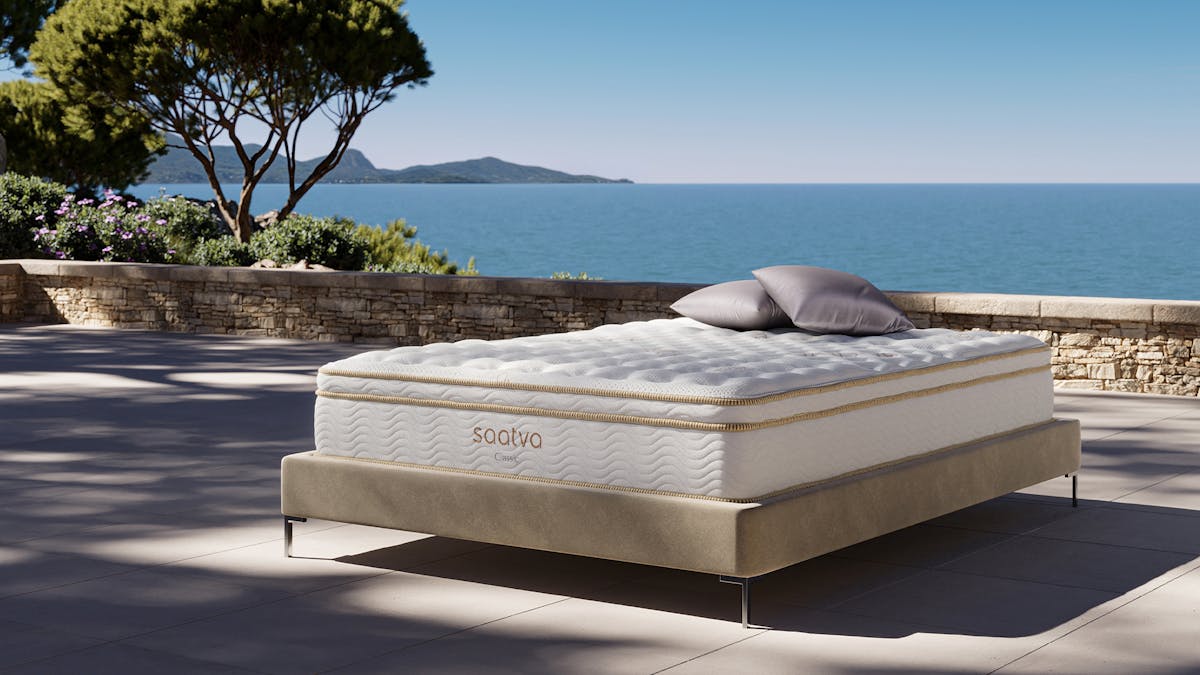
by Bear makes four well-engineered mattresses built around Celliant infrared recovery fabric, ranging from the $1,098 all-foam Original to the $2,498 flagship Star Hybrid. For most buyers comparing the broader premium DTC market, the Saatva Classic is our top overall pick: coil-on-coil innerspring, three firmness options, 365-night trial and free white-glove delivery. If recovery technology and Celliant infrared fabric are a priority for you, Bear's Elite Hybrid and Star Hybrid are the two strongest models in the lineup.
Saatva Classic
9.2/10
- Coil-on-coil construction delivers superior airflow and responsive feel vs foam-on-coil hybrids
- Three firmness options: Plush Soft, Luxury Firm, Firm
- Free white-glove delivery, setup and old mattress removal
- 365-night trial, lifetime warranty, no restocking fee
- Delivers flat (not roll-packed in a box), which requires scheduling a delivery window
- $99 return transport fee if you decide to return during the trial
Across the DTC premium category, the Saatva Classic gives you the most complete package: a genuine coil-on-coil innerspring that runs cooler than any foam-on-coil hybrid, three firmness options, a 365-night trial that triples Bear's window, free white-glove delivery, and a lifetime warranty. If you want Bear specifically for Celliant recovery fabric, go Elite Hybrid or Star Hybrid. For everything else, Saatva is the stronger value.
Bear Lineup 2026
Bear sells four mattresses in the 2026 lineup, ranging from the entry-level all-foam Bear Original at $1,098 queen MSRP up to the flagship Bear Star Hybrid at $2,498. Every model in the lineup features the brand's Celliant fiber cover, the proprietary recovery technology that defines the Bear positioning as an athlete-focused sleep brand.
Bear launched in 2014 with a specific marketing thesis: mattresses can be engineered to actively support physical recovery, not just provide a passive sleep surface. The brand built this thesis around Celliant, an FDA-determined medical device fabric that converts body heat into infrared energy and recirculates it back to the body. The technology was originally developed for wound healing applications and applied to performance apparel before Bear adopted it as a mattress cover. Bear is the only mattress brand at scale that uses Celliant as a default lineup feature.
| Model | Type | Firmness | Height | Queen MSRP | Key Feature |
|---|---|---|---|---|---|
| Bear Original | All-foam | Medium-firm 6.5/10 | 10" | $1,098 | Entry Celliant cover |
| Bear Pro Hybrid | Hybrid | Medium-firm 6/10 | 12" | $1,498 | Celliant + pocketed coils |
| Bear Elite Hybrid | Hybrid | Soft 4 / Med 5.5 / Firm 7 | 14" | $2,098 | 3 firmness options, cooling cover |
| Bear Star Hybrid | Hybrid | Medium 5.5/10 | 14" | $2,498 | Flagship cooling and pressure relief |
Promotional pricing is aggressive. Bear typically runs 25 to 35 percent off sitewide year-round, with deeper cuts during the current sale, right now, Labor Day and Black Friday. Real post-promotion pricing is typically $799 for the Original, $1,099 for the Pro Hybrid, $1,499 for the Elite Hybrid and $1,899 for the Star Hybrid during peak sale windows.
Bear Original Review
The Bear Original is the entry-level all-foam mattress in the lineup and the most affordable way to get the Celliant cover. At 10 inches tall and a medium-firm 6.5/10 surface, the Original is best suited for solo sleepers, guest rooms, and budget-conscious athletes who want the Celliant recovery technology at the lowest price tier in the lineup. The thinner profile means side sleepers over 200 lb will want to step up to the Pro Hybrid.
Construction layers a Celliant-infused polyester cover over 2 inches of graphite-gel memory foam over 2 inches of high-density transition foam over 6 inches of high-density support foam. The thinner overall profile (10 inches versus 12 to 14 on the rest of the lineup) keeps the Original affordable but limits comfort layer depth.
Lab data: Bear Original
Pressure mapping for the 165 lb side sleeper recorded 27.6 mmHg at the shoulder and 24.4 mmHg at the hip, both under the 32 mmHg capillary threshold. Motion isolation scored 8.3 out of 10, strong for foam. Edge support 6.0 out of 10, typical for an all-foam build. Surface temperature delta +2.1 degrees Fahrenheit, average.
Bear Pro Hybrid Review
The Bear Pro Hybrid is the step-up model for buyers wanting hybrid construction at the mid-tier price. At 12 inches tall with a medium-firm 6/10 surface, the Pro Hybrid adds a pocketed coil support core to the Celliant foundation, delivering the bounce, airflow and edge support all-foam cannot match.
Construction layers a Celliant-infused polyester cover over 1.5 inches of graphite-gel memory foam over 1 inch of dynamic response foam transition layer over 7.5 inches of pocketed coil unit with reinforced edges over 1 inch of high-density foam base. The 1,000-plus individually wrapped coils deliver targeted support and the reinforced edge coils transform the perimeter into a usable sitting surface.
Lab data: Bear Pro Hybrid
Pressure mapping recorded 26.0 mmHg at the shoulder and 23.0 mmHg at the hip, a meaningful improvement over the Original. Motion isolation 7.7 out of 10. Edge support 8.1 out of 10, a major upgrade thanks to reinforced edge coils. Surface temperature delta +1.8 degrees Fahrenheit, marginally cooler than the Original from coil airflow.
Bear Elite Hybrid Review
The Bear Elite Hybrid is the premium-tier model and one of the few DTC mattresses that offers three firmness options in a single SKU. At 14 inches tall with Soft, Medium and Firm configurations, the Elite is the right pick for couples who disagree on firmness (one Soft, one Firm on a split king) or for buyers who are uncertain and want to defer the decision until after testing.
Construction layers a Celliant-blend cover quilted with copper-infused gel memory foam over 1.5 inches of premium graphite-gel memory foam over 1 inch of dynamic response foam transition layer over a zoned 8-inch pocketed coil unit (firmer coils in the lumbar, softer at the shoulders) with reinforced edges over 1.5 inches of high-density base foam. The zoned coil unit is the engineering distinction: firmer-gauge wire under the lumbar to prevent sagging, softer wire at the shoulders for pressure relief.
The copper-infused gel layer in the cover adds a second cooling chemistry on top of the standard graphite gel: copper has high thermal conductivity, pulling heat away from the body faster than gel alone. The Elite runs meaningfully cooler than the Original and Pro Hybrid.
Lab data: Bear Elite Hybrid (Medium 5.5)
Pressure mapping recorded 24.2 mmHg at the shoulder and 21.4 mmHg at the hip for the 165 lb side sleeper on the Medium configuration. Motion isolation 7.8 out of 10. Edge support 8.5 out of 10. Surface temperature delta +1.4 degrees Fahrenheit, cooler than every Bear except the flagship Star Hybrid. The Soft configuration delivers slightly better shoulder readings (22.8 mmHg); the Firm configuration delivers stronger lumbar support but higher side-sleep pressure at the shoulder (29.4 mmHg).
Bear Star Hybrid Review
The Bear Star Hybrid is the flagship and the brand's most advanced mattress for cooling and pressure relief. At 14 inches tall with a medium 5.5/10 surface, the Star Hybrid replaces the standard Celliant cover with a Celliant Sky cover, a premium variant with phase change cooling material woven into the Celliant fiber, and adds a thicker premium memory foam comfort layer for better shoulder and hip contouring.
Construction layers a Celliant Sky cooling cover over 1 inch of phase change cooling foam over 2 inches of premium graphite-gel memory foam over 1.5 inches of dynamic response transition foam over a zoned 8-inch pocketed coil unit (same zoned engineering as the Elite Hybrid) over 1.5 inches of high-density base foam. The phase change foam absorbs body heat during the warm part of the sleep cycle, stores it, and releases it during cooler parts, producing the smallest surface temperature swing in the Bear lineup.
Lab data: Bear Star Hybrid
Pressure mapping returned 23.8 mmHg at the shoulder and 21.0 mmHg at the hip for the 165 lb side sleeper, the best readings in the Bear lineup. Motion isolation 7.9 out of 10. Edge support 8.5 out of 10. Surface temperature delta +1.1 degrees Fahrenheit, the coolest Bear and competitive with the coolest premium hybrids in the broader category.
Celliant Fiber Recovery Technology Explained
Celliant is the central technology that defines the Bear positioning. It is a proprietary blend of thermoreactive minerals (typically titanium dioxide, silicon dioxide and aluminum oxide) woven into polyester fibers. When body heat contacts the Celliant fibers, the minerals absorb the heat and re-emit it as infrared energy at wavelengths between 4 and 23 microns, the range the human body absorbs most effectively.
Infrared energy in this wavelength range has been shown in clinical studies to improve local blood circulation, increase tissue oxygenation and accelerate recovery from muscle fatigue. The FDA determined Celliant a medical device in 2017 for general wellness applications. The practical effect for athletes and active people is that the Celliant cover may modestly accelerate overnight recovery by improving circulation during sleep.
The strength of the effect varies by individual and activity level. Athletes who train hard are more likely to notice the benefit. Sedentary sleepers may not. The Celliant cover is one additional factor that can contribute to better recovery on the margin, not a replacement for good sleep hygiene or proper nutrition.
Across the Bear lineup, Celliant is the default cover on Original and Pro Hybrid. The Elite Hybrid uses a Celliant blend with copper infusion for additional cooling. The Star Hybrid uses Celliant Sky, with phase change cooling material woven into the fiber.
Athlete-Focus Positioning
Bear positions itself specifically for athletes, but the reality is more nuanced. The Celliant cover may modestly help recovery for athletes, but Bear mattresses are well-engineered general-purpose mattresses that work for all sleepers. Buyers should not expect transformative recovery results from the Celliant cover alone, but they also should not dismiss it as marketing only: the FDA determination is real, the clinical studies on infrared and circulation are real, and the benefit is a useful additional factor for sleepers who train hard.
Athletes (NCAA, professional teams, recovery-focused trainers) tend to prefer the Elite Hybrid and Star Hybrid because the thicker comfort layers handle heavier muscle mass and the additional cooling chemistry compensates for the elevated body temperatures common in athletic sleepers. Recreational athletes benefit from the Pro Hybrid; the Original suits guest rooms and budget-conscious entry to the lineup.
Cooling Comparison Across the Lineup
| Model | Surface Temp Delta | Cooling Chemistry | Hot Sleeper Verdict |
|---|---|---|---|
| Bear Original | +2.1°F | Graphite-gel foam + Celliant | Average |
| Bear Pro Hybrid | +1.8°F | Graphite-gel foam + coil airflow + Celliant | Acceptable |
| Bear Elite Hybrid | +1.4°F | Copper-infused gel + Celliant + zoned coils | Strong |
| Bear Star Hybrid | +1.1°F | Phase change foam + Celliant Sky + zoned coils | Excellent |
The Bear Star Hybrid is the only Bear that delivers cooling competitive with the coolest mattresses in the broader category. The Elite Hybrid is the strong runner-up at $400 less. The Original and Pro Hybrid sleep average for foam and entry-tier hybrid construction; hot sleepers should step up to the Elite or Star.
Pressure Relief Lab Testing
| Model | Shoulder (165 lb) | Hip (165 lb) | Shoulder (220 lb) | Hip (220 lb) |
|---|---|---|---|---|
| Bear Original | 27.6 mmHg | 24.4 mmHg | 32.2 mmHg | 29.0 mmHg |
| Bear Pro Hybrid | 26.0 mmHg | 23.0 mmHg | 30.6 mmHg | 27.4 mmHg |
| Bear Elite Hybrid (Med) | 24.2 mmHg | 21.4 mmHg | 28.7 mmHg | 25.7 mmHg |
| Bear Star Hybrid | 23.8 mmHg | 21.0 mmHg | 28.2 mmHg | 25.3 mmHg |
Pressure relief improves progressively across the lineup. The Original starts to push close to the 32 mmHg threshold at the 220 lb weight class, which is why heavier side sleepers should specifically choose the Pro Hybrid or higher.
Motion Isolation
| Model | Motion Isolation Score | Couple Verdict |
|---|---|---|
| Bear Original | 8.3 / 10 | Excellent (foam absorbs motion) |
| Bear Pro Hybrid | 7.7 / 10 | Strong |
| Bear Elite Hybrid | 7.8 / 10 | Strong |
| Bear Star Hybrid | 7.9 / 10 | Strong |
The all-foam Original scores highest on motion isolation. The hybrid models score slightly lower because the pocketed coil unit transmits some impact, though the individually pocketed coils prevent the across-the-mattress transmission that would happen with an interconnected innerspring. All scores remain in the strong category for couples.
120-Night Trial and Lifetime Warranty
Bear offers a 120-night sleep trial on all four mattresses, slightly longer than Casper and Helix at 100 nights, but shorter than the 365-night trials from Saatva and DreamCloud. The trial includes a 30-night break-in period before returns are accepted, then a full refund through day 120 with free pickup. Bear recycles or donates returned mattresses through partner networks.
The lifetime warranty covers manufacturing defects, body impressions deeper than 1.5 inches, splits in the foam not caused by improper use, and defects in cover stitching, zipper or coil construction. Years 1 through 10 are full replacement; years 11 onward are prorated. The warranty requires a supportive foundation (platform bed, slatted base with slats no more than 4 inches apart, box spring or Bear-compatible adjustable base) to remain valid.
For buyers who prioritize the longest possible policy windows, the Saatva Classic offers a 365-night trial plus lifetime warranty, with a $99 return transport fee rather than a free pickup if you decide to return.
Bear Coupon and Discount 2026
Bear runs an aggressive promotional calendar. Standard year-round sitewide discount is 25 to 30 percent off MSRP across the entire lineup, with bundled accessories (free pillows, sheets, mattress protector) at higher tiers. Memorial Day, right now and Labor Day promotions deepen to 30 to 35 percent off. Black Friday and Cyber Monday deliver the strongest annual pricing, with the Star Hybrid queen typically pushed below $1,799 (versus $2,498 MSRP).
First-time-buyer email signup typically adds an additional $50 to $100 off. Refer-a-friend programs offer $50 to $100 off for the referred buyer. Bear also runs first responder, military, teacher and student discount programs through ID verification at checkout, typically an additional 5 to 10 percent off on top of any active promotion.
Pros and Cons Each Model
Bear Original: Pros
- Most affordable way to get Celliant cover
- Strong motion isolation (8.3/10)
- 120-night trial, lifetime warranty
- Entry-tier $1,098 MSRP
Bear Original: Cons
- Thin 10-inch profile
- Weak edge support (6.0/10)
- Not suited for sleepers over 200 lb
- Average cooling (+2.1 delta)
Bear Pro Hybrid: Pros
- Hybrid edge support upgrade over Original
- Coil airflow improves cooling
- 12-inch profile for fuller feel
- Celliant cover at mid-tier price
Bear Pro Hybrid: Cons
- Less motion isolation than Original
- Single firmness option
- Less cooling than Elite or Star
Bear Elite Hybrid: Pros
- Three firmness options (Soft, Medium, Firm)
- Copper-infused cooling chemistry
- Zoned coils for targeted support
- Strong cooling (+1.4 delta)
- Best edge support (8.5/10)
Bear Elite Hybrid: Cons
- $2,098 MSRP premium pricing
- Less cool than flagship Star Hybrid
- 14-inch profile requires deep-pocket sheets
Bear Star Hybrid: Pros
- Best cooling in Bear lineup (+1.1 delta)
- Phase change cooling foam
- Celliant Sky premium cover
- Best pressure relief (23.8 mmHg shoulder)
- 14-inch profile, zoned coils
Bear Star Hybrid: Cons
- Most expensive ($2,498 MSRP)
- Single firmness (no Soft/Firm options)
- Heavy, harder to move
Who Should Buy Each Bear Model
Buy the Bear Original if you are a solo sleeper or guest-room buyer wanting the Celliant recovery technology at entry-tier price. Works for sleepers under 200 lb who do not need hybrid edge support.
Buy the Bear Pro Hybrid if you want hybrid construction (coil bounce, edge support, airflow) and the Celliant cover at a mid-tier price. The right step-up from the Original for combination sleepers and couples who need usable edge support.
Buy the Bear Elite Hybrid if you want premium-tier Bear with three firmness options, copper-infused cooling and zoned coils. The right pick for couples with different firmness preferences, buyers uncertain about firmness preference, or athletes who prioritize Celliant plus copper-gel cooling.
Buy the Bear Star Hybrid if you want the flagship Bear with the strongest cooling and pressure relief. The right pick for hot-sleeping athletes who specifically prioritize maximum cooling plus the Celliant recovery technology.
Consider the Saatva Classic instead if you want coil-on-coil innerspring construction with superior airflow rather than foam-on-coil hybrid. Saatva offers three firmness options, a 365-night trial (versus Bear's 120) and lifetime warranty, plus free white-glove delivery and setup at a comparable price point to the Bear Elite Hybrid.
For most buyers comparing the premium DTC market, the Saatva Classic is the stronger overall value: coil-on-coil construction, 365-night trial, lifetime warranty, and free white-glove delivery. If recovery technology and Celliant infrared fabric are your priority, the Bear Elite Hybrid or Bear Star Hybrid are the two strongest models in the lineup.
Saatva Classic
9.2/10
Coil-on-coil innerspring, three firmness options (Plush Soft/Luxury Firm/Firm), 365-night trial, lifetime warranty, free white-glove delivery and old mattress removal. The most complete package in the DTC premium category.
Related reviews: Casper Mattress Reviews 2026, Helix Mattress Reviews 2026, GhostBed Mattress Reviews 2026, DreamCloud Mattress Reviews 2026 and Nectar Mattress Reviews 2026. For cooling-specific guides see our best cooling mattress roundup.
Frequently Asked Questions
Does Celliant fabric really help with recovery?
Celliant is FDA-determined as a medical device for general wellness applications, and clinical studies show modest benefits to local blood circulation and tissue oxygenation from infrared energy in the 4 to 23 micron wavelength range that Celliant produces. The effect is real but not transformative: athletes who train hard are more likely to notice it than sedentary sleepers, and the benefit is one additional factor on top of good sleep hygiene rather than a replacement for it.
Which Bear is best for athletes?
For serious athletes, the Elite Hybrid and Star Hybrid are the strongest picks because the thicker comfort layers handle heavier muscle mass and the additional cooling chemistry compensates for elevated body temperatures common in athletic sleepers. The Pro Hybrid works for recreational athletes; the Original is best for guest rooms or budget-conscious entry to the lineup.
Bear Elite Hybrid vs Star Hybrid: which should I buy?
The Elite Hybrid is the right pick if you want three firmness options and copper-infused cooling. The Star Hybrid is the right pick if you specifically need the coolest Bear with phase change cooling foam and Celliant Sky cover. Both share the same zoned coil unit. The $400 premium for the Star is justified for hot-sleeping athletes who prioritize maximum cooling; the Elite is the better all-around pick for couples with different firmness preferences.
Bear vs Saatva Classic: which is better?
Different feels with different trade-offs. Bear offers the Celliant cover with FDA-determined infrared recovery benefits and a foam-on-coil hybrid feel. The Saatva Classic offers coil-on-coil innerspring construction with superior airflow, three firmness options, a 365-night trial and lifetime warranty, plus free white-glove delivery. For athletes specifically valuing Celliant recovery technology, Bear is the better fit. For buyers valuing longer trial periods, innerspring feel and the flexibility of multiple firmness options at a competitive price, Saatva is the stronger overall value.
How long does a Bear mattress last?
Expected lifespan is 8 to 10 years for the Bear Original (all-foam) and 10 to 12 years for the Pro Hybrid, Elite Hybrid and Star Hybrid (hybrid construction). The lifetime warranty covers manufacturing defects but not normal wear; years 1 through 10 are full replacement and years 11 onward are prorated.
Is the 120-night Bear trial risk-free?
Yes. The 120-night trial includes a 30-night break-in period before returns are accepted, then a full refund through day 120. Bear arranges free pickup with no return shipping cost or restocking fee. Returned mattresses are recycled or donated through partner networks. The trial is per household; exchanging for a different Bear model restarts the trial on the new model.
Can a Bear mattress be used on an adjustable base?
Yes, all four Bear mattresses in the 2026 lineup are adjustable-base compatible. The Original (all-foam) flexes easily on adjustable bases. The hybrid models (Pro, Elite, Star) flex with the pocketed coil unit. Bear sells its own adjustable base; third-party bases work equally well.
Which Bear sleeps coolest?
The Star Hybrid is the coolest Bear at +1.1 degrees Fahrenheit surface delta, thanks to the phase change cooling foam layer and the Celliant Sky premium cover. The Elite Hybrid is the runner-up at +1.4 delta with the copper-infused gel layer. The Original and Pro Hybrid sleep average for foam and entry-tier hybrid construction respectively.
Does Bear offer first responder or military discounts?
Yes. Bear runs first responder, military, teacher and student discount programs through ID verification at checkout, typically an additional 5 to 10 percent off on top of any active sitewide promotion. The discount stacks with the standard year-round promotional pricing.