
 by
by Our Top Mattress Pick
Sleep Lab Pick · Current Sale
Current Sale — $500 off Amerisleep with code AS500. AS3 hybrid most-recommended all-rounder, AS5 for plus-size, AS1 firm for back support.
Make the look happen: Saatva beds & furniture
Saatva's furniture catalog matches the look of the bedrooms featured above with handcrafted, solid-wood construction rather than MDF veneer. The collection covers upholstered bed frames (linen, velvet, leather), four-poster & canopy beds, platform beds, storage beds with hydraulic lift, and matching nightstands, dressers, benches, and headboards.
All furniture ships via free White Glove delivery with in-room setup, removal of packaging, and assembly included. Current promotion: up to $625 off sitewide, plus the $225 off orders $1,000+ professional discount via ID.me (military, veterans, first responders, nurses, teachers).
Ownership terms: 45-day return on furniture, 1-year warranty on frames. Pairs naturally with the Saatva Classic mattress.
The Saatva Classic pairs perfectly with an optimized sleep environment - responsive coils adapt to how you sleep.
The internet is full of plant-for-sleep claims that range from plausible to completely unsupported. This guide reviews the actual research, rates the evidence level for each commonly recommended plant, and gives practical care guidance so you can make an informed choice.
For existing plant recommendations from a different angle, see our page on plants for bedroom sleep. This guide focuses specifically on what the science actually shows for each species.
How Plants Can Affect Sleep: The Mechanisms
There are three plausible mechanisms by which bedroom plants could improve sleep:
Sleep Lab Alternative Picks
- Amerisleep AS3 ($1,449 sale) — Bio-Pur foam + HIVE zoning, 20-yr warranty
- PlushBeds Botanical Bliss ($2,999+) — organic latex, 25-yr warranty
- Puffy Lux ($1,950) — memory foam, lifetime warranty
- SweetNight Twilight ($209 budget) — CertiPUR-US foam
- Olfactory/chemical: Inhaled compounds from certain plants (linalool in lavender, methyl jasmonate in jasmine) interact with GABA receptors and the limbic system to produce anxiolytic or sedative effects
- Air quality: Plants absorb CO2 and produce oxygen; some species absorb certain VOCs at measurable rates in controlled laboratory conditions
- Psychological: Natural elements in a bedroom may reduce perceived stress and cortisol levels (biophilia hypothesis)
The air quality mechanism is frequently overstated. NASA's Clean Air Study, often cited for bedroom plants, tested plants in sealed laboratory chambers with far higher plant density than any bedroom. Real-world air quality benefits require many plants in a ventilated room to be meaningful.
Pros and Cons
What We Like
- Luxury innerspring with excellent lumbar support
- Multiple firmness options available
- Free white-glove delivery and mattress removal
- 365-night trial and lifetime warranty
What Could Be Better
- Higher price than many online brands
- Heavier than foam mattresses
- Not compressed in a box
- Some off-gassing possible initially
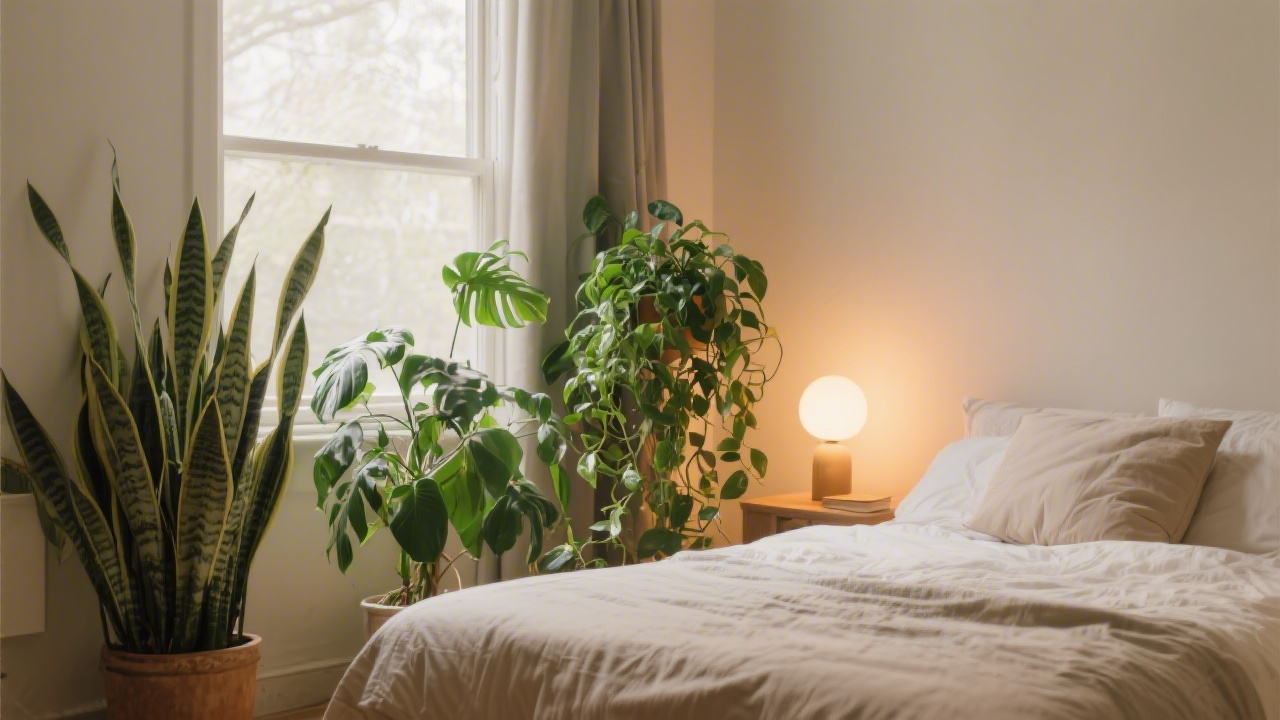
Snake Plant (Sansevieria trifasciata) - Evidence: Moderate
Snake plants are unusual in performing CAM photosynthesis - they absorb CO2 and release oxygen at night rather than during the day. This is the most frequently cited benefit. In a bedroom with one or two snake plants, the oxygen production is measurable but small relative to typical CO2 variation from opening a window.
More significant: Snake plants are among the most effective at VOC absorption (formaldehyde, benzene from furniture) in laboratory conditions. They are also extremely low-maintenance - tolerate low light and irregular watering.
Care difficulty: Very easy. Water every 2-3 weeks. Almost any light condition.
Lavender (Lavandula angustifolia) - Evidence: Strong
Lavender has the strongest evidence base of any bedroom plant. Multiple controlled studies show that inhaled linalool (lavender's primary active compound) reduces anxiety scores, increases slow-wave sleep duration, and improves next-day alertness. A 2015 study in the Journal of Alternative and Complementary Medicine showed a 60% improvement in sleep quality scores compared to a control group.
The caveat: for lavender to produce meaningful sleep effects, it needs to be actively releasing scent (blooming or recently disturbed). A dried lavender sachet near the bed is more reliable than a potted plant for scent delivery.
Care difficulty: Moderate. Needs direct sunlight (south-facing window) and well-draining soil. Not ideal for dark bedrooms.
Jasmine (Jasminum polyanthum) - Evidence: Limited but Positive
A 2010 study from Wheeling Jesuit University found that jasmine-scented rooms produced lower anxiety levels and higher sleep quality ratings than lavender or unscented rooms. The study has not been widely replicated, so the evidence is preliminary.
Jasmine's scent is intense when blooming - position it away from the bed (3-5 feet) to avoid overstimulation. It blooms seasonally, limiting consistent sleep benefits to certain months.
Care difficulty: Moderate to difficult. Needs bright indirect light, consistent moisture, and cool temperatures to bloom.
Aloe Vera (Aloe barbadensis) - Evidence: Weak
Aloe vera is frequently listed as a sleep-promoting bedroom plant. Like snake plants, it performs some CAM photosynthesis. The evidence for specific sleep benefits beyond air quality is minimal. Its practical advantage is extreme low-maintenance: requires watering once a month and tolerates neglect well.
Care difficulty: Very easy. Needs indirect light. Water sparingly.
Pothos (Epipremnum aureum) - Evidence: Weak (Good for Air Quality)
No sleep-specific evidence, but pothos consistently ranks among the most effective plants for VOC absorption in laboratory studies. It is also the most tolerant of low light and irregular care. Good choice for low-maintenance air quality improvement in bedrooms without strong natural light.
Care difficulty: Very easy. Tolerates low light and irregular watering.
Plants to Avoid in the Bedroom
- Strongly fragrant flowering plants (gardenia, hyacinth) - intense scent can overstimulate at close range
- High-pollen plants if you have allergies - lilies, chrysanthemums
- Plants requiring frequent watering - mold in wet soil is a common bedroom allergen
Practical Setup: Maximizing Benefits
If you're upgrading the bed frame
Saatva Santorini Platform Bed — from $1,295
Upholstered platform bed in 6 fabric colorways to match any bedroom palette. Slat spacing safe for foam/hybrid mattresses, rated 1,000 lbs. Free white-glove delivery and assembly.
For a sleep-optimized bedroom plant setup: one snake plant on a shelf (any light level), one lavender near a window for scent (if you have sufficient light), and one pothos for aesthetic and minimal air quality benefit. Total care time: under 5 minutes per week.
Plants complement but do not replace the core variables of a sleep sanctuary. Temperature, darkness, and sound control have stronger evidence. See our sleep sanctuary setup guide for the full optimization picture.
Frequently Asked Questions
Do bedroom plants actually improve sleep?
The evidence is limited but real for specific plants and mechanisms. Snake plants and pothos produce oxygen at night and absorb modest amounts of VOCs. Lavender has multiple controlled studies showing sleep improvement via inhaled linalool. Jasmine shows sleep latency benefits in one notable study. The effects are modest, not transformative, but the cumulative benefit is real.
Is it safe to have plants in the bedroom at night?
Yes, for virtually all common bedroom plants. The concern about plants consuming oxygen at night is largely a myth - the oxygen consumption of a typical bedroom plant is negligible compared to the average person's breathing. Only densely packed rooms with many large plants in sealed spaces would show measurable oxygen reduction.
What is the best plant for a bedroom with no windows?
Pothos (Epipremnum aureum) tolerates very low light conditions and survives on indirect light from a doorway. ZZ plants (Zamioculcas zamiifolia) are similarly low-light tolerant. Neither produces the scent benefits of lavender or jasmine, but both improve air quality modestly and require minimal care.
How close should bedroom plants be to the bed?
Scented plants (lavender, jasmine) should be 2-4 feet from the bed - close enough for gentle scent diffusion, far enough that the scent is not overwhelming. Non-scented plants (snake plant, pothos, aloe) can be placed anywhere in the room with appropriate light conditions.
Can bedroom plants cause allergies?
Flowering plants that produce airborne pollen can trigger allergic responses in sensitive individuals. Most recommended bedroom plants (snake plant, pothos, ZZ plant, aloe vera) are non-flowering or have minimal pollen and are generally safe for allergy sufferers. Mold in overwatered plant soil is a more common bedroom allergen issue than the plant itself.
Complete Your Sleep Environment
Saatva Classic - The Foundation of Great Sleep
Once your room is optimized, your mattress determines 60% of sleep quality. Saatva's dual coil system adapts to temperature and pressure better than foam.