
 by
by Saatva Classic
9.2/10
The cleanest default pick when the reader wants pressure relief without a memory-foam feel.
Zenhaven
9.0/10
A better fit than Avocado or WinkBed in this article because it keeps the latex recommendation inside our Saatva partner stack.
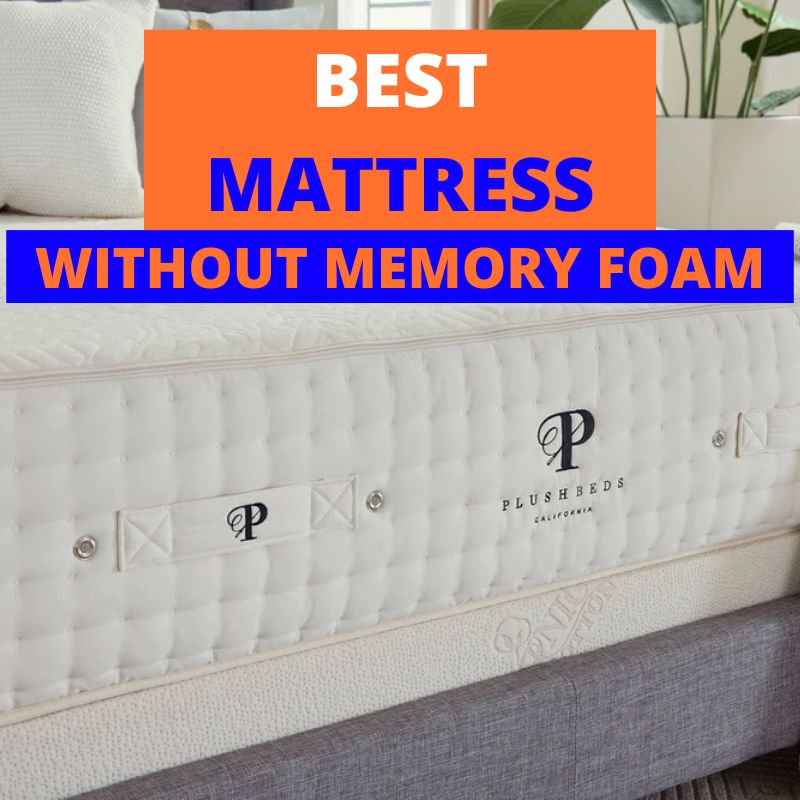
PlushBeds Botanical Bliss
8.9/10
A strong organic latex partner option for readers who want to avoid memory foam entirely.
Amerisleep Organica
8.7/10
Use Organica here instead of AS3 because the page intent is explicitly no memory foam.
| Rank | Mattress | Best for | Why it belongs here |
|---|---|---|---|
| #1 | Saatva Classic Best overall |
Hybrid without memory foam | Coil-on-coil support, three firmnesses, and no memory-foam comfort story. |
| #2 | Zenhaven Latex upgrade |
Latex shoppers | Natural latex feel with buoyant support and no sinky memory foam. |
| #3 | PlushBeds Botanical Bliss Organic latex option |
Organic mattress buyers | A strong alternative for shoppers avoiding memory foam entirely. |
| #4 | Amerisleep Organica Amerisleep latex hybrid |
Organic latex option | An Amerisleep latex hybrid alternative. |
The best mattress without memory foam is the Saatva Classic, a dual-coil innerspring hybrid with a zoned lumbar pad, Euro pillow top, and 365-night trial. For organic latex without any synthetic foam, the Avocado Green Mattress is the strongest alternative. Both deliver excellent pressure relief and support without the slow-response, heat-retaining feel of memory foam.
Why people look for mattresses without memory foam
Memory foam dominates mattress marketing, but it has real drawbacks that push a significant portion of buyers elsewhere. The three most common complaints are heat retention, slow response, and the "stuck" feeling that slow-response foam produces when you change positions at night.
Memory foam is viscoelastic, meaning it deforms slowly under pressure and recovers slowly after you move. For combination sleepers who shift from back to side repeatedly during the night, that lag creates resistance. For hot sleepers, the dense closed-cell structure traps body heat against the skin. And for anyone who wants a bouncy, hotel-style feel, standard memory foam simply does not deliver it.
The alternatives, innerspring, natural latex, and coil hybrids without foam comfort layers, address each of these problems directly. They breathe better, respond faster, and sleep cooler. The tradeoff is typically less deep contouring, which many sleepers prefer anyway.
Best mattresses without memory foam, tested
Latex vs innerspring vs coil hybrid: which is best without memory foam
Each of the three main memory-foam-free categories has a different feel and a different strength profile.
- Innerspring and dual-coil hybrids (Saatva Classic): the most traditional hotel-bed feel. Responsive, bouncy, cool. Best for back and stomach sleepers who want lift rather than contouring. The dual-coil construction of the Saatva puts a zoned pocketed-coil upper layer over a reinforced tempered-steel base, which gives it better lumbar support than a basic innerspring while keeping the bouncy feel.
- Natural latex: slower than coil but much faster than memory foam (typically 0.3 seconds vs. 1 to 8 seconds for memory foam). Latex lifts rather than cradles, which reduces the "stuck" feeling entirely. It runs cool because the open-cell structure of Dunlop and Talalay latex allows air to pass through. The drawback is weight: a solid latex mattress is heavy to move and rotate.
- Coil hybrids with latex comfort layers (WinkBed, Avocado): combine the support and edge stability of coils with the buoyant feel of latex. These tend to score highest in lab testing for both cooling and edge support, and they avoid memory foam in the comfort layer entirely.
The worst choice for someone avoiding memory foam is an "all-foam" or "gel foam" mattress that markets itself as a memory foam alternative but still uses polyurethane foam with slow response. Check the materials list before buying.
WinkBed
8.9/10
- Outstanding cooling rated 10/10 in NapLab lab testing, max surface temp 87.8°F
- Best-in-class edge support (10/10), reinforced with two rows of 13.75-gauge perimeter coils
- Fiberglass-free construction, explicitly confirmed in materials testing
- Four firmness options including a Plus version for sleepers over 300 lb
- Lifetime warranty, free shipping and returns
- 120-night trial is shorter than the Saatva or Avocado
- Low bounce reduces suitability for couples prioritizing responsiveness
- $49 exchange fee if swapping firmness levels
The WinkBed is the strongest performer in the NapLab test pool among coil hybrids, earning 9.49/10 overall. Its Serene foam comfort layer is not memory foam; it is an alternative foam with a faster response and better cooling than traditional viscoelastic foam. The cooling and edge support scores are among the best we have found in this category.
Amerisleep Organica: the organic latex option from Amerisleep
Amerisleep is best known for its Bio-Pur foam line (the AS1 through AS5), which uses a partially plant-based memory foam. For buyers specifically avoiding memory foam, Amerisleep Organica is the relevant model. It uses natural Talalay latex rather than memory foam in the comfort layer, with GOTS-certified organic cotton and wool. The Organica sits at roughly $1,999 queen and comes with the same 100-night trial and 20-year warranty as the rest of the Amerisleep line.
What actually makes a mattress memory foam free
Memory foam is polyurethane foam formulated with added chemicals that make it viscoelastic: it softens under body heat and pressure, conforms slowly to your shape, and recovers slowly when you move. This is distinct from standard polyurethane foam, which is firmer and faster-recovering, and from latex foam, which is derived from rubber tree sap and behaves entirely differently.
When evaluating whether a mattress is truly memory-foam-free, read the materials list for these terms: viscoelastic foam, memory foam, gel memory foam, gel-infused memory foam, or TEMPUR material. All of these are memory foam variants. Standard poly foam, high-resilience (HR) foam, Serene foam, and latex, whether natural Talalay or Dunlop, are not memory foam.
Some hybrid mattresses use a thin transitional layer of gel foam above the coils while marketing the product as an alternative to memory foam beds. Technically accurate, but if you are sensitive to the feel of slow-response foam, check that the comfort layer is genuinely latex or coil-based, not gel-infused memory foam.
For a fully memory-foam-free mattress, choose coil, latex, or a combination of both. The Saatva Classic is our top pick for its dual-coil responsiveness and 365-night trial. The Avocado Green Mattress is the best fully certified organic option. For hot sleepers who want maximum cooling from a hybrid, the WinkBed leads the category in lab temperature testing.
Frequently asked questions
What type of mattress has no memory foam?
Innerspring, dual-coil hybrids, and natural latex mattresses contain no memory foam. Look for construction terms like pocketed coils, Dunlop latex, Talalay latex, or organic cotton and wool layers, and avoid any comfort layer described as viscoelastic, gel-infused memory foam, or slow-response foam.
Is latex better than memory foam?
Latex is faster-recovering, cooler, and more responsive than memory foam. It does not contour as deeply, which is a disadvantage for heavy side sleepers who need significant hip sinkage, but an advantage for combination sleepers and hot sleepers. Latex also tends to be more durable than memory foam over a 10-plus year lifespan.
Is an innerspring mattress better than memory foam?
For sleepers who want a bouncy, hotel-style feel and run hot at night, innerspring outperforms memory foam on both counts. It does not deliver deep pressure relief for side sleepers with prominent hip and shoulder pain, where a softer latex or foam surface performs better. For back and stomach sleepers who want support over contouring, innerspring is generally a better choice.
Do coil hybrids have memory foam?
Many popular coil hybrids do include a memory foam comfort layer above the coils. The DreamCloud, Nectar Premier, and Casper Wave, for example, all include gel-infused memory foam comfort layers. To find a coil hybrid without memory foam, look specifically for Talalay latex, Dunlop latex, or HR poly foam listed as the comfort material. The Saatva Classic, Avocado Green, and WinkBed all fit this profile.
What is the healthiest type of mattress?
Mattresses certified under GOTS (organic cotton and wool) and GOLS (organic latex) have the most rigorous third-party standards for material safety and low chemical emissions. GREENGUARD Gold certification covers indoor air quality. Among the picks above, the Avocado Green Mattress carries GOTS, GOLS, and GREENGUARD Gold certifications, making it the strongest choice for buyers focused on material health.
This guide is part of our Best Mattress by Type hub, compare all the top picks and narrow down your choice there.
If you buy through links on this page, we may earn a commission at no extra cost to you.
OUR PICK
The Saatva Classic is exactly this brief: coil-on-coil innerspring, zero memory foam, per saatva.com.