
 by
by Our #1 recommendation for this topic
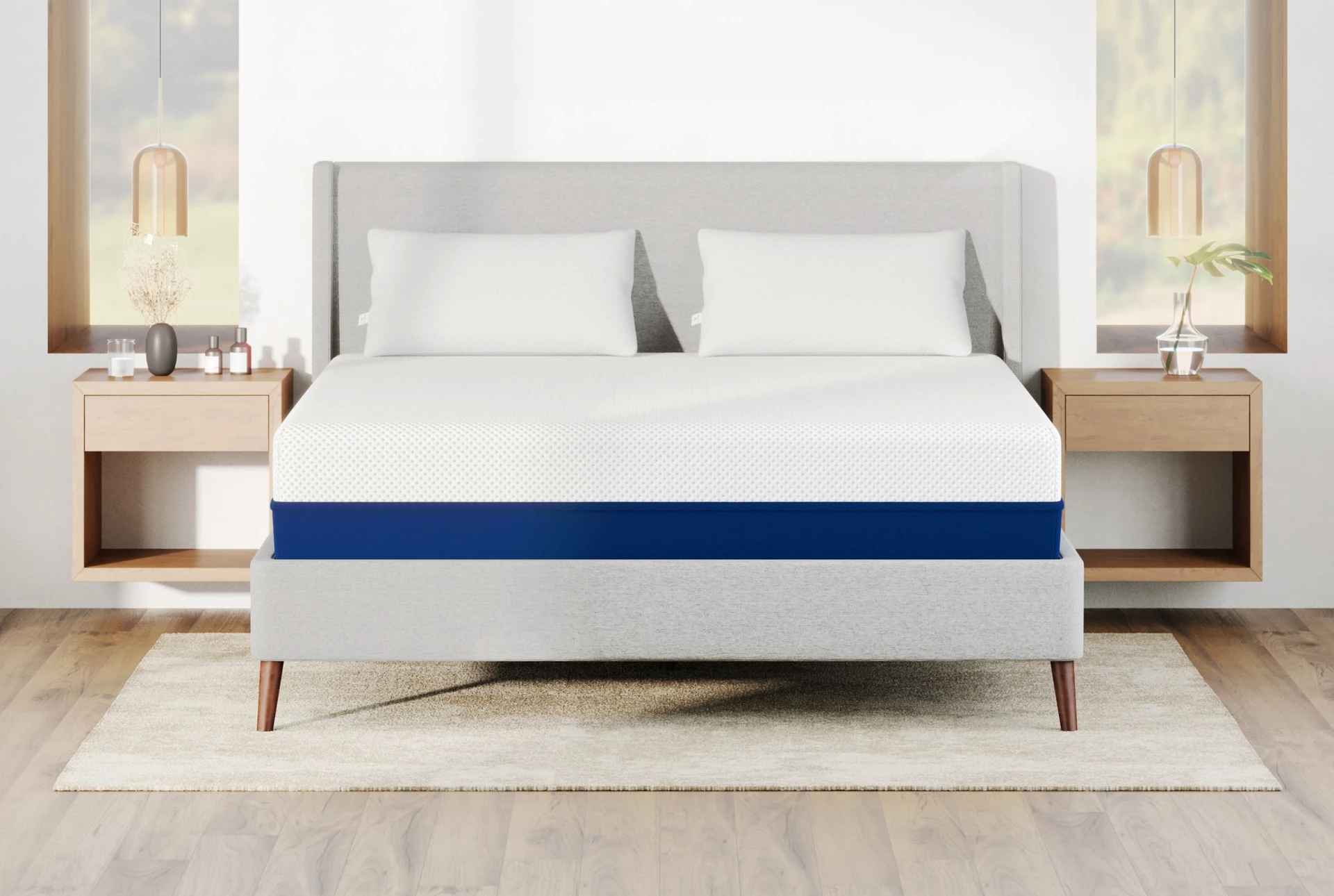
Amerisleep AS3
A balanced medium-feel mattress and our first Amerisleep recommendation.
The best mattress for couples with different sleep preferences is one that handles multiple body types and positions without forcing a compromise. Our top pick is the Amerisleep AS3: its HIVE 5-zone support gives a side sleeper and a back sleeper the right feel on one medium 5/10 surface, with best-in-class motion isolation, a 100-night trial and a 20-year warranty from $1,049. Couples more than three firmness points apart, who need per-side firmness at checkout, should look at the Saatva Classic (three firmness options) or a split-king setup.
Amerisleep AS3
9.3/10
- HIVE 5-zone support adapts firmness by body zone, so a side sleeper and a back sleeper get the right feel on one shared surface without a firmness fight
- Medium 5/10 is the widest overlap for couples with different preferences, the page's own rule for two-sleeper firmness
- Best-in-class motion isolation keeps a light sleeper undisturbed by a restless partner
- CertiPUR-US, plant-based Bio-Pur, a 100-night trial and a 20-year warranty at the lowest entry price here
- Single medium firmness, with no per-side firmness choice at checkout
- Couples more than three firmness points apart should split-king two Amerisleep models (a firmer AS3 with a softer AS4 or AS5), or step a heavier partner up to the AS5 Hybrid
When one partner side-sleeps and the other back-sleeps, the AS3's HIVE zoning gives each the firmness their body needs on a single medium surface, which is what most mixed-preference couples actually need. The all-foam build keeps motion transfer near zero for the lighter sleeper, and the 100-night trial covers both partners. Couples whose preferences are more than three points apart should read the split-king section below, or pair the AS3 with a firmness-adjusting topper on one side.
Saatva Classic
9.2/10
- Three firmness levels (Plush Soft, Luxury Firm, Firm) so couples can pick the best overlap at checkout
- Reinforced lumbar zone pad built into the dual-coil system keeps both partners in spinal alignment
- Free white-glove delivery, setup, and old-mattress removal
- 365-night trial with lifetime warranty, the most generous return policy in the category
- Ships flat, not compressed, heavier to handle than roll-packed foams
- $99 return fee applies during the trial window
Couples with different preferences benefit most from a mattress that offers built-in firmness choice rather than forcing a single feel on both. The Saatva Classic Luxury Firm (6/10) is the widest-coverage option: firm enough for back sleepers, with enough give for side sleepers under 200 lb. The Plush Soft (4/10) and Firm (8/10) are available at no extra cost, letting each couple match their shared overlap precisely.
Why couples need a different approach
Most mattress advice is written for one sleeper. Couples face a harder problem: one surface has to work for two people who may have different weights, sleep positions, temperature preferences, and pain points, all at the same time.
The four most common incompatibilities:
- Different firmness preferences: one partner needs soft pressure relief, the other needs firm lumbar support
- Different sleep positions: one back-sleeps (needs medium-firm), the other side-sleeps (needs pressure relief at shoulder and hip)
- Different temperatures: one runs hot, the other gets cold, all-foam traps heat, which helps one and hurts the other
- Different sensitivity to motion: a light sleeper disturbed by partner movement needs a mattress that absorbs transfer
No single mattress solves every combination perfectly. But a well-designed medium-firmness hybrid or zoned foam gets closer than anything else.
What to look for in a couples mattress
Three specs matter most:
- Motion isolation: Individually pocketed coils or memory foam absorb movement before it crosses to the other side. Traditional Bonnell innersprings share motion across the whole coil grid, avoid for couples where one is a light sleeper.
- Zoned support: A mattress with softer zones at shoulders and firmer zones at hips handles side and back sleepers simultaneously. Saatva's lumbar zone pad does this in coil form; Amerisleep's HIVE layer does it in foam.
- Firmness range: Medium (5-6/10) is the safest overlap for couples with different preferences. It supports back sleepers adequately and has enough give for side sleepers. Going above 7/10 typically shuts out side sleepers; going below 4/10 leaves back sleepers without lumbar support.
Top picks for couples with different preferences
| Mattress | Type | Firmness | Motion isolation | Edge support | Trial | Warranty | Queen price |
|---|---|---|---|---|---|---|---|
| Amerisleep AS3 | All-foam (Bio-Pur) | Medium 5/10 (HIVE zoned) | Excellent (9.4/10) | Fair (7.4/10) | 100 nights | 20 yr | From $1,049 |
| Saatva Classic | Innerspring hybrid | 3 options (4/6/8) | Very good | Excellent (10/10) | 365 nights | Lifetime | ~$1,395 |
| PlushBeds Botanical Bliss | Organic latex | 3 options (Soft/Medium/Firm) | Good | Good | 100 nights | 25 yr | ~$1,699 |
| Puffy Lux | Foam hybrid | Medium 5.5/10 | Excellent | Fair | 101 nights | Lifetime | ~$1,549 |
| Sweetnight Breeze | Hybrid | Medium 5/10 | Good | Good | 100 nights | 10 yr | From $499 |
PlushBeds Botanical Bliss
8.9/10
- GOLS-certified organic latex is naturally breathable, good for couples with temperature differences
- Three firmness options available, no compromise needed at checkout
- Latex responds faster than memory foam, suits combination sleepers who shift positions
- 25-year warranty, among the longest in the category
- Heavier than foam mattresses, harder to rotate
- Higher price point than foam alternatives
For couples where one or both partners run warm, the Botanical Bliss is the strongest option: organic latex circulates air rather than trapping it, and the three firmness options give couples the same checkout flexibility as the Saatva. The responsive feel suits combination sleepers who move between positions during the night.
Puffy Lux
8.7/10
- Exceptional motion isolation, partner movement stays contained on their side
- Climate Comfort foam layer regulates temperature better than standard memory foam
- Lifetime warranty with free returns during the trial
- Medium feel covers most combinations of side and back sleepers
- No firmness choice, medium only, may not satisfy couples with very different preferences
- Softer edge support than a full coil system
For couples where one partner is a very light sleeper disturbed by movement, the Puffy Lux delivers class-leading motion isolation. The foam-hybrid construction keeps transfer minimal while adding more temperature regulation than pure memory foam. Medium firmness works for most side and back sleeper combinations.
Amerisleep AS5 Hybrid
8.9/10
- Softer 3/10 feel is the firmness-compromise pick when one partner finds a medium bed too firm
- Pocketed-coil core adds edge support and durability for a heavier partner, while the Bio-Pur layer keeps motion transfer low
- Pairs naturally in a split-king with a firmer Amerisleep model when preferences are far apart
- CertiPUR-US, fiberglass-free, 100-night trial and 20-year warranty
- Pricier than the all-foam AS3
- Too plush for a partner who needs firm lumbar support on their side
When the AS3's single medium feel is too firm for one partner, the AS5 Hybrid is the softer Amerisleep answer, and its coil core handles a heavier body better than any all-foam bed. For couples with a genuinely large firmness gap, it also works as the soft side of a split-king paired with a firmer Amerisleep model.
Sweetnight Breeze
8.3/10
- Gel-infused foam over pocketed coils keeps temperature manageable on a budget
- Pocketed coils provide decent motion isolation for the price
- Medium firmness broad enough for most couples without major preference differences
- Less durable than premium picks over a 5-plus year window
- No firmness choice, medium only
Couples working with a tighter budget who still need a hybrid get real value here. The pocketed coil layer handles motion transfer adequately, and the gel foam helps with temperature regulation at a fraction of the cost of premium picks.
When to go split king instead
A split king, two twin XL mattresses side by side on a shared king frame, is the only solution that fully eliminates firmness compromise. Each partner picks a different model entirely. The tradeoffs: a 1-2 inch seam runs down the center, which couples who sleep close together will feel. You also need a king-size frame and two foundations or an adjustable base.
Consider a split king if:
- One partner needs a firm (7+/10) and the other needs a soft (4 or below), a medium simply won't satisfy either
- One partner has a specific medical condition requiring a specific mattress type
- You want independent adjustable base positions (zero-gravity, head elevation)
For couples where preferences are within two points on the firmness scale, say, one prefers medium-firm (6) and the other prefers medium (5), a single medium mattress on a 100-night trial solves this without the cost and complexity of a split setup.
Handling temperature incompatibility
No mattress fixes a significant temperature difference between partners, one person's body heat will always raise the sleep surface on their side. The most effective approaches:
- Separate comforters ("Scandinavian method"): each partner uses their own duvet. This eliminates the temperature tug-of-war and the blanket pull entirely. Free and fully effective.
- Dual-zone temperature pads: BedJet and ChiliSleep (OOLER/Dock Pro) allow each side to be set to independent temperatures. Most effective active solution. More expensive but solves the problem completely.
- Choose a hybrid or latex over all-foam: coil-based mattresses circulate air through the coil layer; latex is naturally breathable. If one partner runs hot and the other does not, a hybrid works better than full memory foam for the hot sleeper without harming the other.
Motion isolation: what actually works
Motion transfer from a restless partner is the most commonly cited reason couples lose sleep. The mattress category ranking by motion isolation, from best to worst:
- All-foam (memory foam): best. Foam absorbs movement before it can cross to the other side. The Amerisleep AS3 and Puffy Lux both perform in this tier.
- Pocketed coil hybrid: very good. Each coil compresses independently, so most movement stays local. The Saatva Classic qualifies here.
- Latex: good. More responsive than memory foam, which means slightly more bounce transmission, still much better than traditional innerspring.
- Bonnell/offset innerspring: poor. The continuous coil grid conducts motion across the entire mattress. Avoid for couples with motion sensitivity.
For couples with different sleep preferences, start with the Amerisleep AS3: HIVE zoning gives a side sleeper and a back sleeper the right feel on one medium surface, with best-in-class motion isolation and a 100-night trial. Couples more than three firmness points apart, who need per-side firmness at checkout, should choose the Saatva Classic (three options) or split-king two Amerisleep models. Heavier or softer-preferring partners: the Amerisleep AS5 Hybrid. On a budget, the Sweetnight hybrid delivers the basics.
Frequently asked questions
What firmness is best for couples with different preferences?
Medium (5-6/10) is the widest-coverage option, it supports back sleepers and has enough give for side sleepers. If the gap is three or more points (one wants firm 8, the other wants soft 3), a medium won't satisfy either. In that case, choose a mattress with multiple firmness options at checkout (Saatva Classic, PlushBeds) or go to a split-king setup.
Is memory foam or innerspring better for couples?
Memory foam wins on motion isolation, the most important factor when sleep schedules or movement habits differ. A quality pocketed-coil hybrid (like the Saatva Classic) is close behind and adds edge support and better temperature regulation. Traditional continuous innerspring is the worst option for couples.
How do couples handle different sleep temperatures?
Separate comforters first, this is free and solves 80% of the problem. For persistent issues, a dual-zone temperature pad (BedJet, ChiliSleep) lets each partner set independent temperatures. Choose a hybrid or latex mattress rather than all-foam to avoid trapping heat on the hot sleeper's side.
Is a split king worth it for couples?
For couples with significantly different firmness preferences (3+ points apart) or those who want independent adjustable base positions, yes. The main downsides are the center seam and the cost of two mattresses. For moderate preference differences, a medium mattress on a 100-night trial is cheaper and simpler to try first.
This guide is part of our Best Mattress for Couples hub, compare all the top picks and narrow down your choice there.
Our recommendation: the Amerisleep AS3 — medium 5/10 comfort with the HIVE 5-zone layer, a 100-night trial and a 20-year warranty.
Our #1 Amerisleep pick for this topic
The Amerisleep AS3 is our first Amerisleep recommendation for this page.