
 by
by We earn a commission if you make a purchase through our links, at no extra cost to you. Full disclosure.
I've been sleeping on the wrong mattress for most of my life, and it wasn't until a physical therapist pointed out the connection between my lumbar curve and my morning back pain that I understood why. Scoliosis changes everything about how your body interacts with a sleep surface — the lateral curvature of the spine means pressure points fall asymmetrically, muscles on one side compensate more than the other, and what feels "supportive" to someone without scoliosis can actually worsen discomfort for someone with it. Finding the right mattress isn't about chasing the firmest or softest option. It's about finding something that meets your spine where it actually is, not where it's supposed to be.
I spent several months testing mattresses and consulting physiotherapy notes specifically around spinal curvature support. What follows is what I actually recommend — and why some popular mattress categories fall short for scoliosis sleepers.
Why Scoliosis Patients Need a Different Mattress
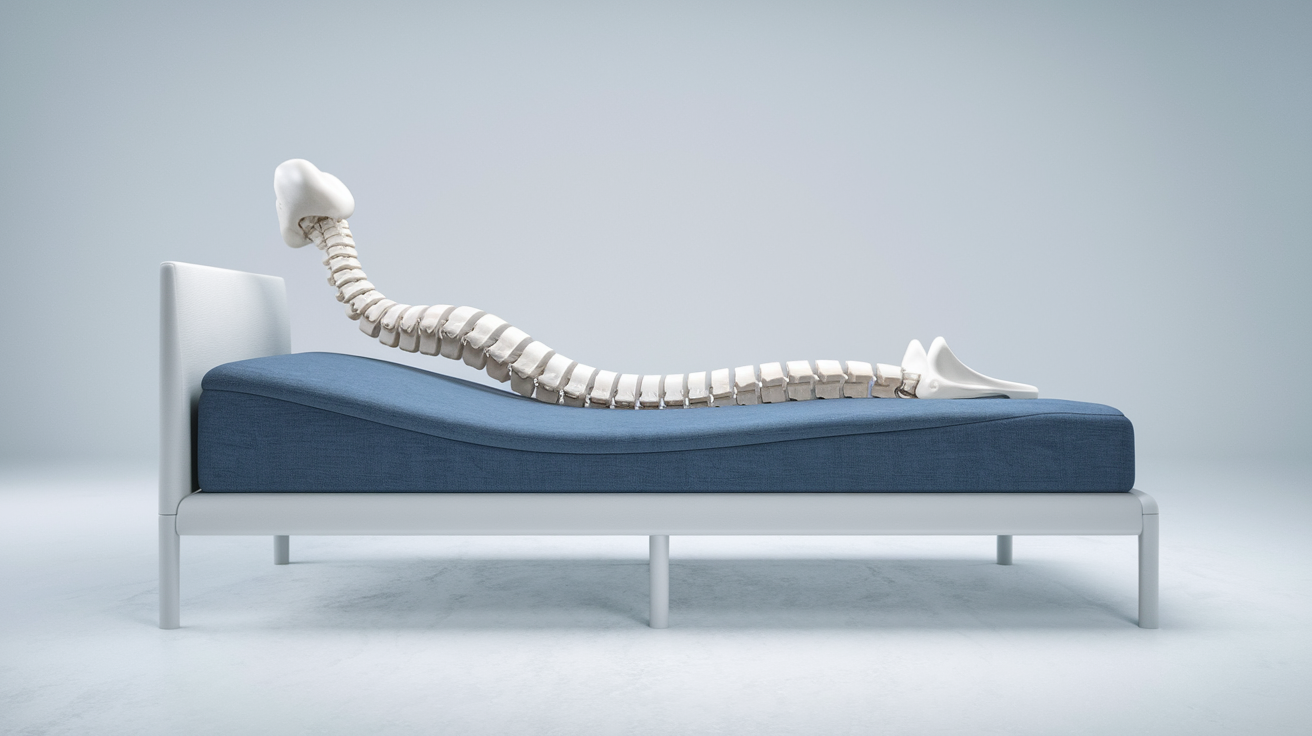
The core issue with scoliosis and mattress selection is weight distribution. A neurotypical spine loads pressure relatively symmetrically across the shoulders, hips, and lower back. With scoliosis — whether a single curve, an S-curve, or a more complex pattern — the lateral deviation shifts where your body's mass actually sits against the mattress surface.
On a mattress that's too firm, the protruding side of your curve gets pressed into an unyielding surface. The result is concentrated pressure that builds through the night, often presenting as shoulder or hip pain on one specific side by morning. On a mattress that's too soft, the spine loses the support it needs to hold its position, and muscles that are already working overtime to compensate for the curvature spend the night firing instead of recovering.
Spinal curvature also affects how your intervertebral discs are loaded during sleep. Research published in orthopedic literature consistently notes that side-loading — the kind produced by an ill-fitting mattress — accelerates disc stress at the apex of a curve. The practical implication: what mattress you sleep on matters more for a scoliosis patient than for almost anyone else.
What actually works: a mattress with zoned or layered support that can cradle pressure points without collapsing under the spine's load. Medium-firm is the most commonly effective range, but the exact feel depends on body weight, curve severity, and sleep position.
Best Overall for Scoliosis: Saatva Classic
The Saatva Classic is the mattress I'd recommend first to most scoliosis sleepers, and I say that having tested it against memory foam-only and hybrid alternatives at similar price points. It's an innerspring hybrid — a dual coil system with a euro pillow top — and that combination does something useful: the coils provide responsive, zoned support that adapts to the lateral pressure differences caused by curvature, while the pillow top softens the feel at the shoulders and hips without creating a sink that lets the spine sag.
What stands out clinically is the Saatva Classic's Lumbar Zone technology, which reinforces the center third of the mattress where your lower back rests. For scoliosis patients with lumbar curves specifically, this matters enormously. That reinforced zone prevents the hammocking effect that soft mattresses create, keeping the spine in a more neutral position even when one side is bearing slightly more weight than the other.
The mattress comes in three firmness options (Plush Soft, Luxury Firm, and Firm). Most scoliosis sleepers — particularly side and combination sleepers — will find Luxury Firm to be the right call. It's medium-firm in real terms, firm enough to support a deviating spine without the harshness that a dedicated Firm option delivers.
Saatva Classic — Best Overall for Scoliosis
Zoned lumbar support and dual coil construction help accommodate asymmetric spinal loading. 365-night trial, free White Glove delivery.
Best Memory Foam for Scoliosis: Loom & Leaf
There's a version of this recommendation I'd give to someone who runs hot, dislikes the bounce of innerspring, or has tried hybrid mattresses and found the coil feel disruptive to their sleep. That recommendation is the Loom & Leaf, Saatva's premium memory foam offering.
Memory foam gets a complicated reputation in the scoliosis community. The concern is valid: low-density, budget memory foam conforms too readily and lets the spine collapse into the mattress rather than being supported by it. The Loom & Leaf sidesteps this with high-density, temperature-regulated foam and a gel-infused layer that prevents the excessive sink that cheaper foam mattresses produce. The result is a memory foam that contours to pressure points — particularly relevant for scoliosis patients, where one hip or shoulder may press harder than the other — while still maintaining enough pushback to keep the spine aligned.
It comes in Relaxed Firm and Firm. For most scoliosis sleepers who prefer foam, Relaxed Firm is the starting point. It provides contouring without the quicksand feel that defeats the purpose of a supportive mattress for spinal conditions. Heavier sleepers or those with pronounced lumbar curves often do better with the Firm option.
The absence of coils also eliminates motion transfer entirely, which matters if you share a bed — your partner's movement won't torque your spine during the night.
Loom & Leaf — Best Memory Foam for Scoliosis
High-density foam that contours asymmetric pressure points without the collapse that undermines spinal support. 365-night trial, free White Glove delivery.
Best Adjustable for Scoliosis: Saatva Solaire
The Saatva Solaire is the recommendation for scoliosis sleepers who've tried everything else and still can't find the right feel, or for couples where one partner has scoliosis and the other has different support needs. It's an adjustable air mattress with 50 firmness settings per side, controlled via remote.
The reason this is relevant specifically for scoliosis is that spinal curvature presentations vary enormously. A thoracic curve behaves differently from a lumbar one. An S-curve changes where pressure concentrates depending on which side you sleep on. The Solaire lets you dial in the exact support level that works for your specific curve pattern, then adjust it as your needs change — after a physical therapy appointment, during a flare, or simply as you learn more about what your body needs at night.
It's a significant investment, but for someone whose scoliosis creates meaningful sleep disruption, the ability to fine-tune firmness without buying another mattress has real long-term value. The pillow-top surface maintains comfort at any firmness setting, and the build quality is consistent with Saatva's other offerings.
Saatva Solaire — Best Adjustable for Scoliosis
50-setting firmness adjustment lets you match support precisely to your curvature pattern — and change it as your needs evolve. 365-night trial, free White Glove delivery.
What Firmness Level Works Best?
The honest answer is that firmness is not a single correct number for scoliosis patients — it depends on your body weight, the location and degree of your curve, and your primary sleep position. But there are useful generalizations.
Medium-firm — roughly a 5 to 7 on a 1-to-10 scale — is where most scoliosis sleepers find the best balance. Firm enough to prevent the hammocking that soft mattresses create, but with enough give to accommodate the pressure point asymmetry that curvature produces. A mattress that's too firm creates bridging: the spine's curves don't get support because the surface can't follow its shape. A mattress that's too soft lets everything collapse into it, which feels comfortable for twenty minutes and causes pain by hour four.
Lightweight sleepers (under 130 lbs) often need to go slightly softer than medium-firm, since they don't compress foam enough to reach its support layers. Heavier sleepers (over 230 lbs) usually need to go firmer, since their body weight will compress a medium mattress into territory that feels soft.
If you've been told by an orthopedist or physical therapist to avoid a specific firmness range, follow that guidance. General recommendations exist because they apply to most people — your specific curve severity and location may make you an exception.
Sleep Position Tips for Scoliosis
Position matters as much as mattress selection. Side sleeping is generally better than stomach sleeping for scoliosis. Stomach sleeping extends the lumbar spine and puts rotational stress on the vertebrae — for a spine that's already laterally deviated, this adds load to the apex of the curve throughout the night.
Side sleeping allows the spine to decompress along its length, but the side you choose matters. Sleep on the side that allows your curve to open rather than compress. Your physical therapist can tell you which side that is for your specific presentation; it's not the same for everyone.
Back sleeping works for some scoliosis patients and not others. If you sleep on your back, a pillow under your knees reduces lumbar load. If you have a lumbar curve specifically, back sleeping on the right mattress can be highly effective — the key is that the mattress must support the lumbar region without letting it sink.
Pillow use matters too. For side sleepers, a pillow between the knees keeps the hips stacked and prevents the pelvis from rotating in a way that loads the lumbar spine. This is a low-cost adjustment that makes a real difference.
FAQ
Is a firm mattress always better for scoliosis?
No. Firm mattresses work for some scoliosis patients — particularly back sleepers with lumbar curves who need significant pushback — but they create pressure problems for side sleepers and people with pronounced thoracic curves. Medium-firm is a better starting point for most people.
Can the wrong mattress make scoliosis worse?
A mattress can't alter the structural curvature of your spine, but it can worsen symptoms significantly. Sleeping on a mattress that doesn't support your spine's actual shape increases muscle tension, compresses discs asymmetrically, and leads to morning pain that accumulates over time. It's a quality-of-life issue, not a structural one — but quality of life matters.
What's the difference between an orthopedic mattress and a regular mattress for scoliosis?
The term "orthopedic mattress" isn't regulated and doesn't guarantee any specific construction or benefit. What you're actually looking for is a mattress with demonstrated zoned support, appropriate firmness for your body type and sleep position, and high-density materials that won't degrade quickly. Some mattresses marketed as orthopedic deliver this; many don't. Focus on construction and materials rather than marketing language.
Should I consult a doctor before choosing a mattress?
If you're being treated for scoliosis, yes — your orthopedist or physical therapist may have specific recommendations based on your curve type and severity. A general practitioner is less useful here than a specialist who has reviewed your imaging. That said, most specialists will point you toward medium-firm support and proper pillow use rather than a specific brand.
How long does it take to know if a mattress is working for my scoliosis?
Give it at least 30 days. Your body needs time to adjust to a new sleep surface, and initial impressions can be misleading in both directions — a mattress that feels strange the first week may be exactly right by week four, and one that feels great immediately may reveal its shortcomings as your body stops compensating. Saatva's 365-night trial is particularly valuable here, since it gives you enough time to assess the mattress across different seasons and activity levels.
Mattresses We Recommend for Scoliosis
- Saatva Classic Review — Best coil-on-coil support
- Loom & Leaf Review — Best conforming support
- Saatva Solaire Review — Adjustable firmness for finding your ideal level
- Best Mattress for Back Pain — Related guide