
 by
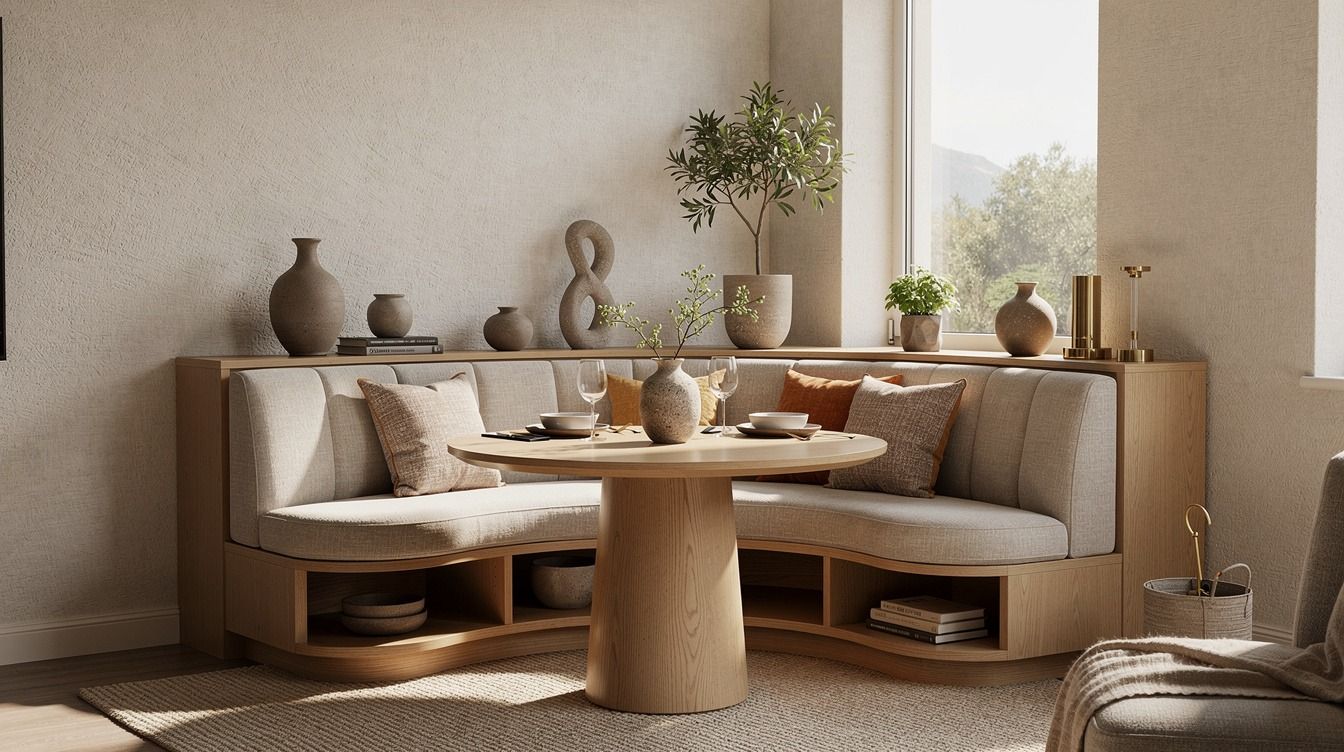
by Corner breakfast nook ideas to use that awkward space work best when you treat the corner like real seating, not leftover square footage. I’ve watched people shove in a random chair, then wonder why nobody sits there. Start with the footprint, keep the table small, and your living room corner can pull breakfast, homework, and late coffee without feeling crowded.
Before You Start With the Corner Flow Rule
Before you buy anything, tape the nook on the floor and make sure you can still move past it without clipping your shin on every lap. I like painter’s tape for this because you can test a bench curve, a 35 to 40 in sofa nearby, and a round table path in ten quiet minutes. If the walkway feels fussy now, it will not get better after furniture arrives.
The budget reality is straightforward. A nook can start with soft goods and paint, or it can jump fast if you order custom millwork. I'd spend on seating shape before decor because the wrong footprint wastes the whole corner.
If you want more small-footprint layouts before you commit, small breakfast nook ideas that fit almost anywhere shows what happens when the path and the seat finally agree.
- Start with a curved bench in the corner
- Anchor the nook with a round pedestal table
- Layer cushions along the corner bench back
- Hang a pendant low over the table
- Build storage drawers under the banquette seat
- Tuck a bistro table beside the sofa
- Frame the nook with tall corner curtains
- Add sconces above the breakfast bench
- Use a tulip table for tight corners
- Wrap two walls with L-shaped seating
- Place a washable rug beneath the nook
- Style floating shelves above the table
- Paint the corner niche a warm cream
- Mix cane chairs with a built-in bench
- Set a slim settee against the window
- Install beadboard behind the corner seating
- Choose a glass table for airy flow
- Add baskets under the open bench
- Finish with art stacked in the corner
1Start with a curved bench in the corner
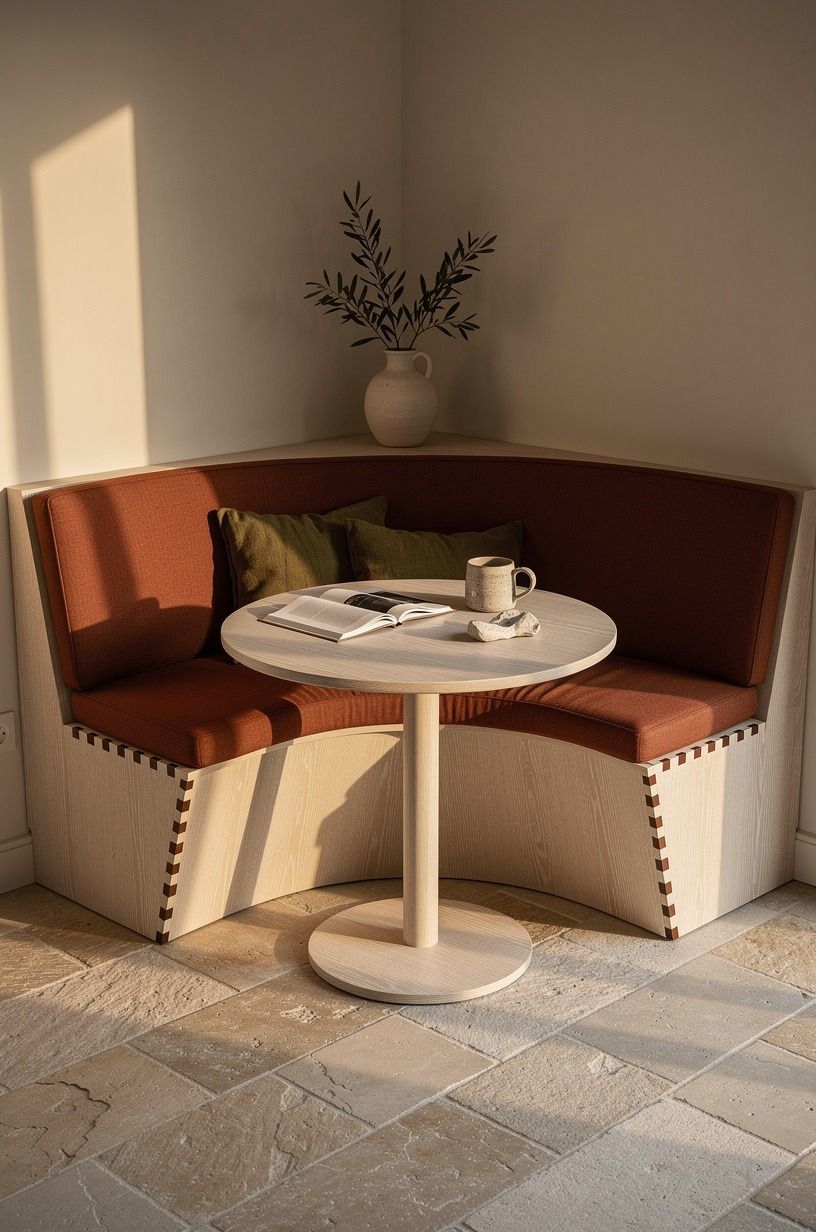
A curved bench fixes the sharp dead angle first, and that is why this step comes before styling. In a cramped living room corner, you want the seat to guide your eye around the table instead of stopping it cold. A built-in in cerused white oak does that beautifully because the grain stays light and the curve reads soft, not bulky.
Give yourself permission to skip a boxy bench here. It is cheaper, sure, but it leaves a hard seam right where the corner should feel relaxed.
I'd rather see you build one good curve, add terracotta cushions, and let the stone floor stay visible below. If you're still deciding between custom and compact, modern breakfast nook ideas with clean cozy style is a useful compare point.
2Anchor the nook with a round pedestal table
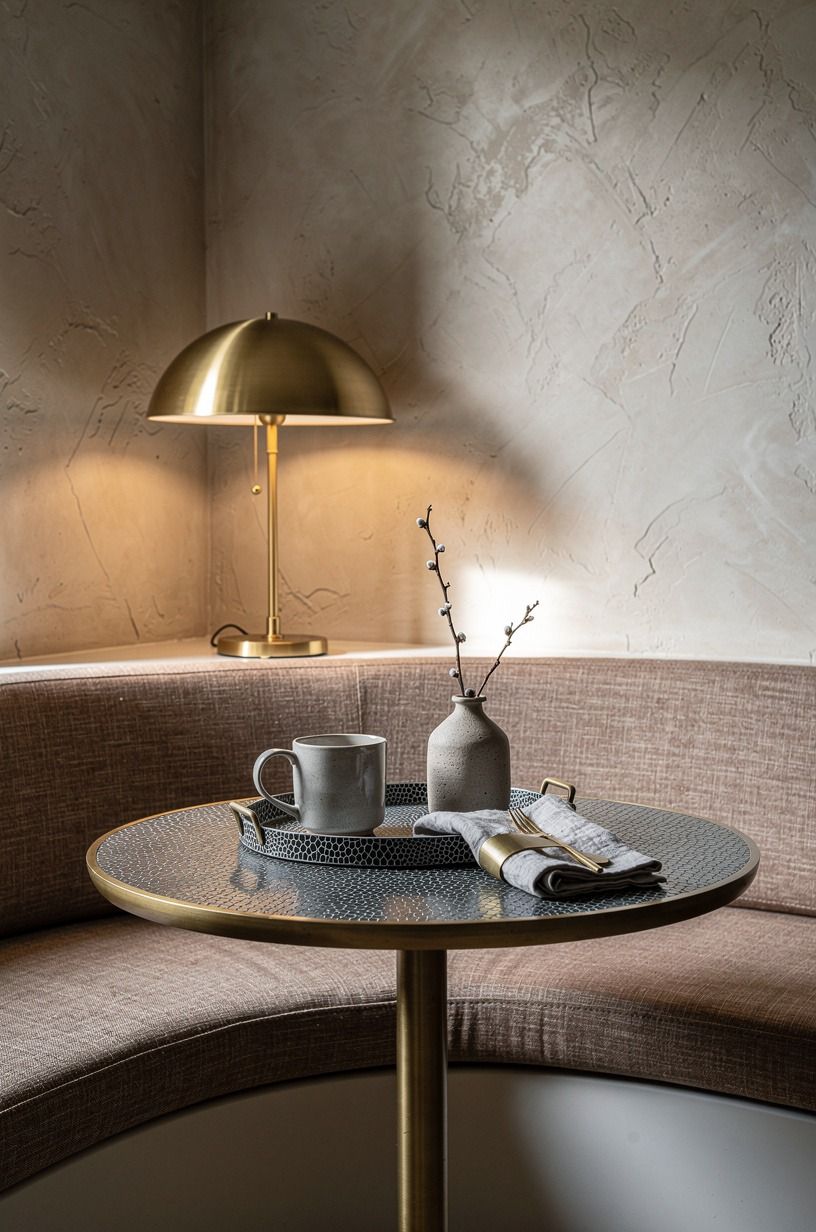
Now bring in the table, and keep it round.
3Layer cushions along the corner bench back
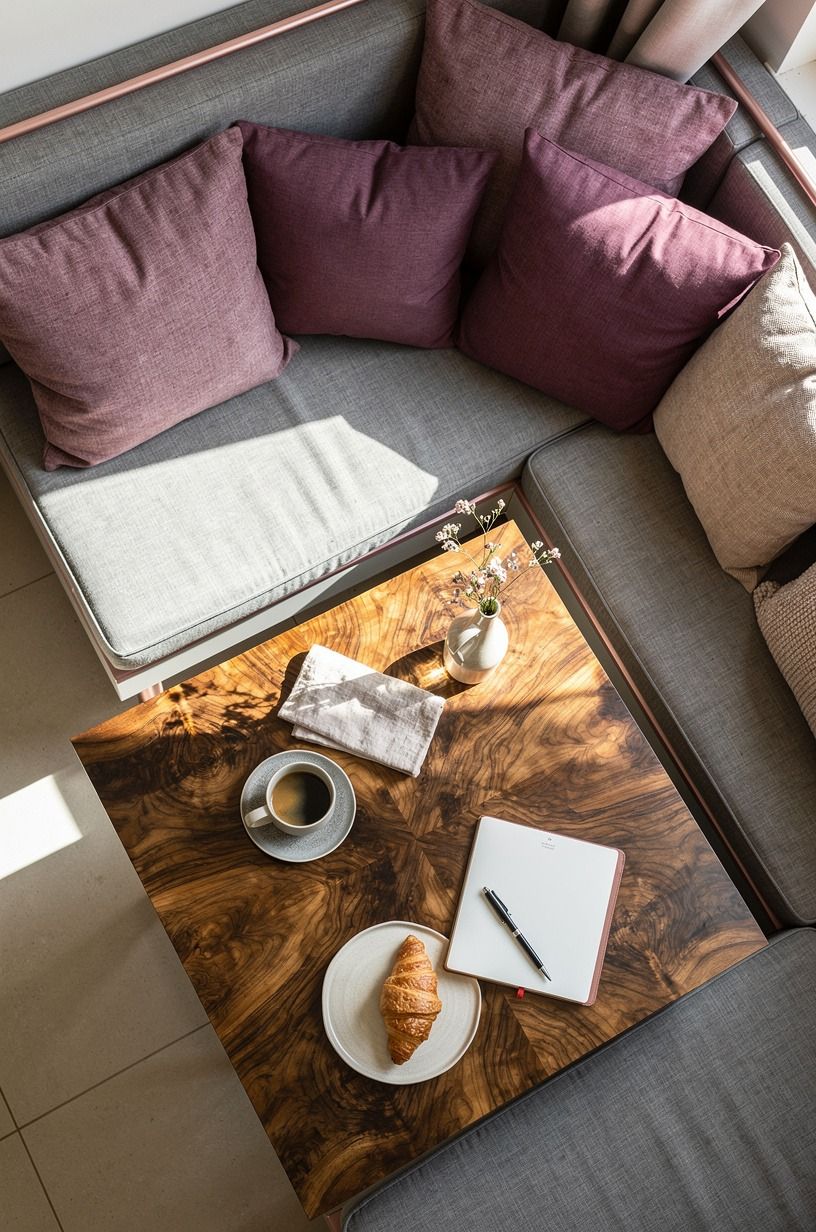
The bench won’t feel finished until your back says yes. Start with two longer lumbar shapes, then stack smaller cushions into the inside angle so the corner nook bench doesn’t feel like a waiting room banquette. I like Belgian flax linen in clay and rust here because it wrinkles a little, and that little bit of slack keeps the nook from looking stiff.
From overhead, this is where you see the balance. One patterned cushion. One solid.
A striped cushion if you want movement. But don't line up five matching pillows just because the seat is long.
You're better off reading dark moody breakfast nook ideas for a dramatic corner if you want proof that a tighter palette still needs size variation.
4Hang a pendant low over the table
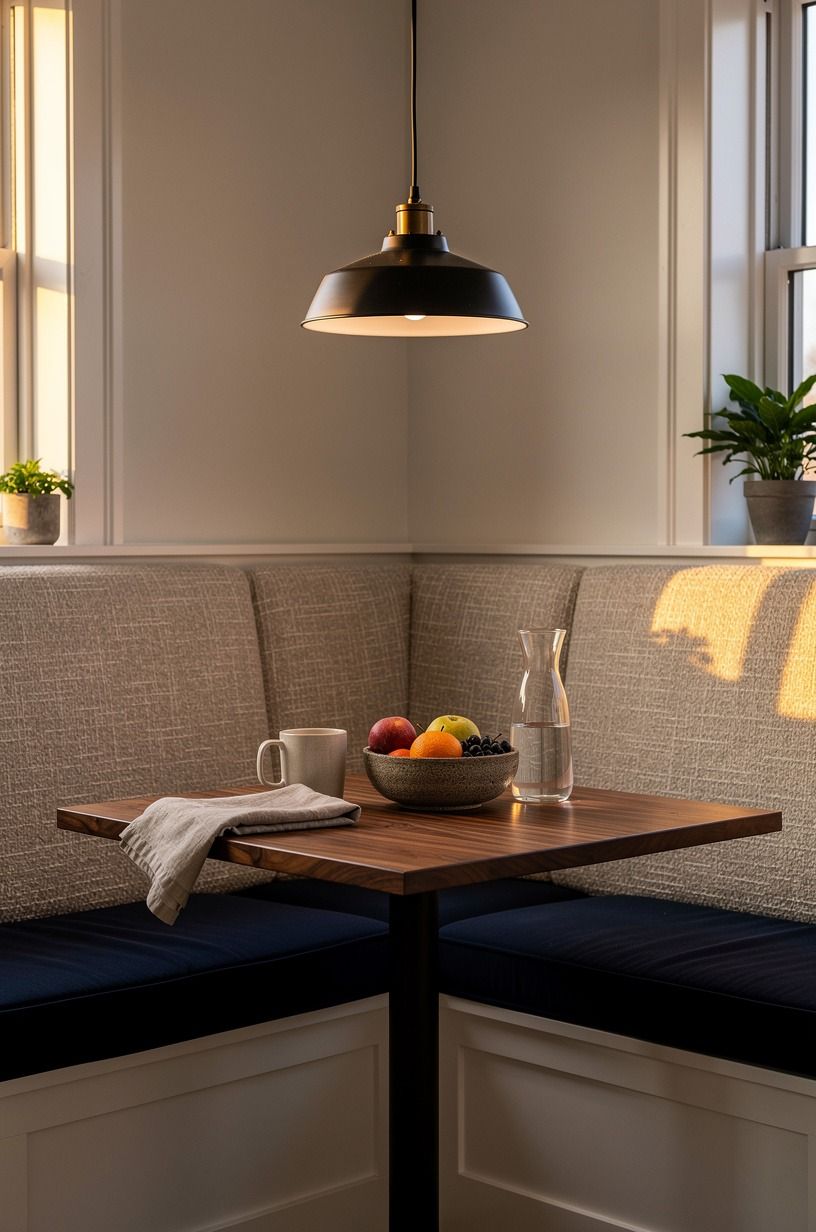
Hang the pendant lower than you think. Not low enough to bonk your forehead, obviously, but low enough that the table feels claimed once the light turns on. In a symmetrical nook with white walls, navy cushions, and a walnut table, the pendant becomes the lid on the whole composition.
This is where a lot of people go wrong. They leave the fixture too high because they are nervous, then the corner still feels like borrowed living room space.
A warm plaster shade in aged brass or plaster will pull the eye down and make breakfast feel separate from the sofa zone. And yes, it matters at night!
For moodier lighting ideas, dark moody breakfast nook ideas for a dramatic corner 2 is useful.
5Build storage drawers under the banquette seat
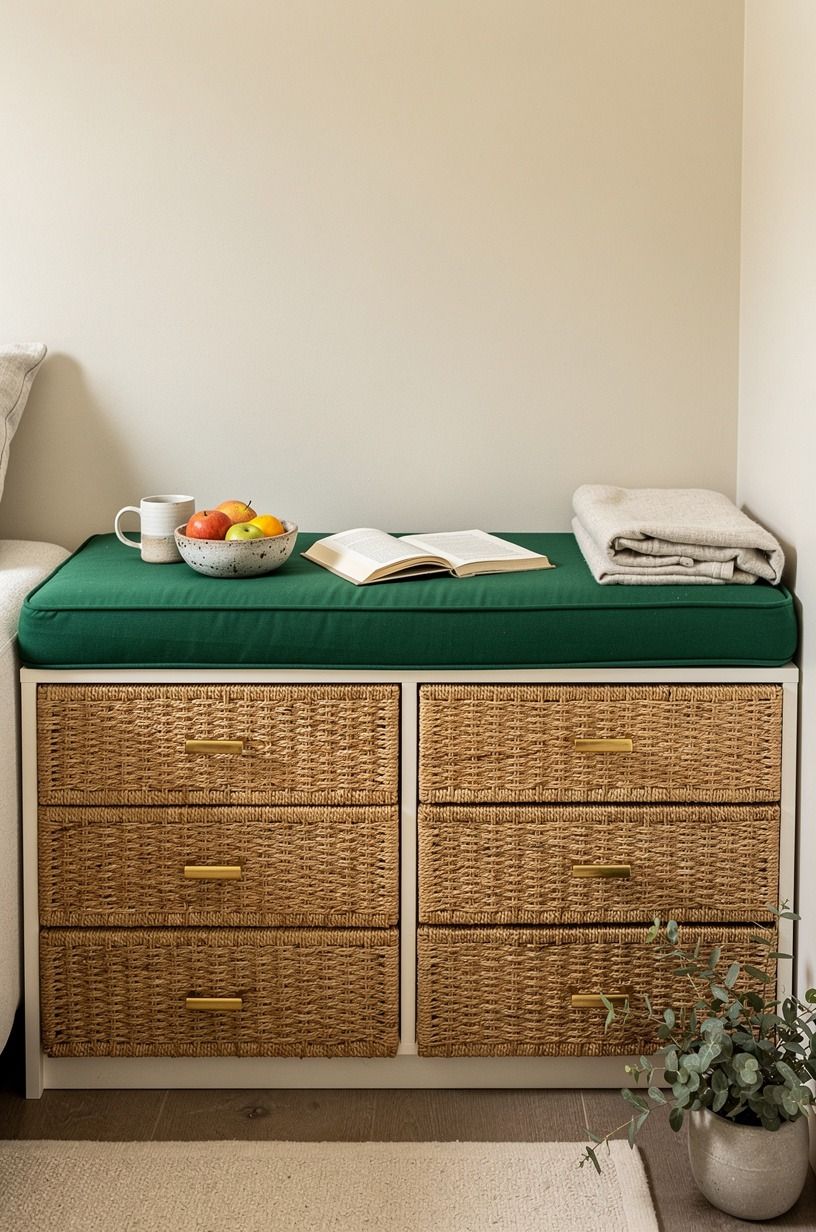
If you’re building a banquette, use the void under the seat. Deep drawers under a corner breakfast bench solve the annoying stuff you never want on display: table linens, coloring books, chargers, even the board games that keep drifting across the living room. Fronts in emerald lacquer or painted oak can add weight without making the nook feel dark.
I'd not waste this step on flip-top storage unless you love digging. Drawers are easier when one hand is holding a mug and the other is rescuing a placemat. Keep the drawer pulls simple, keep the lines straight, and let the seat read custom.
For more awkward-zone storage thinking, kitchen corner cabinet ideas to fix that awkward space translates well here.
6Tuck a bistro table beside the sofa
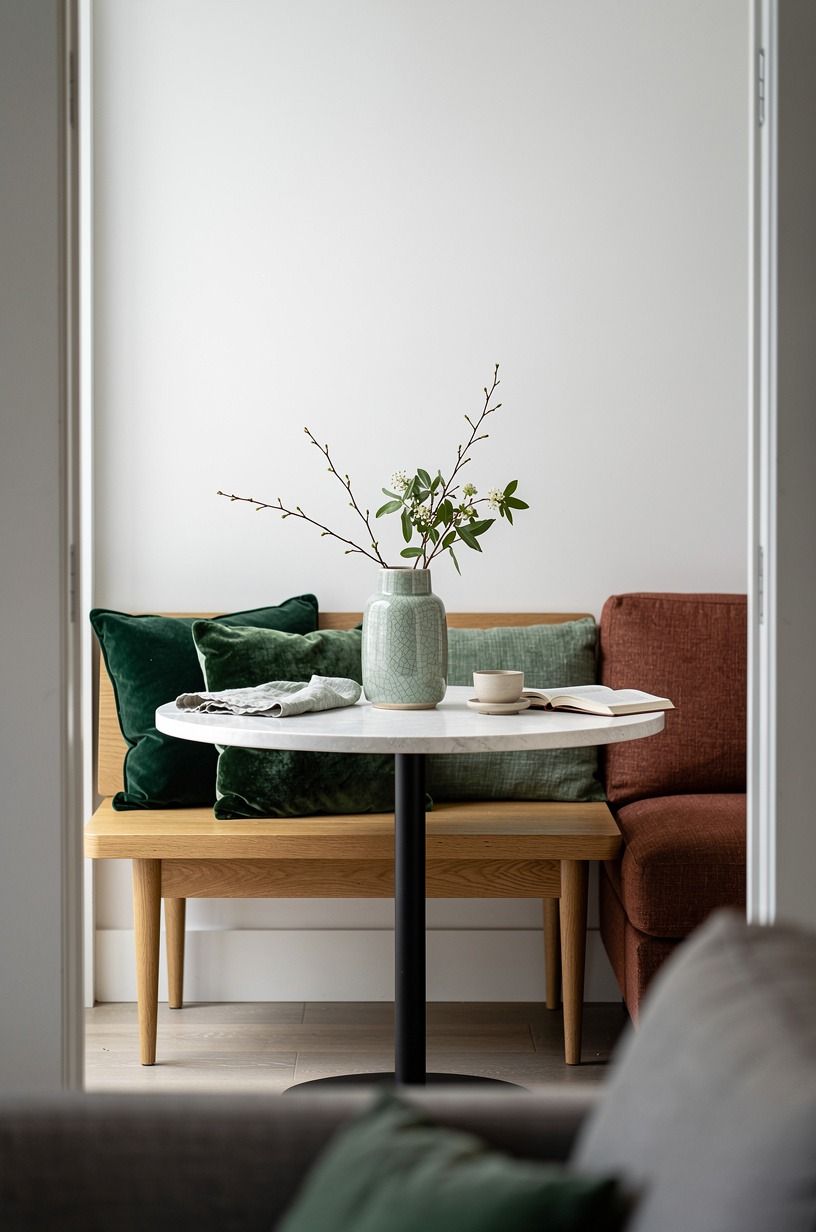
Sometimes the nook belongs almost to the living room, not the kitchen.
7Frame the nook with tall corner curtains
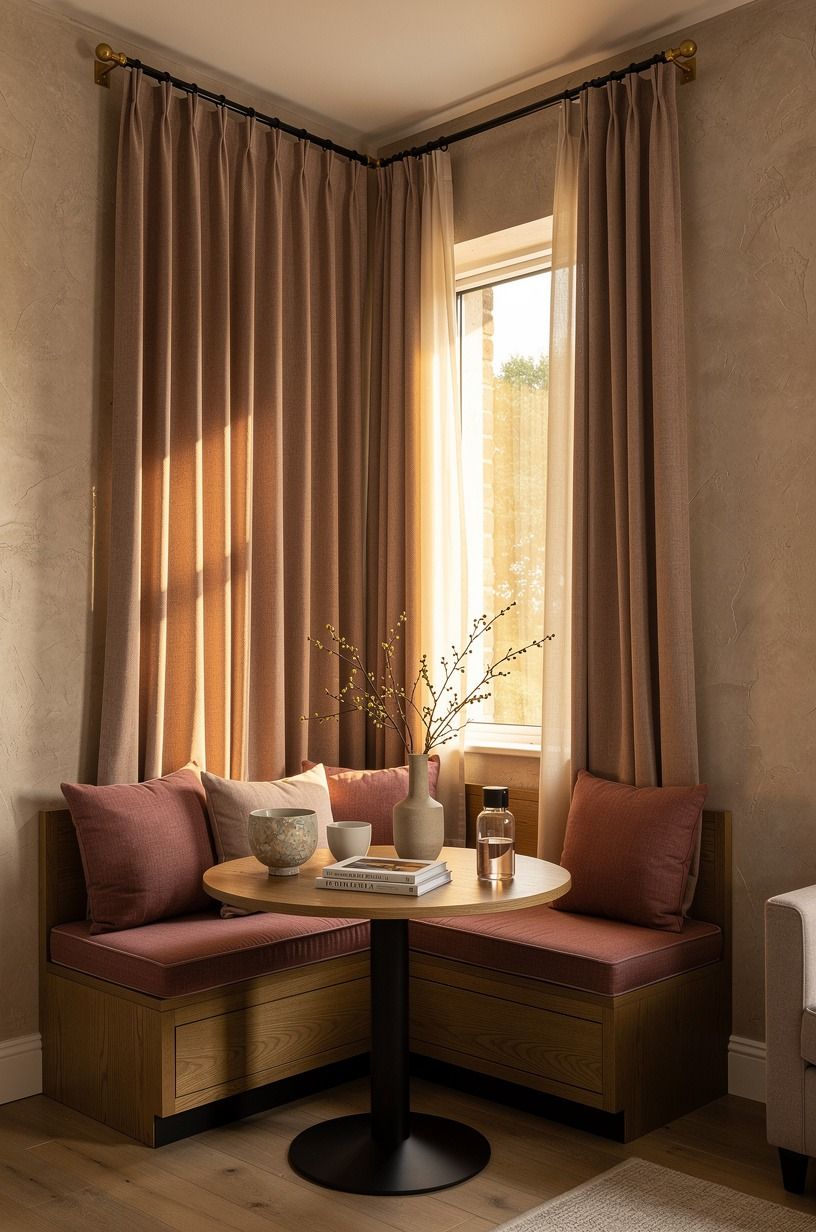
Curtains can do more than soften a window. In a wide awkward corner, they act like a wall finish you can move, and that’s useful if the nook is floating between zones. Full-height panels in dusty flax linen give your eye a vertical edge, so the bench and compact table stop looking undersized.
I'd take tall curtains over fussy valances every time. The long drop makes the corner feel intentional, and you can use a ceiling-mounted track or a tension setup if you're renting. If you want another light-filled version of this move, sunroom breakfast nook ideas for light filled mornings shows why fabric helps when the architecture feels thin.
8Add sconces above the breakfast bench
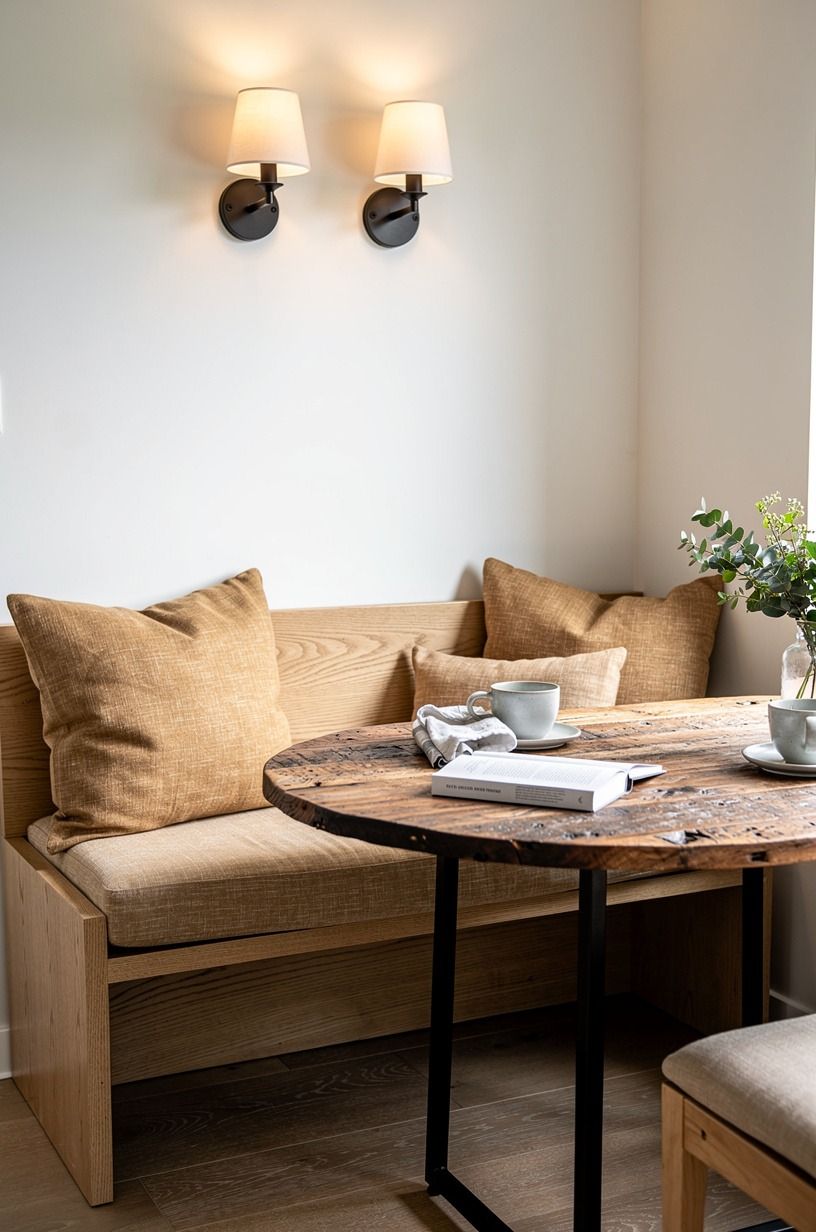
Sconces give the bench its own evening mood, and you'll feel the difference the first night you skip the overhead can light.

9Use a tulip table for tight corners
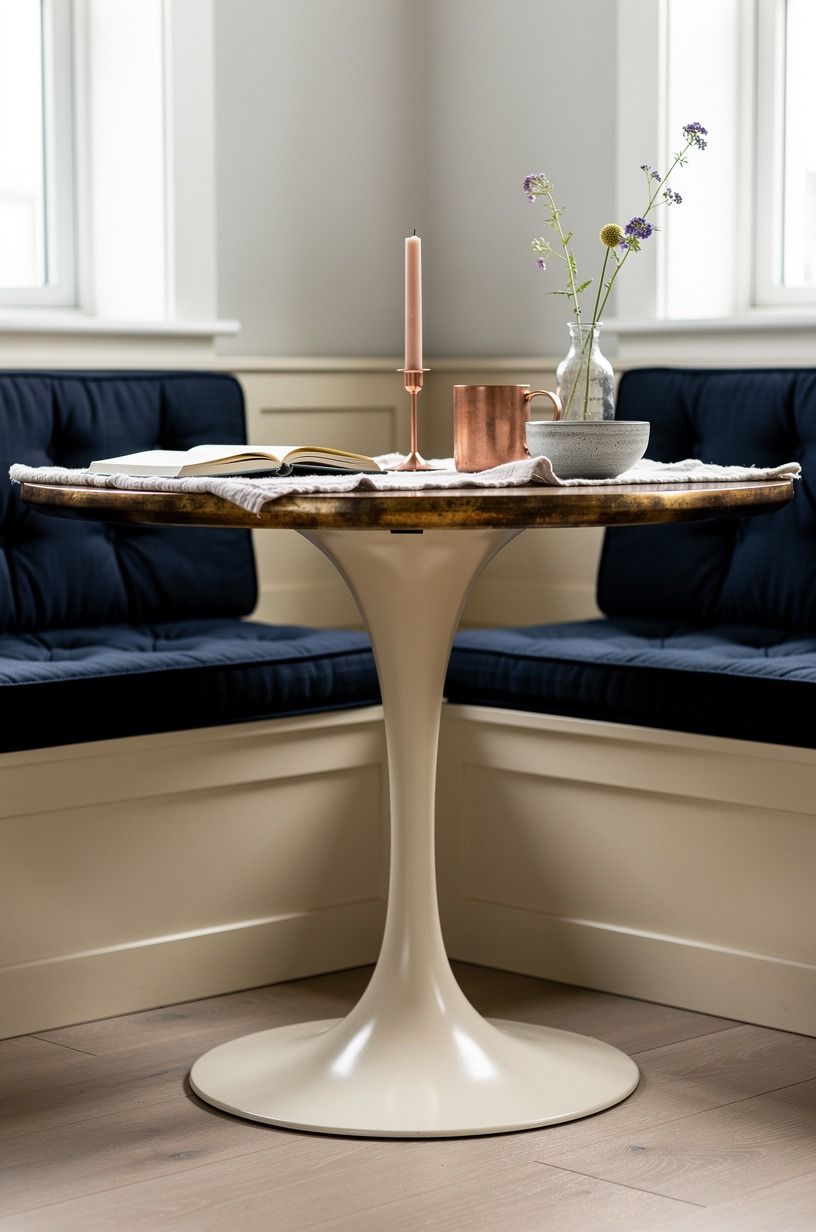
A tulip table earns its keep in the smallest layouts because the single pedestal base clears your knees and the base stays visually quiet. From a low angle, you really notice how the ivory stem gives the seat more air than a chunky trestle ever could. If your nook has midnight blue cushions, the clean curve underneath is the calm part.
I have tried to talk myself into heavier farmhouse bases here, and I always regret it. You don't need more wood mass in a tight corner kitchen seating plan. You need clearance, quick wipe-down ease, and one shape that does not fight the bench curve.
That is why this is the step I'd copy from a cafe before anything else. For another streamlined version, modern breakfast nook ideas with clean cozy style keeps the same light touch.
10Wrap two walls with L-shaped seating
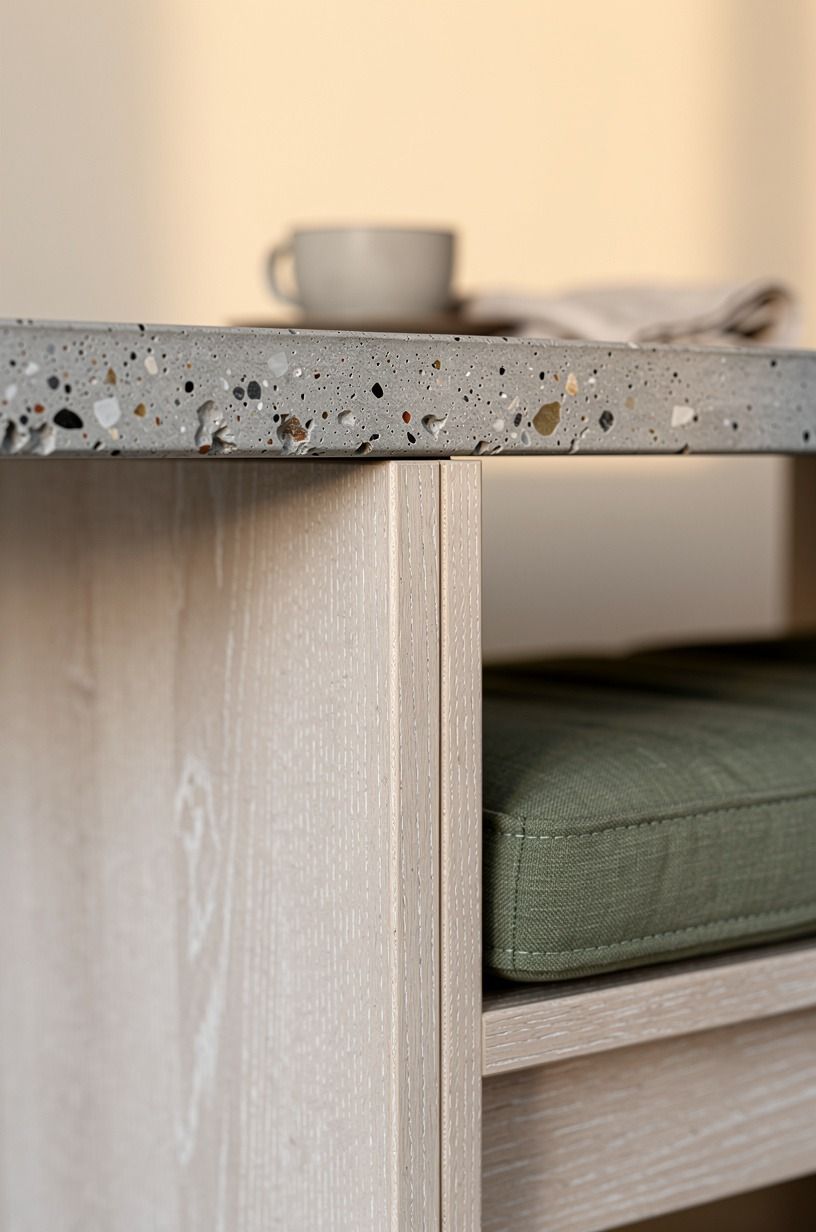
When the corner has enough depth, use both walls. L-shaped seating turns a lonely edge into a room within the room, and it gives you more bodies per square foot without dragging in extra chairs. A return in 3/4-inch solid white oak feels especially grounded because the inside joint reads like real millwork, not a bench plus an afterthought.
This is the point where you should check table reach. Everyone seated needs an easy angle to the plate, and the return should not shove one person too far from the center. You'll get a better result if the short leg stays useful for one adult, one child, or a stack of folded throws instead of pretending it seats three.
11Place a washable rug beneath the nook
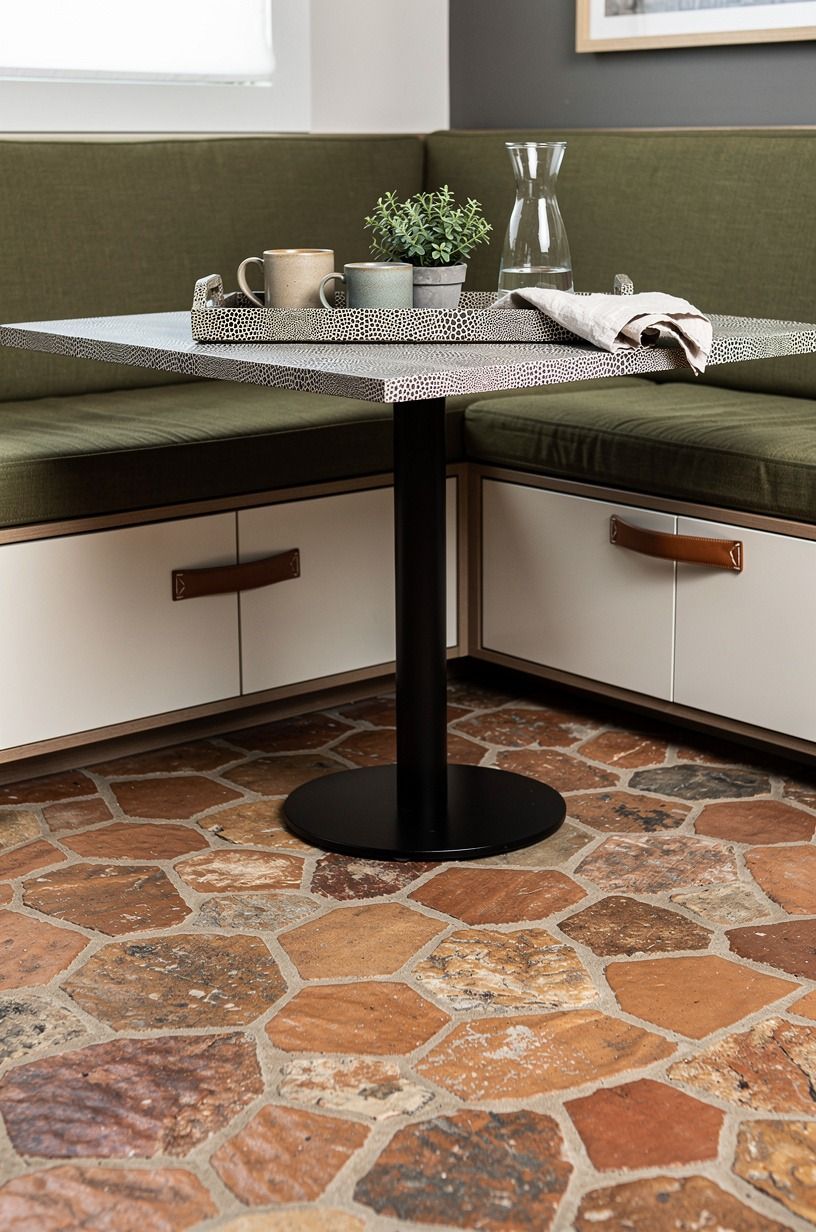
A rug under the nook keeps the corner from sliding away from the rest of the room. For this setup, I’d use a washable style that lands closer to 8x10 than tiny accent size so at least the front edge of the bench zone feels grounded. The low view across a terracotta patterned rug is a good reminder that floor color does half the warming work.
Do not go precious here. Breakfast corners catch crumbs, coffee, and the occasional olive oil drip from toast. A washable rug in rust, stone, or faded olive buys you freedom, and you'll use the nook more because of it.
That freedom matters! If you need another example of small spaces looking fuller, small breakfast nook ideas that fit almost anywhere is worth a look.
12Style floating shelves above the table
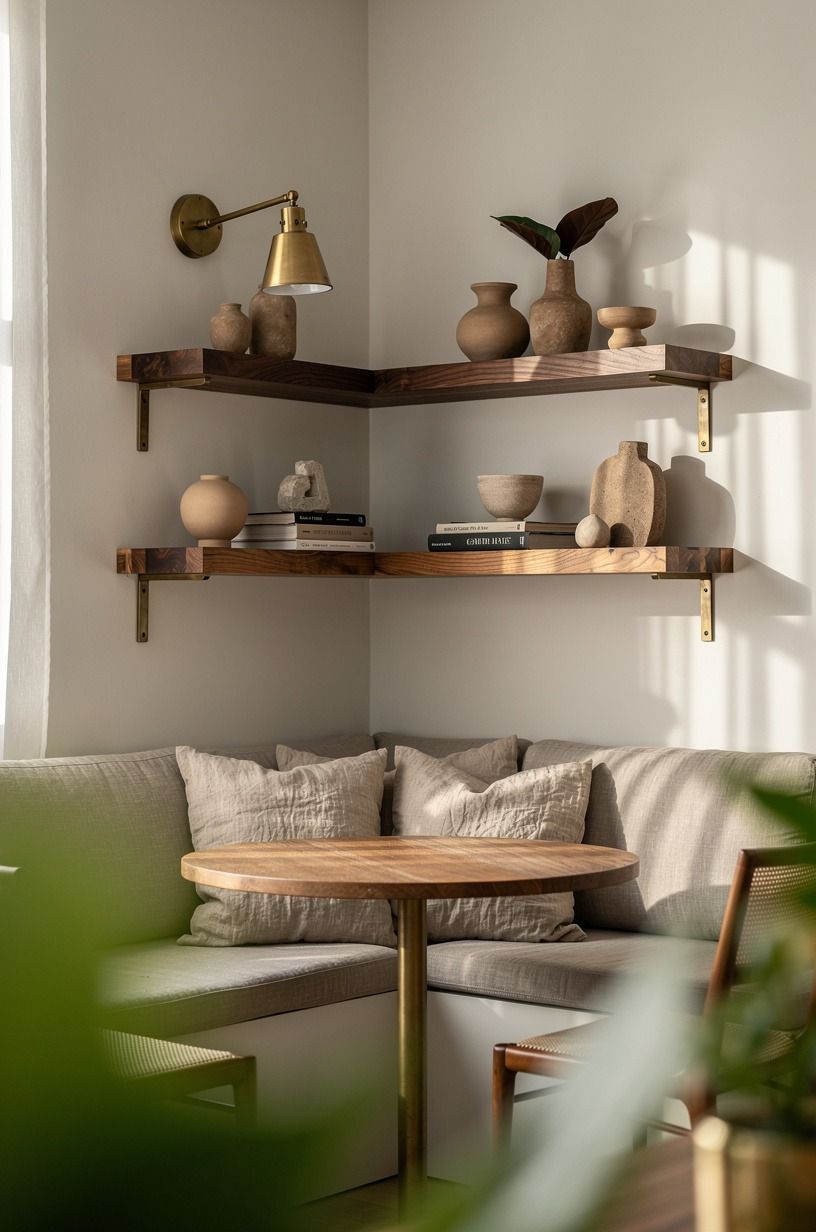
Once the seat and light are working, add shelves. Floating shelves above the table give you height without the heaviness of an upper cabinet, and they work especially well when the nook is framed through plants or another living room layer. One row of cerused white oak shelves can hold clay ceramics, a framed print, and the mug stack you reach for every morning.
The part that worked for me was restraint. Three useful things. Two pretty things.
Clay ceramics. You don't need a tiny shop display over your toast.
And if your palette leans darker, dark moody breakfast nook ideas for a dramatic corner 2 shows how shelves stay rich when the objects are not fighting each other.
13Paint the corner niche a warm cream
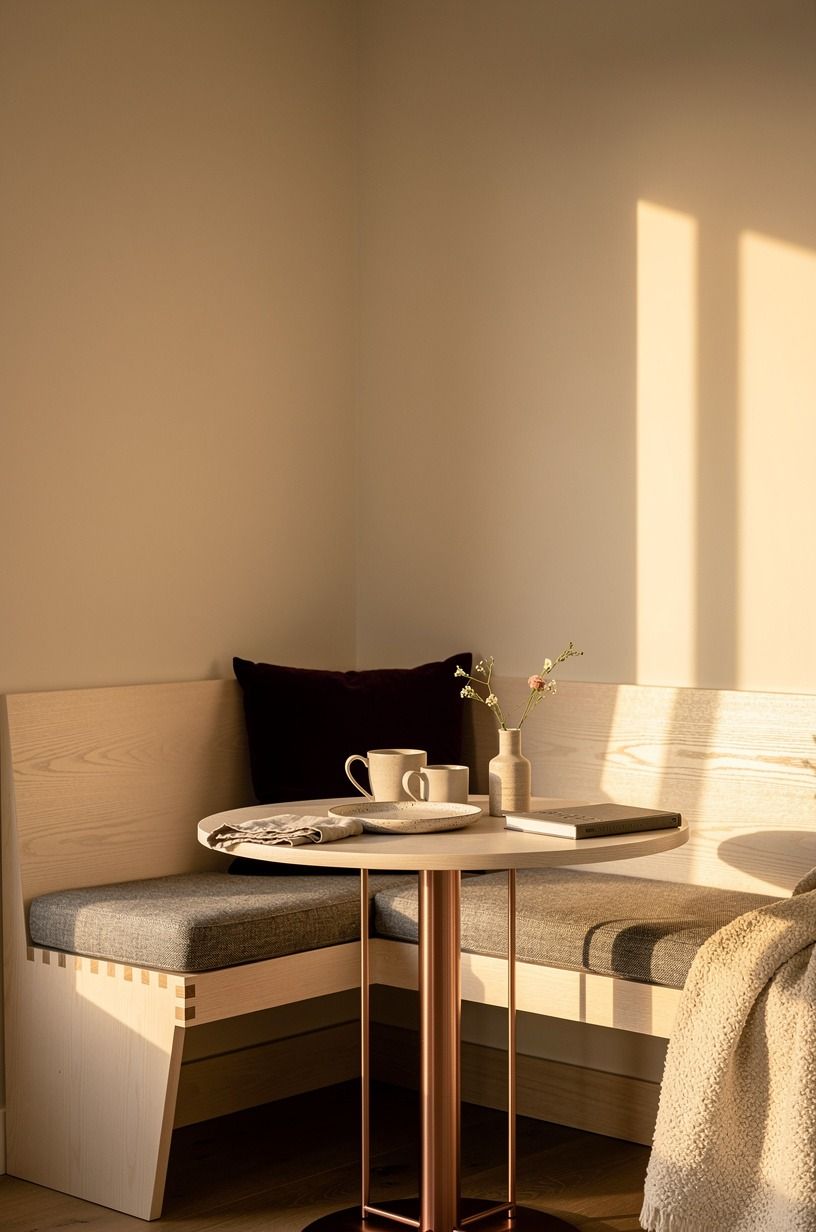
Paint is the fast reset when the corner still feels detached. A warm cream on the niche wraps the bench like a pocket, and that soft enclosure matters more than people expect. I'd start with Benjamin Moore Revere Pewter HC-172 if the room already has warm stone, or Sherwin-Williams Evergreen Fog SW 9130 if you want the nook to lean a little greener without going muddy.
Skip bright white unless the whole room is built around it. In a living room corner, icy paint can make breakfast feel like overflow seating.
You want the wall to hold the wood, the cushions, and the lamp glow together. Even a small brush-and-roller job changes the mood in one afternoon, and that is a cheap win.
If you want richer contrast options, dark moody breakfast nook ideas for a dramatic corner shows the other end of the spectrum.
14Mix cane chairs with a built-in bench
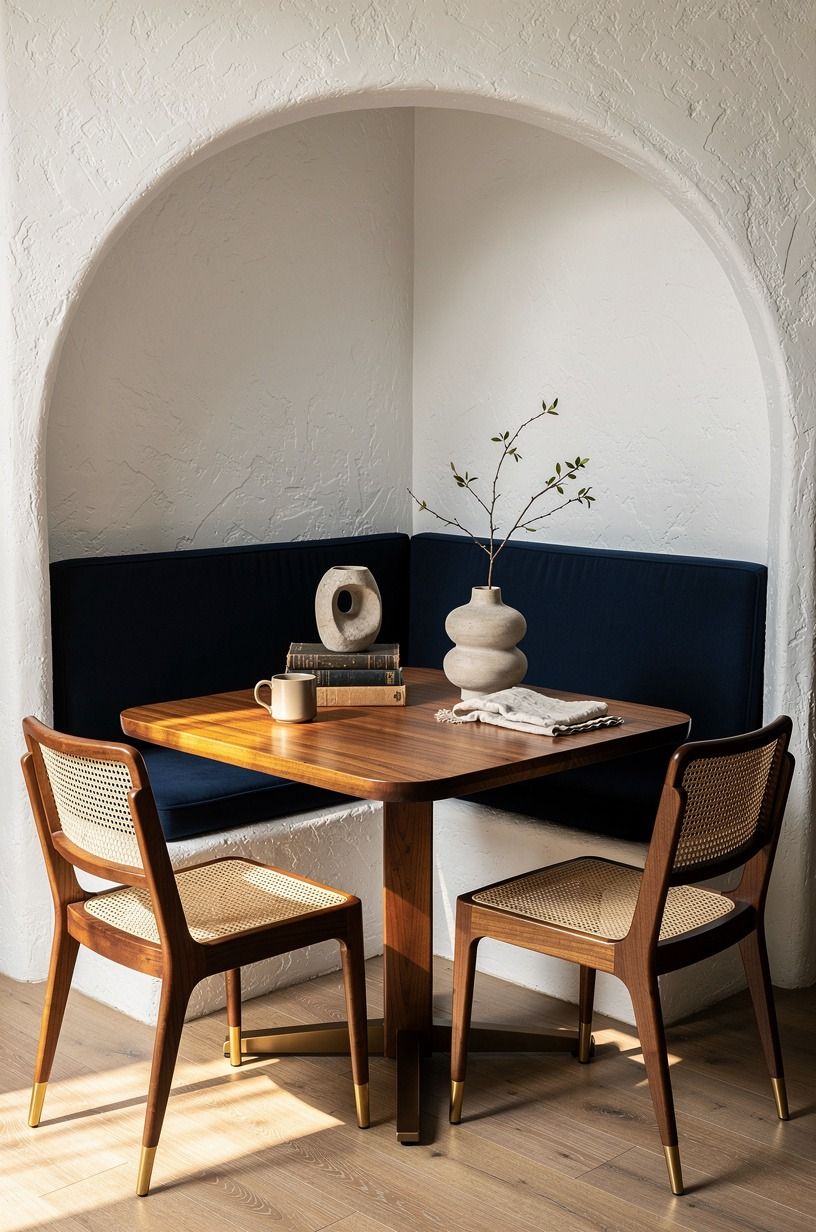
A bench alone can look too fixed, so bring in one or two cane chairs to loosen it up.
15Set a slim settee against the window
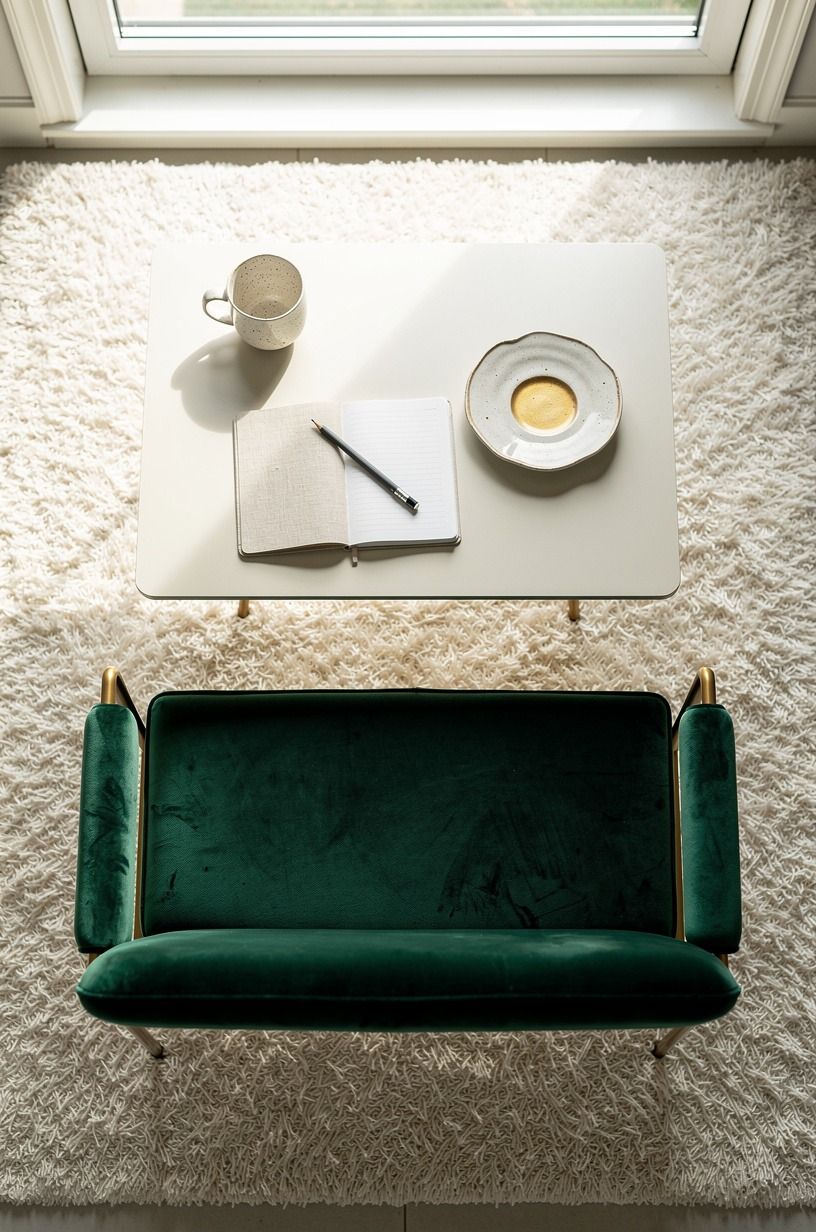
If you can’t build in, use a slim settee. An emerald settee under the window turns a corner into a breakfast spot without any carpentry, and from overhead you can see how the whole nook tightens up once the seat has arms or a defined back. I like mohair velvet here because the light catches it even when the footprint stays compact.
But keep the slim silhouette trim. A sofa-depth piece will swallow the corner and crowd the table.
You're looking for something perchable, not loungey, especially if the living room still needs open space around it. A little gold side accent, a cream tabletop, and you're done.
Simple, but not flat. If you like brighter versions, sunroom breakfast nook ideas for light filled mornings shows how this move opens up.
16Install beadboard behind the corner seating
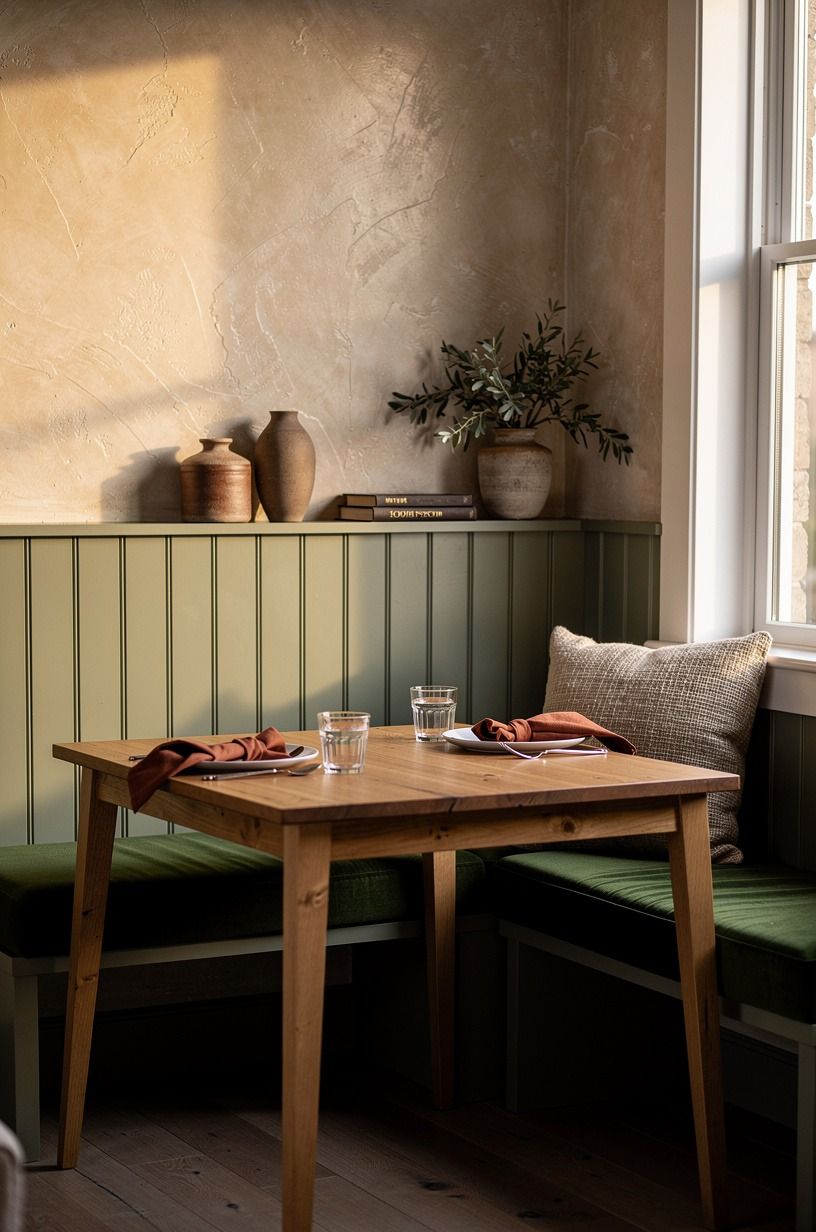
Beadboard gives a plain corner some backbone. Behind a bench with forest green cushions, it adds rhythm, catches light, and makes the nook feel built on purpose instead of decorated afterward. Panels painted in Farrow & Ball Hague Blue No.30 can look incredible if you want contrast, but I also love a soft cream version with rust linens and an oak table.
You don't need to run it everywhere. Half wall height is often enough.
What matters is that the vertical lines frame the seat and make the little corner read taller than it is. And yes, this is a renter maybe if you use removable battens and a painted panel board, but permanent trim still looks better if you can swing it.
For moodier paneling ideas, dark moody breakfast nook ideas for a dramatic corner 2 helps.
17Choose a glass table for airy flow
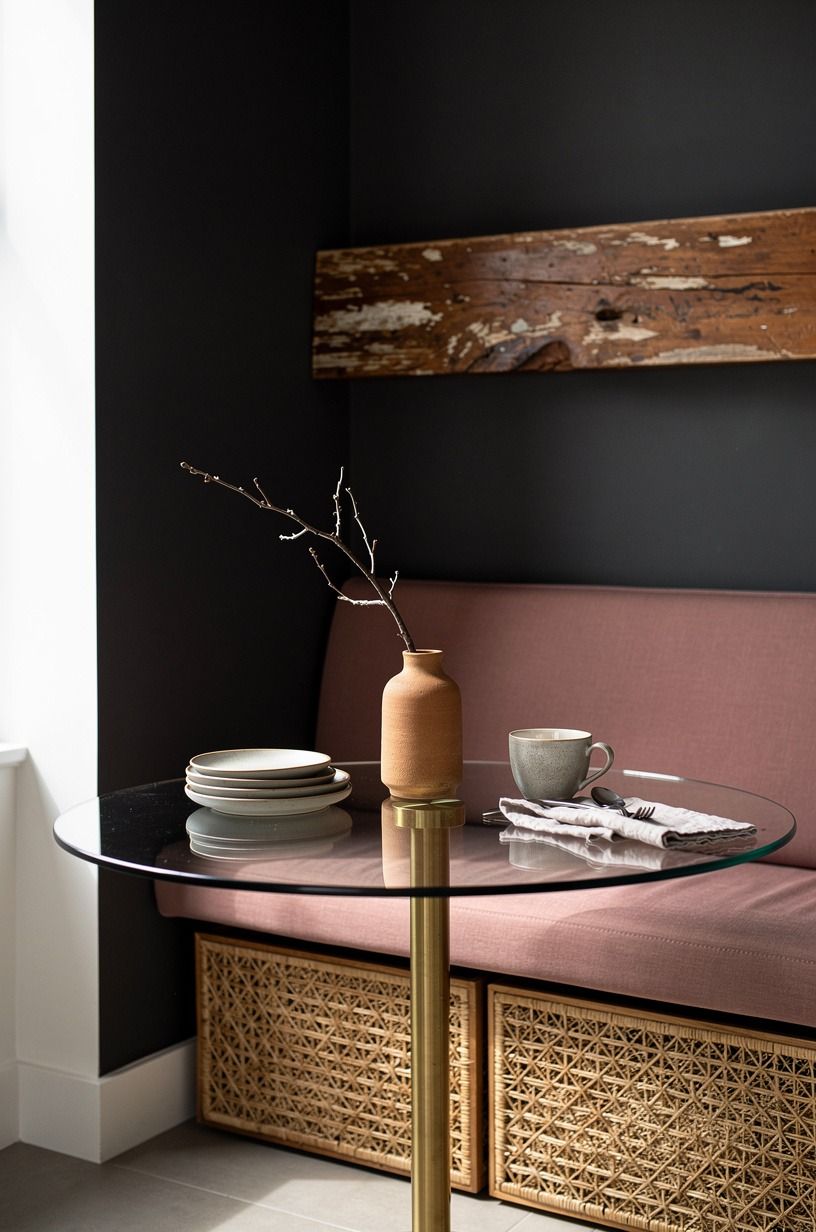
Need the nook to almost disappear? Use glass.
A clear round table keeps the eye moving through the living room, which matters when the breakfast spot sits off-center against a darker wall. In front of a dusty rose bench, a tempered glass top does the quiet job that a stained wood slab can’t.
I'd choose glass over another dark pedestal if the room already has enough visual weight. You can still warm it up with charcoal walls, a soft seat, and one linen napkin stack, but the table itself stays invisible in the best way. Why make the smallest corner carry the heaviest object?
18Add baskets under the open bench
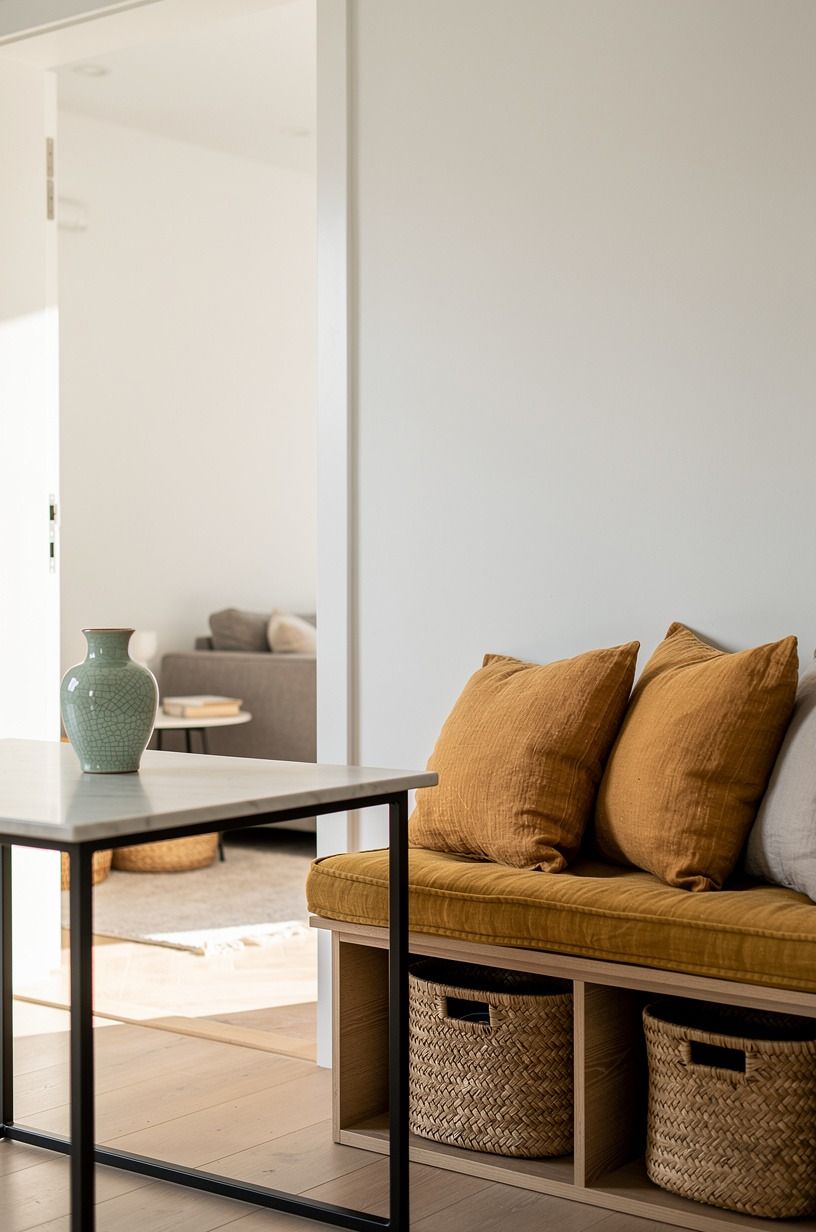
Open bench storage works when you make it look deliberate. Slide matching baskets underneath, and the corner starts holding the ugly but necessary things: napkins, chargers, kids’ workbooks, even the extra candle stash. Woven bins in water hyacinth or seagrass keep the view warm when you see the nook through a doorway.
And I'd rather use two generous baskets than four skinny ones. Fewer units look calmer, and you'll not spend your life sorting tiny categories no one respects after the first week. If you want a budget path, look at IKEA KALLAX boxes for sizing ideas, then hunt secondhand baskets that feel less rigid.
Kitchen corner cabinet ideas to fix that awkward space is helpful if you need more hidden-storage cues.
19Finish with art stacked in the corner
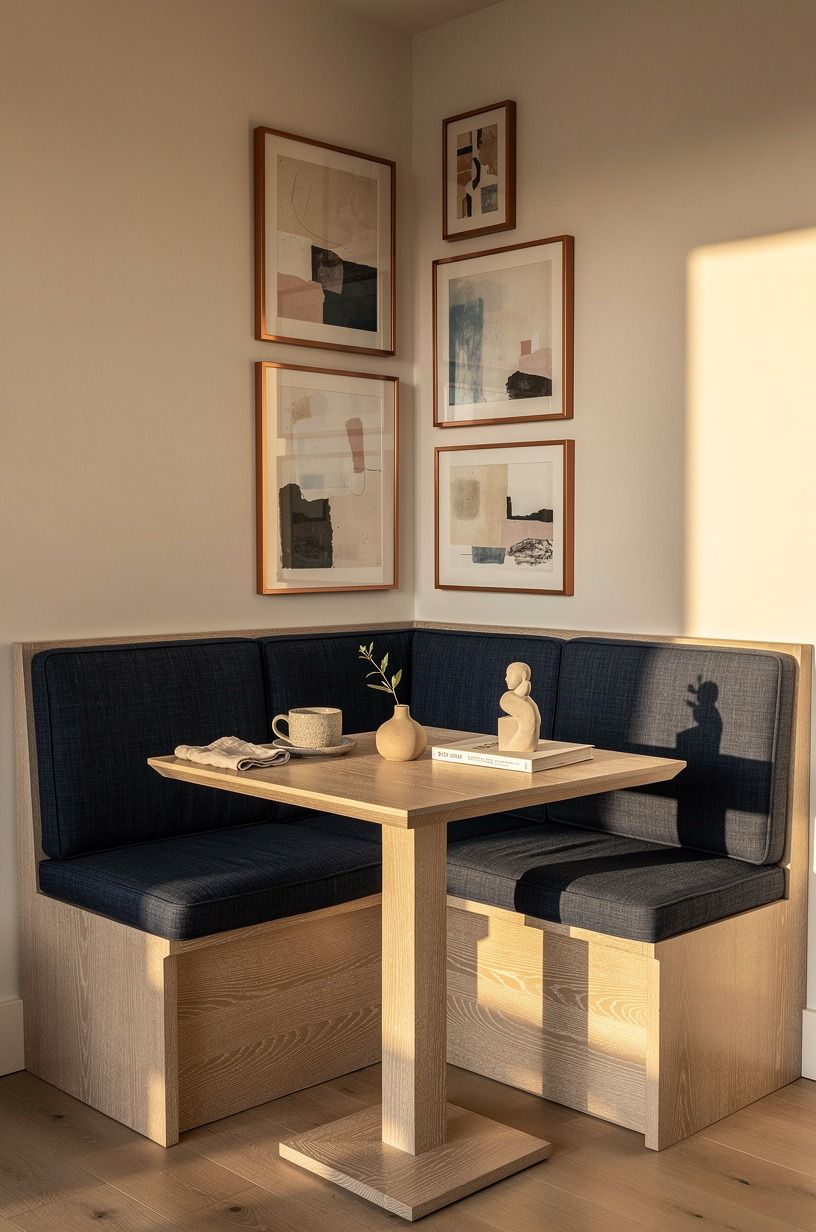
Art is the last layer because it tells you what the nook wants to be after the useful pieces are set.
The Corner Footprint Rule
Before anything else, before cushions, before a pendant, before the beadboard and the art, you have to lock the footprint. Walk the corner with a roll of painter's tape and lay it down on the floor exactly where the bench curve, the table edge, and the chair backs will land. Then live with it for a day.
Make coffee past it. Carry a basket of laundry past it.
Have a kid run past it twice. If you don't clip the tape once, the layout works.
If you clip it, the layout is wrong, no matter how pretty the Pinterest photo looked.
This is the single move that saves the most money on a nook. People skip it because tape feels silly.
It's the opposite of silly. It's the cheapest $4 you'll ever spend, and it has saved every corner I've ever built from going sideways. Worth it?
Every single time. The boring move wins the corner, and you'll feel it the first morning you sit down without bumping your shin.
Why the IKEA Tape Test Beats Guessing
Here is what I have learned after watching these corners go wrong in otherwise lovely rooms: people think the issue is style when the real issue is commitment. They will buy art first, or a cute chair first, or a pendant first, because those feel fun and visible. The boring move is the one that decides everything, and that boring move is footprint.
Tape the bench. Tape the table.
Walk around it three times. Sit in the fake opening and imagine carrying eggs, a laptop, or a basket of laundry past it.
I have done the opposite. I once started with the light because I loved the light, then spent two weeks pretending the seat depth was not off.
It was off. The table felt cramped, the bench entry felt mean, and every nice material choice after that was just makeup on a bad plan. That is why I push what I call the IKEA Tape Test: mark the footprint with cheap tape, then notice what your body does. Do you slow down?
Do you turn sideways? Do you keep brushing the sofa arm?
Your body answers faster than your mood board does.
The other thing people miss is that breakfast nooks in living rooms don't need to feel restaurant-correct. They need to feel easy at 7 a.m. and harmless at 7 p.m. That means softer edges, fewer sharp corners, and finishes that can take repetition without looking tired. A little wear in Belgian flax linen looks human.
A nick in painted beadboard is fine. But a table that is too wide will annoy you every single day, and daily annoyance is what kills a good corner.
Start with circulation, then light, then softness. That order is not glamorous. It is why the nook gets used.
What's the cheapest corner nook upgrade that actually changes the room?
Honestly? Paint.
A gallon of warm cream like Benjamin Moore Revere Pewter HC-172 runs about $45, and a Saturday brush-and-roller job will reset the corner so hard you'll feel like you did a full renovation. It's not glamorous, but it's the move that adds the most value per dollar on the entire project, especially when paired with two new cushion covers and one sconce.
If you've already painted and want the next cheapest hit, it's lighting. A plug-in sconce ($60) and a warm 2700K bulb swap will change the corner at night more than any furniture upgrade you can make for under $300.
Spend on the things your hand touches every day: the cushion fabric, the table edge, the seat depth. Skip the things that just sit there looking expensive.
A Few Things Worth Answering
What is the best Corner Breakfast Nook Ideas to Use That Awkward Space for a small living room?
A curved bench plus a round pedestal table is the strongest combo for a small living room. You get better flow because the corners disappear and your knees have one clear center base. If you want visual proof, small breakfast nook ideas that fit almost anywhere and Article-style rounded tables are the direction I'd study first.
Where can I buy Corner Breakfast Nook Ideas to Use That Awkward Space pieces on a budget?
Start with IKEA, Target Threshold, and Wayfair for the practical basics, then check Facebook Marketplace for the bench, chairs, or art. You'll save the most money through secondhand mixing. New cushion covers, a used pedestal table, and thrifted frames usually look better than one flat matching set.
How much does a Corner Breakfast Nook Ideas to Use That Awkward Space makeover cost?
Most makeovers land somewhere between about $300 and $1,200 if you’re using paint, pillows, art, and a rug. Custom millwork moves you into the mid to high tier fast. The free part is layout testing, because tape, editing, and shifting what you own still solve a lot before you spend.
Can I create a Corner Breakfast Nook Ideas to Use That Awkward Space on a budget?
Yes, and you don’t need custom cabinetry to make it work. The best cheap moves are paint, cushions, and lighting. A secondhand table, removable sconces, and one washable rug give you function first, while baskets and art can come later when the seat already feels right.
Is a Corner Breakfast Nook Ideas to Use That Awkward Space worth it in a small space?
Yes, especially in a small space, because the corner is already there waiting to earn its keep. You get more daily use out of square footage you were walking past. Keep the table round, keep the bench shallow enough for circulation, and the nook will feel additive instead of crowded.
Is Corner Breakfast Nook Ideas to Use That Awkward Space a good idea for a rental?
Yes, if you build it with reversible moves. Use no-damage layers like a slim settee, a tension-rod curtain setup, plug-in sconces, and leaned art instead of wall-to-wall millwork. Removable beadboard-style panels and peel-and-stick paintable surfaces can fake the built-in feeling without a lease fight.
Bench First Over Decor Later
If I had to pick one step, I'd start with the curved bench. Get the seat shape right first, because a bad corner keeps fighting you no matter how pretty the rug or pendant is. Pin that move for later, then build everything else around it.