
 by
by For car camping, a cot wins: better back support, no puncture risk, and off-ground warmth. For backpacking or tight tent spaces, an air mattress wins: lighter, packs small, adjustable firmness. If you also want a proper everyday mattress, the Saatva Classic is our top indoor pick for all-around support.
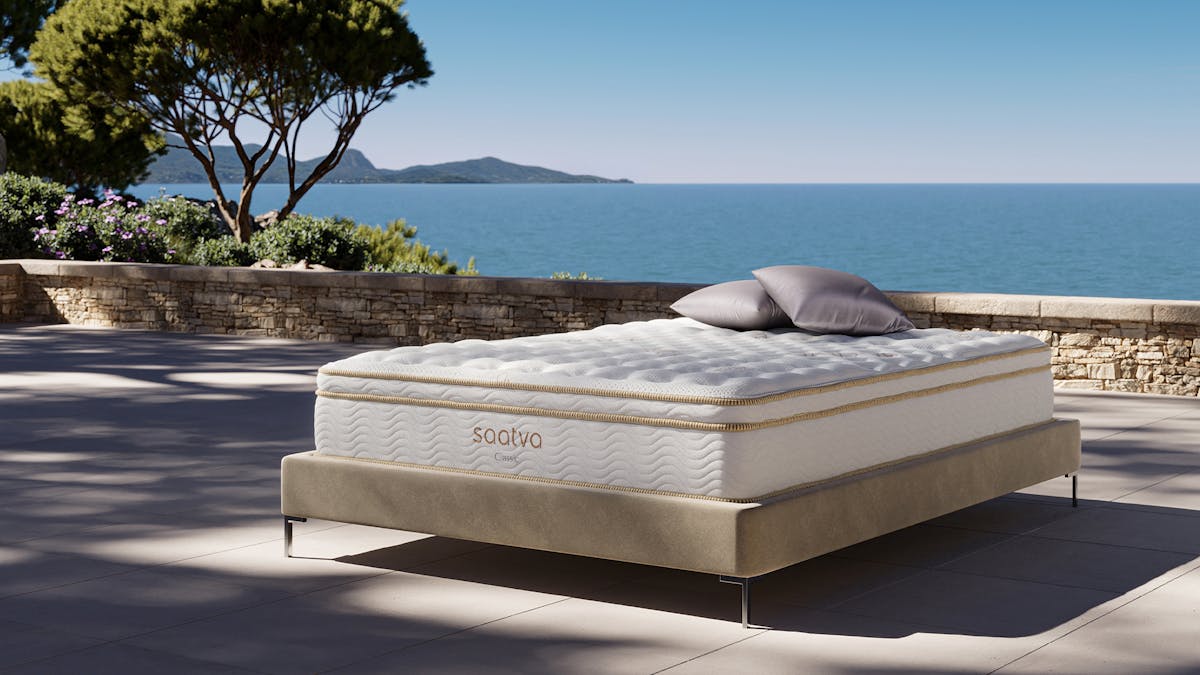
Saatva Classic
9.2/10
- Dual-coil construction with a reinforced lumbar zone pad
- Three firmness options (Plush Soft, Luxury Firm, Firm) to suit any sleep style
- Free white-glove delivery, in-room setup, and old mattress removal
- 365-night trial and a lifetime warranty
- Heavier than a boxed mattress, ships flat
- $99 return fee if you decide to send it back during trial
If camping gear has you thinking about sleep quality in general, the Saatva Classic is what we recommend most for home use. It delivers hotel-level support in three firmness options, ships free with white-glove setup, and backs that up with a 365-night trial.
Cot vs air mattress: the quick breakdown
Both camping cots and air mattresses solve the same problem, getting you off the bare ground, but they do it very differently. A cot lifts you on a rigid frame. An air mattress stays flat on the ground but cushions you with pressurized air. Which is better depends almost entirely on how you camp, how much you pack, and what your back needs from a sleeping surface.
The answer is rarely universal. A weekend car camper and a thru-hiker have completely different constraints. This guide breaks down every relevant category so you can make the right call for your situation.
What is a camping cot?
A camping cot is a portable, foldable bed built on a metal or aluminum frame with a fabric sleeping surface stretched across it. Most are designed for one person, though double-wide options exist. They stand roughly 12 to 20 inches off the ground, which is high enough to keep you away from tent floods, cold ground, and insects.
Strengths of a camping cot
- Off-ground elevation: The gap between you and the ground keeps moisture, insects, and cold air away from your sleeping surface. In rainy conditions this matters more than almost any other feature.
- Firm, consistent support: The taut fabric provides a stable sleeping platform that does not deflate or compress unevenly. Back sleepers and stomach sleepers tend to find cots more comfortable than air mattresses.
- Durability: Steel or aircraft-grade aluminum frames do not puncture, and the fabric rarely tears under normal use. A well-built cot can last a decade or more.
- Under-cot storage: The space beneath the frame is free real estate for gear bags, shoes, and anything you want off the tent floor.
- No inflation required: Unfold, lock the legs, done. No pump, no waiting, no guessing whether you have enough pressure.
Weaknesses of a camping cot
- Size and weight: Even lightweight backpacking cots run 3 to 5 pounds and fold down to an awkward cylinder. Car campers handle this fine; backpackers generally cannot.
- Tent footprint: A standard cot is 25 to 30 inches wide and 72 to 80 inches long when deployed. You need a tent with a large floor area to fit one comfortably alongside other gear.
- Side sleeper fit: The firm, flat surface with no give at the shoulder or hip can be uncomfortable for side sleepers. Adding a sleeping pad or thin mattress topper fixes this but adds weight.
- Price: Quality cots start around $60 and climb past $300 for ultralight designs. Budget air mattresses cost less.
What is a camping air mattress?
A camping air mattress, also called an inflatable sleeping pad or air bed, is a portable mattress made of PVC or TPU that you inflate before sleeping and deflate for packing. Sizes range from single-person pads to queen air beds large enough for couples. Thickness ranges from 2-inch ultralight pads to 18-inch raised models designed for guest bedroom use indoors.
Strengths of an air mattress
- Packability: Deflated, most air mattresses compress into a carry bag smaller than a sleeping bag. Ultralight options weigh less than a pound.
- Adjustable firmness: Add air for more support, release some for a softer feel. Side sleepers can dial in the pressure they need. No cot gives you that option.
- Lower cost at entry level: Decent air mattresses for occasional camping start around $25 to $40. A good cot costs at least $60 to $80.
- Versatility: The same air mattress works in a tent, in the back of an SUV, or as a guest bed indoors. A cot mostly stays in camping contexts.
Weaknesses of an air mattress
- Puncture risk: Rocks, tent stakes, and sharp tent seams all threaten PVC. A punctured air mattress in the middle of the night leaves you on the ground. Always pack a patch kit.
- Cold ground contact: Because the mattress sits directly on the tent floor, the ground draws heat out through the air inside. In cold conditions you can wake up colder than you went to bed, even inside a good sleeping bag.
- Inflation time: Electric pumps are fast but require a power source. Manual pumps take effort. Blowing it up by mouth is possible but takes 10 or more minutes for a full-size mattress.
- Gradual deflation: Even undamaged air mattresses lose small amounts of air overnight due to temperature drops. You may wake up softer than you intended.
Side-by-side comparison
| Factor | Camping Cot | Air Mattress |
|---|---|---|
| Back support | Excellent (firm, flat, consistent) | Variable (depends on inflation pressure) |
| Side sleeper comfort | Poor without a pad | Good (can soften with less air) |
| Packed weight | 3 to 8 lbs (standard); 1.5 to 3 lbs (ultralight) | Under 1 lb (thin pad) to 6 lbs (raised queen) |
| Packed size | Medium cylinder (awkward) | Small roll or bag |
| Setup time | Under 2 minutes (no tools) | 2 to 10 minutes (pump required) |
| Puncture risk | None | Moderate to high |
| Cold weather performance | Good (elevated, air circulates) | Poor (loses heat to ground) |
| Durability | High (10+ years typical) | Moderate (2 to 5 years with care) |
| Entry price | $60 to $80 | $25 to $40 |
| Best for | Car camping, base camping | Backpacking, guest use, SUV camping |
Which is better if you have back pain?
For back pain, a cot is generally the safer choice when camping. The firm, taut surface keeps your spine in a neutral position without the uneven sinkage that an underinflated air mattress can create. That said, if a cot feels too firm for your hips or shoulders, adding a thin closed-cell foam pad on top brings pressure relief without sacrificing support.
Air mattresses can also work if you inflate them to a firm pressure and keep them there overnight. The problem is gradual deflation, which can leave you on a progressively sagging surface by 3 a.m. A model with a built-in pump that auto-adjusts overnight (like some EnerPlex or SoundAsleep designs) addresses this at higher cost.
For everyday sleeping at home, neither a cot nor an air mattress is a real substitute for a proper mattress with zoned support. If back pain is a concern, that is the category worth investing in.
Best for car camping vs. backpacking
Car camping: Weight and size are not constraints. A quality cot, such as the Coleman Trailhead II or the Helinox Cot One, gives you a hotel-quality sleeping experience in the tent. Pair it with a thin sleeping pad for side-sleeper comfort.
Backpacking: An air mattress wins by default. The best options, Therm-a-Rest NeoAir or Sea to Summit Ether Light, weigh under 12 ounces and pack to the size of a water bottle. Ultralight backpacking cots exist but cost significantly more and still pack bulkier.
SUV or truck bed camping: An air mattress cut to fit the cargo area is the standard solution. Check the dimensions of your load floor before buying.
Tips for staying warm on an air mattress
Cold ground is the primary drawback of sleeping on an air mattress in cool weather. These steps help:
- Place a closed-cell foam pad (R-value 2 or higher) between the ground and your air mattress. It acts as a thermal break and adds significant warmth at minimal cost.
- Use a sleeping bag rated 10 degrees colder than the actual temperature. The ground chill can drop your apparent temperature by 10 to 15 degrees.
- In a tent, park the air mattress toward the center rather than against a cold tent wall.
- Slightly underinflate in very cold conditions. A softer mattress wraps around you slightly better and reduces the convection of cold air inside the bladder.
Frequently asked questions
Is a cot or air mattress better for camping?
A cot is better for car camping: more durable, no pump needed, better back support, and warmer in cold weather. An air mattress is better for backpacking because it packs small and weighs far less. For SUV or family camping, either works depending on your tent size.
Can I use an air mattress in cold weather camping?
Yes, but insulation underneath is essential. Place a foam sleeping pad under the air mattress to block ground cold. An uninsulated air mattress directly on frozen or cold ground will drain body heat quickly and can leave you colder at 3 a.m. than when you fell asleep.
How long does a camping air mattress last?
With occasional use (a few trips per year), a quality air mattress lasts 2 to 5 years. Punctures are the main failure mode, not material degradation. Patch kits extend lifespan significantly. Daily use compresses lifespan to 6 to 12 months due to valve wear and seam stress.
Can a camping cot hold heavy people?
Most standard cots support 250 to 300 pounds. Heavy-duty models from brands like Timber Ridge and Coleman SupportPlus are rated to 600 pounds. Always check the manufacturer weight rating before purchase, not the general "heavy duty" label.
Do I need a sleeping pad with a camping cot?
Not for support, but for comfort. The bare fabric of most cots can feel hard after several hours, especially for side sleepers. A thin sleeping pad or foam mat on top of the cot improves comfort significantly and adds warmth if you camp in cold conditions, since air circulates beneath a cot.
Choose a cot for car camping (support, durability, warmth) and an air mattress for backpacking (weight, packability). For daily sleeping at home, neither replaces a proper mattress. The Saatva Classic is our top pick there, with a 365-night trial and free white-glove delivery.