
 by
by Quick answer: Yes. Lizards sleep, although an open-eyed or motionless lizard can be hard to read. Look for a repeatable rest pattern, and remember that some species never blink.
- EEG measurements can identify sleep stages in reptiles, according to Mattress Clarity.
- Those reptile sleep stages differ, Mattress Clarity cautions.
- Whether reptiles become sleep deprived remains unsettled, although the evidence summarized by Mattress Clarity points toward yes.
Updated July 2026 · Reviewed for accuracy
The short answer is clearer than the visual clues: lizards do sleep. They just don’t always display the familiar signals people expect from a sleeping person or pet.
A fixed pose, open-looking eyes, or a lack of blinking can’t settle the question by itself. I’d look for a recurring pattern of undisturbed rest and treat the animal’s eyes as one clue rather than the final verdict.
Yes, lizards sleep, but a snapshot rarely proves it
EEG recordings provide the strongest evidence behind the answer. Mattress Clarity reports that reptile sleep can be measured with an EEG machine and described in stages. That moves the discussion beyond simply calling a motionless animal “sleepy.”
Mattress Clarity also cautions that the recorded stages differ. I wouldn’t translate a familiar human sleep label directly onto a lizard and assume the underlying state works or looks exactly the same. The source supports reptile sleep, but it doesn’t justify treating every reptile’s rest as visually identical.
That distinction matters because people usually encounter lizard sleep through observation, not equipment. You see a pose. An EEG records physiological activity. The pose may be consistent with sleep, but it doesn’t directly display what an EEG would show.
What the evidence supports
- Lizards sleep as part of the broader reptile evidence described by Mattress Clarity.
- Reptile sleep includes measurable stages.
- The appearance of sleep isn’t necessarily the same across animals.
This is why I’d separate “resting” from “confirmed asleep” in casual observation. Resting describes what you can see: the animal is still and apparently inactive. Sleep describes an internal state supported by physiological measurements. Without those measurements, you’re making a reasonable interpretation rather than conducting a definitive test.
That doesn’t make ordinary observation useless. It simply gives it the right weight. A recurring, unprompted rest pattern offers more context than a single image, while the EEG findings explain why the underlying answer is still yes.
An EEG answers more than visible stillness can
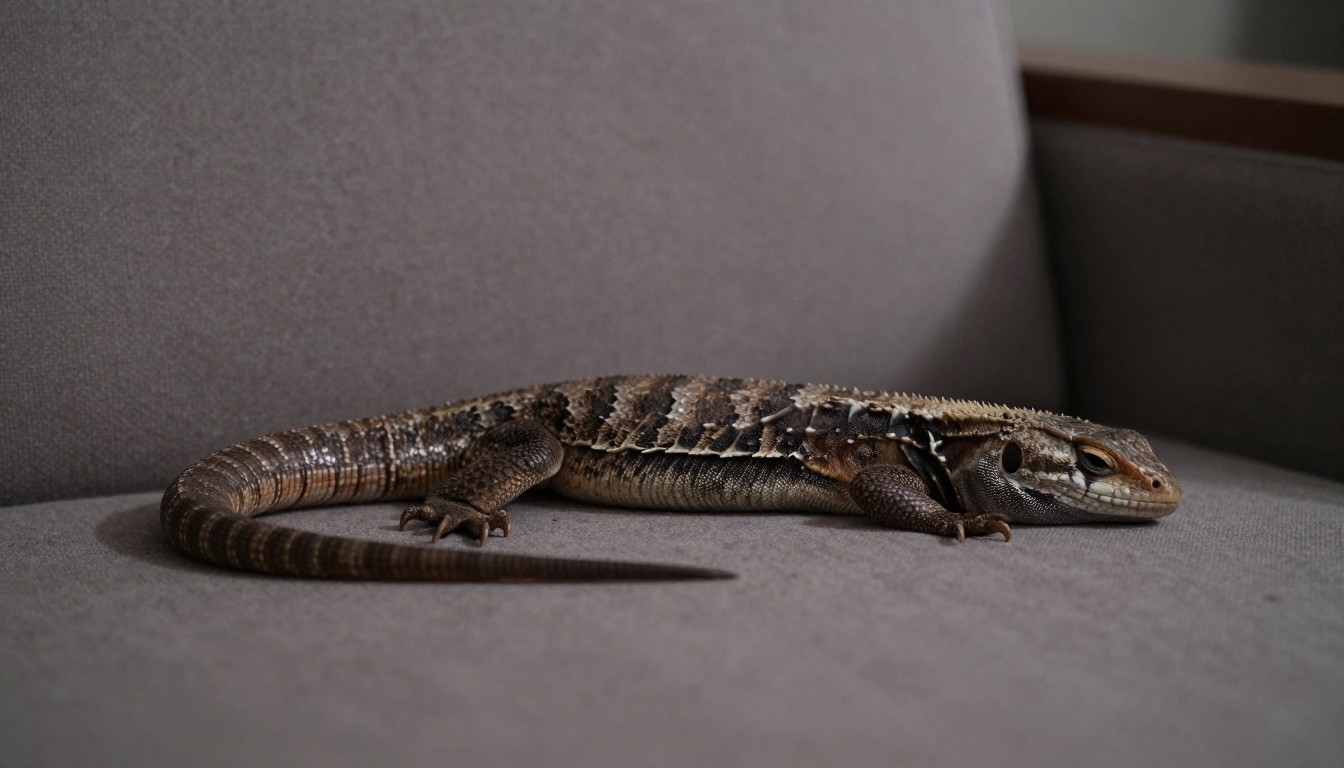
A photograph captures one instant. It can show eye appearance, posture, and lack of visible movement, but it can’t show a sleep stage. Even a long motionless spell remains an outward observation rather than a physiological measurement.
Video gives you more context because it shows a sequence. You can see whether the quiet period begins naturally, continues without interference, and ends on its own. I’d consider that more informative than a photograph, but I still wouldn’t call it the equivalent of an EEG recording.
The practical goal isn’t to prove sleep with home equipment. It’s to distinguish a sensible inference from a guess. The more repeatable the pattern is, the less you’re relying on one ambiguous pose.
| Type of evidence | What it can show | Main limitation |
|---|---|---|
| EEG recording | Measurable reptile sleep stages, according to Mattress Clarity | It isn’t part of ordinary visual observation |
| Recurring rest pattern | A stronger practical basis for inferring sleep | It remains an inference rather than a physiological reading |
| Single photograph | Visible posture and eye appearance at one moment | It can’t establish what happened before, after, or internally |
I’d also avoid turning stillness into a universal sleep test. Stillness tells you that visible movement wasn’t detected during the observation. It doesn’t reveal the animal’s internal state, and it doesn’t rule out quiet wakefulness.
The reverse is worth remembering too. A small movement within an otherwise quiet period doesn’t automatically answer the question. The Mattress Clarity account focuses on measured sleep stages, not a rigid visual rule that every sleeping reptile must remain perfectly motionless.
The cleanest conclusion is narrow but useful: reptile sleep is measurable, while casual observation is interpretive. That’s enough to answer “do lizards sleep?” without pretending that every resting pose can be classified with certainty.
Open eyes don’t automatically mean a lizard is awake
Some lizard species never blink, according to the article titled Do Lizards Sleep With Their Eyes Open? The Truth Revealed. That source also identifies the brille scale as relevant to understanding why visible eye cues don’t work the same way for every species.
This makes blinking a weak universal test. If a species doesn’t visibly blink, waiting for a familiar eyelid movement won’t tell you whether the animal has entered a rest state. An eye that looks open to you can’t automatically be read as evidence of wakefulness.
I wouldn’t push the claim further than the source allows. “Some species never blink” doesn’t mean every lizard sleeps with visibly open eyes. It means eye appearance must be interpreted in the context of the particular animal rather than through a rule borrowed from human sleep.
My rule: Treat the eyes as one observation, not the verdict. A lack of blinking may reflect the species’ eye structure rather than alertness.
Visible eye closure, where present, still describes only what the eye looks like. It doesn’t display an EEG stage. That’s why I’d combine eye appearance with the timing and recurrence of the broader rest pattern.
Species context also prevents bad comparisons. An image of one lizard can’t establish how another species should look while asleep. The source about brille scales and non-blinking species is a direct warning against forcing one eye-based expectation onto every lizard.
This is especially relevant for photographs shared online. A caption may call an animal asleep, but the image itself only preserves an outward moment. Unless the caption is backed by stronger context, it’s better read as an interpretation than a measurement.
Read a repeatable pattern instead of one pose
One motionless moment gives you one data point. A recurring period of undisturbed stillness gives you a pattern. For ordinary observation, I find the pattern much more useful.
Start by watching without changing what the animal is doing. Tapping an enclosure, moving the lizard, or creating a sudden disturbance would interrupt the very state you’re trying to understand. Quiet observation preserves the sequence and avoids manufacturing a reaction.
Note when the rest-like period begins and ends. Record the visible posture and eye appearance without assuming either one proves sleep. If the same broad pattern returns under comparable circumstances, you have a more reasonable basis for describing it as probable sleep.
A simple observation record
- Note the beginning and end of the quiet period.
- Describe the eyes as they appear, without treating blinking as mandatory.
- Record the position rather than assigning meaning to it immediately.
- Watch for the same pattern to recur without prompting.
- Note whether normal visible activity resumes spontaneously.
This isn’t a scientific sleep test, and it shouldn’t be presented as one. It’s a disciplined way to avoid guessing from a single pose. The EEG findings reported by Mattress Clarity remain the physiological evidence; your notes provide behavioral context.
Comparing an animal with its own established pattern is also more sensible than comparing it with a random photograph. The source material doesn’t provide a universal lizard sleep posture or a fixed visible routine. I wouldn’t invent one.
If you’re observing a wild lizard, distance is the better approach. There’s no reason to touch or disturb an animal merely to see whether it wakes. A natural sequence is more informative than a reaction you deliberately provoke.
For a pet lizard, a written record can be useful if a familiar pattern changes and you want qualified guidance. The notes don’t diagnose a cause. They simply give a reptile professional a clearer account than “it looked asleep” or “it seemed different.”
An unusual pose by itself doesn’t explain what’s happening. Neither does an open eye. If the animal’s behavior raises a care or health concern, seek advice from a qualified reptile veterinarian rather than using a general sleep article as a diagnosis.
The sleep-deprivation question isn’t fully settled
Mattress Clarity is explicit about the main uncertainty: it isn’t positively known whether reptiles can become sleep deprived, although the answer so far appears to be yes. That wording matters. It points in a direction without declaring the issue closed.
I wouldn’t turn that tentative finding into an exact claim about how much sleep a lizard needs. The cited account doesn’t provide a universal schedule, a required duration, or a species-by-species threshold. Any precise rule of that kind would go beyond the evidence here.
The same restraint applies to consequences. The source raises sleep deprivation as a plausible reptile phenomenon, but it doesn’t support a list of guaranteed signs or outcomes for every lizard. A visible change might deserve attention, yet observation alone doesn’t identify its cause.
| Question | What can be said confidently |
|---|---|
| Do lizards sleep? | Yes. Mattress Clarity reports measurable sleep stages in reptiles. |
| Must a sleeping lizard visibly close its eyes? | No universal rule is supported. The brille source says some species never blink. |
| Does stillness prove sleep? | No. Stillness is an outward observation, not an EEG measurement. |
| Can reptiles become sleep deprived? | The question remains unsettled, although Mattress Clarity says the evidence so far leans toward yes. |
| Is there one visible sleep routine for every lizard? | The cited material doesn’t establish one. |
That boundary doesn’t weaken the basic answer. It improves it. Lizards sleep, reptile sleep has measurable stages, and some species can defeat the familiar open-eye test. The exact appearance and consequences of disrupted sleep require more specific evidence than a casual glance provides.
My bottom line is simple: assume neither “awake” nor “asleep” from one visual cue. Watch for an undisturbed, repeatable pattern, account for species-related eye differences, and keep physiological certainty separate from sensible observation.
FAQ
Do all lizards sleep?
Yes, the reptile sleep findings summarized by Mattress Clarity support the basic answer that lizards sleep. The source doesn’t show that sleep looks identical in every lizard species, so a universal posture or eye rule would be unjustified.
Do lizards sleep with their eyes open?
Some can appear open-eyed because not every species provides the familiar cue of blinking. Do Lizards Sleep With Their Eyes Open? The Truth Revealed discusses the brille scale and says some species never blink, so visible eye appearance alone can mislead you.
How can I tell whether a lizard is sleeping?
Look for a quiet pattern that begins naturally, recurs, and ends without you provoking a response. Treat that as probable sleep rather than physiological proof, since Mattress Clarity’s strongest evidence comes from EEG measurements.
Can lizards become sleep deprived?
That hasn’t been established conclusively. Mattress Clarity says the answer currently appears to lean toward yes, but the source doesn’t support an exact sleep requirement or a universal list of consequences.
Should I wake a lizard to check whether it’s asleep?
I wouldn’t disturb a lizard merely to confirm sleep, because the reaction would interrupt the pattern you’re trying to observe. If a pet’s behavior has changed enough to cause concern, record what you see and ask a qualified reptile veterinarian for species-specific guidance.