
 by
by |
Quick answer: A motionless tick should not automatically be described as sleeping. Ticks can enter periods of inactivity, including states called quiescence and diapause, but a quick glance cannot identify the underlying state.
|
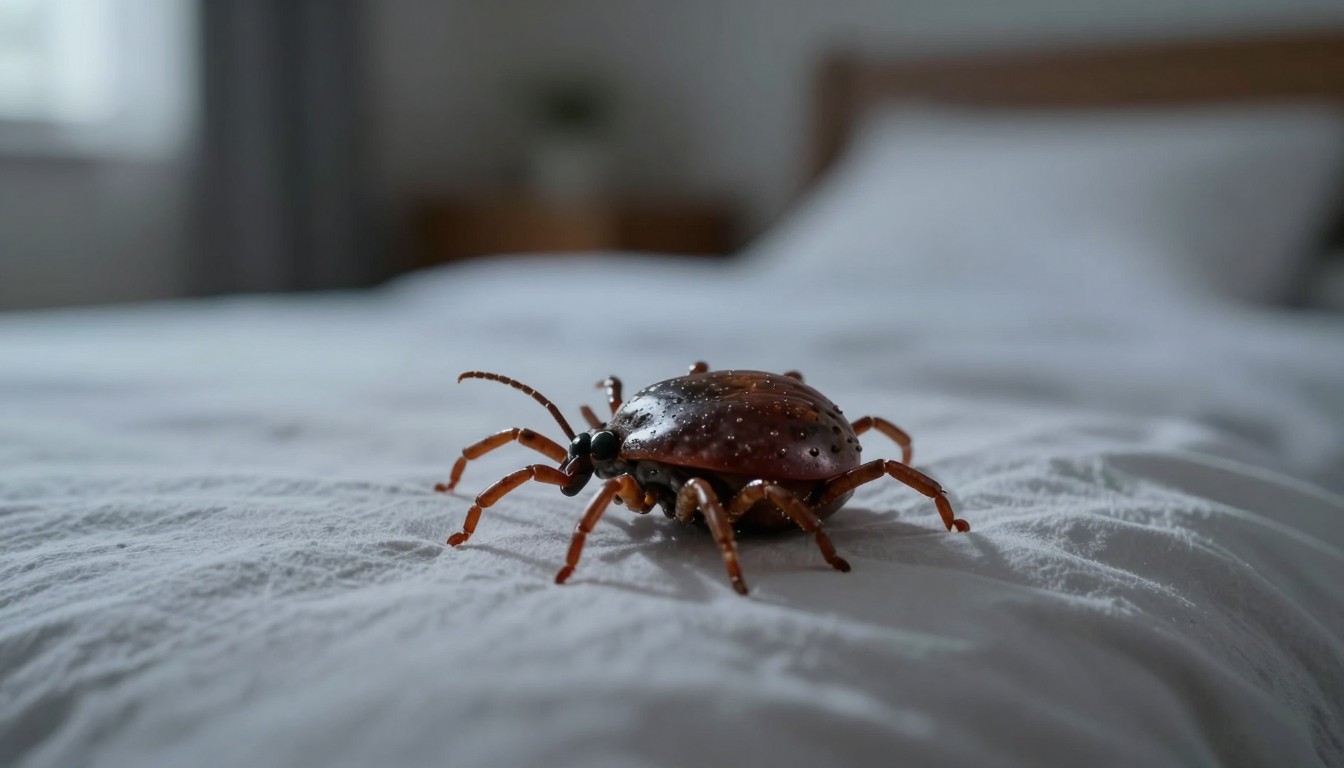
If you have found a tick that is not moving, calling it asleep feels natural. We use the same language for pets, insects and almost anything else that becomes quiet. The problem is that visible stillness tells you only what the tick was doing during the moment you watched it.
It does not reveal the biological process behind that stillness. A tick may be inactive, but the familiar human idea of falling asleep and later waking up is not a conclusion you can draw from appearance alone.
Do ticks sleep, or is sleep the wrong label?
A tick sitting perfectly still presents a camera-frame problem: you can see its position, but you cannot see the process controlling its activity. That makes “sleeping” a stronger claim than the observation supports.
The careful answer is that ticks experience inactivity, but ordinary sleep is not the most useful label for every quiet period. Tick biology includes terms such as quiescence and diapause, each of which describes something more specific than simply taking a nap.
This is not the same as saying that ticks remain active constantly. It means that activity and human-style sleep are not the only choices. A tick can stop moving without fitting the everyday sleep-and-wake story we apply to ourselves.
The distinction that matters: “The tick was not moving” records an observation. “The tick was asleep” assigns a biological state. The first statement is visible evidence. The second requires information that a snapshot cannot provide.
That is why my answer is qualified rather than absolute. If someone casually says a tick looks asleep, the meaning is obvious. If the goal is an accurate explanation, inactive is the better word.
Why inactivity is not automatically sleep
Sleep is more than an animal occupying the same position for a while. To identify a sleep-like state confidently, stillness would have to be interpreted alongside a broader pattern of behavior and responsiveness. A brief household observation does not supply that context.
There is also no universal posture that lets a casual observer look at a tick and declare it asleep. Seeing no leg movement, no crawling and no visible change in position still leaves the cause of the inactivity unresolved.
The length of the observation matters too. A glance across a room, a photograph and a continuous period of watching do not provide the same information. Even continuous watching records behavior only during that window. It does not reveal what happened before or what will happen afterward.
| What you observe | What it supports | What it does not establish |
|---|---|---|
| No visible movement | The tick appeared inactive while you watched it. | That the tick was asleep, dead or in a particular dormant state. |
| Movement begins later | Its activity changed between the observations. | That the earlier inactivity was sleep or that the later movement was waking. |
| The position remains unchanged | No change was visible during that period. | How long the inactivity had lasted or why it occurred. |
| The tick looks curled or still | A physical condition or posture can be described. | A reliable biological diagnosis based on appearance alone. |
Later movement is particularly easy to misread. It may feel natural to say the tick “woke up,” but the only confirmed change is that it was motionless earlier and moving later. That sequence does not identify the earlier state.
The reverse mistake is possible as well. Continued stillness does not, by itself, tell you that the tick cannot move again. The honest boundary is simple: an observer can report behavior but should be cautious about assigning its hidden cause.
- Too certain: “It was asleep because it did not move.”
- More accurate: “It did not move while I watched it.”
- Too certain: “It woke up when I touched the container.”
- More accurate: “It began moving after the container was disturbed.”
What quiescence and diapause mean here
Quiescence and diapause are not decorative scientific words for sleep. They refer to forms of reduced activity or suspended development, and they help explain why “asleep” can be an oversimplification.
Quiescence generally describes inactivity tied closely to the conditions an organism is experiencing. Diapause is a more organized pause associated with the organism’s development or seasonal cycle. Both concepts differ from the ordinary image of becoming tired, sleeping and waking refreshed.
Those definitions do not let you diagnose a tick from across the room. A technical category requires context. A motionless body does not display a label showing whether the tick is quiescent, in diapause or inactive for some other reason.
- Sleep is the familiar comparison behind the question, but it can imply a pattern that has not been demonstrated.
- Quiescence is a form of inactivity, not something that can be confirmed from stillness alone.
- Diapause is a distinct biological pause rather than another word for ordinary rest.
- Inactive is the broadest and safest description when the exact state is unknown.
I would not use quiescence and diapause interchangeably. They point to different mechanisms, even though both may involve little or no visible movement. Replacing “sleep” with a technical term at random does not make the description more accurate.
The useful hierarchy starts with what you know. “Not visibly moving” is the direct observation. “Appeared inactive” is a restrained interpretation. Quiescence or diapause is a specific classification that needs more context than appearance supplies.
The Nut’s take: A precise ordinary word beats an unsupported technical label. If all you know is that the tick stayed still, call it inactive and leave the underlying state open.
Why a motionless tick can be misleading
A motionless tick looks simple because the visible evidence is simple. Nothing appears to be happening. That visual quietness can encourage conclusions that go well beyond the information available.
One common assumption is that a living creature must move frequently enough for us to notice. That is not a safe test of what state a tick is in. Your observation may be too short, too distant or interrupted at exactly the wrong time.
Another assumption is that disturbing the tick reveals whether it was sleeping. If movement follows a disturbance, you have learned that it responded or changed activity. You have not worked backward and proved that the preceding state met a scientific definition of sleep.
- Stillness does not identify the exact inactive state.
- A response to disturbance does not retroactively prove sleep.
- No response during a brief observation does not settle what happens later.
- A technical term should not be assigned solely because it sounds more precise.
A photograph is even more limited. It freezes a single instant and removes the time element completely. It can document location, shape and posture, but it cannot show the transition into or out of inactivity.
Video supplies more behavioral context, yet it still has limits. It shows only the recorded interval and cannot directly reveal the internal process governing the tick. The better the record, the better the description can be, but description is not automatically diagnosis.
How long can a tick remain inactive?
There is no honest duration you can read from a tick’s appearance. The same unmoving posture could have begun moments before you looked or could have been present for a much longer period.
Extended inactivity is one reason the sleep comparison becomes unhelpful. Human conversation treats sleep as a familiar interval followed by waking. Tick inactivity can belong to a different biological pattern, so an everyday expectation about rest does not provide a reliable clock.
The exact duration for a particular tick also cannot be predicted from one observation. Knowing when you first noticed it is not the same as knowing when the inactivity began. Likewise, the end of your observation is not necessarily the end of the inactive period.
| Timing question | Careful answer |
|---|---|
| When did the inactivity begin? | The first sighting gives no information about the period before it. |
| How long will it continue? | Stillness during the present observation cannot predict a future change. |
| Does later movement reveal the duration? | It identifies a later change but not the true starting point. |
| Does a long quiet period prove diapause? | Duration alone does not establish the mechanism behind the inactivity. |
The most useful answer is therefore qualitative. Ticks can remain inactive beyond the brief pause a person might casually call a nap, but a specific tick cannot be timed or classified from stillness alone.
This wording also avoids the opposite error, which is assuming that prolonged stillness must rule out later activity. If you did not observe the complete sequence, you do not have enough information to state where the inactive period began or ended.
How to describe an inactive tick accurately
Good wording separates the visible event from the possible explanation. Start by recording what happened: the tick did not visibly move during the observation. That statement remains accurate regardless of what its biological state turns out to be.
If you need a shorter phrase, say that the tick appeared inactive. The word “appeared” matters because it keeps the claim tied to your viewpoint. It does not pretend that observation alone settled whether the tick was quiescent, in diapause or in another condition.
Include context when it is genuinely available. You might note that the position later changed, that movement began after a disturbance or that you saw the tick only briefly. These details strengthen the record without turning it into a biological diagnosis.
- “The tick was not visibly moving when I found it.”
- “It appeared inactive throughout the time I observed it.”
- “Its position had changed when I looked again.”
- “It began moving after the surrounding object was disturbed.”
- “I could not determine the exact reason for the inactivity.”
Avoid “it woke up” unless you are deliberately speaking in loose conversational shorthand. “It began moving” communicates the visible change cleanly and does not smuggle an unsupported sleep claim into the description.
The same restraint applies to declaring a tick dead. Lack of movement during a short window is not, by itself, a complete determination. The central lesson is broader than sleep: one visible behavior should not be treated as proof of an unseen biological state.
What this answer changes in practice
The practical issue is not finding the perfect label. It is avoiding false confidence. Calling a tick asleep may encourage you to treat temporary stillness as if it were a predictable, harmless rest period.
Nothing about the word “sleep” establishes what the tick will do next. A tick that appears inactive may remain still during your observation or may later move. Its behavior should be described from what actually occurs, not from the story suggested by its posture.
This distinction is especially useful when different people observe the same tick at different times. One person may report no movement while another sees movement later. Those accounts are not contradictory. They describe separate observation windows.
A sensible rule: Do not base your interpretation of a tick on the assumption that it is asleep. Treat stillness as an observation, allow for uncertainty and describe any later change separately.
You also do not need to choose between quiescence and diapause to answer the original question. Their relevance is that tick inactivity has more than one possible biological explanation. Their presence in the vocabulary makes a blanket “yes, ticks sleep” answer too tidy.
The bottom line on whether ticks sleep
Do ticks sleep? The best plain-English answer is that a motionless tick should not be assumed to be sleeping in the familiar human sense. Ticks have inactive states, and visible stillness does not tell you which state applies.
Quiescence and diapause help explain why ordinary sleep language can mislead, but neither term should be assigned from a quick look. The most defensible wording is that the tick appeared inactive during the period you observed it.
If it moves later, report the change without rewriting the earlier stillness as proven sleep. If it remains motionless, keep the same boundary. You know what you saw, but appearance alone does not reveal the mechanism behind it.
| Final verdict: “Do ticks sleep?” deserves a qualified answer. They can become inactive, but a still tick is not automatically asleep. Describe the behavior first, and keep quiescence, diapause or any other specific explanation tentative unless there is enough context to support it. |
FAQ
Do ticks sleep like humans?
A tick should not be assumed to sleep like a human simply because it stops moving. Ticks can enter inactive states, but a casual observation does not establish a familiar sleep-and-wake cycle.
Is a motionless tick necessarily asleep?
No. Motionlessness confirms only that you did not see movement during a particular period. It does not identify sleep, quiescence, diapause or another possible state.
What is tick quiescence?
Quiescence is a form of inactivity associated closely with the conditions an organism is experiencing. It is not a synonym for ordinary sleep, and it cannot be confirmed merely by seeing a tick remain still.
Is diapause the same thing as sleep?
No. Diapause describes an organized biological pause associated with development or seasonal timing. It is distinct from the everyday idea of resting because an animal became tired.
How long can a tick stay inactive?
A specific duration cannot be determined from appearance alone. A tick may have become inactive before you noticed it, and continued stillness during your observation does not reveal when the state will change.