
 by
by Quick answer: I don’t recommend mouth taping as a standalone snoring fix. Evidence is thin, any benefit appears limited to selected sleepers, and persistent snoring deserves a cause-focused assessment.
- Capital ENT says current evidence doesn’t support mouth taping as a reliable standalone treatment for snoring.
- Capital ENT cites a randomized clinical trial in which combined therapy involving mouth taping had a 58% response rate, compared with 91% for mandibular advancement devices.
- Sleep Foundation says there’s no scientific evidence that mouth taping improves the jawline.
Updated July 2026 · Reviewed for accuracy
Mouth taping may reduce snoring for certain people who sleep with their mouths open, but that possibility isn’t the same as a reliable treatment. The strongest practical answer is no: tape alone hasn’t earned the confidence needed for me to recommend it.
The central problem is simple. Closing your lips changes how air can enter, but it doesn’t identify why you snore. That distinction matters more than the social-media trend.
Does mouth taping actually help snoring?
Capital ENT’s conclusion is direct: current evidence doesn’t support mouth taping as a reliable standalone treatment for snoring. That doesn’t prove nobody will notice a difference. It means the evidence can’t support a broad promise that closing the mouth will consistently solve the noise.
Some small studies have reported modest improvements among selected groups, according to the evidence summarized by sleep-health publications covering the practice. The crucial words are “selected groups.” A result from people chosen for a particular breathing pattern can’t automatically be applied to every person who snores.
I’d also separate a quieter night from a solved problem. Snoring volume can change with sleep position, nasal comfort and whether the mouth stays open. If the sound changes after applying tape, that observation still doesn’t establish what caused the snoring or whether the underlying issue has been addressed.
The key distinction: Mouth taping may alter one nighttime behavior, but Capital ENT says it isn’t supported as a dependable treatment on its own.
That’s why my answer isn’t an absolute “it can never help.” It’s a more useful verdict: the evidence is too limited to treat mouth tape as a general snoring remedy, especially without knowing why the snoring occurs.
What mouth taping changes, and what it doesn’t
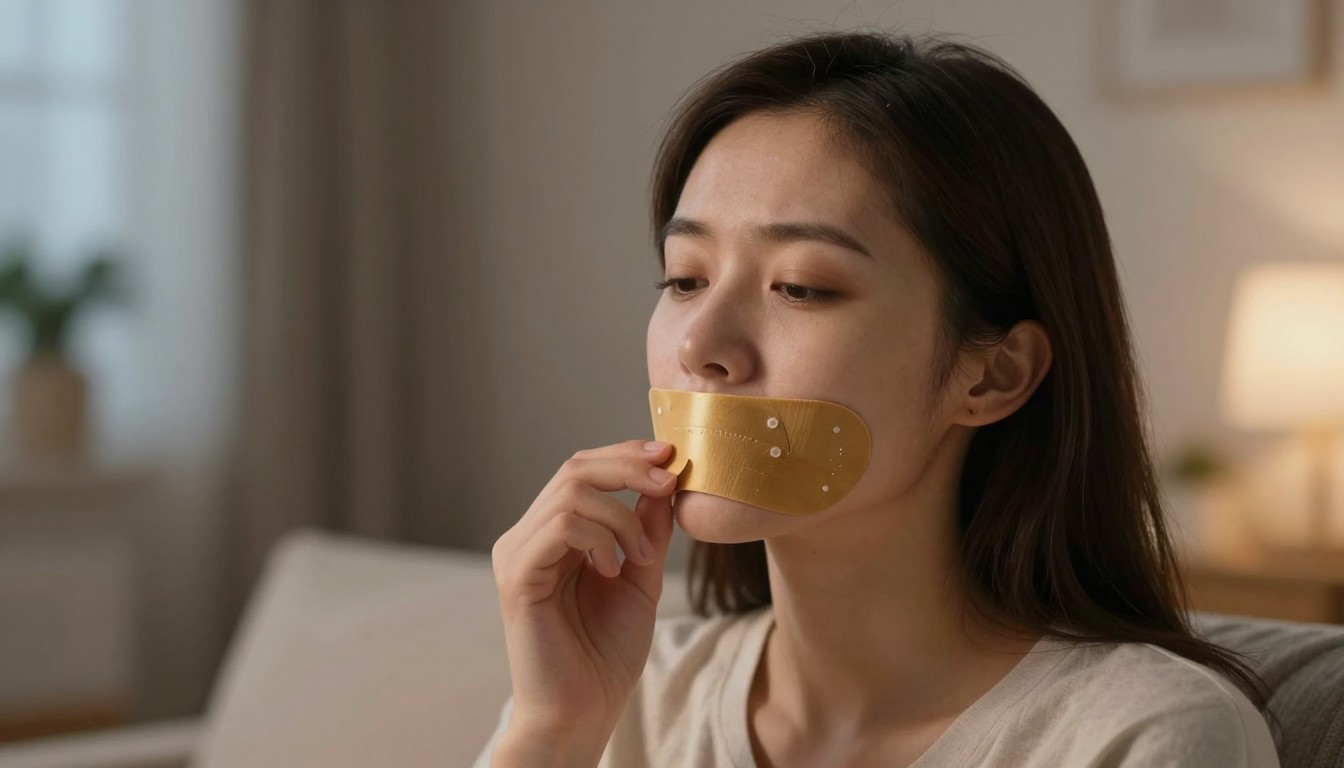
The tape has one immediate mechanical purpose: it keeps the lips together in an attempt to direct breathing through the nose. It doesn’t reposition internal tissues, establish that the nasal route is clear or diagnose the source of the sound.
This creates an easy reasoning trap. A person notices that their mouth is open on waking, assumes the open mouth caused all the snoring and then treats closing it as the complete answer. An open mouth is an observation. By itself, it isn’t proof of cause.
The method also shouldn’t be confused with a mandibular advancement device. Mouth tape holds the lips closed. A mandibular advancement device is intended to alter jaw position. Capital ENT reports substantially different response rates for these approaches in the clinical trial it cites, but that doesn’t make either option universally suitable.
What tape can and cannot tell you
- It can show whether keeping the lips closed coincides with a change you or a bed partner notices.
- It cannot establish why the snoring began or why it continues.
- It cannot show that a different breathing-related concern is absent.
I’m equally skeptical of the cosmetic claims attached to the trend. Sleep Foundation states that there’s no scientific evidence mouth taping directly improves the jawline. Claims that it strengthens jaw muscles or reshapes the face are anecdotal, while jawline appearance is influenced by factors including genetics, body fat and age.
What the evidence really shows
One randomized clinical trial cited by Capital ENT reported a 58% response rate for combined therapy involving mouth taping and a 91% response rate for mandibular advancement devices. Those figures are useful, but they need careful reading.
First, mouth taping was part of combined therapy. The result therefore doesn’t prove that tape produced the response by itself. Without isolating each component, I wouldn’t assign the full outcome to the tape.
Second, “response” isn’t the same as guaranteed silence. The summary doesn’t establish that every responder stopped snoring, nor does it justify applying the result to people outside the study group. It reports the trial’s response rate, not a universal success rate.
| Evidence point | What it supports | What it doesn’t prove |
|---|---|---|
| Combined therapy involving mouth tape had a 58% response rate in the trial cited by Capital ENT. | Some participants responded to the combined approach. | That mouth tape alone caused the response. |
| Mandibular advancement devices had a 91% response rate in the same cited trial. | That study reported a higher response for the jaw-positioning approach. | That such a device is appropriate for every sleeper. |
| Capital ENT doesn’t support tape as a reliable standalone treatment. | The evidence remains insufficient for a broad recommendation. | That no individual could ever notice less snoring. |
Verywell Health also frames mouth taping around uncertain evidence, potential risks and safer established approaches. That framing is sensible. A viral technique doesn’t become dependable merely because its mechanism sounds straightforward.
My reading is that mouth tape currently sits in a narrow evidence category: plausible for a subset of mouth-open sleepers, not established for healthy sleepers as a whole and not supported as a reliable standalone solution. That’s far weaker than the confident claims often made about it.
Risks and reasons to pause before using tape
If breathing comfortably through your nose is difficult while you’re awake, deliberately restricting the mouth route at night is a clear reason to pause. Tape doesn’t make the nasal route easier. It only discourages opening the lips.
Verywell Health specifically advises readers to weigh potential risks and consider safer, proven treatments. I wouldn’t reduce that concern to finding a gentler adhesive or applying a smaller strip. Changing the tape doesn’t answer whether closing the mouth is appropriate for the person using it.
Skin irritation is another practical consideration whenever adhesive sits on the lips and surrounding skin for an extended period. More broadly, discomfort, anxiety or difficulty removing the tape are sufficient reasons to stop rather than forcing the experiment.
Skip the DIY experiment and seek professional advice if:
- You can’t breathe freely through your nose before bed.
- Your snoring is persistent, suddenly changes or is accompanied by observed pauses in breathing.
- You already use a prescribed breathing treatment or oral device.
- The tape causes distress, irritation or a sense that breathing is restricted.
Mouth tape also shouldn’t replace a prescribed therapy. If you already use positive airway pressure and still hear nighttime noise, the relevant issue is how that treatment is working, not whether tape can stand in for it. I explain that distinction further in my guide to whether CPAP stops snoring.
I’d be wary of treating poor sleep quality and snoring as interchangeable, too. A supplement question such as whether magnesium helps you sleep concerns a different mechanism and a different body of evidence. Neither a supplement nor a strip of tape should become a catch-all explanation for nighttime symptoms.
A better way to approach snoring
Start with a narrower question than “Should I tape my mouth?” Ask what you actually know. Do you only know that someone hears snoring, or do you also know that your mouth repeatedly falls open? Those observations are related, but they aren’t identical.
Next, separate experimentation from assessment. An informal change in sound can be worth noting, yet it can’t identify a cause. Record the pattern in plain terms: whether the snoring is regular or occasional, whether a bed partner observes the mouth opening and whether nasal breathing feels easy before sleep.
Then bring persistent or concerning patterns to a qualified health professional. That route is less dramatic than a viral hack, but it allows the proposed solution to follow the cause instead of forcing every snorer into the same theory.
A practical decision path
- Observe: Identify what is actually happening rather than assuming an open mouth explains everything.
- Check comfort: Don’t restrict the mouth if nasal breathing isn’t easy.
- Assess: Get advice when the snoring persists, changes or raises concern.
- Match the response: Use an approach suited to the identified issue rather than treating mouth tape as a universal fix.
If a clinician does consider an oral approach, ask what it is intended to change and what evidence supports that use. The trial cited by Capital ENT illustrates why this matters: combined therapy involving tape and a jaw-positioning device aren’t equivalent interventions, even if both are discussed under the broad heading of snoring.
Also ask how success will be judged. “It seemed quieter once” is different from a consistent, meaningful response. A useful plan needs a clear goal and a way to decide whether the approach is helping without creating new discomfort.
My verdict on mouth taping for snoring
My verdict is no, mouth taping isn’t a dependable standalone answer to snoring. Capital ENT’s assessment is the most decisive fact here, and the clinical-trial result it cites came from combined therapy rather than isolated mouth taping.
A selected mouth-open sleeper might notice a reduction in sound, but that possibility is narrower than the claim that taping “treats snoring.” I wouldn’t use an uncertain response as proof that the cause has been found.
Bottom line: Treat mouth tape as an unproven tactic, not a diagnosis or a complete treatment. If snoring keeps happening, focus on identifying the reason before choosing the remedy.
FAQ
Can mouth taping stop snoring completely?
There’s no sound basis for promising that it will. Capital ENT says the current evidence doesn’t support mouth taping as a reliable standalone treatment, although selected sleepers may notice a modest change.
Does mouth taping help if my mouth falls open during sleep?
It may keep the lips closed, but noticing an open mouth doesn’t prove that mouth opening is the sole cause of the snoring. A change after taping would be an observation, not a diagnosis.
Is mouth taping a substitute for CPAP or an oral device?
No. Mouth tape shouldn’t replace a prescribed treatment, and it doesn’t work in the same way as a mandibular advancement device. Capital ENT’s cited trial reported different response rates for combined therapy involving tape and for mandibular advancement devices.
Should I tape my mouth if my nose feels blocked?
I wouldn’t. Tape restricts the option to open the mouth but doesn’t make nasal breathing easier, so difficulty breathing comfortably through the nose is a reason to stop and seek professional guidance.
Does sleeping with mouth tape improve the jawline?
Sleep Foundation says there’s no scientific evidence that it directly improves the jawline. Claims about strengthening jaw muscles or reshaping the face are anecdotal, while factors such as genetics, body fat and age influence jawline appearance.