
 by
Farmhouse oak kitchen ideas for a cozy, timeless look don't start with a renovation. They start with the wood you already have. I spent two years apologizing for my oak cabinets before I painted one wall and realized the oak wasn't the problem. The cold room around it was. Here are the 19 moves that fixed mine.
- Paint the Walls Warm White, Not Gallery White
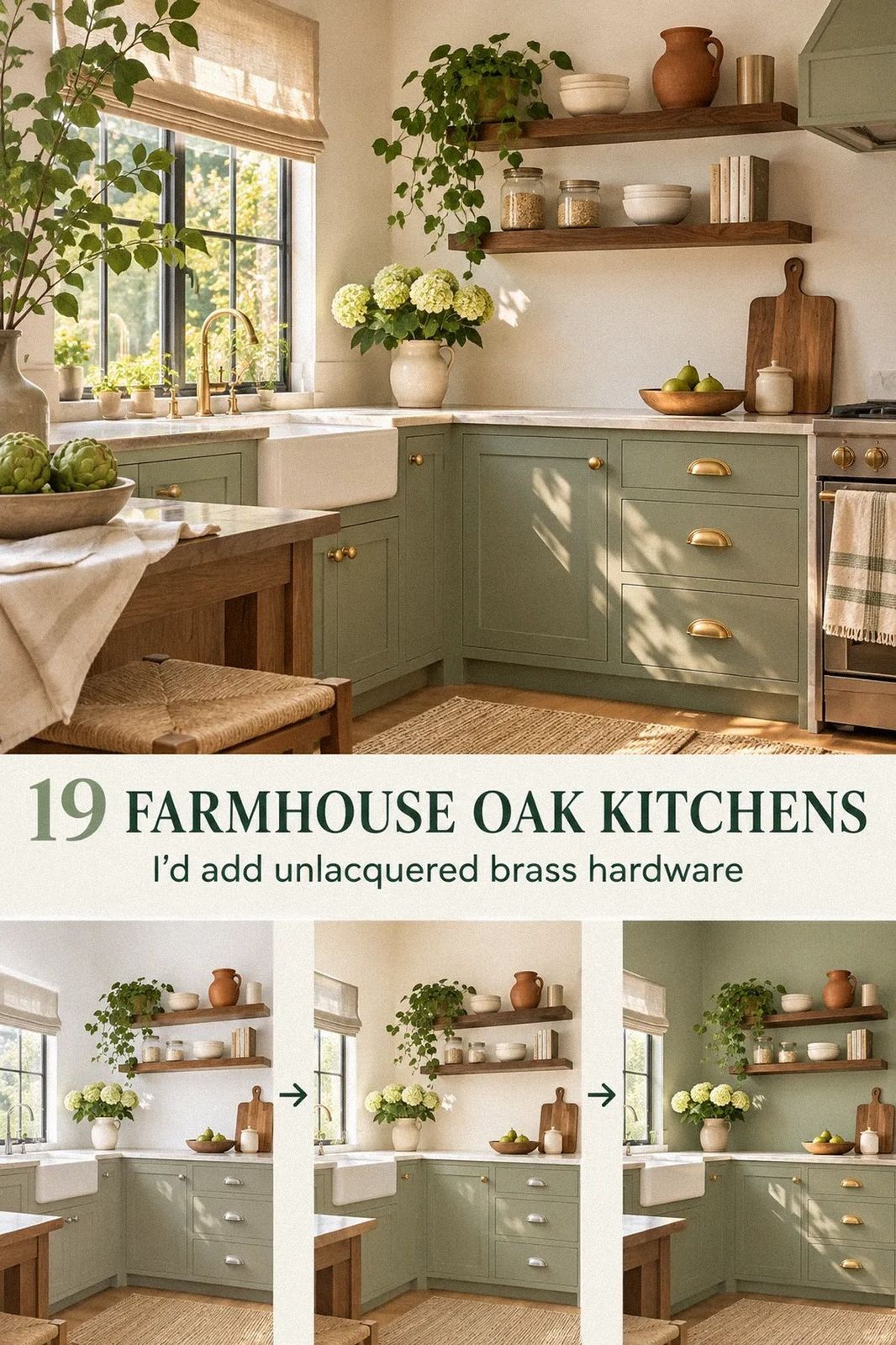
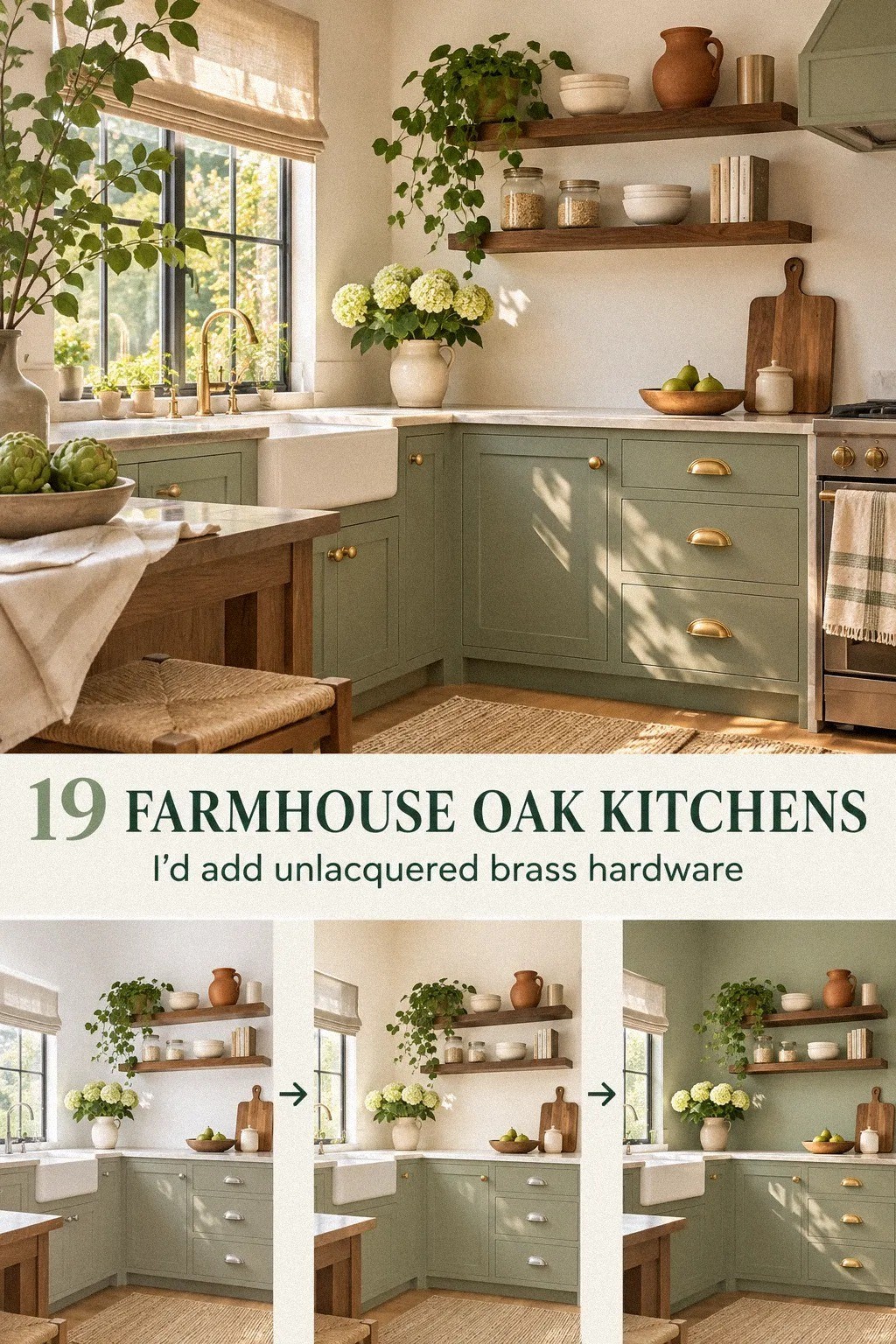
- Swap the Hardware for Unlacquered Brass
- Follow the Two-Wood Rule
- Lay Down a Wool Runner, Not a Mat
- Open Shelves Over Uppers, on One Wall Only
- Hang a Rail and Let the Copper Show
- Build the Three-Height Light Stack
- Stack Your Everyday Dishes in the Open
- Park a Freestanding Hutch in the Corner
- Which Counter Tops Oak Best?
- Frame the Window With a Café Curtain
- Embrace the Worn-In Finish
- Instead of Cabinet Doors, Skirt the Sink
- Ground It With One Deep Green
- Mix Your Stools, Skip the Set
- Warm the Floor With Brick or Terracotta
- Lean Your Boards, the Backsplash Layer
- Style the Island Like a Worktable
- Add One Vintage Piece and Stop
1Paint the Walls Warm White, Not Gallery White
The fastest way to make oak look intentional is a wall color with yellow in it, not blue. Benjamin Moore White Dove (OC-17) is the one I recommend every time someone asks, because it sits next to honey oak like they were planned together.
A stark gallery white does the opposite. It turns your cabinets orange by comparison, and you'll hate the wood for a problem the paint caused.
I tested four swatches on my own wall before committing, and the cool white was the clear loser by afternoon light. One gallon covers a standard kitchen, so this is your cheapest big win.
2Swap the Hardware for Unlacquered Brass
New pulls are a Saturday project with a drill and a screwdriver, and they change how the whole cabinet run reads.
3Follow the Two-Wood Rule
Here's a rule I made up after ruining a perfectly good kitchen with a third wood tone: in one sightline, you get two woods. That's it.
Oak cabinets plus a walnut stool? Fine.
Oak cabinets, walnut stools, and a pine shelf? The room starts arguing with itself.
The walnut cutting board against oak is the pairing that never fails, because the tones share a warm base but sit far enough apart to read as a choice. Count the woods in your kitchen right now. If you find three, remove one, and the room will settle down immediately.
4Lay Down a Wool Runner, Not a Mat
A flat-weave Turkish wool runner in front of the sink softens the hardest-working stretch of floor in your house, and it's the difference between a kitchen and a room.
5Open Shelves Over Uppers, on One Wall Only
Standard upper cabinets run 30 to 42 inches tall, and a full wall of them in oak can feel like a wood tunnel. Pulling the uppers off one wall and hanging two thick white oak floating shelves breaks that up and gives you a place to style instead of store.
But only do one wall. Kitchens with zero uppers photograph beautifully and function terribly, because all that stuff has to live somewhere.
I'd keep your uppers on the sink wall and open up the range wall instead. The small oak kitchen ideas I wrote about use this same move to make tight layouts breathe.
6Hang a Rail and Let the Copper Show
A simple brass or iron rail with S-hooks turns your utensils and pans into the styling.
7Build the Three-Height Light Stack
One overhead fixture is why your kitchen feels like a break room at 8pm. The fix is light at three heights: a pendant or two over the island at eye level, under-cabinet strips at counter level, and one small lamp on the counter itself. Yes, a lamp.
In the kitchen!
That counter lamp is the move people resist and then photograph constantly. A linen-shaded accent lamp throws a low pool of amber across the worktop and suddenly the room feels like evening instead of errands.
Warm bulbs only, 2700K, nothing cooler. The whole stack costs less than one statement fixture, and it does ten times the work.
8Stack Your Everyday Dishes in the Open
Open shelving only works if what's on it gets used. Stack your daily bowls and plates there, the ones you reach for twice a day, and the shelf styles itself because nothing sits long enough to gather dust. Soft grey stoneware against oak shelves is the combination I'd start with.
The styling formula is boring on purpose: stacks of four, one wooden bowl, one pitcher. Done. Don't arrange objects you'll never touch, because you'll stop wiping them down and everyone can tell.
If you're rethinking the cabinet run itself while you're at it, my oak kitchen cabinet ideas post goes deeper on door styles and finishes.
9Park a Freestanding Hutch in the Corner
The single most farmhouse thing you can add isn't a sign. It's a piece of furniture. A freestanding hutch or cupboard against an empty kitchen wall gives you display space, pantry overflow, and that collected-over-time feeling that fitted cabinets can't fake.
The IKEA HEMNES glass-door cabinet in white stain is the budget version I've pointed friends to for years, and secondhand hutches on Facebook Marketplace go for less than dinner out most weekends. Leave a few inches of breathing room on each side so it reads as furniture, not a built-in that missed.
If the piece is slightly beat up? Better.
That's the point.
10Which Counter Tops Oak Best?
Black marble with soft white veining, if you ask me, and I'll defend it.
11Frame the Window With a Café Curtain
A café curtain on a tension rod covers the bottom half of the window, keeps your privacy, and lets every bit of light through the top. It's the fastest softening move in this whole list, and it costs about forty bucks!
A deep forest green velvet is the fabric you want, something with real weight so it hangs like fabric and not like a sheet. I went back and forth on curtains versus a bare window for months, and the velvet won the first morning the sun came through it. I wrote a whole post on kitchen cabinet curtain ideas if you want the cottage version of this look.
12Embrace the Worn-In Finish
Farmhouse oak reads best slightly matte and slightly imperfect. If your cabinets have a glossy orange-toned polyurethane from 1998, that shine is what's dating the room, not the oak itself. A light scuff sand and a matte topcoat changes the entire read without touching the color.
And if your wood already has dings and worn edges near the pulls, leave them alone. The cerused white oak look everyone pays for in new kitchens is literally manufactured wear. You've got the real thing for free.
Don't sand away twenty years of patina because a showroom told you surfaces should be flawless.
13Instead of Cabinet Doors, Skirt the Sink
Pull the doors off the under-sink cabinet and hang a gathered fabric skirt on a tension rod.
14Ground It With One Deep Green
Warm oak wants one deep, earthy counterweight in the room, and green is the right one. Sherwin-Williams Evergreen Fog (SW 9130) on a single accent piece, like the island or the hutch interior, gives the wood something to push against without going dark everywhere.
Farrow & Ball Studio Green (No.93) is the moodier option, but I'd skip it in a north-facing kitchen, because it reads almost black by mid-afternoon and you'll lose the warmth you came for. Evergreen Fog keeps its gray-green balance in bad light.
Paint the island first. It's the lowest-commitment surface, and it anchors the whole room from the center.
15Mix Your Stools, Skip the Set
Matching bar stool sets are where farmhouse kitchens go to die. Three identical stools lined up at an island look like a waiting room, and the whole point of this style is that nothing arrived on the same truck.
Pull together vintage wooden stools in the same height family but different shapes: one with a back, one saddle seat, one painted and chipped. The unifier is tone, not shape, so stay in the warm wood or cream-painted range.
I've collected mine over about four years, one estate sale at a time. Total spend across all three was under what one new "farmhouse" stool costs at the big retailers.
16Warm the Floor With Brick or Terracotta
If you're touching the floor at all, this is your moment.
17Lean Your Boards, the Backsplash Layer
Here's a free one. Take your biggest wooden cutting boards and lean them against the backsplash behind the stove or along the counter run.
Overlapping, different sizes, no hooks, no drilling. It takes ninety seconds, and suddenly the kitchen looks styled by someone who cooks.
The leaning boards warm up that 18-inch backsplash gap visually, and they're still right there when you need one. A thick end-grain walnut board in front of a pale zellige or limewash wall is the strongest version of this. Mine have been leaning for two years and I've never once secured them.
If they fall, they fall. They're boards.
18Style the Island Like a Worktable
Islands in farmhouse kitchens shouldn't look like a landing strip for mail. Style yours like a worktable mid-task: a wooden dough bowl with whatever fruit is in season, a crock of wooden spoons, one linen towel folded over the edge. Things that imply use, because they get used.
Keep the styling to one third of the surface. You need clear landing space, and the standard 42 to 48 inches of clearance around the island matters more than anything on top of it. The Nancy Meyers kitchen look does this worktable styling better than anyone, and it translates straight onto oak.
19Add One Vintage Piece and Stop
Every great farmhouse kitchen has exactly one thing in it that's old, weird, and not for sale anywhere. A chipped stoneware crock holding utensils.
A brass scale. A bread box with someone's initials worn into the lid.
One piece, and it does more for the room than any ten new purchases.
The key word is one. Two vintage objects is charming.
Nine is an antique mall. Estate sales and thrift stores are where you'll find yours, usually for under twenty bucks, and you'll know it when you see it.
Then stop. The restraint is what makes the single piece feel like it means something.
What This Kind of Refresh Actually Costs
Here's the honest math, because "budget-friendly" means nothing without numbers. Most of this list sits in the cosmetic tier, and that's the whole point of working with your oak instead of against it.
If you do replace surfaces down the line, these are the going rates worth knowing before you get quotes:
Every idea above except the floor and counters lives in that first row. Paint, hardware, a skirt, stools, a runner. That's a cosmetic tier kitchen that looks like a refresh, and nobody who visits will know the difference.
What I Got Wrong With My Own Oak Kitchen
I want to be honest about the two years I spent hating a kitchen that wasn't the problem, because I think a lot of you are in that exact place right now.
When we moved in, I was convinced the oak had to go. I got a quote for cabinet replacement that made me sit down, and then a quote for painting them that still felt steep, so I did nothing. For two years.
And the kitchen just sat there being "the thing we'd fix eventually," which is a terrible way to live in a house.
The mistake wasn't waiting. Waiting is fine. The mistake was assuming the cabinets were the enemy, when the actual problems were a cold blue-gray wall color the previous owners loved, a single overhead light doing all the work, and brushed nickel hardware from a bulk pack.
Three fixable things. None of them were oak.
The wall color change is the one that rearranged my brain. I rolled on the warm white on a Saturday, and by Sunday afternoon the cabinets looked like a different wood.
Same cabinets. Same orange-ish honey tone I'd been apologizing for.
But next to warm white instead of cold gray, they read as honey, not as orange. That's when I understood that oak is a warm material that had been sitting in a cold room, and everything I'd blamed on the wood was actually the room arguing with it.
My second mistake was overcorrecting. Once I saw the paint work, I bought a third wood tone, a matching stool set, and a sign with a word on it. I know.
I removed all of it within a month, and the kitchen got better every time something left. Farmhouse isn't accumulation.
It's editing toward warmth, and it took me longer to learn the stopping than the starting.
So if you're where I was, standing in a kitchen you're saving up to hate properly, try the cheap warm stuff first. You might be one gallon of paint away from liking what you own.
The Questions I Get Asked Most
What is the best farmhouse oak kitchen idea for a small kitchen?
Warm white paint and open shelves on one wall. Removing one run of uppers in a tight kitchen makes the whole room breathe, and the warm white walls bounce light onto the oak instead of fighting it. The IKEA KALLAX in white stained oak also doubles as a freestanding pantry when floor space allows.
Where can I buy farmhouse oak kitchen pieces on a budget?
Start with IKEA for furniture pieces, Target's Threshold line for stoneware and linens, and Wayfair for runners and lighting. Your best bargains live secondhand, though: Facebook Marketplace and estate sales for hutches, stools, and crocks. No affiliate links here, just where I'd actually spend my own money.
How much does a farmhouse oak kitchen makeover cost?
A cosmetic refresh typically runs $300 to $1,500 in the US: paint, hardware, a runner, curtains, and styling pieces. Paint and hardware are under $200 of that. Thrifted stools and secondhand linen bring the rest down further, and anything involving counters or floors moves you into the mid tier.
Can I create this look without replacing my cabinets?
Yes, and that's the entire point of this list. Paint the walls warm white, swap the hardware to unlacquered brass, scuff the glossy finish to matte, and add warmth around the wood. Replacing honey oak cabinets is a $25,000 answer to a $300 problem.
Is a farmhouse oak kitchen worth it in a small space?
It's worth it, and small spaces help you. Oak's warmth reads as inviting in a compact kitchen instead of overwhelming, because there's less of it in one sightline. Keep one deep accent color maximum, run the runner lengthwise to stretch the room, and let the wood do the cozy work.
Is this look a good idea for a rental?
Very much so, because most of it doesn't touch anything permanent. Tension-rod café curtains, a peel-and-stick backsplash, leaning boards, a runner, and freestanding furniture all leave with you.
Swap the hardware and keep the old pulls in a labeled bag for move-out day. Your deposit stays intact.
Where I'd Start First
If I had to pick one, I'd start with the warm white paint. You can't layer warmth on top of a cold room, and every stool, runner, and crock you buy will fight the walls until the walls stop fighting back. Pin this for later and start with my oak kitchen cabinet ideas next.