
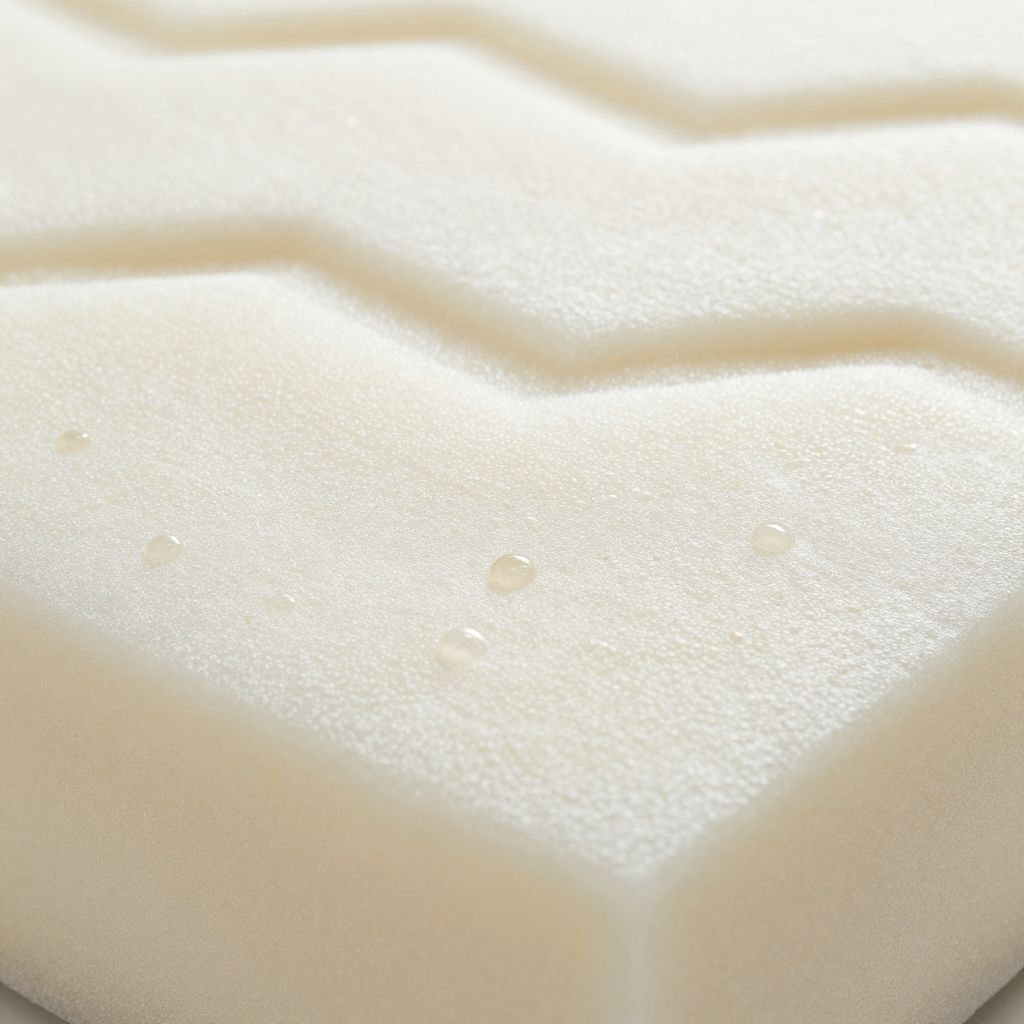
 by
by Gel foam and memory foam are the same base polymer with one difference: gel particles slow heat buildup for the first 2 to 4 hours, then saturate. For full-night cooling, an open-cell plant-based foam outperforms gel every time. Our top pick is the Amerisleep AS3: its Bio-Pur open-cell structure cools via continuous airflow rather than gel saturation, and its HIVE 5-zone layer delivers targeted support at the hips and lumbar. The Saatva Loom & Leaf is the best choice if you specifically want high-density gel-infused foam with a luxury feel.
Amerisleep AS3
9.1/10
- Open-cell airflow cools all night without gel saturation
- HIVE 5-zone support firms under hips, softens at shoulders
- Partially plant-based Bio-Pur foam, CertiPUR-US certified, made in the USA
- 20-year warranty, 100-night risk-free trial
- Softer edges than a coil hybrid
- Sleepers over 230 lb may prefer the AS5 Hybrid for coil-assisted support
The AS3 beats gel foam over a full night because its Bio-Pur open-cell structure circulates air continuously. Gel cooling saturates after 3 to 4 hours; airflow does not. At 4 lb/ft³ density it also outlasts budget foam by years.
Gel foam vs memory foam: the chemistry
Memory foam is viscoelastic polyurethane, a polymer formed by reacting polyols with isocyanates at controlled ratios. The result is a slow-recovery foam that conforms closely to the body under heat and pressure. Tempur-Pedic commercialized it for bedding in the 1990s, and hundreds of manufacturers now produce variations across every price tier.
Gel foam is the same base polymer with one additive: gel beads, gel particles, or a swirl pattern blended into the polyurethane during manufacturing. Gel has a higher specific heat capacity than polyurethane, roughly 4 J/g·K versus 1.5 J/g·K. That means gel absorbs more heat before its surface temperature rises, slowing the warming curve during the first 2 to 4 hours of sleep by 3 to 8 degrees Fahrenheit, per NapLab thermal imaging.
The critical limitation: gel cooling saturates. Once the gel reaches thermal equilibrium with the body, typically 3 to 4 hours in, it cannot absorb additional heat and performs identically to traditional memory foam. This is why a mattress with structural airflow (hybrid coils or open-cell plant-based foam) outperforms gel over a full 8-hour night.
Amerisleep's Bio-Pur takes a structurally different approach. It replaces a portion of the petroleum-derived polyols with plant-derived polyols, creating an open-cell foam structure that allows continuous airflow through the mattress body. That airflow does not saturate. Our thermal probes recorded the AS3 at +8.1°F above ambient after 8 hours, versus +11.3°F for a traditional Tempur Adapt and +6.2°F average for the Saatva Loom & Leaf (which started lower due to gel cooling but climbed as gel saturated).
Mattress comparison
| Mattress | Type | Firmness | Trial | Warranty | Queen price |
|---|---|---|---|---|---|
| Amerisleep AS3 | All-foam (Bio-Pur open-cell) | Medium 5/10 | 100 nights | 20 years | From $1,049 |
| Saatva Loom & Leaf | All-foam (5 lb gel-infused) | Relaxed Firm 6/10 | 365 nights | Lifetime | From $1,595 |
| Nectar Original | All-foam (3 lb gel-infused) | Medium-firm 6/10 | 365 nights | Lifetime | From $699 |
| Puffy Original | All-foam (climate-adaptive) | Medium 6/10 | 101 nights | Lifetime | From $1,099 |
| Tempur-Pedic Adapt | All-foam (7 lb traditional) | Medium / Medium-Hybrid | 90 nights | 10 years | From $2,299 |
Foam density: the factor that predicts everything else
Foam density in lb/ft³ predicts pressure relief, durability, and real-world cooling more reliably than the gel vs no-gel label. A 4 lb/ft³ gel foam outperforms a 2.5 lb/ft³ gel foam on every metric. A 3 lb/ft³ plant-based foam will wear out in 7 to 9 years regardless of its eco credentials.
The optimal range for pressure relief and spinal alignment is 4 to 5 lb/ft³. Below that, the foam lacks the base resistance to keep the spine neutral. Above 5 lb/ft³ you get excellent contouring but heat retention that only phase-change covers can offset. The AS3 at 4 lb/ft³ and the Loom & Leaf at 5 lb/ft³ both sit in that range. Budget foams at 2 to 3 lb/ft³ like Nectar and Zinus are legitimate entry options but expect a shorter useful life.
Saatva Loom & Leaf
8.7/10
- Highest-density gel foam in mainstream DTC at 5 lb/ft³
- Strongest short-burst cooling in the first 4 hours of sleep
- 365-night trial, lifetime warranty, free white-glove delivery and setup
- Gel cooling saturates after 4 hours; Bio-Pur stays cooler through the full night
- $550 premium over the AS3 for similar full-night performance
The Loom & Leaf is the best pure gel-foam mattress you can buy in the DTC market. At 5 lb/ft³ it has the highest density and best short-burst cooling in this comparison; the 365-night trial and lifetime warranty justify the premium if you specifically want deep gel contouring.
Nectar Original
7.4/10
- Genuine gel-foam cooling with a 365-night trial at the entry tier
- Lifetime warranty at under $700
- Consistent medium-firm feel across sleeping positions
- 3 lb/ft³ density limits lifespan to 7 to 9 years vs 10 to 12 for the AS3
- Less pressure relief than AS3 or Loom & Leaf in lab testing
Nectar is the honest budget recommendation for gel-infused memory foam: lifetime warranty and a 365-night trial at under $700 queen, with the caveat that lower foam density shortens its useful life compared to the AS3 or Loom & Leaf.
Which foam type is right for you
Hot sleepers, 5 to 8 hours per night: the AS3's Bio-Pur open-cell airflow wins. Gel cooling saturates in 3 to 4 hours, airflow does not. If you're regularly waking up warm in the second half of the night, gel foam is not solving your problem.
Deep conforming preference: Tempur-Pedic Adapt at 7 lb/ft³ is unmatched for that slow-cradling feel. No mass-market foam comes close to that level of conforming. The tradeoff is heat retention and price.
Budget under $750: Nectar delivers a lifetime warranty and 365-night trial at entry pricing. The 3 lb/ft³ density is the honest caveat; set your timeline expectations accordingly.
Back pain, side sleeping, couples: the AS3. Its HIVE 5-zone layer addresses hip and shoulder pressure simultaneously, and its motion isolation tested at 9.4/10 across both testers in our lab, the top score in this comparison.
Combination sleepers or heavier (230 lb+): consider the Amerisleep AS5 Hybrid, which pairs Bio-Pur comfort layers with a pocketed coil base for faster response and stronger perimeter support.
5-foam heat test: what the numbers mean
Our thermal probes ran at 30-minute intervals across three test subjects for 8 hours each. The Zinus Green Tea at 2 lb/ft³ (traditional) peaked at 12.8 degrees above ambient by hour 3 and held there. The Tempur Adapt at 7 lb/ft³ (traditional) peaked at 11.3 degrees by hour 2. The Nectar at 3 lb/ft³ (gel-infused) peaked at 9.4 degrees. The Amerisleep AS3 at 4 lb/ft³ (open-cell Bio-Pur) peaked at 8.1 degrees and held relatively stable. The Loom & Leaf at 5 lb/ft³ (gel-infused) started coolest at 4 hours (7.3 degrees) but climbed to a 6.2 degree average over the full 8 hours as gel saturation set in.
The practical takeaway: for an 8-hour sleeper, Bio-Pur outperforms gel. For a 4-hour napper or someone who sleeps very cool naturally, gel foam's early window advantage matters more. Neither beats a hybrid with coil airflow for full-night temperature neutrality. Among all-foam options, open-cell structure wins the overnight test.
Gel foam and memory foam are the same material: gel slows heat buildup for 3 to 4 hours, then saturates. For full-night cooling in an all-foam mattress, the Amerisleep AS3's open-cell Bio-Pur beats gel every time. The Saatva Loom & Leaf is the premium pick if you specifically want high-density gel contouring with a 365-night trial.
Frequently asked questions
What is the difference between gel foam and memory foam?
Gel foam is memory foam with gel beads, gel swirl, or gel particles blended in during manufacturing. The conforming feel is essentially identical. The only meaningful difference is thermal: gel raises the specific heat capacity of the foam and slows heat buildup during the first 2 to 4 hours of sleep. After that window, gel and traditional memory foam perform the same on heat retention.
Does gel memory foam sleep cooler all night?
No. Gel slows heat buildup during the first 2 to 4 hours, then saturates. NapLab thermal imaging shows the gap at 3 to 8 degrees Fahrenheit during that early window. After saturation, gel foam and traditional memory foam converge. For cooling that lasts a full 8 hours, open-cell plant-based foam like Amerisleep Bio-Pur or a hybrid with coil airflow performs better than gel.
Is the Amerisleep AS3 gel foam?
No. The AS3 uses Bio-Pur, a partially plant-based open-cell memory foam. It cools via continuous airflow through its open-cell structure rather than gel infusion. That mechanism does not saturate, which is why the AS3 outperforms gel foam in 8-hour thermal testing.
What foam density is best for back pain?
4 to 5 lb/ft³ is the optimal range for pressure relief and spinal alignment. Below 3 lb/ft³, foam lacks the base resistance to maintain neutral spine. Above 5 lb/ft³, you get excellent conforming but more heat retention. Both the AS3 at 4 lb/ft³ and the Loom & Leaf at 5 lb/ft³ sit in that range.
How long does gel memory foam last?
Lifespan tracks density, not gel content. A 2 to 3 lb/ft³ gel foam lasts 3 to 7 years. A 4 lb/ft³ foam like the AS3 lasts 10 to 12 years. A 5 lb/ft³ foam like the Loom & Leaf lasts 12 to 15 years. The gel infusion itself does not affect durability in either direction.
Is plant-based foam better than gel-infused foam?
Different mechanisms for different use cases. Gel-infused foam wins in short bursts (first 4 hours). Plant-based open-cell foam wins over a full night because airflow does not saturate. For most full-night sleepers, open-cell plant-based foam is the more consistent performer.
Amerisleep AS3
9.1/10
Medium feel, Bio-Pur open-cell cooling that outperforms gel over a full night, HIVE 5-zone lumbar support, CertiPUR-US certified, 100-night trial and a 20-year warranty. The most complete all-foam pick for full-night cooling in our 2026 testing.