
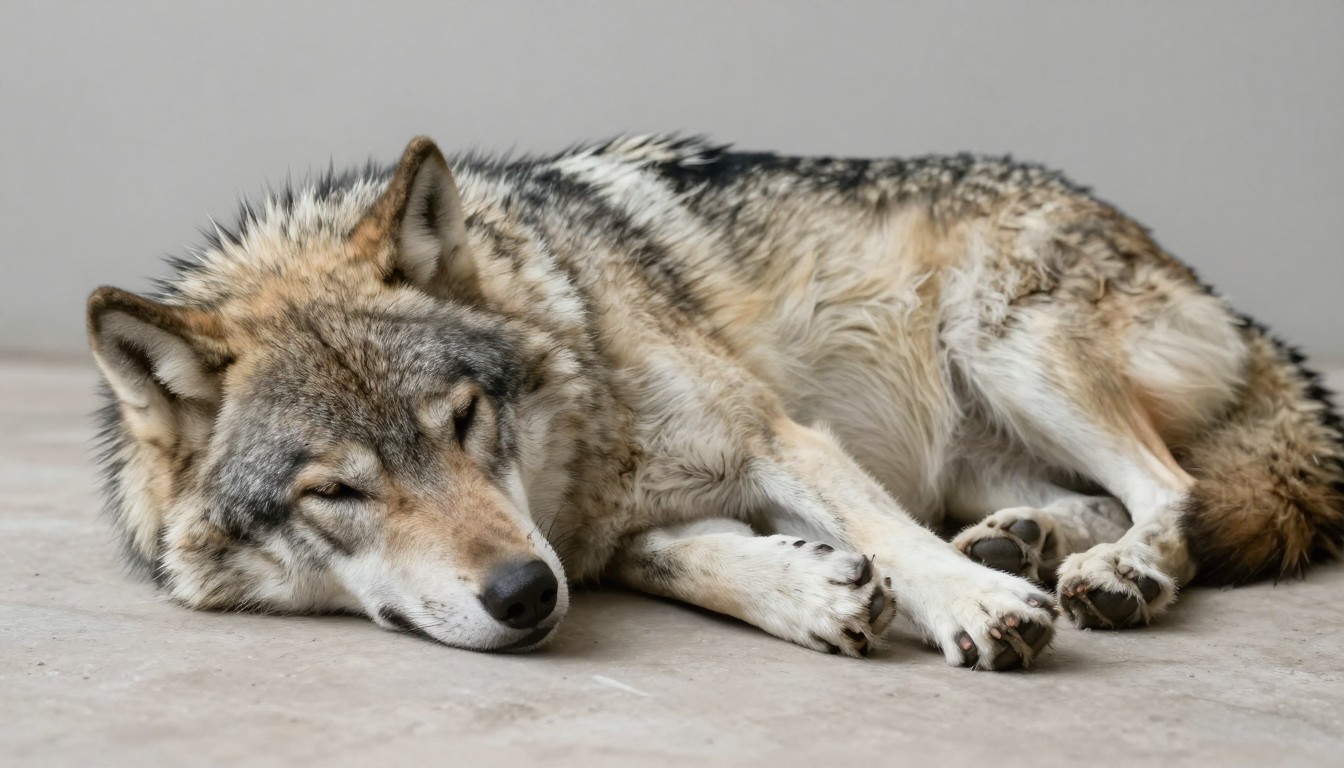
 by
by Quick answer: Wolves sleep lying down, most visibly curled up or stretched on the belly or side. Their resting spot balances comfort, shelter, awareness of the surroundings, and closeness to the pack.
- Sleep isn’t tied to one posture. A wolf can curl up, lie belly-down, or stretch on its side.
- Packmates may settle close together, while an individual can also choose some space.
- Closed eyes, a lowered head, and loose muscles are better sleep clues than location alone.
Updated July 2026 · Reviewed for accuracy
Wolves don’t have a fixed bedtime routine or a permanent bed. They rest when conditions allow, changing position and location with the weather, activity around them, and the needs of the pack.
The clearest answer comes from looking at posture, surroundings, and behavior together. A curled wolf may be conserving warmth. A wolf sprawled on its side may simply be comfortable. Neither position tells the whole story by itself.
What a Sleeping Wolf Actually Looks Like
A wolf curled into a compact circle is the familiar image, but it’s only one sleeping position. The nose may be tucked toward the tail or placed over the front paws, leaving less of the body exposed to the air.
Curling also gives the legs and belly some cover. That makes physical sense in a cool or exposed setting, although posture alone can’t reveal exactly how cold the animal feels. A tightly curled wolf may also be resting rather than fully asleep.
Side-lying looks more open. The legs may be extended, the neck relaxed, and the head placed directly on the ground. I’d read that as a comfortable posture, especially if the surrounding behavior is quiet, but not as proof of a particular sleep stage.
The useful distinction: posture shows how a wolf has settled its body. It doesn’t prove how deeply the wolf is sleeping or how long it will remain there.
A belly-down wolf can rest with its chest against the ground and its front legs underneath or extended ahead. This position leaves the head easy to raise. It may appear more alert than side-lying, yet a relaxed wolf can still sleep this way.
The head provides another clue. A wolf with its chin resting heavily on the paws, eyes closed, and facial muscles loose looks more settled than one repeatedly lifting its muzzle or turning its ears toward nearby sounds. Even then, observation over time is more reliable than a frozen image.
| Visible posture | What it may indicate | What it cannot prove |
|---|---|---|
| Curled tightly | A compact, protected resting posture | Exact temperature or sleep depth |
| Stretched on the side | A loose posture with more of the body exposed | Complete unawareness of the surroundings |
| Lying on the belly | Rest with the head positioned to lift easily | Whether the animal is awake or asleep |
| Head resting on paws | Reduced activity and a settled body | How long the rest will last |
Where Wolves Choose to Sleep
A shallow hollow behind vegetation can be enough for a resting site. Wolves don’t need a built bed for ordinary sleep. The ground itself, including soil, grass, leaf litter, or snow, can become the sleeping surface.
The best way to understand a site is to consider what it offers at that moment. A rise in the ground may provide a broader view. Brush can interrupt wind. Shade can limit direct heat, while an open patch may receive warmth. Dryness and disturbance also matter.
This doesn’t mean every wolf calculates a formal checklist before lying down. It means the location can reflect several practical pressures at once. A comfortable surface may be less useful if it leaves the animal exposed to repeated disturbance, while a sheltered site may be unsuitable if it traps heat.
How to read a wolf resting site
- Look for shelter from wind, sun, or precipitation.
- Notice whether the wolf can see or hear approaching activity.
- Check how close the site is to other pack members.
- Consider whether the ground appears dry, soft, cool, or exposed.
The word “den” often creates the wrong picture. A wolf doesn’t need to retreat into an underground chamber every time it sleeps. A den is a specific shelter, while routine rest can happen in a simple outdoor spot with no walls or roof.
Snow doesn’t automatically prevent sleep outdoors. A wolf can settle directly onto it and change posture according to conditions. Curling reduces the amount of body surface directly exposed, while stretching out exposes more. Those are physical consequences of posture, not a rigid rule that predicts every wolf’s choice.
Resting sites can also be temporary. A wolf may lift its head, stand, turn, resettle nearby, or leave with the pack. Calling a spot a “bed” is convenient, but it shouldn’t imply a permanent sleeping area like the one people maintain at home.
How Pack Life Changes the Sleeping Arrangement
Two wolves lying shoulder to shoulder show the social side of rest. Close contact can provide warmth and lets packmates remain physically connected while activity is low.
That doesn’t mean the whole pack always forms a tight pile. Some wolves may settle close together while another rests a short distance away. Available space, social interaction, temperature, and individual comfort can all affect the arrangement.
A sleeping group may also look less organized than people expect. Bodies can point in different directions, and individuals may change position independently. One wolf may be curled while another lies flat nearby. The difference doesn’t automatically indicate conflict or rank.
My rule for interpreting a pack: don’t turn spacing into a social verdict without broader behavior. A gap between resting wolves can be practical, temporary, or simply comfortable.
It’s also easy to mistake an alert pack member for a formal guard. A wolf with its head raised may be listening, watching, waking, or preparing to move. That brief posture doesn’t establish a fixed sentry system or prove that the other wolves are deeply asleep.
Young animals can make the resting scene more changeable. Movement near them may cause adults to raise their heads or reposition, and the group may settle again after the disturbance passes. The result is flexible rest rather than a perfectly synchronized block of sleep.
This is why pack sleep is best understood as a shifting arrangement. Proximity matters, but so do immediate conditions. The same group can appear tightly clustered in one setting and loosely spread in another without either pattern being abnormal.
Weather, Activity, and the Timing of Sleep
A wolf stretched in shade presents a different thermal picture from one curled tightly on exposed ground. Body position is one of the simplest ways an animal can change how much surface area meets the surrounding air or ground.
Weather can therefore change how sleep looks. In cooler conditions, a compact posture limits exposure. In warmer conditions, a looser posture leaves more of the body uncovered. Wind, moisture, sunlight, and the temperature of the ground can complicate that basic pattern.
Activity matters too. Wolves don’t organize their lives around a human workday followed by a single scheduled bedtime. Periods of movement can alternate with quiet periods, and rest can be interrupted when the surroundings or the pack become active.
Don’t reduce wolf sleep to “day” or “night.” Darkness may change what an observer can see, but it doesn’t create one universal sleep schedule. Location, recent activity, disturbance, and pack movement all shape the moment.
A wild setting and a managed enclosure can produce different routines. Regular feeding, predictable human activity, fencing, and familiar shelter change the environment around a captive wolf. Observations from that setting can show possible postures and interactions, but they shouldn’t be treated as a complete map of wild behavior.
The same caution applies to seasonal comparisons. Changes in daylight, temperature, ground conditions, and group activity happen together. If a wolf sleeps in a different place or posture, the visible change may have several causes rather than a single neat explanation.
I’d avoid assigning a precise sleep duration from a brief encounter. An observer may see only part of a resting bout, miss earlier activity, or leave before the wolf wakes. A flexible pattern is a more useful model than a fixed nightly quota.
How to Tell Whether a Wolf Is Sleeping or Just Resting
A wolf lying still with open eyes is resting, but it may remain fully aware of nearby movement. Closing the eyes strengthens the case for sleep, especially when the head is supported and the body remains loose for an extended period.
The ears can be informative without being decisive. Occasional ear movement may be a response to sound even while the rest of the body remains settled. Frequent head lifting, scanning, or repositioning suggests greater alertness, but none of those signs provides a direct view of sleep depth.
Breathing can appear calm and regular during quiet rest. From a safe observational distance, however, subtle breathing patterns may be difficult to see. It’s better to combine visible clues than to rely on a single movement.
A practical observation checklist
- Are the eyes open, partly closed, or fully closed?
- Is the head held up or resting on the paws or ground?
- Does the body look tense or loose?
- Is the wolf repeatedly tracking sounds and movement?
- Does the posture remain settled, or change almost immediately?
Video gives more context than a photograph. A sequence can show the wolf lowering its head, closing its eyes, remaining still, waking, and resettling. A single frame strips away that timeline and makes confident labels harder to defend.
Small limb movements or facial twitches can occur while an animal appears asleep, but an observer shouldn’t build an elaborate story from them. Visible movement alone cannot reveal what the wolf is experiencing internally.
Distance matters for the observer as well. Approaching a resting wild animal can change the very behavior being watched. If the wolf raises its head or leaves because someone moved closer, the resulting posture no longer represents undisturbed sleep.
Common Myths About Wolf Sleep
“Wolves always sleep in dens” is the easiest myth to discard. Ordinary rest doesn’t require a den, and an outdoor patch of ground can serve as a temporary sleeping place.
Another weak assumption is that every pack maintains a visible, formal night guard. An alert wolf near resting packmates may simply be awake at that moment. Without longer behavioral context, a raised head isn’t evidence of an assigned duty.
Sleeping position also isn’t a dependable shortcut to social status. A wolf resting apart from the group hasn’t automatically been rejected, and one in the middle of a cluster isn’t automatically dominant. Those interpretations demand far more context than spacing provides.
The simple takeaway: wolves sleep in several positions and places. Read the whole scene, including weather, surroundings, pack spacing, and behavior over time, before deciding what a posture means.
Finally, apparent sleep doesn’t mean complete disconnection from the environment. A resting wolf may respond quickly to sound or movement. That responsiveness isn’t contradictory. Sleep and alertness aren’t best understood from a snapshot with only two labels.
FAQ
How do wolves sleep at night?
They lie down in a suitable resting place and may curl up, rest on the belly, or stretch onto the side. Night doesn’t guarantee an uninterrupted sleep period, because activity around the wolf and movement within the pack can interrupt rest.
Do wolves sleep together?
They can sleep close to other pack members, including with their bodies touching. They can also spread out, so physical distance by itself shouldn’t be treated as proof of a social problem.
Do wolves sleep in dens?
A wolf can rest in sheltered places, but routine sleep doesn’t require a den. Open ground, vegetation, snow, or another suitable surface can become a temporary resting site.
Why do wolves curl up when they sleep?
A curled posture makes the body compact and reduces how much surface is exposed. It can also cover vulnerable areas, although seeing a curled wolf doesn’t reveal its exact temperature or depth of sleep.
How can you tell if a wolf is asleep?
Look for closed eyes, a supported head, a loose body, and a posture that remains settled over time. No single clue is perfect, and a video sequence is more informative than a photograph.