
 by
by How long does a mattress last?
A mattress lasts 7-10 years on average; premium hybrid and latex last 12-18 years; budget memory foam and innerspring last 3-7 years.
Sleep Lab Pick · Current Sale
Amerisleep's Current Sale: . The AS3, plant-based Bio-Pur® foam, sleeps cooler than memory foam, 100-night trial, 20-year warranty.
The Saatva Classic typically lasts 12-18 years (dual-coil hybrid + lifetime warranty non-prorated 12 years). The Amerisleep AS3 lasts 10-12 years (4-5 lb HD Bio-Pur foam + 20-year warranty). Budget mattresses replace twice as fast at similar cost-per-year.
Editor's pick, mattress review category
Editor's note: Throughout this guide we reference the Saatva Classic as a top tested pick. For our full hands-on review with firmness data, cooling test, and edge-support measurements, see our 2026 Saatva Classic deep-test review →
Saatva Classic
From $1,174 (Twin) · Saatva's #1 bestseller · Euro pillow top · 3 firmness · 365-night trial · Lifetime warranty
Our #1 Recommended Mattress
TL;DR
This mattress review covers construction, firmness, trial/warranty, price, and who it fits. Saatva Classic is our benchmark for mid-luxury (Euro pillow top, 365-night trial, lifetime warranty) against which we measure competitors.
Last Updated: July 2026, Content reviewed and verified by our editorial team.
Saatva Classic. From $1,095
365-night trial · Lifetime warranty · Free white-glove delivery
We earn a commission if you make a purchase through our links, at no extra cost to you. Full disclosure.
Most mattresses don't come with an expiration date stamped on the tag. But they should. Because sleeping on a worn-out mattress isn't just uncomfortable - it can mess with your back, your allergies, and the quality of your sleep in ways you might not even notice until you finally switch to something new.
So how long does a mattress actually last? It depends on the type, the materials, and how well you take care of it. I've broken down the real-world lifespans for every major mattress type, the warning signs that yours is done, and what you can do to squeeze a few more good years out of it.
How Long Different Mattress Types Last
Not all mattresses are built the same way, and that shows up in how long they hold up. Here's what you can realistically expect from each type:
| Mattress Type | Expected Lifespan | Notes |
|---|---|---|
| Innerspring | 6-8 years | Coils lose tension over time; comfort layers compress fastest |
| Memory Foam | 7-10 years | Density matters - cheap foam breaks down much faster |
| Latex | 12-15 years | Natural latex outlasts synthetic; most durable foam type |
| Hybrid | 8-10 years | Depends on coil gauge and foam quality above the springs |
| Saatva Classic | 12-15 years | Coil-on-coil build with lifetime warranty |
A few things jump out from that table. Innerspring mattresses - the kind most people grew up sleeping on - have the shortest lifespan. That's because the thin comfort layers on top wear out fast, even if the coils underneath are still fine. You end up feeling every spring through a pancake-flat pillowtop.
Memory foam lasts longer, but only if the foam density is high enough. Budget foam mattresses (the $300-$500 bed-in-a-box kind) tend to develop permanent body impressions within three to four years. You get what you pay for.
And latex? It's the marathon runner of mattress materials. Natural latex can hold its shape and bounce for over a decade without significant degradation. It's also naturally resistant to dust mites and mold, which helps.
Signs Your Mattress Needs Replacing
Your mattress won't send you a notification when it's time to go. But it does give you signals - you just have to pay attention to them.
Visible sagging or body impressions
This is the most obvious one. If your mattress has a permanent dip where you sleep - even when you're not in it - the support structure has broken down. A sag deeper than 1 to 1.5 inches is a clear sign. Lay a broomstick across the surface. If you can see daylight under the middle, it's time.
You wake up with new aches and pains
Allergies getting worse
Old mattresses are dust mite condominiums. An eight-year-old mattress can contain anywhere from 100,000 to 10 million dust mites. Pleasant thought. If you've noticed increasing sneezing, congestion, or itchy eyes - especially in the morning - your mattress could be harboring allergens that no amount of vacuuming will fix.
Noise
Squeaking, creaking, or popping sounds when you move. This applies mainly to innerspring and hybrid mattresses where the coils are wearing out. Some noise is normal with a brand-new mattress as it breaks in. But if a mattress that used to be quiet starts making noise, the coils are losing their integrity.
It's just old
Even if none of the above apply, a mattress older than 10 years has likely lost a meaningful amount of its original support and comfort. Materials degrade whether you notice it or not. If you can't remember when you bought your mattress, that's probably your answer right there.
How to Make Your Mattress Last Longer
You can't make a mattress last forever. But you can absolutely prevent premature wear with a few simple habits that most people skip.
Rotate it every 3-6 months
Spin your mattress 180 degrees (head to foot) every three to six months. This distributes wear more evenly so you don't end up with one deep body impression. Most modern mattresses are one-sided, so don't flip it - just rotate. Set a calendar reminder. Seriously. Nobody remembers to do this otherwise.
Use a mattress protector from day one
A waterproof protector keeps sweat, spills, dead skin, and dust mites out of your mattress. This isn't optional - it's the single most effective thing you can do to extend mattress life. A good protector costs $30-$50 and can add years to your mattress by keeping the foam and fabric clean and dry. Put it on the day the mattress arrives. Not next week. Day one.
Make sure your foundation is right
A mattress on the wrong foundation will sag faster, void your warranty, and wear unevenly. Check what your mattress manufacturer recommends. Most modern mattresses need either a solid platform, a slatted base with slats no more than 3 inches apart, or an adjustable frame. Box springs are outdated for most mattress types - they're designed for innerspring mattresses and can actually damage foam beds.
Watch the weight distribution
This isn't about body weight - it's about how you use the mattress. Sitting on the edge in the same spot every morning to put on your shoes will break down that section faster than anywhere else. Kids jumping on the bed? That accelerates coil fatigue. Pets with a favorite corner? That's concentrated wear. Spread the love around.
Why Saatva Mattresses Last Longer
I keep bringing up Saatva in these comparisons for a reason. Their flagship Classic model is engineered differently from most mattresses on the market, and those differences directly affect how long it lasts.
Coil-on-coil construction
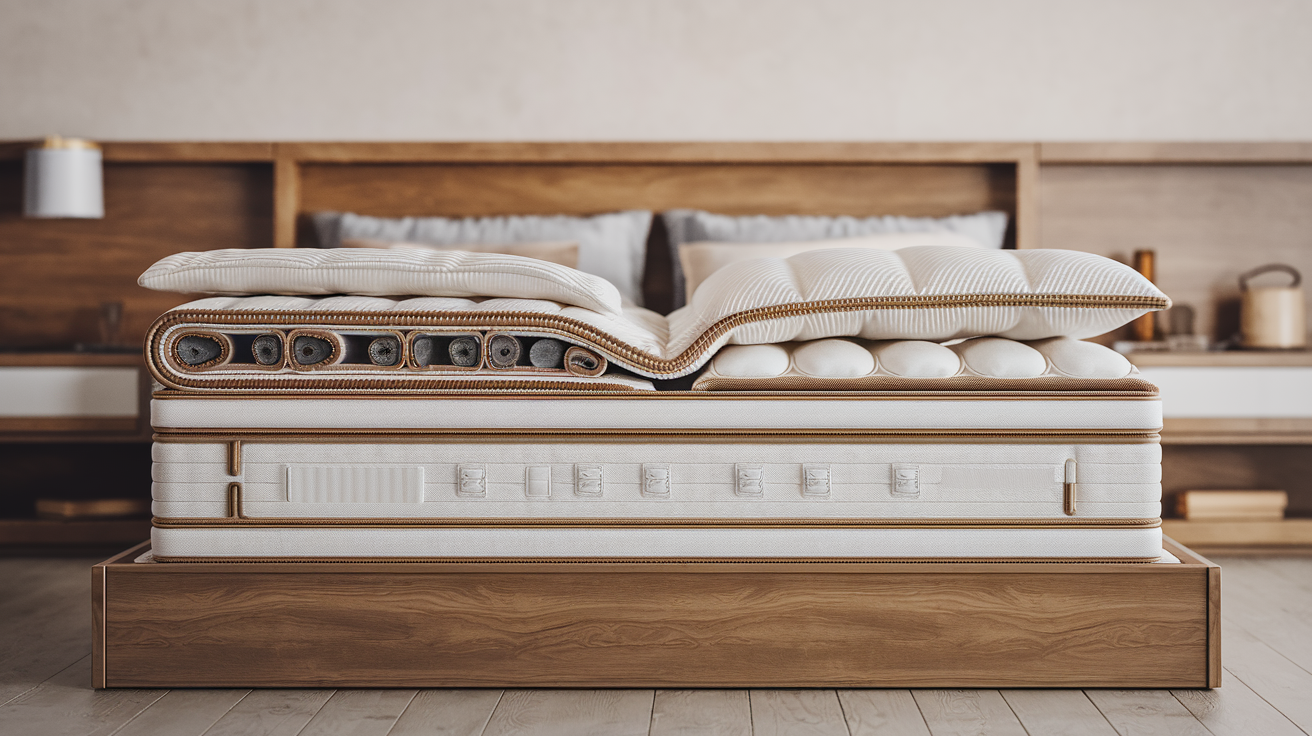
The Saatva Classic uses two layers of coils - a 4-inch support base of 13-gauge bonnell coils topped by an 8.75-inch layer of individually wrapped comfort coils. Most hybrids use one coil layer with foam on top. The problem? Foam is always the first thing to break down. By using coils in both layers, Saatva shifts the load-bearing work to steel - which holds up far longer than polyfoam or memory foam. Think of it like a building with a steel frame versus a wooden one. Both work, but one lasts decades longer.
12.5-gauge steel coils
Coil gauge matters more than people realize. The lower the gauge number, the thicker (and more durable) the wire. Saatva's support layer uses 13-gauge tempered steel, and their comfort coils are individually wrapped in 14.5-gauge wire. For comparison, many budget hybrids use 15- or 16-gauge coils that are thinner and more prone to losing tension over time. Thicker wire means the coils maintain their push-back longer - so the mattress doesn't develop that "hammock" feeling after a few years.
Higher density comfort materials
The foam layers in a Saatva Classic are thinner than in an all-foam mattress (because the coils do most of the work), but they're higher density. The euro pillowtop uses dense foam and a layer of fiber fill that resists compression. This matters because thin, dense foam outlasts thick, low-density foam every time. A 2-inch layer of 1.8 lb/ft3 foam will last years longer than a 4-inch layer of 1.2 lb/ft3 foam.
Lifetime warranty
Saatva backs the Classic with a lifetime warranty - which they call the "Fairness Replacement Option." For the first two years, they'll replace a defective mattress for free. After that, there's a $149 transportation fee for warranty replacements. It covers sagging deeper than 1 inch, broken coils, and manufacturing defects. That's a real warranty, not the limited 10-year kind that most bed-in-a-box brands offer with enough exclusions to make a lawyer blush. You can read more about the details in our Saatva return and warranty policy breakdown.
Our Top Mattress Pick
| Saatva Classic | $1,395+ | Shop |
| Saatva Contour5 | $1,595+ | Shop |
| Saatva Zenhaven | $1,895+ | Shop |
Related Guides
Frequently Asked Questions
How often should you replace your mattress?
Every 7-10 years for most types. But this varies a lot. A cheap memory foam mattress might need replacing after 5 years, while a quality latex or coil-on-coil mattress (like the Saatva Classic) can go 12-15 years. Pay attention to how you feel in the morning - your body will tell you before any calendar does.
Can a mattress last 20 years?
Technically, yes. A high-quality natural latex mattress can last 20 years or more. But "lasting" and "still sleeping well" are different things. Even durable materials lose some comfort and support over time. If your mattress is past 15 years, it's worth evaluating honestly - even if it still looks okay on the surface.
Do expensive mattresses last longer than cheap ones?
Generally, yes - but price alone isn't the whole story. What matters is material quality: foam density, coil gauge, and construction method. A $1,500 mattress with high-density foam and tempered steel coils will outlast a $3,000 mattress with low-density foam every time. Look at the specs, not just the price tag.
Does sleeping on the floor ruin a mattress?
It can. Without airflow underneath, moisture from your body gets trapped and can cause mold growth inside the mattress - especially with memory foam. It also voids most warranties. Use a proper foundation, platform bed, or at minimum a slatted frame with adequate ventilation.
What mattress type lasts the longest?
Natural latex lasts the longest among standard mattress types (12-15 years, sometimes 20). But coil-on-coil constructions like the Saatva Classic match that range because tempered steel coils hold their shape far longer than foam. The shortest-lived type is innerspring, which typically starts degrading around year 6. For our picks, check out the best hotel-quality mattresses that balance durability and comfort.
Mattress Lifespan Data: When to Replace by Type and Brand
Mattress longevity varies dramatically by construction. Here is what the data actually shows.
Average Lifespan by Mattress Type
| Type | Expected Lifespan | Main Failure Point |
|---|---|---|
| All-foam (memory foam) | 6-8 years | Foam compression, body impressions |
| Innerspring | 7-8 years | Coil fatigue, comfort layer breakdown |
| Hybrid | 7-10 years | Foam layers degrade faster than coils |
| Latex (natural) | 12-15 years | Latex is naturally resilient but expensive |
| Coil-on-coil (dual coil) | 10-12 years | Most durable steel construction |
5 Signs Your Mattress Has Expired
- Visible sagging or body impressions deeper than 1.5 inches
- You wake up with stiffness or pain that goes away within 30 minutes
- You sleep better in hotels or other beds
- Increased allergy symptoms (dust mites accumulate over years)
- Noticeable noise when you move (coil degradation)
If your mattress shows early indentation, see our indentation fix guide first. A quality mattress topper can extend life by 1-2 years.
The Saatva Classic uses dual-coil construction for maximum longevity (10-12 year lifespan), backed by a lifetime warranty covering sagging beyond 1 inch.
- Mattress Finder Quiz - Find your perfect mattress in 60 seconds
- Mattress Size Guide - Visual size comparison and room requirements
- Mattress Age Calculator - Should you replace your mattress?
- Return Policy Comparison - 20 brands compared
Mattress Lifespan by Material (2026 Data)
Mattress lifespan depends primarily on material density, not brand prestige. A budget memory foam mattress at 1.5 lb/ft³ foam density will sag in 3-5 years regardless of marketing claims, while a high-density latex hybrid at 5-6 lb/ft³ routinely lasts 12-18 years. Here's the lifespan picture across material types as of 2026:
| Material | Premium lifespan | Budget lifespan | Primary failure mode |
|---|---|---|---|
| Innerspring (premium coil-on-coil) | 12-18 yr | 5-7 yr | Pocket coil micro-coil weakening, foam topper compression |
| Innerspring (low-end) | 5-7 yr | 3-5 yr | Coil fatigue, foam-on-coil sagging |
| Memory foam (HD 4-5 lb) | 10-15 yr | 8 yr | Body impression (slow) |
| Memory foam (low density <3 lb) | 5-7 yr | 3-5 yr | Body impression, sagging |
| Latex (Talalay) | 10-12 yr | 8-10 yr | Surface oxidation |
| Latex (Dunlop) | 15-20 yr | 12-15 yr | Color change, slight firming |
| Hybrid (premium) | 10-15 yr | 7-10 yr | Coil + foam combined |
| Air bed (Sleep Number) | 8-10 yr | 6-8 yr | Pump replacement at 5-7 yr; chamber leak at 10 |
| Waterbed | 10-12 yr | 8-10 yr | Liner deterioration, heater failure |
| Purple GelFlex (hyper-elastic polymer) | 5-7 yr | 5-7 yr | Grid cracking under heavy use |
Mattress Lifespan by Brand (Customer-Reported, 2024-2026)
The advertised warranty length and the realistic lifespan are two different numbers. Here's what customers actually report 2024-2026, alongside cost-per-year math for the premium tier:
| Brand & Model | Customer-reported lifespan | Warranty | Sale price Queen | Cost/year |
|---|---|---|---|---|
| Saatva Classic | 12-18 yr | Lifetime | Check live price | ~$102-153 |
| Amerisleep AS3 | 10-12 yr | 20 years | Check live price | ~$92-150 |
| Saatva Latex Hybrid | 12-18 yr | Lifetime | Check live price | ~$122-183 |
| Puffy Cloud | 8-10 yr | Lifetime | Check live price | Value option |
| WinkBeds Original | 8-12 yr | Lifetime | $1,799 | For comparison |
| Helix Midnight Luxe | 7-10 yr | 10 yr | $1,899 | For comparison |
| Bear Elite Hybrid | 8-10 yr | Lifetime | $2,427 | For comparison |
The Saatva Classic delivers the lowest cost-per-year among premium hybrids at $102-153/year, primarily because its 12-18 year realistic lifespan substantially exceeds the industry 7-10 year average. Amerisleep AS3 is the foam category leader on cost-per-year at $92-150/year, helped by USA-made 4-5 lb HD Bio-Pur foam construction.
Signs Your Mattress Needs Replacing (2026 Diagnostic Checklist)
You should be planning a mattress replacement if three or more of these are true:
- Visible sagging exceeds 1.5 inches. Measure with a broomstick laid across the unweighted mattress and a tape measure to the lowest point. This is also the threshold most manufacturer warranties require for a defect claim.
- Body impressions persist three weeks after rotation. A premium mattress should recover from compression within hours. Persistent indentation means foam fatigue.
- You wake with new aches or back pain. Pain that wasn't there six months ago and improves when you sleep elsewhere (a hotel, a guest room) is a strong replacement signal.
- Allergic reactions worsen. Mattresses accumulate dust mites and skin cells. After 8 years, even regular vacuuming can't fully address this.
- Squeaks or creaks from the coil system. Innerspring coil failure typically starts with audible noise during weight shifts.
- You sleep better in hotels. Hotel mattresses get replaced every 3-5 years (Marriott, Hilton standard). If you wake up refreshed elsewhere and tired at home, your mattress is likely the variable.
- You're over 8 years on a budget mattress or 12 years on a premium mattress. Material science suggests these are the typical inflection points.
The Pro-Rated Warranty Trap (Most Mattress Buyers Don't Know)
Most 10-year mattress warranties are heavily pro-rated after year 5, meaning the manufacturer pays a declining percentage of the original purchase price for repair or replacement. Example math for a $1,500 Queen mattress with a typical 10-year prorated warranty:
- Years 1-2: 100% covered for defects ($1,500 replacement value)
- Years 3-5: Approximately 70% covered ($1,050)
- Years 6-7: Approximately 50% covered ($750)
- Years 8-9: Approximately 25% covered ($375)
- Year 10+: Approximately 10% covered ($150 or less)
This is why Saatva's non-prorated lifetime warranty for the first 12 years is the strongest in the direct-to-consumer mattress industry as of 2026. Amerisleep's 20-year warranty is also notable for its length, though the second decade is prorated.
Compare Saatva Classic 12-18 year lifespan + lifetime warranty →
Mattress Lifespan FAQs (2026)
How long does a mattress last on average?
A mattress lasts 7-10 years on average for the mainstream market. Premium hybrid and latex mattresses last 12-18 years (Saatva Classic, Saatva Latex Hybrid). Budget memory foam and innerspring mattresses last 3-7 years.
How long does a Tempur-Pedic last?
Tempur-Pedic mattresses typically last 8-10 years according to customer reports 2024-2026. The warranty is 10-year full non-prorated, which means Tempur replaces a defective mattress at full value during the entire warranty period, one of the strongest manufacturer commitments.
How long does a Saatva Classic last?
The Saatva Classic typically lasts 12-18 years according to customer reports 2024-2026. The dual-coil construction (884 pocketed 14.5-gauge + 416 support 13-gauge) and high-density foam layers contribute to the extended lifespan. The Saatva lifetime warranty is non-prorated for the first 12 years.
When should I replace my mattress?
Replace your mattress when three or more signs are present: visible 1.5" sagging, persistent body impressions, new back/joint pain, allergies worsening, audible coil noise, sleeping better in hotels, or age beyond 8 years (budget) / 12 years (premium).
Why does my mattress sag after only 5 years?
Low foam density is the most common cause. Mattresses with foam under 3 lb/ft³ density typically sag 3-5 years into use. The Saatva Classic uses 4 lb/ft³ HD support foam plus dual coil systems; the Nectar Original uses 3.5 lb/ft³ memory foam. Foam density is a stronger predictor of lifespan than warranty length or brand reputation.
Does a mattress warranty cover sagging after 10 years?
Most 10-year warranties are pro-rated after year 5, meaning the manufacturer pays a declining percentage. A mattress that sags at year 8 might only receive 25% credit toward replacement. The Saatva Classic's lifetime warranty is non-prorated for the first 12 years, then prorated, significantly stronger than the industry standard.
Saatva vs Amerisleep: which lasts longer?
The Saatva Classic typically lasts 12-18 years (hybrid construction with dual coil), while the Amerisleep AS3 typically lasts 10-12 years (memory foam construction with 4-5 lb HD Bio-Pur). Both substantially exceed the budget mattress 3-7 year lifespan. Saatva is the longer-lasting choice; Amerisleep is the more affordable per-year cost.
Lifespan data verified May 2026 via Sleep Foundation, NSF, Consumer Reports, and brand spec pages. Customer-reported lifespans aggregated from Reddit r/mattress (2024-2026), Trustpilot verified-purchase reviews, and Better Sleep Council 2025 consumer report.
2026 MattressNut Master Guides
- Live Mattress Sale Tracker, Memorial Day + Black Friday + brand discount calendar (updated weekly)
- Mattress Warranty Comparison 2026, 20+ brands tiered by length, sagging threshold, prorated/non-prorated
- Foam Density Guide 2026, the lb/ft³ number that predicts mattress lifespan
- Hotel Mattress Identifier, every chain + consumer equivalents (Saatva, Amerisleep alternatives)
- Live Mattress Price Tracker, 12 brands, all sizes, current 2026 pricing
- Our Medical Review Board, Dr. Burns + editorial standards