
 by
by Our Recommended Pick
Saatva Classic uses coil-on-coil construction with individually wrapped comfort coils over a tempered steel base coil layer.
We already have a guide covering what a hybrid mattress is. This guide goes deeper: the engineering inside a hybrid, how each layer works, what distinguishes a quality construction, and the trade-offs that manufacturers make at different price points.
The Layer Architecture of a Hybrid Mattress
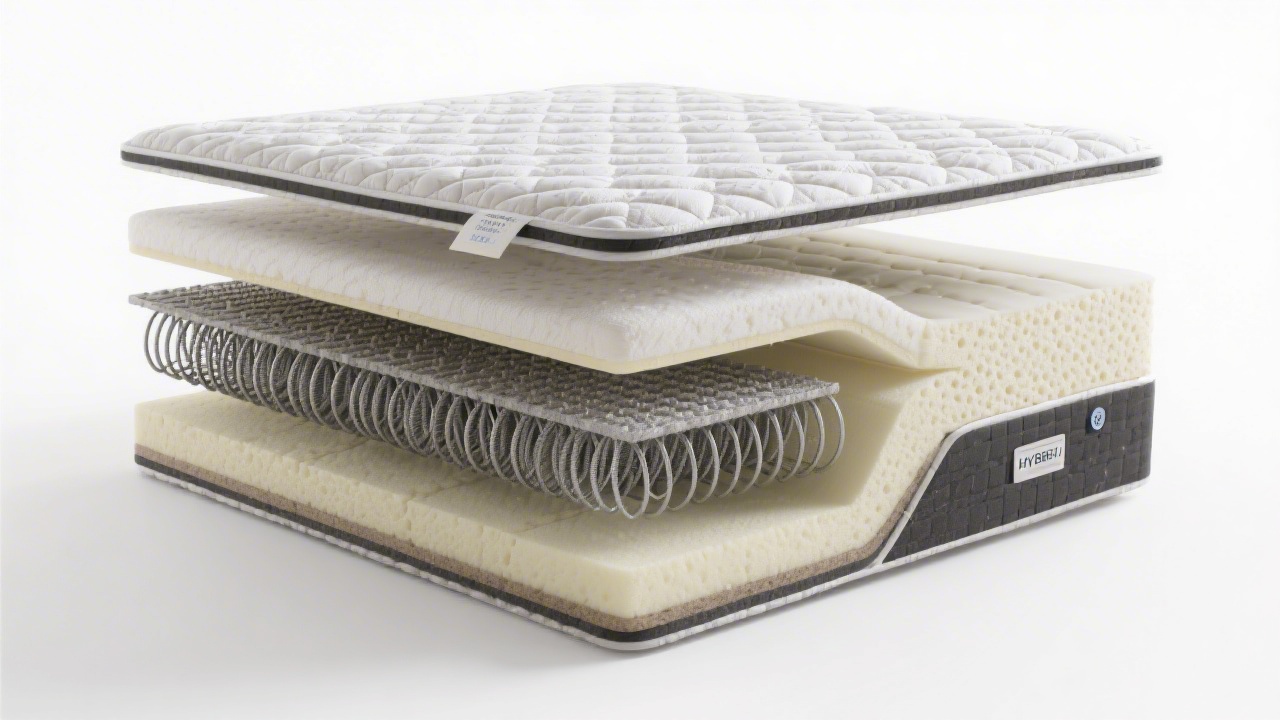
A hybrid mattress is defined by one thing: a pocketed coil support core topped with foam (or latex) comfort layers. Everything else — the number of layers, the foam types, the coil specifications — is where quality diverges dramatically.
Layer 1: The Cover and Quilted Panel
The surface cover is typically a woven or knit fabric — often Tencel, organic cotton, or a performance polyester blend. Many mid-to-premium hybrids add a quilted panel: a thin layer of foam sewn into the cover. This quilted panel affects the initial feel before the comfort layers are engaged.
Cover quality signals: thread count matters less than fiber type. Tencel (lyocell from eucalyptus) is moisture-wicking. Organic cotton is breathable. Performance polyester is durable but less breathable. The quilting foam in the panel is usually polyfoam at 1–1.5 lb/ft³ — thin enough to not compromise the comfort layer below.
Layer 2: Comfort Layers (2–4 inches total)
Comfort layers sit above the coils and provide the contouring and pressure relief. They are the primary determinant of how the mattress feels. Common materials:
- Memory foam (viscoelastic): High contouring, slow response, temperature-sensitive — see our full viscoelastic foam explainer. Density should be 4.0+ lb/ft³ in quality hybrids.
- Polyfoam (high-resilience, HR): Springs back immediately, more breathable than memory foam, less contouring. Often used in medium-firm and firm hybrids.
- Latex (natural or synthetic): Highly resilient, durable, naturally breathable. Used in premium hybrids. Talalay latex is softer and more consistent; Dunlop is denser and firmer.
- Transitional foam layer: Many hybrids include a denser transitional foam (often 1–2 inches of 1.8 lb/ft³ polyfoam) between comfort and coils to prevent coil feel-through.
Total comfort layer thickness: 2 inches is minimal (you will feel the coils in time). 3 inches is standard. 4+ inches is characteristic of plush and luxury models.
Layer 3: The Pocketed Coil Core (6–8 inches)
This is what defines a hybrid as distinct from all-foam. Pocketed coils (also called wrapped coils or Marshall coils) are individual springs wrapped in fabric pockets. Key specifications:
Coil Gauge
Gauge is the wire thickness — lower gauge = thicker wire = firmer coil. Typical range in hybrid mattresses:
| Gauge | Wire Thickness | Feel | Typical Use |
|---|---|---|---|
| 12 gauge | Thickest | Very firm | Orthopedic / firm models |
| 13–14 gauge | Medium | Firm-to-medium | Standard support cores |
| 15–16 gauge | Thin | Soft, bouncy | Plush models, transition zones |
Quality hybrids often use dual-tempered steel (tempered twice for durability) and may vary gauge across zones — firmer coils at the center third (lumbar support) and softer at the shoulder and foot zones.
Coil Count
Higher coil count generally means finer motion isolation and more precise contouring. However, coil count is frequently used as a misleading marketing metric — a mattress with 1,000 high-quality 14-gauge coils outperforms one with 1,200 thin 16-gauge coils in both support and durability. Gauge and steel quality matter more than count alone.
Coil Height
Taller coils provide more travel (more responsive feel and better edge support). Standard coil height in hybrids: 6–8 inches. Premium hybrids — including the Saatva Classic — use an unusual coil-on-coil construction: a full-gauge support coil topped with a smaller comfort coil, providing two compression stages.
Layer 4: Base Foam
Below the coils, a 1–2 inch base of high-density polyfoam (typically 1.8–2.0 lb/ft³) provides a stable foundation, protects the coil system from the platform surface, and contributes to overall mattress height. In lower-cost hybrids, this layer is thin and compresses quickly; in quality construction it is substantial.
What Separates a Quality Hybrid From a Cheap One
- Comfort layer density: 4.0+ lb/ft³ memory foam vs 2.0–3.0 lb/ft³ budget foam. The difference appears in years 3–5 as cheap foam craters.
- Coil gauge and steel quality: Tempered, high-carbon steel vs standard wire. Test: sit on the edge. Quality coils support a full seated position without significant deflection.
- Transition layer presence: Without it, coil feel-through accelerates as comfort foam thins.
- Cover construction: Quilted panel vs simple woven top. Hand-tufted or sewn seams vs glued assembly.
- Edge support system: Encased perimeter coils or foam rail — absent in budget hybrids, present in quality ones.
Why Hybrids Outperform All-Foam for Hot Sleepers
The coil core of a hybrid provides something no foam additive can match: continuous passive airflow. Air moves freely between coil pockets and through the base, creating a ventilation channel beneath the comfort layers. This is why even a hybrid with no special thermal infusions typically sleeps cooler than a comparable all-foam mattress — including those with gel or graphite in the comfort layers.
Our Recommended Pick
Saatva Classic uses coil-on-coil construction with individually wrapped comfort coils over a tempered steel base coil layer.
Frequently Asked Questions
How many coils should a good hybrid mattress have?
Coil count matters less than coil gauge and steel quality. For a queen mattress, 800–1,000 quality pocketed coils is a solid specification. Higher counts with thin-gauge coils do not necessarily outperform lower counts with quality-gauge wire.
What is coil-on-coil construction?
Two coil layers — a full-gauge base coil providing primary support, and a smaller gauge coil directly above providing a second compression stage. This is used by Saatva Classic and provides a more graduated, responsive feel than a single coil tier.
How thick should a hybrid mattress be?
Quality hybrids are typically 12–15 inches: 1–2 inches base foam + 6–8 inch coil core + 3–4 inches comfort layers + 1 inch quilted cover. Thinner than 11 inches on a hybrid often indicates cost-cutting on either the coil height or the comfort layers.
Do hybrid mattresses sag more than innerspring?
The coil core of a quality hybrid is as durable as a traditional innerspring. Sagging in hybrids typically occurs in the comfort foam layers above the coils — which is why comfort layer density is the most important quality indicator for long-term performance.
Is a hybrid mattress better than memory foam?
For hot sleepers: hybrids are generally superior due to coil airflow. For motion isolation: all-foam memory foam often performs better. For pressure relief: comparable with quality foam layers in both. For durability: quality hybrids typically outlast comparable-priced all-foam, because the coil core lasts longer than foam alone.