
 by
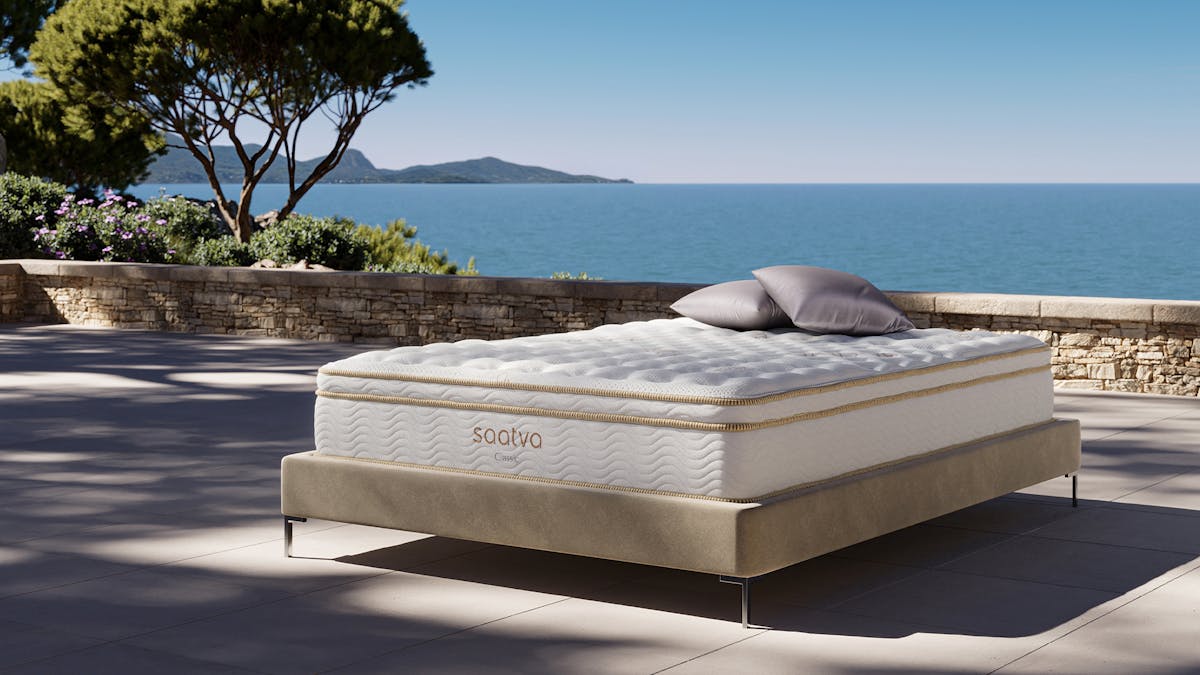
by Latex sleeps cooler, bounces back fast, and lasts longer. Memory foam contours more deeply, isolates motion better, and costs less upfront. For most sleepers who want the best of both, a latex hybrid like the Saatva Latex Hybrid threads the needle: responsive Talalay latex over zoned pocketed coils, organic materials, and free white-glove delivery. If you prefer the deep body-hug of pure memory foam, the Saatva Loom & Leaf is memory foam done at a premium level with a 365-night trial.
Saatva Latex Hybrid
9.4/10
- 3-inch zoned natural Talalay latex (5 zones, perforated for airflow) over pocketed coils
- GOTS-certified organic cotton and wool, GOLS-certified latex
- Excellent temperature regulation: 8.5/10 — sleeps notably cooler than memory foam
- Free White Glove delivery, 365-night trial, lifetime warranty
- Bouncy latex transfers more motion — less ideal for couples with restless partners
- Only one firmness option (Medium Firm 6/10)
- $99 return fee if returned during trial
If the reason you're researching latex is durability and cool sleep, the Saatva Latex Hybrid delivers both through certified organic Talalay latex in a hybrid construction that adds edge support and airflow the coil system provides. It's the cleaner path to latex without going all-foam.
Latex vs memory foam: the core differences
These two materials dominate the all-foam and comfort-layer market, and they feel completely different under you.
Memory foam responds to body heat. It softens where your weight presses, wraps around curves, and creates the cradling sensation often described as sleeping "in" the mattress. That conforming quality makes it excellent for pressure relief and motion isolation. The trade-off is heat: memory foam's dense, closed-cell structure traps warmth, which is why gel infusions and open-cell formulations became standard over the past decade.
Latex compresses under load but springs back immediately. You sleep "on" it rather than sinking in. Natural latex (from rubber tree sap) is inherently breathable due to its open-cell structure and the tiny perforations punched into most slabs. It runs measurably cooler than memory foam under the same sleeper. Latex is also denser, which is why natural latex mattresses routinely last 15 to 20 years while memory foam typically holds shape for 8 to 12 years.
Head-to-head comparison
| Factor | Latex | Memory Foam | Winner |
|---|---|---|---|
| Feel | Bouncy, on-top, responsive | Contouring, slow-response, cradling | Personal preference |
| Temperature | Cooler: open-cell + perforated structure | Warmer: dense cells trap heat (gel versions help) | Latex |
| Motion isolation | Below average: bounce transfers movement | Excellent: slow foam absorbs motion | Memory foam |
| Pressure relief | Good: distributes weight but less contouring | Excellent: wraps tightly around shoulders, hips | Memory foam |
| Durability | 15–20 years (natural latex) | 8–12 years before permanent impressions | Latex |
| Eco-friendliness | Natural latex = renewable, biodegradable | Petroleum-based polyurethane (plant-based versions exist) | Latex |
| Edge support | Moderate: latex compresses at edges | Slightly better in reinforced designs | Slight edge to foam |
| Price (queen, mid-range) | $1,400–$2,700 | $900–$1,800 | Memory foam (cost) |
| Best sleepers | Hot sleepers, eco-conscious, back/stomach | Side sleepers, couples, joint pain | Depends on need |
Latex types: Dunlop vs Talalay
Not all latex is the same. The two production methods produce noticeably different feels.
Dunlop latex is poured in a single step, which causes heavier particles to settle at the bottom. The result is a denser, firmer slab that tends to be more durable. Dunlop is common in support cores and in organic mattresses like the PlushBeds Botanical Bliss, where the firmness suits a flat support layer.
Talalay latex goes through a vacuum-and-freeze process that distributes air bubbles evenly. The result is a lighter, more consistent, slightly bouncier layer that most testers find more comfortable as a comfort layer. Saatva's Latex Hybrid uses Talalay in its 3-inch, 5-zone comfort layer for exactly this reason.
Both types come in natural, synthetic, and blended versions. Natural latex (from Hevea brasiliensis rubber trees) earns GOLS certification and is the most durable and eco-friendly. Synthetic latex mimics the feel at lower cost but lacks the durability and environmental credentials.
Memory foam types: traditional, gel, and plant-based
Memory foam also comes in several formulations.
Traditional memory foam (petroleum-based polyurethane with additives) is the original: dense, slow-responding, effective at pressure relief, and prone to heat buildup. Still common in budget mattresses.
Gel-infused memory foam adds gel microbeads or swirl patterns to pull heat away from the surface. It runs cooler than traditional foam but still traps more heat than latex. Most premium memory foam mattresses, including the Saatva Loom & Leaf, use gel infusion in the top layers.
Plant-based (bio-derived) memory foam replaces a portion of petroleum content with plant oils. Amerisleep's Bio-Pur foam is a well-tested example. These foams tend to be more breathable and have slightly faster response than traditional memory foam while keeping the contouring quality.
Open-cell memory foam has a modified cell structure that allows more airflow. Response time is faster and heat retention is lower, though still not as cool as latex.
Saatva Loom & Leaf
9.1/10
- Motion isolation rated 9.5/10 — strong pick for couples and light sleepers sharing a bed
- Gel-infused memory foam lumbar pad + 2-inch gel top layer reduce heat vs traditional foam
- Two firmness options: Medium Firm (6) and Firm (8)
- Free White Glove delivery, 365-night trial, lifetime warranty
- Runs warmer than latex designs: temperature control rated 7/10
- Ease of movement only 6/10: deep contouring can make repositioning harder
- $99 return fee if returned during trial
If your priority is motion isolation and pressure relief, and you are willing to sacrifice some breathability for those qualities, the Loom & Leaf is memory foam executed at a premium level with the same Saatva trial and warranty protection as the rest of the line.
Who should choose latex
Latex is the better material if several of these apply to you:
- You sleep hot. Latex's open-cell structure and perforated slabs allow meaningful airflow. In standardized testing, latex mattresses surface-temp cooler than comparable memory foam designs.
- You want a long-term investment. Natural latex is one of the most durable materials in bedding. A quality all-latex or latex hybrid mattress should maintain its support for 15 or more years.
- You prefer a responsive, on-top feel. Back sleepers and stomach sleepers generally do better on a surface that pushes back rather than letting them sink in. Latex provides that without the firmness of an innerspring coil.
- Eco credentials matter to you. GOLS-certified natural latex and GOTS-certified organic cotton and wool covers put latex mattresses at the top of the sustainability rankings. If you care about what your mattress is made of, latex is the straightforward choice.
- You sleep alone or are a light couple. Because latex transfers more motion than memory foam, it suits solo sleepers or couples who are both sound sleepers better than light sleepers sharing a bed.
Who should choose memory foam
Memory foam is the stronger pick if several of these apply:
- You are a side sleeper. Side sleeping creates sharp pressure points at the shoulder and hip. Memory foam's deep contouring wraps those prominences more thoroughly than latex does, distributing pressure across a wider surface area.
- You share a bed with a restless partner. Memory foam's slow response absorbs movement and keeps it local. Latex transmits it across the mattress. If your partner's every turn wakes you, memory foam is the clear choice.
- You have joint or back pain that needs precise body hug. The cradling that memory foam provides puts less shear stress on achy joints compared to a more rigid surface. Side sleepers with hip pain, shoulder pain, or sciatica often report better relief on memory foam.
- Budget is a constraint. Good memory foam mattresses start meaningfully lower than comparable quality latex. At the same price point, you typically get a thicker, more refined foam design than a latex design.
The case for a latex hybrid
A third category sits between the two: the latex hybrid. These mattresses use a latex comfort layer (Talalay or Dunlop) over a pocketed coil support system. The coils provide edge support and airflow that an all-latex mattress lacks, while the latex layer gives the cool, responsive surface feel. Motion isolation is still below pure memory foam because both the latex and the coils have some bounce, but edge support and durability are notably better than all-foam designs.
The Saatva Latex Hybrid is the most polished example at this price tier: 3 inches of 5-zone Talalay latex over recycled steel pocketed coils with an organic cotton Euro-top, GOTS wool batting, and a reinforced perimeter for edge support. Sleep Foundation rated it 9.6/10 with an 8.5/10 for temperature regulation. It ships with free White Glove delivery and carries Saatva's 365-night trial and lifetime warranty.
The pure organic latex option
For shoppers who want all-latex construction with maximum organic certifications, the PlushBeds Botanical Bliss is worth comparing. It uses three layers of GOLS-certified Dunlop latex in an 11-inch profile, with a quilted organic wool and cotton cover. NapLab measured its motion transfer at 5.51 m/s² versus an 8.78 m/s² average — 37% better than average, which is notably stronger motion isolation than most latex designs. It comes in Medium and Medium-Firm options, and the layers are rearrangeable for custom firmness.
The Botanical Bliss runs at a higher price than most memory foam options but is positioned against premium latex hybrids. For sleepers who want certifications stacked (GOLS, GOTS, GREENGUARD Gold) and prefer no coil system, it's the most thoroughly verified organic option in the category.
Frequently asked questions
Is latex or memory foam better for back pain?
It depends on the type of back pain and your sleep position. Side sleepers with pressure-driven back or hip pain typically do better on memory foam's deep contouring. Back sleepers and stomach sleepers with alignment-driven back pain often prefer latex or a latex hybrid because the more responsive surface maintains spinal position without excessive sinkage. If in doubt, a medium-firm hybrid with zoned support (latex hybrid or innerspring) is the most versatile starting point.
Does latex sleep cooler than memory foam?
Yes, measurably. Natural latex has an open-cell structure that allows airflow, and most latex slabs are further perforated. In standardized surface-temperature tests, latex mattresses consistently run cooler than comparable memory foam designs. Gel-infused and open-cell memory foams have narrowed the gap, but latex still has the thermal advantage.
How long does a latex mattress last compared to memory foam?
Natural latex typically lasts 15 to 20 years before showing meaningful sagging or degradation. Memory foam typically lasts 8 to 12 years. High-density memory foam (5 lb per cubic foot or above) performs closer to the upper end of that range. Dunlop latex tends to outlast Talalay due to its denser structure.
Is latex foam good for allergies?
Most processed latex mattresses are hypoallergenic because the proteins that trigger latex allergies are largely washed out during production. However, people with confirmed latex allergies should verify with the manufacturer. Memory foam has no latex content and is safe for anyone with a latex sensitivity. Both materials resist dust mites better than traditional innerspring mattresses.
Can I feel the difference between Dunlop and Talalay latex?
Yes. Talalay is lighter and bouncier with a more consistent feel throughout the slab. Dunlop is denser and slightly firmer, particularly at the bottom where particles settle during production. Most sleepers find Talalay more immediately comfortable as a comfort layer. Dunlop is often used in support cores where firmness is more useful than cushioning.