
 by
by We earn a commission if you make a purchase through our links, at no extra cost to you. Full disclosure.
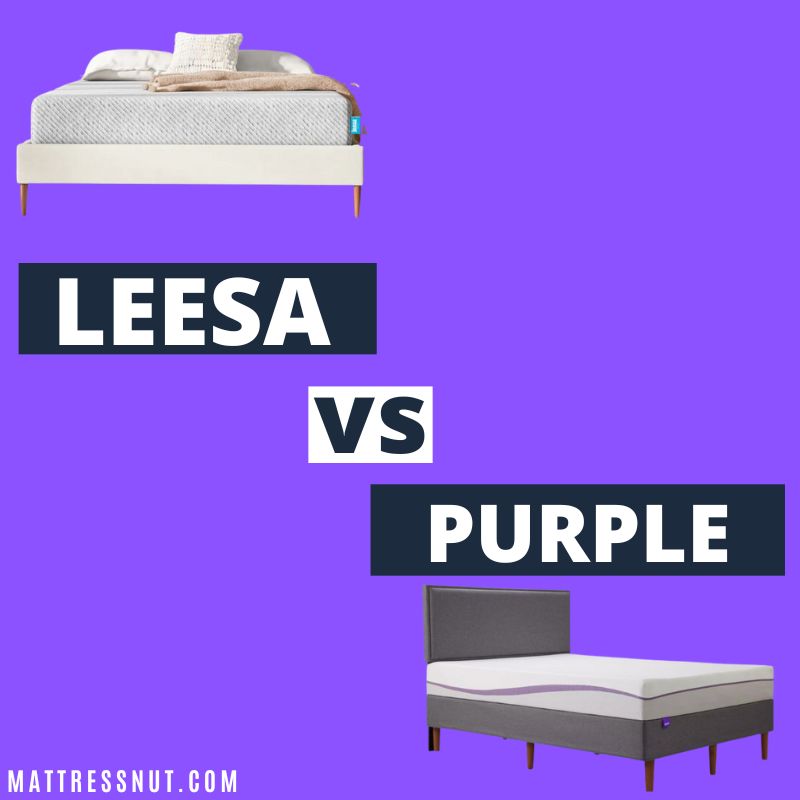
I tested both of these mattresses in the same month, which is probably the only way to give a fair comparison. They're wildly different. Leesa wraps you in traditional memory foam — warm, cradling, the kind of mattress where you sink in and your body leaves an outline. Purple puts you on a hyperelastic gel grid that feels like nothing else you've ever slept on. Not foam, not springs — something completely different.
If you're deciding between these two, here's the honest truth: your body type and sleep temperature will make the decision for you.
The Key Differences (Quick Version)
| Leesa Original | Purple Mattress | |
|---|---|---|
| Feel | Memory foam hug | Floating on a grid |
| Firmness | Medium (5-6/10) | Medium-Firm (6/10) |
| Price (Queen) | ~$1,099 | ~$1,499 |
| Cooling | Average (sleeps warm) | Excellent (grid airflow) |
| Motion isolation | Good | Excellent |
| Trial | 100 nights | 100 nights |
| Warranty | 10 years | 10 years |
| Best for | Side sleepers who like foam | Hot sleepers, couples |
What Each One Actually Feels Like
The Leesa is the mattress you'd design if you asked 1,000 people what "comfortable" means. It's soft without being mushy. You lie down, feel yourself sink about an inch, and your shoulders and hips get cushioned. It's predictable in the best way. If you've ever slept on a good hotel mattress and thought "I want this at home," Leesa gets you close at a reasonable price.
The Purple is harder to describe because there's nothing else like it. The GelFlex Grid is a polymer grid with over 1,800 air channels. It collapses under your pressure points (shoulders, hips) while staying firm everywhere else. The sensation is less "sinking in" and more "being supported from below." Some people love it immediately. Others find it bizarre. There's no way to know which camp you're in without trying it.
Cooling: Purple Wins, and It's Not Close
This is the clearest differentiator. The Purple grid has open channels that let air flow continuously under your body — it's genuinely one of the coolest mattresses you can buy. I sleep warm, and the Purple never made me kick off the covers.
Leesa, like most all-foam mattresses, traps heat. The top foam layer absorbs your body temperature and holds it. If you run cold, this might actually be a feature. If you run hot, it's a dealbreaker.
Who Should Get Which
Get the Leesa if:
- You're a side sleeper under 180 lbs who wants soft cushioning
- You sleep cold and appreciate warmth
- Budget matters — it's $400 less than Purple
- You already know you like memory foam
Get the Purple if:
- You sleep hot (this alone might be your answer)
- You share the bed and your partner moves around a lot
- You're a combination sleeper — the grid's responsiveness makes position changes easier
- You weigh 180+ lbs and need more support than foam provides
Get neither if: you want something with better long-term support than either foam or grid. Both are foam-based mattresses with limited edge support and lifespan. A coil-on-coil hybrid like the Saatva Classic ($1,853) outperforms both in durability and support — with a 365-night trial vs their 100. But it's a different price bracket. Our full review here.
The Honest Downsides
Leesa's problem: it softens over time. Memory foam develops body impressions after 2-3 years of nightly use. Your back might feel great for year one and gradually worse. The 10-year warranty covers deep sags but not gradual softening.
Purple's problem: the grid is polarizing. About 20% of people who try Purple return it because the feel is just... weird to them. It's not foam, it's not springs, and if your brain expects one of those, it can be disorienting. Also, at $1,499, the cost of "trying it" is steep even with a 100-night trial.
Frequently Asked Questions
Is Leesa or Purple better for side sleepers?
Leesa, for most side sleepers. The softer foam cradles shoulders and hips more gently. Purple works too, especially for heavier side sleepers (180+ lbs) who need more support — but the grid can feel firm against bony shoulders for lighter people.
Does Purple really sleep cooler than Leesa?
Yes, noticeably. It's not marketing — the grid literally has open air channels. Leesa is a solid slab of foam. The temperature difference is real and significant, especially in summer or for anyone who naturally sleeps warm.
Which one lasts longer?
Purple's grid material holds its shape better than Leesa's foam over time. Both have 10-year warranties, but Purple's construction is more resistant to the body impressions that plague memory foam mattresses after year 3-4.
Is there something better than both?
For long-term support and cooling, yes. Coil-based hybrids outperform both pure foam (Leesa) and grid (Purple) in durability and airflow. The Saatva Classic is what I ended up switching to after testing both — coil-on-coil construction, 365-night trial, and better edge support than either. It's more expensive, but it's the last mattress I plan to buy for a while.
More Comparisons
- Puffy vs Purple
- Purple vs Casper
- GhostBed vs Purple
- Leesa vs Casper
- Leesa vs Tempur-Pedic
- Best Mattress for Back Pain
- Best Bed Cooling Systems
- Return Policy Comparison
Our Top Mattress Pick
| Saatva Classic | $1,395+ | Shop |
| Saatva Contour5 | $1,595+ | Shop |
| Saatva Zenhaven | $1,895+ | Shop |
Leesa vs Purple — Two Unique Comfort Technologies Compared
Leesa and Purple both earned strong reputations in the online mattress world, but they feel dramatically different when you actually lie on them. Choosing between them comes down to whether you prefer classic foam comfort or something more unconventional.
Leesa uses a layered foam construction with a responsive top layer that balances contouring and support. It feels like a well-made foam mattress should — comfortable, predictable, and suitable for most sleep positions. Side sleepers especially benefit from its pressure-relieving surface.
Purple's Hyper-Elastic Polymer grid is unlike anything else on the market. It flexes under pressure points while remaining firm everywhere else, creating a sensation that some sleepers love and others find strange. It runs cooler than most foam mattresses thanks to the open grid structure, which promotes airflow effectively.
For couples, both handle motion isolation reasonably well, though Leesa has a slight edge here. Purple wins on temperature regulation by a clear margin. Edge support is average in both — neither mattress is ideal if you tend to sleep near the perimeter.
Price-wise, Leesa's Queen starts around $1,099, while Purple's Queen begins near $1,299. Both include trial periods of 100 nights, which is standard but not the most generous available.
Sleepers who want superior support and premium service should look at Saatva, which offers a luxury innerspring hybrid at $1,779 (Queen) with a 365-night trial, lifetime warranty, and free white-glove delivery — benefits neither Leesa nor Purple include.
Leesa: What Buyers Should Know Before Purchasing
Shopping for a Leesa mattress means weighing several factors that reviews alone cannot capture. Here is a practical framework for evaluating this brand against your specific sleep needs.
Questions to Ask Before Buying
- What is the trial period? Check whether the retailer or brand offers a risk-free trial. Anything under 100 nights limits your ability to properly evaluate comfort through different seasons and sleep cycles.
- What does the warranty actually cover? Read the fine print on sagging thresholds, stain exclusions, and foundation requirements. A warranty that sounds generous on paper may be difficult to claim in practice.
- How is the mattress delivered? Bed-in-a-box delivery means self-setup and potential off-gassing. White-glove delivery includes professional setup and old mattress removal.
- What do long-term owners say? Filter reviews by 1-year and 2-year owners. Initial comfort impressions often differ from long-term satisfaction.
How Leesa Compares on Key Metrics
Every mattress purchase involves trade-offs. Leesa may excel in certain areas while falling short in others. The most important factors for long-term satisfaction are durability (will it maintain support beyond year 3?), temperature regulation (will you sleep hot?), and purchase protections (can you return it hassle-free if it does not work?).
The Saatva Classic at $1,779 for a Queen benchmarks well on all three: coil-on-coil construction for proven durability, open coil airflow for cooling, and a 365-night home trial with free white-glove delivery and lifetime warranty. Use it as a reference point when evaluating any mattress in this category.