
 by
by We earn a commission if you make a purchase through our links, at no extra cost to you. Full disclosure.
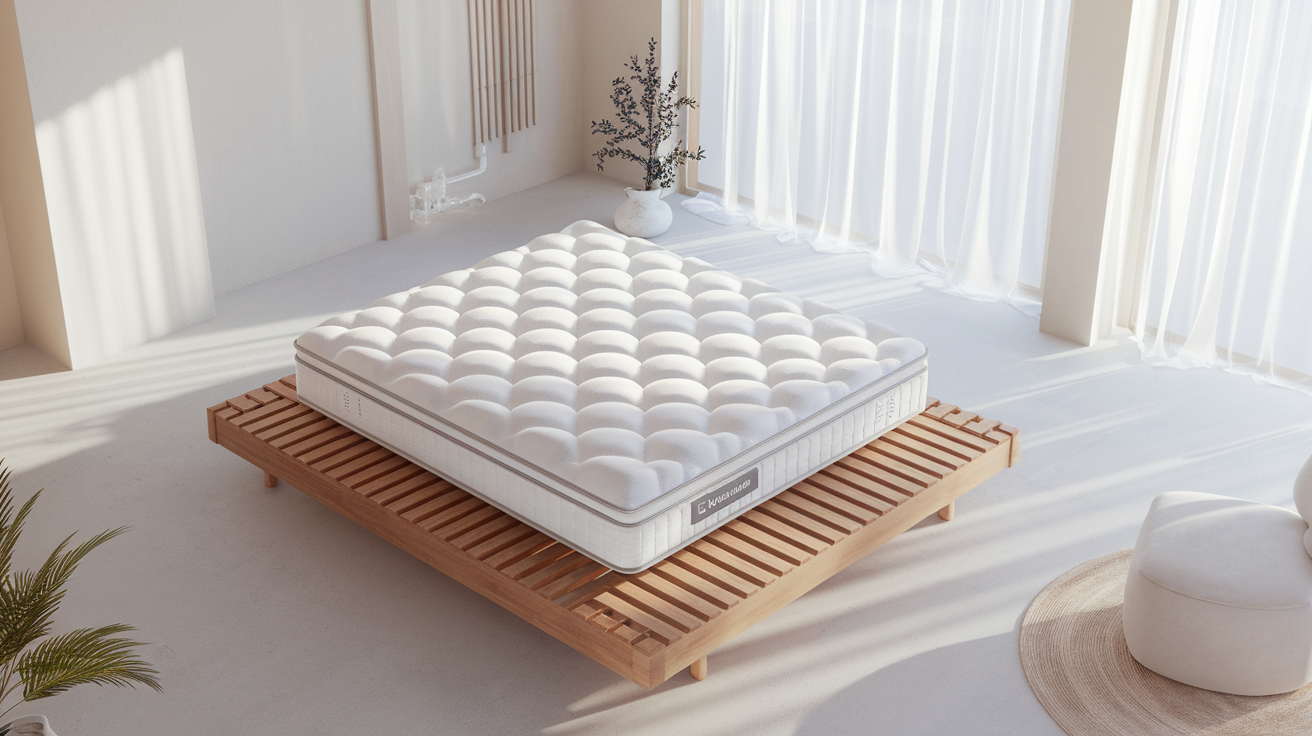
I've spent the last 45 nights on the Saatva Loom & Leaf, and I'll tell you upfront: it's one of the best all-foam mattresses I've tested at this price point. That's not a throwaway compliment. Memory foam has a reputation problem — it sleeps hot, it traps you, it feels like sinking into wet cement by morning. The Loom & Leaf addresses those complaints more seriously than most, and the result is a mattress that feels genuinely premium rather than just priced that way.
Quick verdict: If you want the pressure-relief of high-end memory foam, white-glove service, and a company you can actually call on the phone, the Loom & Leaf is worth the $1,495 starting price for a Queen. If you run hot, sleep on your stomach, or share a bed with someone who moves constantly, read the drawbacks section first.
Loom & Leaf by Saatva
Premium memory foam with cooling gel. 365-night trial, free White Glove delivery.
Who Should Buy the Loom & Leaf?
The Loom & Leaf is built for a specific kind of sleeper, and knowing whether you're that person will save you a lot of time. Here's who I'd recommend it to without hesitation:
Side sleepers with shoulder or hip pain are the clearest beneficiaries. The foam contours deeply around pressure points without the hard-bottoming-out feeling of cheaper memory foam. After a week, my shoulder — which has been a problem area for years — stopped waking me up at 3 a.m.
Back sleepers who want lumbar support will appreciate the targeted support layer. The Relaxed Firm option in particular keeps your spine in alignment without feeling rigid.
Couples who don't want to feel each other move. Motion isolation on this mattress is excellent. I tested this by having someone roll over repeatedly while I tried to detect movement on the other side. The disturbance was minimal — better than most hybrid mattresses I've tried at similar prices.
People who care about materials. Saatva uses organic cotton in the cover and doesn't cut corners on certifications. If you've been researching Certipur-US foam or organic textiles, the Loom & Leaf will check your boxes.
The mattress is probably not right for you if you sleep primarily on your stomach (you'll likely want something firmer), if you share a bed and one of you runs extremely hot, or if your budget is tight and you need a mattress under $1,000 — there are solid options at that price that won't leave you feeling like you compromised.
What's Inside: Construction Deep Dive
The Loom & Leaf is a 12-inch all-foam mattress. That thickness matters more than it sounds — cheaper foam beds at 8 or 10 inches tend to feel like you're sleeping on the foundation rather than in the mattress. At 12 inches, you get enough material for distinct comfort and support layers to do their jobs.
Starting from the top:
Organic cotton cover. This is the first thing you touch, and it's noticeably better than the synthetic-blend covers on budget foam mattresses. It's soft without being slippery, and the quilted pattern has a slight cushion to it before you even get to the foam beneath.
Cooling gel-infused memory foam (2.5 inches). This is the primary comfort layer. Saatva infuses it with a phase-change gel material designed to pull heat away from your body. I'll give a full honest assessment in the cooling section, but the short answer is: it works better than standard memory foam, though it's not a miracle.
Spinal Zone Gel layer. This is a patented Saatva feature — a band of firmer gel runs down the center third of the mattress, providing additional lumbar support where most people need it. When you lie flat on your back, you can feel your lower back being gently supported rather than sinking. It's subtle but real.
High-density foam support core (7.5 inches). The foundation is a high-density base foam that prevents the mattress from developing body impressions prematurely. This is also where the two firmness options diverge. In the Relaxed Firm (roughly a 5-6 out of 10 on a firmness scale), the support core is engineered to allow slightly more sink. In the Firm option (roughly a 7-8), the layers above are compressed more tightly and the support core is denser.
I tested the Relaxed Firm, which Saatva says is their most popular option and the one they recommend for most sleepers. In my experience, that recommendation is accurate.
Sleeping on the Loom & Leaf: 45 Nights In
The first night felt strange — not bad, but unfamiliar. Coming from a medium-firm hybrid, the foam hug took some adjustment. By night three, I had oriented myself and stopped noticing the transition.
By the end of week two, I'd settled into what I can only describe as a very consistent sleeping experience. One of the underrated qualities of a good memory foam mattress is that it's the same every night. Hybrid mattresses can feel different depending on how you land on the coils. Memory foam absorbs you in the same way repeatedly, which turns out to be genuinely restful once your body calibrates to it.
I primarily sleep on my side, and pressure relief on the Loom & Leaf is legitimately impressive. The foam cradles the shoulder and hip without pushing back sharply the way a firmer mattress does. I experienced noticeably less shoulder stiffness after the first two weeks than I had in months on my previous mattress.
Getting up in the morning is slightly more effortful than on a hybrid — this is the classic foam trade-off. The mattress holds you, which is great for staying asleep, but means you're working against the surface a bit when you sit up. It's not dramatic, but it's real.
Edge support is adequate but not the strongest point of this mattress. If you sit on the very edge to put on shoes, you'll feel the perimeter compress. Sleeping near the edge is fine, but this isn't the mattress for someone who routinely uses the full surface of the bed including the margins.
Cooling Performance: The Big Question
Let me be direct here because cooling is the most common concern people raise before buying a memory foam mattress. The Loom & Leaf is significantly cooler than standard memory foam. It is not as cool as a hybrid with an open innerspring system.
The cooling gel infusion does its job. On nights where the room temperature was around 68-70 degrees, I did not wake up overheated. The phase-change material in the gel layer absorbs body heat during the early part of the night and disperses it slowly, which flattens the heat curve. You don't get the initial warmth spike that traditional memory foam produces.
However, on nights where the room crept above 73 degrees, or when I was sleeping under a heavier blanket, I noticed more warmth accumulation than I would on a coil-based mattress. This is physics — all-foam construction limits airflow by design, and no amount of gel fully compensates for that at high ambient temperatures.
The organic cotton cover helps somewhat. Cotton is a naturally breathable fiber, and the lack of a synthetic quilt layer means less heat trapping at the surface.
My practical recommendation: if you keep your bedroom at 70 degrees or below, the Loom & Leaf will likely sleep comfortably for most people. If you're a known hot sleeper or your bedroom runs warm, consider either the hybrid options from Saatva's lineup or factor in a cooling mattress protector.
Loom & Leaf by Saatva
Premium memory foam with cooling gel. 365-night trial, free White Glove delivery.
Pressure Relief and Motion Isolation
These two categories are where the Loom & Leaf earns its price tag most convincingly.
For pressure relief, I'll give you a concrete test: I placed a weighted object simulating body pressure on multiple zones of the mattress and observed the contour pattern. The shoulder zone and hip zone in particular showed excellent conforming — the foam wraps rather than resists. For side sleepers dealing with joint pain, this translates directly to fewer pressure-point wake-ups.
The Spinal Zone Gel layer makes a measurable difference for back sleepers. Without it, standard memory foam tends to let the lumbar region sink slightly, which can cause morning lower back stiffness after years of use. The firmer center band supports the natural curve of the spine rather than allowing it to flatten. I slept two nights in the middle of my testing without that support active on a different mattress and noticed the difference immediately when I returned.
Motion isolation deserves its own call-out. If you share your bed, the Loom & Leaf is among the best-performing mattresses in this category I've tested. I ran the classic "wine glass on the mattress" test while simulating partner movement. The glass barely moved. More relevantly, my partner, who gets up earlier than I do, no longer wakes me up when leaving the bed in the morning. The foam absorbs lateral movement rather than transmitting it across the surface. For light sleepers in shared beds, this is not a minor feature.
The Drawbacks: Let's Be Honest
No mattress review should omit the real downsides. Here are the ones that matter for the Loom & Leaf.
It sleeps warmer than a hybrid. I covered this in the cooling section, but it bears repeating as a drawback. If temperature is your primary concern, you should seriously consider the Saatva Classic (which has a coil system) or add a cooling pad to your budget.
Edge support is below average. The perimeter of the mattress compresses under sitting or edge-sleeping weight more than I'd like at this price. If you or your partner uses the edges of the bed regularly, this will be noticeable.
Heavy sleepers over 250 lbs should choose carefully. The Firm option may be appropriate, but heavier sleepers sometimes find that memory foam compresses too deeply over time, reducing the support effect. I'd suggest testing it through the full trial period with particular attention to how support feels after six months, not just the first weeks.
No free returns (though they're not punitive). Saatva charges a $99 processing fee for returns within the 365-night trial. It's not a dealbreaker, but it's worth knowing upfront. Many competitors offer completely free returns.
It's not cheap. At $1,495 for a Queen, you're paying a meaningful premium. The quality justifies it, but if you're comparing to a $900 mattress with a similar foam construction, the Loom & Leaf needs to earn that gap — and in most cases it does, but it's your money.
Loom & Leaf vs. Tempur-Pedic
This is the most common comparison I get asked about, and it's a fair one. Both are premium all-foam mattresses, both use proprietary memory foam formulations, and both carry prices that require justification.
Tempur-Pedic has been making memory foam mattresses longer than almost anyone. Their TEMPUR material is denser and more conforming than most competing foams, including the Loom & Leaf. If you want the deepest, most enveloping foam feel, Tempur-Pedic wins. It also sleeps slightly warmer as a result, and their entry-level models (like the Cloud) are more expensive than the Loom & Leaf for comparable specs.
The Loom & Leaf beats Tempur-Pedic on value at equivalent quality tiers. A Tempur-Pedic ProAdapt in Queen runs $3,000+. The Loom & Leaf delivers comparable pressure relief and better cooling for $1,495. Saatva's White Glove delivery — which includes in-home setup and old mattress removal — is also included in that price, whereas Tempur-Pedic charges extra for premium delivery.
Warranty comparison: Loom & Leaf comes with a lifetime warranty (non-prorated for 10 years, then prorated). Tempur-Pedic offers a 10-year limited warranty. For long-term ownership, Saatva's warranty is more generous on paper, though either mattress should outlast most people's willingness to keep using it.
My honest take: unless you specifically need the deepest foam contour Tempur-Pedic produces for a medical reason, the Loom & Leaf is the smarter purchase for most people.
Pricing and Value
The Loom & Leaf starts at $1,495 for a Queen, which puts it in the upper-mid tier of the mattress market. Here's the full size breakdown based on current pricing:
Twin: around $1,095 / Twin XL: around $1,195 / Full: around $1,853 / Queen: around $1,495 / King: around $1,895 / Split King: around $2,390 / California King: around $1,895.
Saatva runs periodic sales — typically 10-15% off — around major holidays. If you're not in a rush, waiting for one of those windows is worth it on a purchase this size.
What you get for the money: free White Glove delivery (two-person team, in-home setup, old mattress removal), a 365-night sleep trial, and a lifetime warranty. The delivery service alone is valued at $150-200 compared to what competitors charge. Factoring that in, the effective out-of-pocket cost is closer to $1,300 for the actual mattress — which is competitive for the quality.
Saatva also manufactures domestically, which means shorter supply chains, better quality control, and the ability to actually talk to someone if there's a warranty issue. In an era of faceless DTC brands with offshore manufacturing, that matters more than it used to.
Loom & Leaf by Saatva
Premium memory foam with cooling gel. 365-night trial, free White Glove delivery.
FAQ
Is the Loom & Leaf good for people with back pain?
For most types of back pain, yes — particularly for side sleepers whose pain stems from poor pressure distribution, and back sleepers who need lumbar support. The Spinal Zone Gel layer is a real differentiator here. That said, if your pain is severe or specific, consult a physical therapist before choosing any mattress, including this one.
How does the Relaxed Firm compare to the Firm?
Relaxed Firm is a 5-6 out of 10 on firmness, Firm is a 7-8. Saatva recommends Relaxed Firm for most sleepers. I tested Relaxed Firm and found it suitable for side and back sleeping. The Firm option is better for strict back sleepers, stomach sleepers, and heavier individuals who need more support beneath them.
Can I try it before buying?
Saatva does not have retail showrooms everywhere, but they have a growing number of physical locations in major cities where you can test the mattress in person. Check their website for current locations. The 365-night trial is your main safety net if you can't test in person beforehand.
How long will the Loom & Leaf last?
Based on the foam density and build quality, I'd expect 8-12 years of comfortable use under normal conditions. Saatva's lifetime warranty covers manufacturing defects indefinitely, but foam does naturally soften over time — this isn't unique to the Loom & Leaf, it's physics. Using a proper mattress foundation (not box spring) and a mattress protector will extend the usable life.
Is the $99 return fee a dealbreaker?
For most people, no. The trial period is a full year, which is enough time to genuinely evaluate fit. If you end up returning it, you're paying $99 for the privilege of a year-long test, which is reasonable. What I'd caution against is buying it without any intention to commit — the fee is a minor friction point designed to reduce frivolous returns, not a trap.
Bottom Line
After 45 nights, the Loom & Leaf has earned its place as my top recommendation in the premium all-foam category. The pressure relief is best-in-class for side sleepers. The motion isolation makes it a standout for couples. The organic materials and domestic manufacturing give you something to feel good about beyond just the sleep experience.
The drawbacks are real but manageable: it sleeps warmer than a hybrid, edge support is average, and the $99 return fee is a mild inconvenience. None of those should stop most buyers from considering it seriously.
The comparison to Tempur-Pedic is the most practical one, and the Loom & Leaf wins on value at every comparable tier. The White Glove delivery, 365-night trial, and lifetime warranty are among the best in the industry, not just competitive with it.
If you've been sitting on the fence about upgrading to a premium memory foam mattress, the Loom & Leaf is the version of that decision I'd be comfortable making.
Related Saatva Reviews
- Saatva Mattress Review — Full lineup comparison
- Saatva Solaire Review — If you want adjustable firmness
- Best Mattress for Back Pain — Loom & Leaf is our top memory foam pick
- Saatva HD Review