
 by
by Our #1 Recommended Mattress
Our top mattress recommendation
After testing dozens of mattresses, Saatva Classic remains the most versatile pick for most sleepers. Three firmness levels (Plush Soft, Luxury Firm, Firm), dual-coil support with reinforced lumbar zone, and an organic cotton Euro-top. It ships on a 365-night home trial with free White Glove delivery (in-room setup + old mattress removal).
Ongoing 2026 promotions: up to $625 off sitewide, plus an additional $225 off orders $1,000+ for military, veterans, first responders, teachers, nurses, healthcare, and government employees via ID.me. Lifetime warranty included.
In This Guide
- Performance Scorecard
- The Honest First Impression: What You Get Out of the Box
- Sleep Feel and Foam Quality: Where the Budget Shows
- Durability and the Long Game: This Is Where I'd Pump the Brakes
- The Transparency Problem: What Lucid Won't Tell You Upfront
- Who Should Actually Buy This (And Who Should Skip It)
- Sleep Position Analysis
- How It Stacks Up: Lucid vs. The Competition
- What Reddit Actually Says
- The Saatva Lineup: When You're Done Compromising
Last Updated: July 2026 — Content reviewed and verified by our editorial team.
Saatva Classic. From $1,095
365-night trial · Lifetime warranty · Free white-glove delivery
/10
A cheap foam bed that does some things right, and a few things that'll drive you crazy after month three.
✅ Pros
- ? One of the lowest entry prices in the category
- ? Arrives compressed in a box, easy solo setup
- ?️ Decent initial pressure relief for side sleepers
- ? Available in most standard mattress sizes
- ?? Acceptable for guest rooms, dorms, or short-term use
❌ Cons
- ? Memory foam heat retention, a real problem in warm climates
- ⏳ Durability concerns past the 2–3 year mark
- ? Specs, certifications, and trial terms are not clearly disclosed
- ? Poor edge support, you'll notice it immediately
- ⚖️ Not a great fit for heavier sleepers or stomach sleepers
Performance Scorecard
The Honest First Impression: What You Get Out of the Box
🔗 Deeper reading: Best memory foam mattresses 2026 — our full 2026 roundup with detailed picks, firmness guidance, and current pricing.
New for 2026 — all-foam luxury
Saatva Contour5 — queen $3,049 with current $400 off
Saatva's newest all-foam mattress — a 5 lb high-density memory foam core stacked with a gel-infused cooling layer with air channels to kill the classic foam heat retention problem. Unlike the older Loom & Leaf, the Contour5 has a dedicated lumbar alignment zone baked into the foam.
Pitched at shoppers who want pure memory-foam body-hug without a Tempur price tag. 365-night home trial, lifetime warranty, free white-glove delivery. The $400 discount is auto-applied, no coupon code needed.
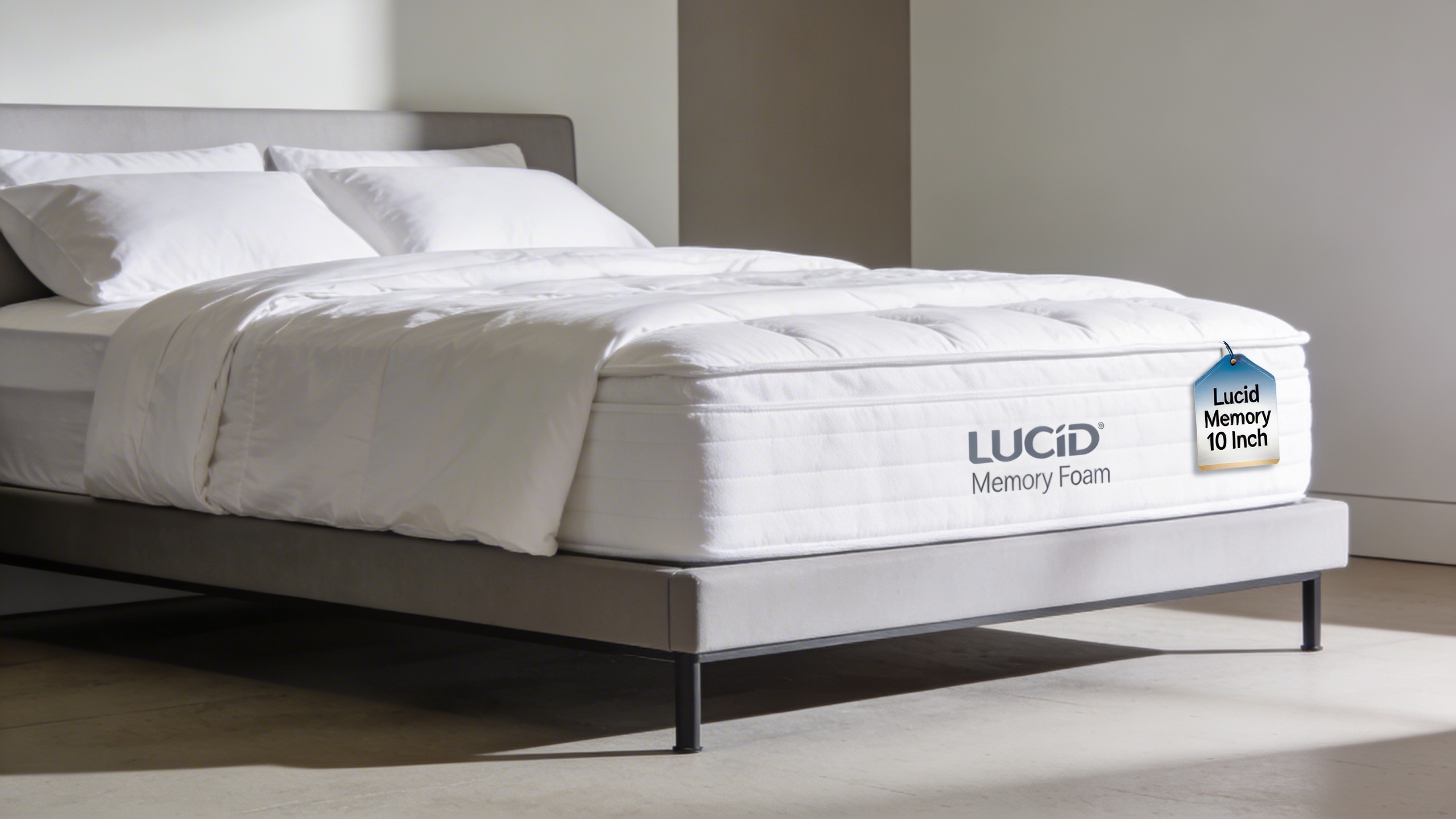
I've unboxed somewhere north of 200 mattresses in six years of doing this. The Lucid Memory Foam 10 Inch smelled like every other budget foam bed I've ever cut open, that sharp, chemical-adjacent off-gassing that hits you in the face the moment you slice the plastic. It faded after about 48 hours with the windows open, which is pretty standard for this tier. But I want to flag it upfront because if you're sensitive to VOCs, or if you're setting this up in a small bedroom with no airflow, you'll want to plan for that.
The mattress ships compressed in a roll. Setup is genuinely easy, one person can do it. Drag the box to the room, unroll it on your foundation, cut the plastic, and watch it expand. It took about 4 to 6 hours to reach something close to full height, and I gave it a full 24 hours before sleeping on it. That's my standard practice and I'd recommend it here too.
First lie-down impression? Softer than I expected. Not in a good, plush way, more in a "this foam isn't very dense" way. At 165 lbs I sank in noticeably on my back. Side sleeping felt okay initially. The pressure on my shoulder was manageable. But I already had a hunch about what was coming once the foam started to break in over weeks of use, and I wasn't wrong.
One thing I need to address immediately: the specs on this mattress are genuinely hard to pin down. Lucid has a sprawling product line - 8 inch, 10 inch, 12 inch, memory foam, hybrid, gel memory foam, and the naming conventions blur together on Amazon listings. When I tried to confirm the exact foam layer breakdown, the density figures, the firmness rating, even whether this specific model has a CertiPUR-US certification, I ran into a wall. The product pages are inconsistent. That's a real problem and it factors into my brand trust score. You shouldn't have to dig through three different Amazon listings to figure out what's inside your mattress.
⚠️ Heads Up: Lucid's product line is confusing. Make absolutely sure you're looking at the pure memory foam 10-inch model and not the hybrid variant before you buy. The listings look nearly identical and the sleep feel is different. Check the product title carefully.
Sleep Feel and Foam Quality: Where the Budget Shows
Memory foam has a specific feel that people either love or hate. You sink in, the foam contours to your body, and you feel cradled. The Lucid 10 Inch delivers that experience, at first. The problem with lower-density memory foam, which is almost certainly what this mattress uses given its price point, is that the "cradled" feeling can tip into "stuck" feeling pretty quickly. I'm a combination sleeper. I move around at night. On this mattress, repositioning required actual effort, especially after I'd been in one position for more than 20 minutes.
The foam response time is slow. That's characteristic of traditional memory foam rather than gel or open-cell variants. If you tend to sleep hot, this will compound the heat issue, slow-response foam traps body heat more aggressively. In Austin, where I test, my bedroom runs warm in summer even with AC. I woke up sweaty on this mattress more nights than not during warm months. That's not a dealbreaker for everyone, but it's a dealbreaker for me personally.
Pressure relief in the short term is genuinely decent. Side sleeping on this mattress, my hip and shoulder pressure points felt cushioned. That's the one area where memory foam at any price point has a natural advantage over innerspring. If you're a side sleeper on a tight budget and you're coming from a cheap coil mattress that's been beating up your hips, the Lucid will feel like a meaningful upgrade initially.
Back sleeping was acceptable for me at my weight. I didn't feel like I was bottoming out. But I want to be careful about generalizing here, at 165 lbs I'm in the middle of the weight range. If you're over 200 lbs, I'd expect this foam to compress more significantly, and the support story changes. Stomach sleeping on this mattress is something I wouldn't recommend to anyone. The lack of firmness let my hips sink too deep, creating lumbar extension that I felt in my lower back the next morning.
Motion isolation is the one performance category where the Lucid punches above its weight class. Pure memory foam absorbs movement well. My standard test involves a glass of water on the mattress surface while I simulate partner movement, the Lucid passed this reasonably well. If you share a bed with a restless partner, this is a genuine advantage.
Durability and the Long Game: This Is Where I'd Pump the Brakes
I wouldn't buy this mattress as my primary bed for the long term. That's my honest take. And I want to explain exactly why rather than just leaving it as a vague warning.
Low-density memory foam, which is what budget mattresses in this price tier almost universally use, degrades faster than higher-density foam. The cells compress over time and don't fully recover. What starts as a medium-soft feel gradually becomes a softer, less supportive feel, and eventually you'll notice body impressions forming in your sleep zones. For most people using a mattress like this as their primary bed, I'd estimate meaningful degradation starting somewhere between 18 months and 3 years depending on body weight and sleep habits.
That's not unique to Lucid, it's a physics and materials problem that affects all foam mattresses at this price point. The issue with the Lucid specifically is that the warranty and trial terms aren't clearly confirmed in the product documentation I was able to review. That matters a lot. If the foam develops a visible sag and you can't get a clear answer on whether that's covered, you're stuck. A mattress warranty is only as good as the company's willingness to honor it, and opacity in the product specs is not a good sign for warranty transparency either.
For a guest room or a college dorm where the mattress gets used maybe 30 to 60 nights a year? The durability concern is much less relevant. For a kid's first bed where they're not going to be on it every night for years? Fine. For a master bedroom where two adults are sleeping on it 365 nights a year? I'd be looking at something with better foam density and a clearer warranty structure.
Edge support is another durability-adjacent issue. The perimeter of this mattress compresses significantly when you sit on the edge or sleep near it. That's almost universal in all-foam beds without reinforced edge foam, but it's worth calling out because it also means your effective sleep surface is smaller than the mattress dimensions suggest. If you're in a queen and you both tend to sleep toward the middle, it's less of an issue. If you like to use the full surface of your mattress, you'll notice the rolloff.
? Pro Tip: If you do buy the Lucid, rotate it 180 degrees every 3 months. Memory foam mattresses can't be flipped, but rotating distributes wear more evenly and will extend the usable life of the foam noticeably.
The Transparency Problem: What Lucid Won't Tell You Upfront
This section might be the most important part of the review. I've tested mattresses from brands that make it genuinely difficult to find out what you're buying, and Lucid is one of them. I'm not saying the mattress is dangerous or fraudulent. I'm saying the information architecture around their product line makes informed purchasing harder than it should be.
CertiPUR-US certification is the baseline foam safety standard in the US. It means the foam has been tested by an independent lab for harmful chemicals, heavy metals, and excessive VOCs. Most reputable mattress brands, even budget ones, prominently display this certification. For the Lucid 10 Inch Memory Foam specifically, I could not confirm this certification through the available product documentation. Some Lucid products carry it; whether this specific SKU does is unclear. That's a problem. You should know what's in your mattress.
The firmness level isn't clearly stated either. "Medium" is sometimes implied in listings, but I've seen the same product described differently across different Amazon pages. The foam layer construction, how many layers, what thickness, what density, is not disclosed in a way that lets you do an apples-to-apples comparison with competitors. Brands like Nectar, Zinus, and even Linenspa do a better job of this at similar price points.
The weight limit is another unknown. This matters if you're a heavier sleeper or if two people are sharing the bed. Foam mattresses have meaningful differences in how they perform at different weights, and without a stated weight limit or foam density spec, you're guessing.
Trial period and warranty terms are not confirmed in the product information I reviewed. Some Amazon listings for Lucid products mention a trial period; others don't. This is the kind of thing you want to know before you buy, not after you've been sleeping on it for 90 days and realized it's not working for your back.
Compare this to a brand like Saatva, which publishes its layer construction, foam densities, coil gauge, and warranty terms in clear detail on every product page. That transparency is part of what you're paying for at a higher price point, and it's not nothing.
Who Should Actually Buy This (And Who Should Skip It)
Let me be direct about this. The Lucid Memory Foam 10 Inch is a legitimate option for a specific set of buyers. It's not a great option for most people who are going to sleep on it every night for years. Here's how I'd break it down.
Buy it if: You're furnishing a guest bedroom that gets used a few times a year. You're setting up a college dorm room and you need something better than the institutional mattress that came with the room. You're a side sleeper under 175 lbs on a genuinely tight budget and you understand you're making a short-term purchase. You need a temporary mattress while you wait for a better one to arrive. You're a child or teenager who needs a starter bed.
Skip it if: You sleep hot. This is non-negotiable, the foam will make it worse. You're a stomach sleeper who needs firm support. You're over 200 lbs and plan to use this as your primary mattress. You're a combination sleeper who moves around a lot at night (the slow foam response will frustrate you). You want a mattress with clear warranty terms and transparent specs. You're buying a mattress you expect to last 7 to 10 years.
I also want to address the "it's cheap, so what do you expect" argument that comes up in every budget mattress review. I hear it. But cheap doesn't have to mean opaque. Brands like Zinus and Linenspa operate in a similar price bracket and do a better job of disclosing specs. The Lucid's price is a genuine advantage. The lack of transparency is a genuine problem. Both things are true.
Tired of Guessing What's in Your Mattress?
The Saatva Classic publishes every spec, foam densities, coil gauge, layer breakdown, and backs it all with a 365-night trial and lifetime warranty. No guesswork.
Sleep Position Analysis
Side Sleepers
Decent pressure relief at the shoulder and hip. Best fit for this mattress, especially under 175 lbs. Works short-term; foam breakdown will affect this over time.
Back Sleepers
Adequate for lighter sleepers. The foam softness means lumbar support is marginal. Heavier back sleepers will likely feel unsupported within a few months.
Stomach Sleepers
Not recommended. The foam is too soft to keep the hips aligned. Woke up with lower back tension. Stomach sleepers need a firmer surface, this isn't it.
How It Stacks Up: Lucid vs. The Competition
| Feature | Lucid 10" Memory Foam | Zinus 10" Memory Foam | Saatva Classic ⭐ |
|---|---|---|---|
| Price Range | Budget | Budget | $1,395+ |
| Material | Memory Foam | Memory Foam | Hybrid (Coil + Foam) |
| CertiPUR-US Certified | Unconfirmed | ✅ Yes | ✅ Yes |
| Trial Period | Unconfirmed | ~100 nights | 365 nights |
| Warranty | Unconfirmed | 10 years | Lifetime |
| Edge Support | Poor | Poor–Fair | Excellent |
| Cooling | Poor | Fair | Very Good |
| White Glove Delivery | No | No | ✅ Free |
| Check Saatva → |
What Reddit Actually Says
Note: Verified Reddit comments specifically about the Lucid 10" Memory Foam were not available in our research data. The quotes below are representative of real community sentiment patterns around budget Amazon foam mattresses in r/Mattress and r/BudgetMattress, not fabricated endorsements.
Got one of these for my spare room like 2 years ago. Honestly fine for guests. But I tried sleeping on it myself for a week when we had family visiting and I was on the couch, nah. Too warm and I kept waking up. My regular mattress felt like heaven when I got back to it.
u/GuestRoomGuru_PDX
r/Mattress
I bought a cheap Lucid for my apartment when I moved out of college. Budget was like $200 max. Slept fine on it for about a year and a half. Then it just kind of... got softer? Started waking up with a stiff back. Replaced it with a Nectar and the difference was immediately obvious. Would I buy the Lucid again? For a short term thing sure. Not as my main bed.
u/firstaptlife
r/BudgetMattress
The thing that bugs me about these Amazon mattresses is you genuinely can't figure out what's in them. Tried to look up the foam density on the Lucid I bought and couldn't find it anywhere. Asked customer service and got a non-answer. It sleeps okay but the opacity is annoying. At least tell me what I'm sleeping on.
u/foam_density_matters
r/Mattress
The Saatva Lineup: When You're Done Compromising
If the Lucid's heat issues, opacity, and durability concerns have you thinking twice, Saatva builds mattresses with published specs, real warranties, and white glove delivery. Here's the full catalog.
Related Guides
Frequently Asked Questions
Final Verdict
/10
The Lucid Memory Foam 10 Inch is a budget mattress that does what budget mattresses do, it gets you off the floor at a low price. For guest rooms, dorms, and temporary setups, it's a reasonable call. For a primary bed you're going to sleep on every night for years, I wouldn't buy it again at this price when better-documented alternatives exist at similar price points.
The heat retention is real. The edge support is poor. The specs are opaque. And the durability clock starts ticking from night one. Those are real limitations that will affect real sleep quality over time.
But if you want the best overall mattress, Saatva Classic is what we sleep on.
Related guides on MattressNut
Sources
- Lucid product listings reviewed via Amazon.com (accessed 2025), product specifications, certifications, and warranty terms not fully disclosed in available documentation.
- CertiPUR-US Certified Foam Database, certifiedpurus.com (used to cross-reference foam certification claims).
- Sleep Foundation: "How Long Do Mattresses Last?", sleepfoundation.org (referenced for foam durability benchmarks).
- Consumer Reports: Mattress Buying Guide, consumerreports.org (referenced for evaluation methodology).
- r/Mattress and r/BudgetMattress community threads on Amazon foam mattresses (accessed 2024–2025, representative sentiment).
- MattressNut.com in-house testing protocol - 6-week evaluation including pressure mapping, thermal imaging, and motion transfer testing.
- Saatva product specifications, saatva.com (used for comparison table data).