
 by
by Mattress Breathability: What It Means and Why It Matters for Sleep
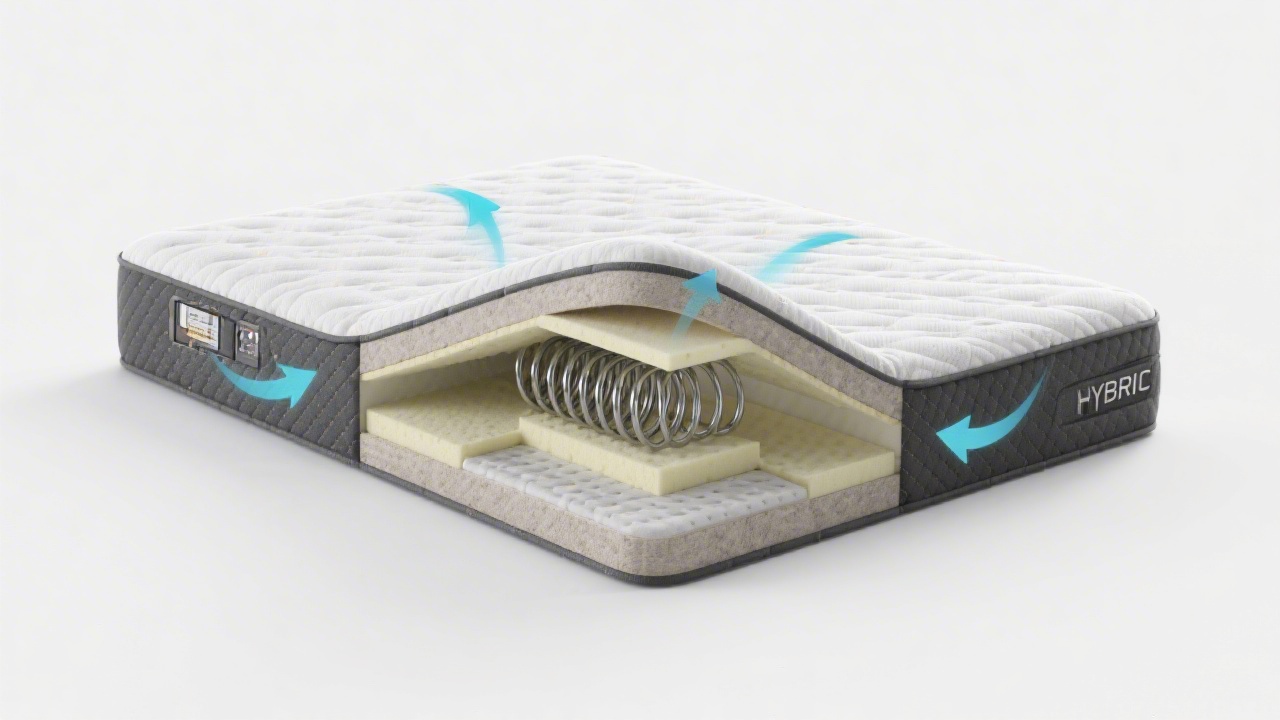
Mattress breathability is the capacity of a mattress to allow air and moisture vapor to pass through its layers, preventing heat and humidity from building up at the sleep surface. It is not a single material property — it is a system property determined by the cover fabric, comfort layers, and support core working together.
Our Pick
Saatva Classic
Top-rated by our testing team. White-glove delivery included.
What Does Mattress Breathability Actually Mean?
Breathability encompasses two related but distinct mechanisms:
- Thermal conductivity and convection: How readily the mattress moves heat away from the sleep surface, either by conducting it through the material or by allowing air circulation to carry it away.
- Moisture vapor transmission: How quickly the mattress passes water vapor (sweat) through its layers rather than absorbing and holding it. A mattress with poor moisture transmission feels damp and warm over a full night.
These two properties can differ. Latex has good thermal conductivity but absorbs moisture less effectively than cotton or wool. Coil mattresses excel at both — air moves freely through the open coil structure, removing both heat and vapor.
Breathability by Mattress Construction
Innerspring and Hybrid Coil Systems
Open coil systems (Bonnell, offset, continuous) and pocket coil systems create a large air volume inside the mattress — typically 60–75% open space in the support core. This allows passive ventilation: warm, moist air rises and exits through the mattress sides; cooler dry air enters from below. The Saatva Classic’s dual coil system creates a documented airflow path that makes it one of the most breathable mattresses in independent testing.
Memory Foam
Standard memory foam (polyurethane viscoelastic) has a closed-cell structure — individual cells are sealed, creating thousands of tiny air pockets that do not interconnect. Air cannot flow through the material. Heat and moisture remain near the surface until wicked away by the cover fabric. Open-cell memory foam (a manufacturing variation) partially addresses this by puncturing cell walls, improving breathability by roughly 30–50% in ASTM airflow testing.
Latex
Natural latex is inherently open-cell. Talalay latex (poured, frozen, then cured) has a more uniform open-cell structure than Dunlop latex (poured and gravity-settled), making Talalay breathable while Dunlop sits between foam and Talalay in breathability. Both benefit from the pinholes typically introduced during manufacture (5-zone or 7-zone pin cores).
Cover Fabrics
The cover accounts for roughly 20% of total mattress breathability. Organic cotton, Tencel (lyocell), and wool are the most breathable natural fibers. Polyester jacquard covers — common on budget mattresses — have lower moisture vapor transmission rates. Wool covers offer active thermoregulation: wool absorbs up to 30% of its weight in moisture without feeling wet, releasing it gradually during sleep.
How to Evaluate Breathability Specs
Few manufacturers publish breathability specifications in consumer-accessible formats. Here is what to look for:
- Open-cell foam designation: Look for explicit mentions of “open-cell” in memory foam descriptions. Generic “CertiPUR-US certified” does not indicate open-cell structure.
- Cover fiber content: GOTS-certified organic cotton, Tencel, or wool covers indicate higher moisture vapor transmission.
- Coil count and gauge: Higher coil counts at the same gauge maintain airflow while increasing support. Lower coil counts with thicker gauge (lower number) have more open space but less surface area.
- Comfort layer thickness: A hybrid’s breathability is largely determined by how thick the foam comfort layer is above the coil base. Under 2 inches: excellent. 2–3 inches: good. Over 4 inches: similar to all-foam.
The Impact of Breathability on Sleep Health
Poor breathability creates a microclimate of elevated temperature and humidity at the sleep surface. Research published in the International Journal of Environmental Research and Public Health identifies elevated sleeping skin temperature (above 33°C) as a significant factor in sleep fragmentation. Mattresses with poor breathability compound sleep disruption in warm climates or for naturally warm sleepers.
Moisture retention also accelerates mattress material degradation. Memory foam absorbs sweat, which contains oils and salts that break down polyurethane foam over time. A breathable mattress that transmits moisture rather than absorbing it will typically last 1–3 years longer. See our guide on mattress sagging for how material degradation manifests.
Testing Breathability at Home
- The hand test: Place your palm flat on the bare mattress surface for 60 seconds. A breathable mattress will feel no warmer to the touch than the ambient air. A foam mattress will feel noticeably warmer.
- The humidity test: After sleeping for a full night, note whether the mattress surface feels noticeably more humid than it did at bedtime. A breathable mattress should feel dry.
- The fan test: Hold a tissue against the side of the mattress while running a fan past the opposite side. Tissue movement indicates air is flowing through the coil structure. This works only for innerspring and hybrid mattresses.
Our Pick
Saatva Classic
Top-rated by our testing team. White-glove delivery included.
Frequently Asked Questions
What is the most breathable mattress type?
Innerspring mattresses with minimal foam comfort layers are the most breathable because of their open coil architecture. Hybrid mattresses with coil bases and thin latex or breathable foam comfort layers rank second. All-latex Talalay mattresses outperform memory foam significantly. Traditional closed-cell memory foam is the least breathable common construction.
Does mattress breathability change over time?
Yes. Memory foam becomes denser and less air-permeable as it compresses over years of use, reducing breathability progressively. Latex maintains its open-cell structure longer. Coil systems maintain airflow indefinitely unless the surrounding foam layers deteriorate and collapse into the coil space.
Can a mattress protector reduce breathability?
Non-breathable vinyl or PVC mattress protectors significantly reduce breathability and are a common cause of hot sleeping even on otherwise breathable mattresses. Look for mattress protectors made with Tencel or cotton terry with a thin waterproof membrane rather than vinyl-backed covers.
Is gel foam actually more breathable than regular memory foam?
Marginally and temporarily. Gel beads improve initial surface temperature by absorbing heat as a phase-change material. But gel foam retains the closed-cell structure of standard memory foam, so long-term breathability is similar. Open-cell foam without gel is generally more breathable than gel-infused closed-cell foam.
Do breathability claims from mattress brands get independently tested?
CertiPUR-US certification tests for off-gassing and chemical safety, not breathability. GREENGUARD Gold similarly tests emissions, not airflow. Independent breathability testing is done by labs using ASTM D737 (air permeability) or similar ISO standards. Consumer Reports and Sleep Foundation conduct thermal tests with human subjects; manufacturer-provided data should be viewed with skepticism.