
 by
by Edge support is one of the most overlooked mattress specifications — and one of the most consequential for real-world usability. Poor edge support reduces your effective sleeping surface, makes getting in and out of bed harder, and degrades faster over time. Here’s everything you need to know to evaluate it properly.
What Is Edge Support?
Edge support refers to a mattress’s ability to maintain its structure and height at the perimeter — the outer 4–6 inches on each side. A mattress with poor edge support collapses when you sit or lie near the edges, creating a rollout sensation and a dramatically compressed surface.
Why Edge Support Matters More Than You Think
Usable Sleep Surface
For couples sharing a queen or king, poor edge support effectively reduces the usable sleep surface. If the outer 4–6 inches on each side sag or feel unstable, both partners unconsciously migrate toward the center. On a standard queen (60 inches wide), losing 4 inches per side reduces usable width to 52 inches — significantly tighter for two adults.
Getting In and Out of Bed
Most people sit on the edge of the mattress to put on shoes, get dressed, or transition from lying down to standing. A mattress that compresses significantly under seated pressure makes this task harder — you’re essentially sitting in a depression and must work harder to stand up. This is particularly relevant for older adults or anyone with hip, knee, or joint issues.
Longevity
The edges of a mattress receive disproportionate stress from sitting, particularly near the foot of the bed and on the side closest to the door (the primary exit side). Mattresses without reinforced edge support in these areas often develop premature sagging that eventually spreads toward the center, reducing overall sleep surface quality.
Intimacy Near the Edges
For couples, edge collapse during activity near the mattress perimeter is a practical issue that affects comfort and stability. Strong edge support maintains the full mattress surface as a stable platform.
Edge Support by Mattress Type
Innerspring (Best)
Traditional innerspring mattresses with perimeter-reinforced coil systems offer the strongest edge support. The steel coils maintain their height under lateral pressure, and reinforced perimeter coils (often wrapped or encased in a firmer foam border) add additional edge stability. This is why innerspring and hybrid mattresses dominate in edge support comparisons.
Hybrid (Very Good)
Hybrid mattresses combine a coil support system with comfort layers (foam, latex, or micro-coils above). The coil base provides inherent edge stability; the quality of the foam border encasement determines how much of that stability reaches the sleeping surface. Premium hybrids with high-density foam perimeters perform nearly as well as pure innerspring systems.
Memory Foam (Variable)
All-foam mattresses rely entirely on foam density for edge support. Low-density foams (under 1.8 PCF) compress significantly at the edges and degrade faster. High-density foams (2.5+ PCF) provide better edge stability but never match coil-based systems. Some all-foam mattresses include a high-density foam border that significantly improves edge performance.
Latex (Good)
Natural latex has better elastic recovery than memory foam — it returns to shape faster after compression. Latex mattresses generally provide adequate edge support, though they still don’t match well-constructed coil systems. Latex is also significantly heavier, which adds inertial stability at the edges.
How to Test Edge Support
The Sit Test
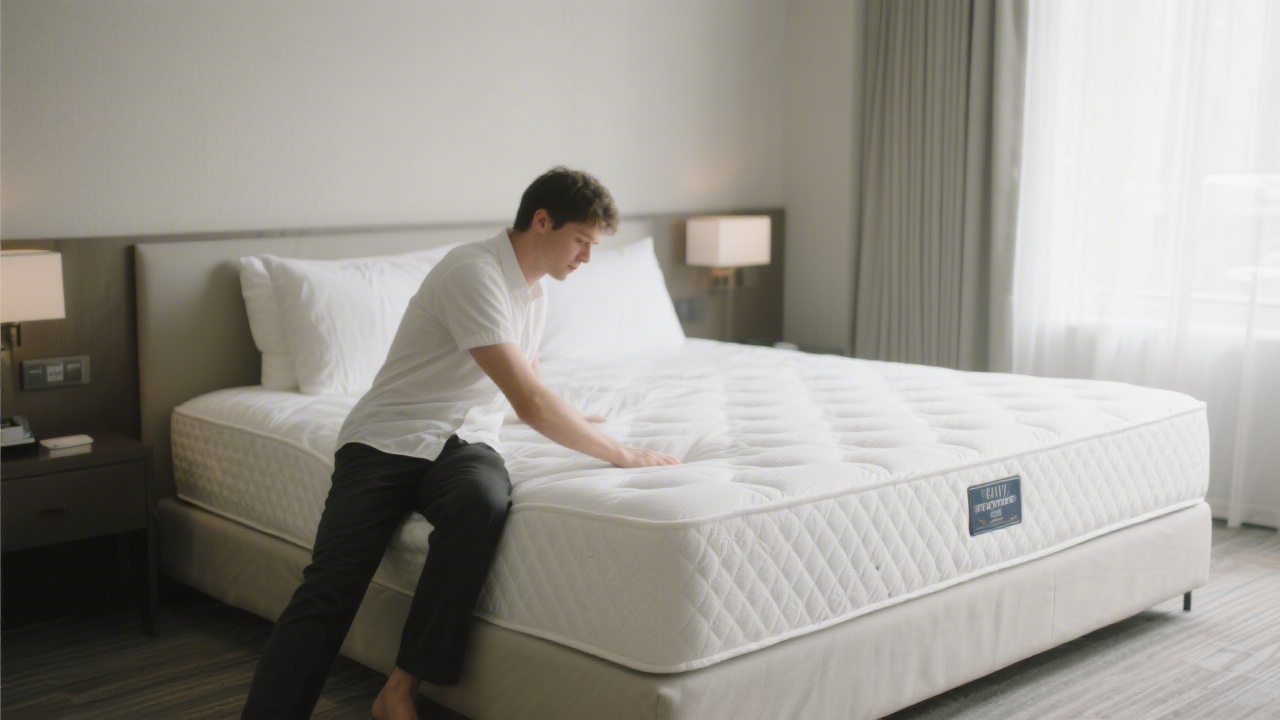
Sit on the edge of the mattress with your full body weight. A mattress with good edge support should compress no more than 2–3 inches under seated pressure. More than 4 inches of compression, or a feeling that you might roll off, indicates weak edge support.
The Perimeter Lying Test
Lie on your back with your shoulder at the very edge of the mattress. Roll slightly toward the edge. Good edge support should give you a stable, secure feeling even at the very perimeter. Rollout sensation indicates the edge is insufficiently supported.
The Push Test
Press your hand firmly into the edge of the mattress. Compare how much it compresses vs. the center. A significant difference — the edge compresses much more easily — indicates poor edge construction that will get worse over time as the edge foam or perimeter coils degrade.
Edge Support and Adjustable Bases
If you use an adjustable base, edge support becomes more complex. When the head section elevates, the mattress flexes at the hinge point — this puts different stress on the mattress than flat-surface sitting. Coil-based mattresses generally handle this flex better than all-foam, which can develop creasing or structural damage at the flex zone over time. See our coil construction guide for more on how internal structure affects durability.
For sleep position considerations that interact with edge support — particularly if you sleep near the edge due to a bed-sharing arrangement — see our firmness guide.
Frequently Asked Questions
Voted best luxury innerspring mattress with exceptional lumbar support and white-glove delivery.
Check Price & Availability FAQPage", "mainEntity": [{"@type": "Question", "name": "Why does my mattress sink on the edges?", "acceptedAnswer": {"@type": "Answer", "text": "Edge sinkage is caused by inadequate perimeter support — either foam edges that have compressed over time, or an absence of reinforced edge coils. All-foam mattresses are most susceptible. This is a degradation process that gets worse over time and reduces usable sleep surface."}}, {"@type": "Question", "name": "Which mattress type has the best edge support?", "acceptedAnswer": {"@type": "Answer", "text": "Innerspring and hybrid mattresses with reinforced perimeter coils consistently outperform all-foam mattresses on edge support. The steel coil structure maintains height under lateral pressure better than foam, particularly over years of use."}}, {"@type": "Question", "name": "Does edge support matter for a single sleeper?", "acceptedAnswer": {"@type": "Answer", "text": "Yes, though it matters most for couples. For single sleepers, edge support primarily affects the ease of getting in and out of bed, the stability of the perimeter for sitting, and long-term durability of the mattress surface."}}, {"@type": "Question", "name": "How do I test edge support when buying a mattress online?", "acceptedAnswer": {"@type": "Answer", "text": "Look for mattresses that specify reinforced perimeter coils or high-density foam borders. Read reviews specifically mentioning edge performance. Extended home trial periods allow real-world testing — the edge experience during the first week is predictive of long-term edge quality."}}, {"@type": "Question", "name": "Does edge support affect sleep quality?", "acceptedAnswer": {"@type": "Answer", "text": "Indirectly, yes. Poor edge support reduces usable sleep surface for couples, causing both partners to sleep closer to center. It also creates psychological anxiety about rollout that can affect sleep onset. The sit-to-stand transition quality affects overall bedroom ergonomics, particularly for older adults."}}]}- Why does my mattress sink on the edges?
-
Edge sinkage is caused by inadequate perimeter support — either foam edges that have compressed over time, or an absence of reinforced edge coils. All-foam mattresses are most susceptible. This is a degradation process that gets worse over time and reduces usable sleep surface.
- Which mattress type has the best edge support?
-
Innerspring and hybrid mattresses with reinforced perimeter coils consistently outperform all-foam mattresses on edge support. The steel coil structure maintains height under lateral pressure better than foam, particularly over years of use.
- Does edge support matter for a single sleeper?
-
Yes, though it matters most for couples. For single sleepers, edge support primarily affects the ease of getting in and out of bed, the stability of the perimeter for sitting, and long-term durability of the mattress surface.
- How do I test edge support when buying a mattress online?
-
Look for mattresses that specify reinforced perimeter coils or high-density foam borders. Read reviews specifically mentioning edge performance. Extended home trial periods allow real-world testing — the edge experience during the first week is predictive of long-term edge quality.
- Does edge support affect sleep quality?
-
Indirectly, yes. Poor edge support reduces usable sleep surface for couples, causing both partners to sleep closer to center. It also creates psychological anxiety about rollout that can affect sleep onset. The sit-to-stand transition quality affects overall bedroom ergonomics, particularly for older adults.