
 by
by The average American mattress is replaced every 7 to 10 years. At a national level, that replacement cycle generates 15 to 20 million discarded mattresses annually, most of which end up in landfills. But disposal is only one phase of mattress environmental impact. A full lifecycle assessment must account for raw material extraction, manufacturing, transportation, energy use during the product's life, and end-of-life management. This page provides that full picture — a companion to existing coverage of the full history of mattress materials and the the modern mattress industry.
Phase 1: Raw Material Extraction
The environmental cost of a mattress begins before manufacturing. The primary input materials — steel, polyurethane foam, cotton, wool, and latex — have very different environmental profiles.
Steel coils are the most recyclable component: steel scrap rates exceed 70 percent in the U.S., and recycled steel has substantially lower embodied energy than virgin steel. An innerspring mattress's steel content is an environmental asset at end of life, provided the mattress reaches a recycling facility.
Polyurethane foam — the dominant fill material in comfort layers and the exclusive material in all-foam mattresses — is petroleum-derived. Production requires naphtha and other petrochemical feedstocks, processes that are energy-intensive and generate industrial chemical byproducts. Polyfoam is not biodegradable and has limited recycling markets (primarily crumb rubber for carpet underlay).
Natural latex from Hevea brasiliensis (rubber tree) is the most environmentally favorable fill material: the rubber tree is a carbon-sequestering perennial crop, latex tapping does not kill the tree, and natural latex is biodegradable. Certified organic natural latex (GOLS certification) requires no synthetic pesticides and is tested for VOC emissions and harmful chemical content.
Organic cotton and wool require fewer synthetic inputs than conventional versions (no synthetic pesticides under GOTS certification) and are biodegradable, though they require significant water and land for production.
Phase 2: Manufacturing
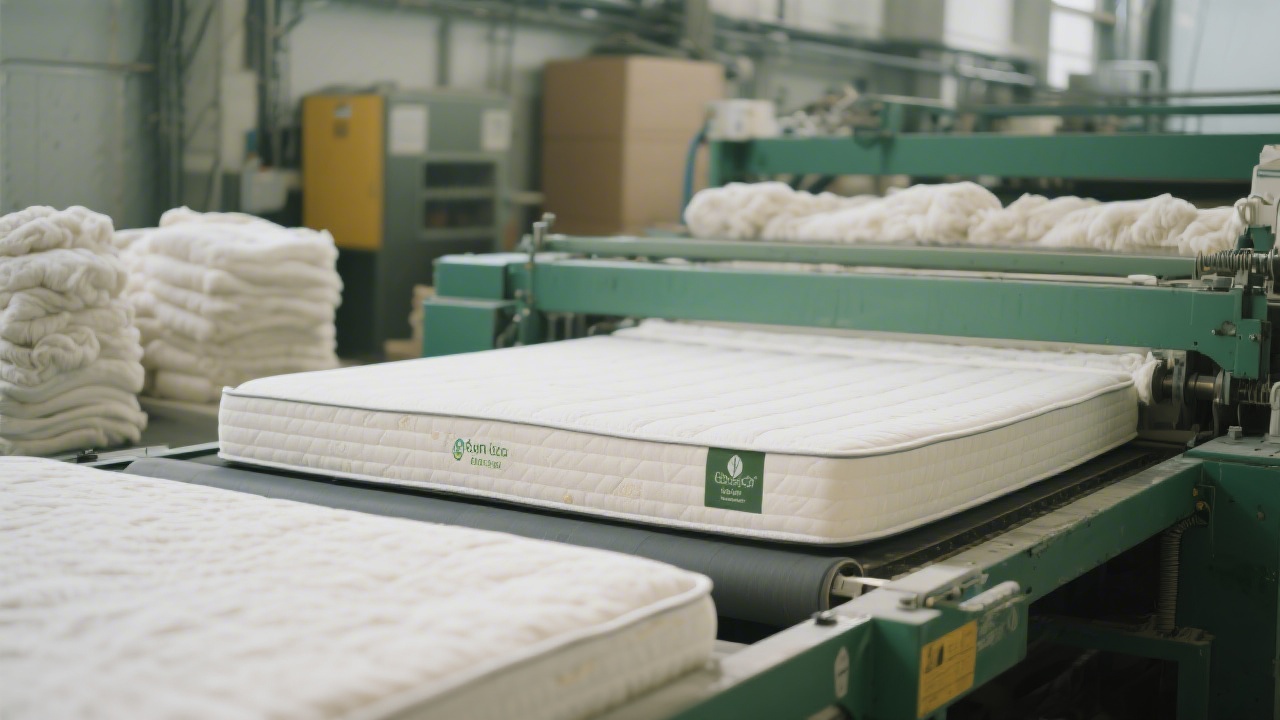
Mattress manufacturing is energy-intensive regardless of material type. Foam pouring requires precise temperature control and chemical handling. Coil fabrication requires metal forming machinery. Latex vulcanization (the process that converts latex sap into foam) requires heat treatment.
The location of manufacturing significantly affects lifecycle carbon impact via transportation. A mattress manufactured in China or Vietnam and shipped to U.S. consumers adds substantial freight carbon (containerized ocean shipping, U.S. inland trucking) to the manufacturing emissions. Domestically manufactured mattresses (a segment in which Saatva, Sealy, and Serta-Simmons have significant U.S. production) have materially lower total transportation emissions.
Chemical emissions during manufacturing — including VOCs, flame retardant treatment processes, and adhesive application — are regulated under CertiPUR-US and comparable certification schemes but are not zero for any conventional manufacturing process.
Phase 3: Transportation to Consumer
The direct-to-consumer (DTC) mattress revolution, which compressed mattresses for shipment in boxes, created a counterintuitive environmental problem: compressed foam mattresses ship individually via UPS and FedEx rather than consolidated on retail freight trucks, increasing per-unit emissions for the final mile despite consolidation savings upstream.
White-glove delivery services (Saatva's model) use dedicated delivery fleets but allow the delivery team to remove the old mattress simultaneously — eliminating one disposal vehicle trip. For consumers, the total emissions difference between box delivery and white-glove delivery depends heavily on delivery density in their area.
Phase 4: The Use Phase
Most lifecycle assessments underweight the use phase for mattresses because mattresses themselves do not consume energy directly. However, sleep surface thermal properties affect room heating and cooling loads over a 10-year product life.
Memory foam and polyfoam retain body heat, potentially increasing cooling demand by a small but non-trivial amount in warm climates. Natural latex and innerspring/hybrid mattresses with open-cell structure sleep cooler, reducing this indirect energy load. The total use-phase environmental difference between mattress types is likely small relative to manufacturing, but it is non-zero.
Phase 5: End of Life and Disposal
The U.S. produces an estimated 50,000 mattresses per day. At standard 1,500 liter landfill displacement per mattress, the annual total represents significant landfill volume. Mattresses are notoriously difficult for landfills: their bulkiness and spring-back behavior make compaction difficult, and they trap other waste around them.
Recycling rates remain below 20 percent nationally, though the Bye Bye Mattress program (Mattress Recycling Council) operates in California, Connecticut, and Rhode Island and has demonstrated that infrastructure makes recycling viable: its participating states achieve 75-85 percent diversion rates for mattresses in covered channels.
Natural latex mattresses are uniquely positioned at end of life: they can be composted (latex biodegrades over 1-5 years in composting conditions) or repurposed. Wool fill can be re-carded and used in textile applications. These end-of-life advantages partially offset the lower production volumes compared to polyfoam.
Which Mattress Type Has the Lowest Lifecycle Footprint?
Synthesizing across all phases: natural latex mattresses (particularly Dunlop-process latex from certified rubber tree sources with domestic manufacturing and distribution) have the lowest total lifecycle carbon footprint. Innerspring mattresses have the highest end-of-life recovery rate due to steel recyclability. All-polyfoam mattresses — including most DTC bed-in-a-box products — have the highest embodied carbon and worst end-of-life profile despite often being positioned as affordable and accessible.
A key caveat: the differential between mattress types is dwarfed by the differential between a 7-year and a 15-year mattress lifespan. A durable conventional mattress that lasts 15 years has substantially lower annualized environmental impact than a marginally greener mattress replaced in 5 years.
For guidance on the best mattresses including eco-friendly options by environmental profile alongside other quality factors, our comprehensive guide covers the full range. And for the biological case for why a quality sleep surface matters beyond environmental considerations, see why the quality of your sleep surface matters biologically.
Frequently Asked Questions
How many mattresses are discarded in the US each year?
Approximately 15 to 20 million mattresses are discarded in the United States annually, according to the Mattress Recycling Council. They generate an estimated 450 million to 600 million pounds of waste. Less than 20 percent are currently recycled through formal programs, though recycling infrastructure has expanded significantly since the Mattress Recycling Council launched state-level programs in California (2015), Connecticut (2015), and Rhode Island (2016).
Which mattress type has the lowest carbon footprint?
Natural latex mattresses (Dunlop or Talalay from certified rubber tree sources) have the lowest measured lifecycle carbon footprint among conventional mattress types, primarily because the rubber tree is a carbon-sequestering crop and natural latex is biodegradable. Innerspring mattresses have high steel recycling rates at end of life. Memory foam and polyfoam mattresses have the highest embodied carbon due to petroleum-based feedstocks and non-biodegradable disposal.
What chemicals are emitted by new mattresses?
New polyurethane and memory foam mattresses emit volatile organic compounds (VOCs) including toluene, benzene, and formaldehyde during off-gassing, primarily in the first weeks of use. CertiPUR-US certified foams are tested to limits of ozone depleters, flame retardants, heavy metals, formaldehyde, and phthalates. GOLS-certified natural latex is tested for VOC emissions under ISO 16000 standards.
Are organic mattresses actually better for the environment?
GOTS-certified organic cotton and GOLS-certified organic latex require significantly lower synthetic pesticide and fertilizer inputs than conventional versions. However, organic certification does not address carbon footprint from transportation, manufacturing energy, or end-of-life disposal. A GOTS/GOLS mattress manufactured overseas and shipped transcontinentally may have a higher total lifecycle carbon impact than a domestically produced conventional mattress.
Can mattresses be recycled?
Most mattress components are recyclable: steel springs become scrap metal; polyurethane foam is crumb-ground for carpet underlay and sports surfaces; cotton and wool filling becomes industrial insulation; latex can be composted or repurposed. The barrier is disassembly cost relative to virgin material costs. The Mattress Recycling Council's Bye Bye Mattress program has recycled over 10 million mattresses since 2016 in participating states.
Related Articles
- Best Mattress for Chronic Back Pain 2026: Long-Term Support Options
- How to Set Up a Mattress Gift Registry: A Complete Guide
- Mattress Buying Timeline 2026: Month-by-Month Sale Schedule
Key Takeaways
Mattress Environmental Impact is a topic that depends heavily on individual needs and preferences. The most important thing is to consider your specific situation — your body type, sleep position, and personal comfort preferences — before making any decisions. When in doubt, take advantage of trial periods to test before committing.