
 by
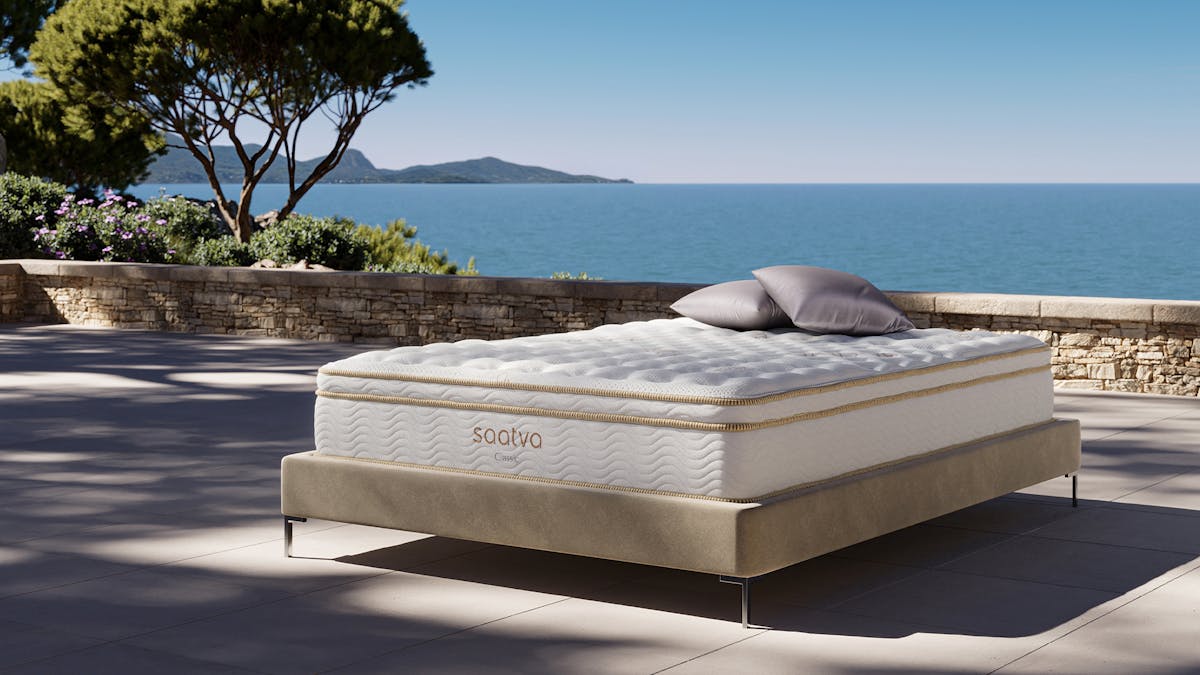
by The best mattress for light sleepers combines exceptional motion isolation and silent construction. Our top pick is the Saatva Classic (Plush Soft): its thick Euro pillow-top and zoned pocketed coils deliver hotel-quality comfort while the plush surface absorbs a meaningful share of partner movement. For maximum motion deadening in an all-foam build, the Amerisleep AS3 is the strongest foam alternative.
Saatva Classic
9.2/10
- Plush Soft option pairs a deep Euro pillow-top with zoned pocketed coils to dampen partner movement far better than a standard innerspring
- Free white-glove delivery, in-room setup, and old mattress removal
- 365-night trial with a lifetime warranty, the longest coverage in this category
- Outstanding edge support, couples can use the full mattress surface
- Innerspring coils transfer some motion; all-foam options isolate partner movement more completely
- Ships flat, not compressed in a box, and carries a $99 return fee during the trial
For light sleepers who want the comfort and durability of a hotel-quality innerspring without sacrificing too much on motion isolation, the Saatva Classic in Plush Soft is the most complete choice. The 365-night trial is long enough to genuinely confirm the fit across seasons.
Why light sleepers need different mattresses
Light sleepers wake more easily because their sleep cycles spend more time in lighter NREM stages where arousal thresholds are lower. Any stimulus, partner movement, a mattress creak, positional pressure, can push a light sleeper from stage 2 into wakefulness. The right mattress removes two of the three biggest triggers: motion transfer and pressure buildup that causes unconscious repositioning.
The third trigger, noise, is a material issue. Traditional coil systems creak under load, though a well-built innerspring with a thick pillow-top dampens this significantly. For extreme light sleepers, all-foam construction is acoustically silent. For most, a properly constructed hybrid with a deep comfort layer falls well within acceptable noise levels.
Motion isolation: what actually matters
Motion isolation is the top mattress spec for light sleepers sharing a bed. Here is the honest ranking by construction type:
- Memory foam (best): Slow-response foam absorbs movement entirely. A partner sitting up or rolling over produces virtually no detectable wave.
- Plant-based foam (excellent): Slightly more responsive than slow memory foam, still among the best isolators. Bio-Pur in the Amerisleep AS3 falls here.
- Natural latex (good): Responsive and springy, some movement perceptible, still much less than coil systems.
- Pocketed-coil hybrid with thick comfort layer (moderate-good): Individual coils limit motion transfer, especially when topped with 2 or more inches of foam. The Saatva Classic Plush Soft lands in this bracket.
- Traditional innerspring (avoid): Interconnected coil grid transmits motion across the full surface.
Best mattresses for light sleepers, tested picks
| Mattress | Type | Motion isolation | Noise | Trial | Queen price |
|---|---|---|---|---|---|
| Saatva Classic | Innerspring hybrid | Good (Plush Soft) | Low | 365 nights | ~$1,395 |
| Amerisleep AS3 | All-foam Bio-Pur | Excellent | Silent | 100 nights | From $1,049 |
| PlushBeds Botanical Bliss | Natural latex | Good | Silent | 100 nights | ~$1,800-2,000 |
| Puffy Original | All-foam | Excellent | Silent | 101 nights | ~$1,499 |
Amerisleep AS3
9.0/10
- Plant-based Bio-Pur foam absorbs partner movement completely, no spring noise, no wave transfer
- HIVE 5-zone construction reduces pressure-point wake-ups without creating motion
- Runs cooler than standard memory foam, important for light sleepers who also overheat
- CertiPUR-US certified, made in the USA
- Softer edges than a coil hybrid, partners lose usable surface near the edge
- Sleepers over 230 lb may prefer the firmer AS5 Hybrid for adequate edge support
If maximum motion deadening is the priority and you prefer all-foam silence over innerspring responsiveness, the AS3 is the strongest choice in its price range. The 100-night trial is enough time to confirm it matches your feel preference.
PlushBeds Botanical Bliss
8.8/10
- Natural Dunlop latex layers are acoustically silent, no springs to creak under load
- Responsive yet pressure-relieving, useful for light sleepers who also change positions frequently
- GOLS and GOTS certified organic materials, no off-gassing concern
- 25-year warranty with configurable firmness layers
- Latex is more buoyant than foam, so some partner motion is perceptible, less than coils but more than slow foam
- Heavy and expensive relative to all-foam options
For light sleepers who want organic materials, durable construction, and silent response without the slow-sink feel of memory foam, the PlushBeds Botanical Bliss is the cleanest option in its price tier.
Puffy Original
8.5/10
- Excellent motion isolation, foam construction eliminates spring noise entirely
- Strong pressure relief reduces unconscious repositioning that triggers light-sleep arousals
- Lifetime warranty removes long-term replacement risk
- Runs warmer than plant-based foam options, hot light sleepers should consider the AS3 instead
- Slower recovery can feel restrictive for frequent position changers
Puffy delivers the core light-sleeper benefits, motion isolation and silent construction, with a lifetime warranty that protects the investment. The trade-off versus the AS3 is slightly more heat retention and a slower, more enveloping response.
Light sleeper and hot sleeper
If you run hot and sleep lightly, slow-response memory foam is a problem: its dense construction traps body heat, and overheating is itself a strong arousal trigger. The Amerisleep AS3 handles this combination well, its plant-based Bio-Pur foam uses an open-cell structure that runs significantly cooler than standard memory foam while still isolating motion. The Saatva Classic innerspring system provides better airflow through the coil core, useful for hot sleepers who prefer a more responsive surface.
For couples where one partner is a hot, light sleeper and the other is a stomach or back sleeper who needs edge support, an adjustable base with a split-king setup eliminates partner disruption entirely, each side is a separate surface.
Other ways to reduce disturbance for light sleepers
- White noise machine: Masks ambient sounds, doors, traffic, building noise, that trigger arousals.
- Separate blankets (Scandinavian method): Each partner has their own duvet, eliminating blanket-pulling as a disturbance.
- Sleep mask: Blocks light level changes from screens, passing cars, or early sunrise.
- Synchronized bedtimes: The act of a partner joining the bed is one of the highest-risk disturbance events, going to bed at the same time eliminates it.
- Split king setup: Two twin XL mattresses on an adjustable base completely decouple partner movement, the best option for extreme light sleepers.
For light sleepers, prioritize motion isolation and silent construction. The Saatva Classic (Plush Soft) is our top pick for its hotel-quality feel and 365-night trial. If maximum motion deadening from an all-foam build is the priority, the Amerisleep AS3 is the strongest foam alternative.
Frequently asked questions
Is memory foam or an innerspring better for light sleepers?
All-foam options are the strongest motion isolators and are acoustically silent. A well-built innerspring hybrid with a thick comfort layer, like the Saatva Classic Plush Soft, performs much better than a traditional innerspring and is acceptable for most light sleepers, especially those who prefer a more responsive feel.
What firmness is best for a light sleeper?
Medium (5 to 6 out of 10) is the most broadly useful firmness for light sleepers. It relieves enough pressure to prevent unconscious repositioning while still providing spine support. Heavier light sleepers above 200 lb may do better on medium-firm (6 to 7).
Can a mattress actually help me sleep through the night?
Yes, if the cause is partner movement or pressure buildup. A mattress with strong motion isolation removes one of the most common disturbance triggers in shared beds. Pressure relief from a properly zoned mattress reduces how often you unconsciously shift positions, which lowers the chance of surfacing into lighter sleep stages.
How long is the adjustment period for a new mattress?
Most sleepers adapt within 2 to 4 weeks. Your body re-patterns to better alignment and pressure distribution over that time. Saatva offers a 365-night trial, Amerisleep 100 nights, giving you a real decision window rather than just an accommodation period.
This guide is part of our Best Mattress hub, compare all the top picks and narrow down your choice there.