
 by
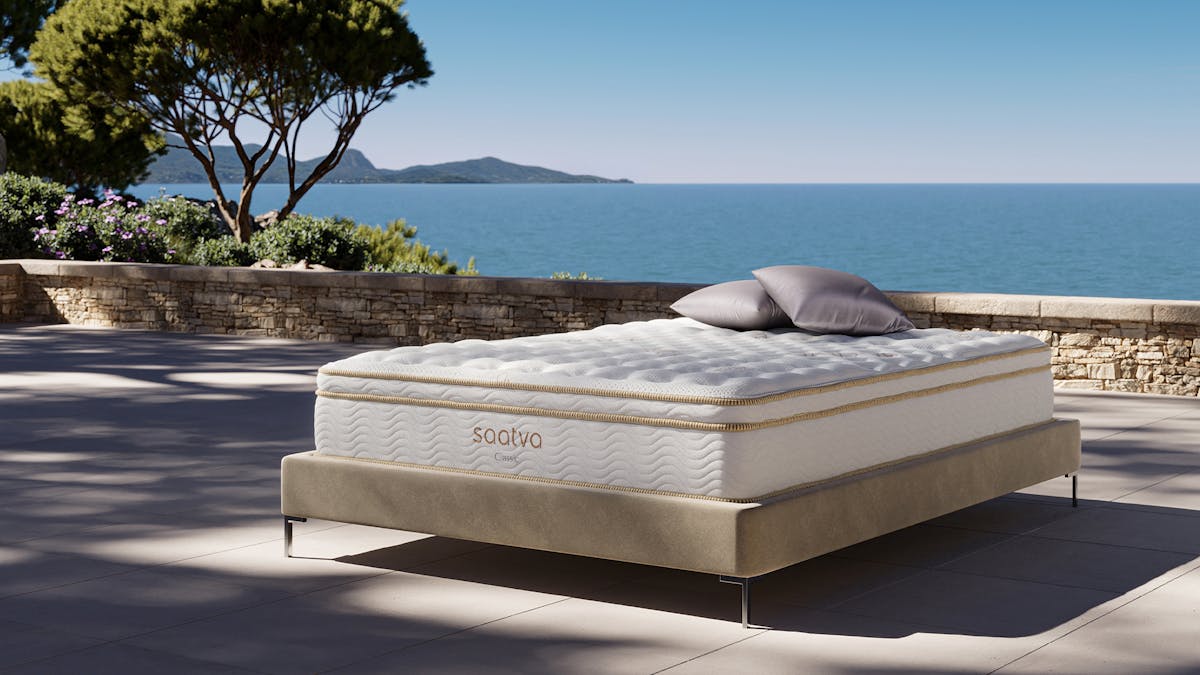
by The best mattress for a sailboat is the Saatva Classic, whose open dual-coil construction provides maximum airflow to fight cabin humidity, and whose organic cotton cover is removable and washable. For a lighter, easier-to-move option on flat berths, the Amerisleep AS3 open-cell foam is the practical alternative. Custom-cut marine latex remains the right call for V-berths and shaped berths that standard sizes cannot fit.
Saatva Classic
9.2/10
- Dual-coil open construction provides the strongest airflow of any residential mattress, critical in high-humidity cabins
- Organic cotton cover is removable and washable, a must-have in a marine environment
- Zoned lumbar pad keeps spinal alignment when boat motion constantly shifts your position
- Zero off-gassing, ships uncompressed, no chemical smell in confined cabins
- 365-night trial, long enough to evaluate across multiple sailing seasons
- ~110 lb queen, heavier to maneuver through a companionway hatch
- $99 return fee applies during trial
- 14.5" height profile may be tight in low-clearance berths
The Saatva Classic's open dual-coil core breathes better than any foam option, the organic cotton cover is washable, and the lifetime warranty means it will outlast most foam mattresses in the demanding marine environment. Best for flat-base aft cabins and catamaran doubles where hatch access is not a problem.
Why sailboat berths are so hard on mattresses
Humidity aboard a sailboat routinely reaches 70 to 90%, particularly in tropical and coastal cruising. At those levels, any mattress material that traps moisture will develop mold within weeks. Salt air accelerates foam degradation. The berth itself, often a V-berth, quarter berth, or settee, rarely matches standard mattress dimensions.
Three factors drive every good sailboat mattress decision: moisture resistance, breathability, and weight. A 130 lb queen-size mattress that is barely manageable in a house bedroom becomes impossible to remove, air out, and reinstall through a companionway hatch. This is why most serious cruisers either go custom-cut or choose a thinner, lighter residential mattress that fits a flat aft cabin.
Material guide: what actually works below decks
Coil-hybrid construction
The open coil structure in a hybrid like the Saatva Classic provides the most airflow of any residential mattress construction. Dual-layer coils create constant air movement through the mattress core, which helps in humid conditions. The organic cotton cover is washable, which matters enormously when sea spray, sweat, and humidity are a constant. The trade-off is weight: coil hybrids are heavier and harder to move through a hatch.
Natural latex
Natural latex is the gold standard for marine use. It resists mold and mildew naturally, does not off-gas in a confined cabin, and performs well across the temperature range typical of coastal and offshore sailing. A natural latex mattress custom-cut to berth dimensions is the right call for serious live-aboards or offshore cruisers. PlushBeds offers natural latex mattresses that can be cut to custom dimensions, though that adds cost and lead time.
Open-cell foam (Bio-Pur and equivalents)
Open-cell foam breathes considerably better than traditional closed-cell memory foam. The Amerisleep Bio-Pur layer uses a partially plant-based open-cell structure that dissipates heat and moisture vapor faster than petroleum-derived memory foam. At around 68 lb queen, it is much easier to maneuver through a hatch than a coil hybrid. For flat berths where a standard size fits and hatch access is limited, this is the most practical choice among mainstream residential brands.
What to avoid
Closed-cell foam traps moisture and degrades faster in marine environments. Thick pillow tops hold humidity. Any mattress without a removable, washable cover is a liability aboard a boat.
Quick-compare: sailboat-relevant specs
| Mattress | Type | Profile | Est. Queen Weight | Airflow | Trial |
|---|---|---|---|---|---|
| Saatva Classic | Dual-coil hybrid | 11.5" or 14.5" | ~110 lb | Excellent (open coil) | 365 nights |
| Amerisleep AS3 | All-foam | 12" | ~68 lb | Good (open-cell) | 100 nights |
| PlushBeds Botanical Bliss | Natural latex | 9" or 12" | ~80 lb | Very good (latex) | 100 nights |
Amerisleep AS3
8.8/10
- ~68 lb queen, much lighter than any coil hybrid and easier through a hatch
- Open-cell Bio-Pur foam dissipates heat and moisture vapor better than standard memory foam
- HIVE 5-zone support keeps the spine neutral, useful when boat motion interrupts sleep
- CertiPUR-US certified, no off-gassing in confined cabins
- 12" profile is still tall for some low-clearance berths
- Standard rectangular only, not custom-cut for V-berths
- No washable outer cover, less practical for heavy marine use
When hatch access is limited or weight is a critical factor, the AS3's lighter build and breathable open-cell foam make it the most practical premium pick for flat-base aft cabins and marina accommodations. Use a slatted base for airflow underneath.
PlushBeds Botanical Bliss
8.6/10
- GOLS-certified organic latex resists mold and mildew naturally, better than any foam in humid conditions
- No off-gassing in confined cabins
- Durable, does not develop compression grooves from constant micro-movement at anchor
- Can be custom-cut to berth dimensions for non-standard shapes
- Higher price point than foam alternatives
- Lead time for custom cuts adds weeks
- Not available in thinner marine profiles without custom order
For live-aboards and offshore cruisers who want the best long-term mold resistance and durability, natural latex justifies its higher cost. The Botanical Bliss is the right investment when you are living aboard year-round in humid conditions.
Custom-cut marine foam: when standard sizes do not work
Most sailboat berths require custom cuts. V-berths taper toward the bow. Quarter berths may have angled sides. Settee berths often need cutouts for storage hatches underneath. Many marine foam suppliers offer pattern-cut services where you trace the berth shape on paper and they cut the foam to match.
Typical marine foam suppliers charge $80 to $200 for custom cuts depending on complexity. The foam is usually shipped rolled or flat. Order at least 2 inches of thickness for a sleeping surface; 3 to 4 inches is more comfortable for overnight or offshore passages. At those thicknesses, high-resilience foam at an ILD of 35 to 45 prevents rolling off the berth when the boat heels.
For shaped berths, the standard residential brands covered in this guide are not the right tools. In that case, look at marine foam specialists who supply ILD-rated foam to template. A natural latex core from a supplier like PlushBeds cut to berth size is worth the cost for live-aboard use.
By boat type: monohull vs catamaran vs live-aboard
Monohull sailors deal with constant heel and motion at sea. Firmer foam, ILD 35 to 45, prevents rolling off the berth on a tack. If your aft cabin berth is flat and accessible, the Saatva Classic in Luxury Firm fits this use case well, and the zoned lumbar pad maintains support when the boat's motion shifts your body position through the night.
Catamaran berths are more stable but often have unusual shapes in forward cabins. The flat double berths in catamaran aft cabins do accept standard mattress sizes, which is where the Saatva Classic makes the most sense: maximum airflow, a washable cover, and a lifetime warranty.
For live-aboards or offshore cruisers, invest in natural latex. The longevity and mold resistance justify the higher cost over any foam option. Latex also responds better to the constant micro-movements of a boat at anchor without developing compression grooves.
See our van life mattress guide for overlapping strategies on custom-size, high-humidity sleeping environments.
Ventilation matters as much as the mattress material
No mattress survives a marine environment without airflow. Install slatted berth bases rather than solid plywood. On boats where the base is solid, add ventilation holes or use a breathable mattress pad that creates a gap between the mattress and the base. Lift the mattress and air it out whenever in port. A removable, washable cover is not optional on a boat.
Condensation mats, sometimes sold as DRY-Mat or air-flow matting, create a ventilated gap under the mattress and prevent black mold on the bunk base. This is a worthwhile investment regardless of which mattress you choose.
For a flat-base aft cabin or catamaran double berth, the Saatva Classic is the top pick: maximum airflow from its open dual-coil core, washable organic cotton cover, and a lifetime warranty. For tight hatch access or weight constraints, the Amerisleep AS3 is the lighter alternative. For V-berths and shaped berths, go custom-cut marine foam or latex instead.
Frequently asked questions
What foam density is best for a marine mattress?
ILD 30 to 45 works well for marine use. Lower ILD (softer) compresses too easily under motion; higher ILD is more durable and prevents rolling in a seaway. For residential foam on flat berths, medium (ILD around 30) is comfortable. For shaped marine foam, ILD 35 to 45 adds stability when the boat heels.
Can I use a standard mattress on my sailboat?
On flat-base aft cabins and catamaran double berths that match standard dimensions, yes. The Saatva Classic at 11.5" and the Amerisleep AS3 at 12" both work for flat berths. For V-berths and quarter berths, standard mattresses do not fit, and a custom-cut marine foam is the right answer.
How do I prevent mold in a marine mattress?
Use natural latex or treated open-cell foam. Ensure slatted ventilation under the mattress. Use a removable, washable cover. Air the mattress in direct sunlight whenever possible. A condensation mat under the mattress makes a significant difference.
What is the best berth mattress thickness for offshore sailing?
3 to 4 inches is practical for most berths. Thicker than 4 inches may interfere with lee cloths or berth boards used to prevent rolling out of the berth at sea. For residential mattresses at 10 to 12 inches, confirm your berth clearance before ordering.
How long does a marine foam mattress last?
With proper care, including ventilation, regular airing, and a good waterproof cover, a quality latex or open-cell foam marine mattress should last 5 to 10 years. Cheaper closed-cell foam in humid conditions may degrade in 2 to 3 years.
This guide is part of our Best Mattress by Use Case hub, compare all the top picks and narrow down your choice there.